
Hideaki Anno | 120 mins | Blu-ray | 2.35:1 | Japan / Japanese, English & German | 12A

To the best of my knowledge, the Godzilla movies have never been particularly well treated in the UK. With the obvious exceptions of the two US studio movies and the revered 1954 original (which, similar to its inclusion in the Criterion Collection in the US, has been released by the BFI over here), I think the only Godzilla movie to make it to UK DVD is King Kong vs. Godzilla, and that’s clearly thanks to the Kong connection. Contrast that with the US, or Australia, or Germany, or I expect others, where numerous individual and box set releases exist, not only on DVD but also Blu-ray. There were some put out on VHS back in the ’90s (I owned one, though I can’t remember which), but other than that… Well, maybe we’ll be lucky and the tide will now change, because the most recent Japanese Godzilla movie — the first produced by the monster’s homeland in over a decade — is getting a one-night release in UK cinemas this evening. It’s well worth checking out.
Firstly, don’t worry about it being the 29th Japanese Godzilla film, because it’s also the first full reboot in the series’ 62-year history (previous reboots in 1984 and 1999 still took the ’54 original as canon). The movie opens with some kind of natural disaster taking place in Tokyo Bay, to which the Japanese government struggle to formulate a response. But it quickly becomes clear the event is actually caused by a giant creature, which then moves on to land, leaving a trail of destruction in its wake. Ambitious government secretary Rando Yaguchi (Hiroki Hasegawa) is put in charge of a special task force to research the creature. Soon, the Americans are muscling in, contributing a dossier they’d previously covered up, which gives the creature its name: Dave.
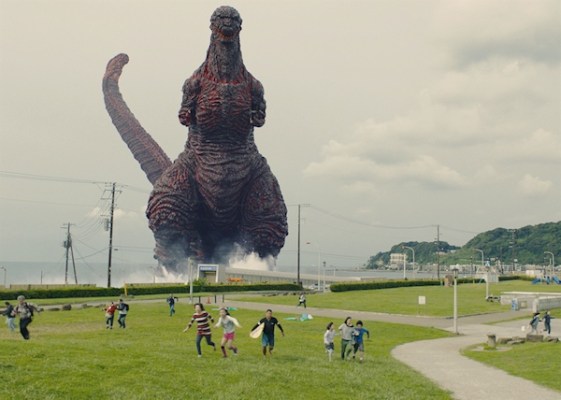
No, it’s Godzilla, obv.
Written and directed by Hideaki Anno of Neon Genesis Evangelion fame (and fans of that franchise will recognise many music cues throughout the film), Shin Godzilla is not just a film about a giant beastie stomping on things. Most obviously, it pitches itself as a kind of political thriller, as an intrepid gang of semi-outsiders battle establishment red tape to get anything done. In this respect it’s something of a satire, though not an overtly comedic one. It also seems to be taking on Japanese society, with the in-built deference to age or rank being an obstacle to problem-solving when it’s the young who have the outside-the-box ideas to tackle such an unforeseen occurrence. There’s also the problem of the Americans sticking their oar in, being both a help and a hindrance. Clearly the Japanese feel broadly the same way towards the U.S. of A. as do… well, all the rest of us.
Anno takes a montage-driven, almost portmanteau approach to the storytelling, flitting about to different locations, organisations, departments, and characters as they come into play. This lends a veracity to the “as if it happened for real” feel of the film: rather than take the usual movie route of having a handful of characters represent what would be the roles of many people in real life, Anno just throws dozens of people at us — the film has 328 credited actors, in fact. It means there’s something of an information overload when watching it as a non-Japanese-speaker: as well as the subtitled dialogue, there are constant surtitles describing locations, names, job titles, types of tech being deployed, etc, etc. In the end I wound up having to ignore them, which is a shame because I think there was some worthwhile stuff slipped in there (possibly including more satire about people’s promotions throughout the film).

I’d be amazed if anyone can follow both, to be honest, because the dialogue flies at a rate of knots. Anno reportedly instructed the actors to speak faster than normal, aiming for their performances to resemble how actual politicians and bureaucrats speak. Apparently he cited The Social Network as the kind of vibe he was after, though a more appropriate comparison might be that other famous work from the same screenwriter, The West Wing. Either way, I think he achieved his goal, further contributing to the film’s “real” feel and the (geo)political thriller atmosphere — even if it’s a nightmare to follow in subtitled form.
Letting the side down, sadly, is actress Satomi Ishihara, who plays an American diplomat of Japanese descent. Apparently she found out she was playing an American after being cast, and was shocked to see how much English dialogue she had to speak. It shows. There’s nothing wrong with her performance on the whole, but casting a Japanese actress as a supposed American is a really obvious mistake to English-speaking ears. All of the English speech in the film is subtitled, which isn’t necessary for American generals and the like, but for her… well, I didn’t always realise she was no longer speaking Japanese. Poor lass, it’s not her fault, but it does take you out of the film occasionally.
On another level from the politics, Shin Godzilla is also about wider issues of humanity and the planet. The ’54 film was famously an analogy about nuclear weapons, and Anno updates that theme to be about nuclear waste and its effect on the environment, inevitably calling to mind the 2011 earthquake and tsunami that led to the Fukushima power plant disaster. This is less front-and-centre than the thriller stuff — the actions of the humans are what drives the film’s plot, whereas the nuclear/environmental stuff is more thematic subtext. Put another way, I wouldn’t say the film gets too bogged down by this — it’s still about a giant monster blowing shit up with his laser breath.

Said giant monster is realised in CGI, some of it derived from motion capture, presumably as a tribute and/or reference to the old man-in-a-suit way of creating him. This is not a Hollywood budgeted movie and consequently anyone after slavishly photo-real CGI will be disappointed, but that’s not really the point. It still creates mightily effective imagery, and for every shot that’s less than ideal there’s another that gives the titular creature impressive heft and scale. He’s also the largest Godzilla there’s ever been, incidentally.
If you come to Shin Godzilla expecting to see a skyscraper-sized monster destroy stuff and be shot at and whatnot for two hours straight, you’re going to leave dissatisfied. There are scenes of that, to be sure, but it’s not the whole movie. If a thriller about a bunch of tech guys and gals fighting bureaucracy while analysing data that will eventually lead to a way to effectively shoot (and whatnot) the monster, this is the film for you. It was for me. I have to mark it down for some of the niggles I’ve mentioned, but I enjoyed it immensely. (You can make you own size-of-Godzilla pun there.)

Shin Godzilla is in UK cinemas tonight only. For a list of screenings, visit shingodzillamovie.co.uk.
 Well now, hasn’t this been a long time coming? Just over two years since its western disc release was first announced, just over three years since it debuted in Japanese cinemas, and just over four-and-a-half years since
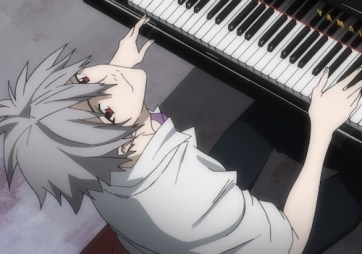
  Change, and the embracing or rejection of it, is surely one of the major themes of Evangelion. This is more explicitly debated as 3.33 moves into its middle section, where we get an extended dose of Shinji’s traditional insecurities. Hey, it wouldn’t be Evangelion without Shinji having a self-pitying whinge, right? Fortunately there’s more going on than that, but this is a section light on action and heavy on the series’ more thoughtful elements. There are answers to some of the mysteries, but it again wouldn’t be Evangelion if it all made easy sense. At the same time, Shinji bonds with new Eva pilot Kaworu. A controversial character, apparently, and not just because of the homosexual overtones (which some reviewers claim to miss, presumably because they’re blind), but the scenes where they harmonise by playing piano together are quite fantastically animated.
 3.33 divides quite neatly into three half-hour sections. I guess that should be expected, as the whole tetralogy has been based in traditional Japanese ideas of narrative/musical structure, hence the films’ Japanese titles incorporating the names for the three movements: jo, ha, and kyū (序破急), which roughly equate to “beginning”, “middle”, and “end”. As discussed, the first is fantastic, some of the best material in the entire series, in my estimation. Also as discussed, the second is a lot slower, but has its plus points too. The third… ah, the third. Here we get some more action, which will please anyone who thrills to Eva combat, but it is also utterly mind-boggling. I’ve been reading up on a few fan sites since watching, and I’m still not absolutely sure what was going on or what it signified. You won’t find any enlightenment in the disc’s special features, which present a long list of extras at first glance, but turn out to be 19 repetitive trailers, TV spots, and promo reels. Yes, nineteen.
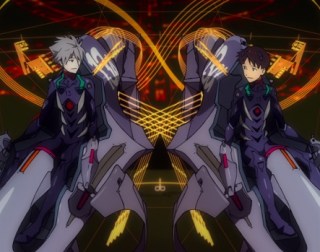 So when will that conclusion come? Well, a few years ago Anno ‘joked’ that the finale might be released “four to six years” after 3.33. As we’re already almost at four years with no sign of a release date, I guess it wasn’t so much of a ‘joke’ after all. An English-friendly DVD/Blu-ray will inevitably take an additional couple of years, too. So an indefinite, but undoubtedly lengthy, wait begins…
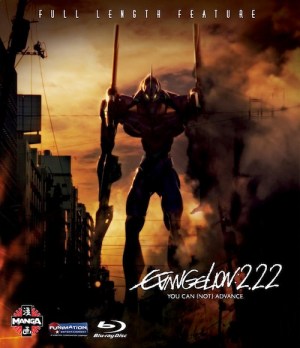 Just over a year since the
  For my money, the first 40 minutes or so of the film are (by and large) the best bits. It opens with a barnstorming action sequence, a great scene for newbies and fans alike as we’re introduced to Eva pilot Mari, who didn’t appear in the TV series. That she then disappears for most of the film, only to make a thoroughly mysterious return later, is one of those explanation-lacking flaws. I’m sure it won’t look so bad once the next two films provide us with answers. Well, I hope not.
 Then the gang take a trip to a scientific installation which is trying to preserve the oceans and their wildlife. It feels like animation shouldn’t be as effective for such a sequence as, say, the footage in a David Attenborough documentary, but nonetheless it feels extraordinary, in its own way. It also marks itself out with the interaction of the characters on a fun day out rather than their usual high-pressure monster-fighting world. And then it’s back to that world for another impressive three-on-one Angel attack.
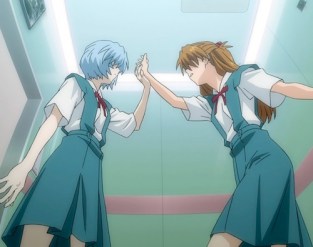 But it’s all building somewhere. For one, there’s another of the film’s best sequences — certainly, its most shocking, which readily earns the 15 certificate. I don’t want to spoil it for anyone yet to see the film, because it’s one of the plot points that differs from the TV series, but it involves the death of a main character in a brutal, deranged way. I say “death” — they pop up in the third film trailer that runs after the end credits, so there’s more to this yet…
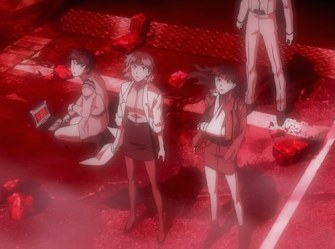 And then, after the end credits, there’s a brief scene that throws another spanner in the works! Double-cliffhanger-tastic… one might say…
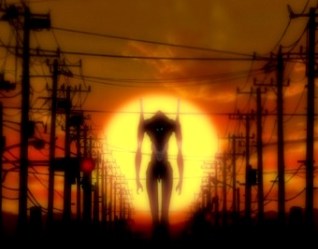 In short, if you’ve always liked Evangelion then you won’t be waiting for me to tell you this is a must-see reimagining; if
 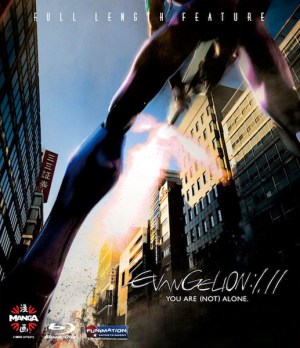 When I (first) reviewed
 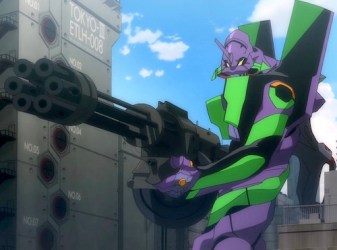 is a new addition I swear, while he also listens to a (digital, at least) cassette player rather than an iPod (other MP3 players are available, naturally). It’s not a major flaw — unlike, perhaps, the fact that the “covert” and top-secret Nerv organisation has great big signs plastered all over town and everyone seems to know about them — but, still, maybe a new bit of animation to replace the tape-playing close-ups would’ve been nice.
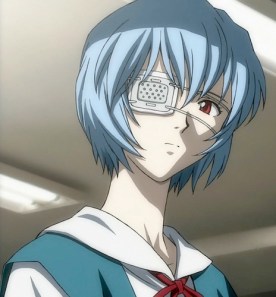 The pros and cons of the series remain. Shinji is alternately interesting, perhaps even complex, and a whiney little irritant. Here he has a character arc at least, suggesting he may be more sufferable next time out. His relationship with Major — sorry,
 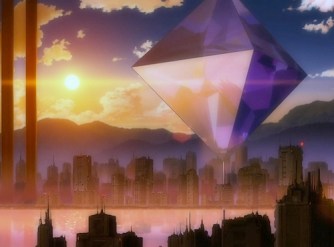 Another factor thrown up by the TV-series-to-feature conversion is the image quality. An HD big screen is a mixed blessing here. On one hand, it looks great on Blu-ray, with crisp lines and solid colours, the result of re-filming, colouring and CGI-ing the original animation elements rather than using the finished TV shots. On the other, such clarity sometimes shows up a lack of detail in the original animation — these elements were created for 4:3 mid-’90s TV, not a hi-def (home) cinema — and the solid colours and money-saving techniques (for example, showing something static rather than a lip-synched (ish) mouth during conversations) can remind the viewer of cheaper TV roots. Perhaps I’m being overly critical though, because much of it does look fabulous; at the very least, the thorough ground-up rebuild means it looks better than the TV series ever will, never mind has.
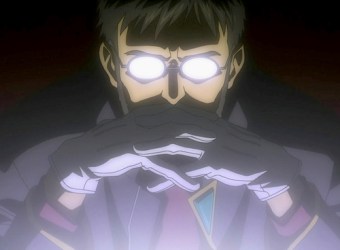 It’s enough to make one scurry back to the series for answers, though the three movies still to come promise whole new characters, plots and a — frankly, much-needed — brand-new ending. After two misfires (one in the series, one in
 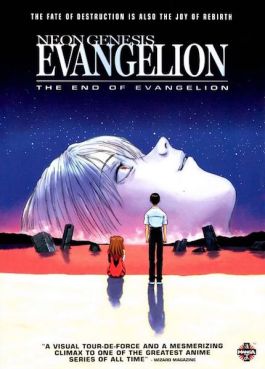 Eight weeks and sixteen films later than I’d’ve liked, I can finally complete the Evangelion story! (For my review of the first film, look
 The genesis of this film is a long story (at least, longer than I’d like for this review!) The anime series Neon Genesis Evangelion ends with bizarre theme-centric episodes that fail to conclude the story; a film was produced to re-tell the end from a story-centric position and/or to provide an alternate ending (depending who you believe). This is not that film, but something that was released a bit before that.
 100Films.co.uk