
Joseph Losey | 91 mins | TV | 2.35:1 | UK / English | 12
 Sometimes, at least for me, films improve in retrospect. My opinion while watching may be different to when I look back days, weeks, months, or even years later. Films I thought I disliked may benefit from a kind of nostalgia; some films just gain something from extended reflection, even if that isn’t conscious; films I underrated may improve when I gain perspective on their qualities relative to other works; in some cases, it’s just that I’m getting older and wiser.
There are several films reviewed on this blog that I think would warrant a different opinion if I watched them again now, but The Damned is the most recent example. I think if I’d got round to this review any quicker it would be less enthusiastic than what I’m about to write.
That said, it’s not as if I’ve had a complete turnaround of opinion: The Damned is an interesting film, certainly, but one that is perhaps somewhat undercut by its age; a kind of ’60s SF that would probably require a distinctly different approach if you were to attempt to make it today.  Not necessarily a bad thing, but it has that kind of disconnect from reality that’s markedly ’60s. In his review for MovieMail, James Oliver notes that “despite his background in low-budget genre flicks, Losey was at heart an art house director, keen to communicate big themes and ideas”, which perhaps explains some of this.
It’s also oddly constructed (perhaps due to studio interference — see Oliver again), starting out as a kind of small town British gang B-movie, with some eccentric and apparently irrelevant characters turning up in asides, before segueing into a nuclear-age SF parable. As a post on IMDb’s boards put it (yes, sometimes those are worth reading — it astounds me too), The Damned is “continually in flux — just as you think you’ve got it pegged as one genre of film, it becomes another.” Again, not necessarily a bad thing, but unusual.
Once the film hits its genre stride, it shows that it is (to borrow further from that IMDb post) “true science fiction, in that it’s about ideas, and a commentary on current culture, and where that culture may be leading. In other words, science fiction for adults”. Obviously that’s the “current culture” of 1963, but in that sense it perhaps offers an insight into the thoughts and attitudes of the time, 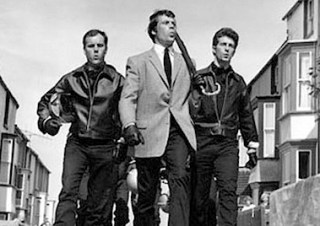 and the kind of inhumanity that might be reached in the quest to survive nuclear war.
My mixed reaction to The Damned leaves its score in the middle of the board, but I’d encourage those with an interest in intelligent science-fiction or ’60s genre films to give it a go.

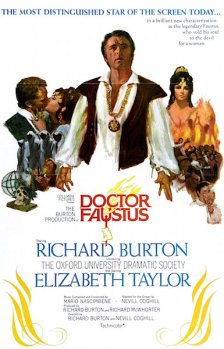 Despite the numerous film versions of the Faust story, this is the only one that adapts Christopher Marlowe’s A-level-favourite 1588 play. It’s a shame, then, that it’s heavily edited from the original text and, despite also being a filmed version of the Oxford University Dramatic Society’s 1966 stage production, has clearly been inappropriately chosen as a vehicle for then-couple Richard Burton and Elizabeth Taylor.
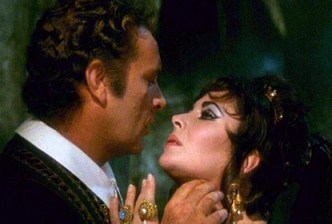 Elsewhere, Burton and Coghill’s vision of Faustus is stylistically reminiscent of a Gothic Hammer Horror, which is either wholly inappropriate or an ingenious genre mash-up — after all, such a genre-mashing trick has been pulled many a time with Shakespeare over the years. There are repulsively horrific corpses, a harem of naked ladies, an array of special effects, plus a medieval-styled gothic atmosphere to all the sets and costumes, though the scene where Faustus mucks about with the Pope feels more Carry On. Using inanimate objects in the roles of the Good and Evil Angels — respectively, a statue of Christ and a skull — is a small but inspired touch.
 perhaps just to heighten the presence of Helen by losing scenes she couldn’t have been shoehorned into; but in the process it both loses some of the best material and destroys any hope the film had of being a definitive filmed version of the play. Ultimately, such oversights proved to be the final straw for the film’s already-tenuous grip on a three-star rating.
 100Films.co.uk