Archive 5, Vol.9

I have a backlog of 525 unreviewed feature films from my 2018 to 2023 viewing. This is where I give those films their day, five at a time, selected by a random number generator.

Today, a couple of Agatha Christie adaptations from very different eras; plus a heist, a horror, and a Hong Kong love story for the ages.

This week’s Archive 5 are…

  • Evil Under the Sun (1982)
  • Sneakers (1992)
  • Us (2019)
  • Crooked House (2017)
  • In the Mood for Love (2000)


    Evil Under the Sun

    (1982)

    Guy Hamilton | 112 mins | digital HD | 16:9 | UK / English | PG / PG

    Evil Under the Sun

    The third in the run of Poirot adaptations that began with Murder on the Orient Express and continued with Death on the Nile — no, not the recent Branagh ones: this is the first time they did exactly that. But, funnily enough, both third films in their respective series (i.e. this and Branagh’s A Haunting in Venice) take a UK-set Christie and relocate it somewhere more exotic, to fit with the style of the rest of the series. So, rather than a small island off the north Devon coast (which likely stretches the definition of “under the sun”, based on my experience of Devon), here the action is located to the Adriatic Sea, although actually filmed on Mallorca.

    All of which is incidental when the rest of the movie is, at best, fine. It doesn’t help that the storyline is ultimately very similar to Death on the Nile, making the whole affair feel like more of a rehash than it needs to. Guy Hamilton’s direction underwhelms, giving a TV movie-ish feel, which is only exacerbated by the less-starry cast — there are recognisable names and faces here (James Mason, Diana Rigg, Maggie Smith), but, in totality, it’s not in the same league as the previous two films. It rather prefigures where Ustinov’s Poirot would appear next: literally, TV movies.

    3 out of 5

    Evil Under the Sun was #2 in my 100 Films in a Year Challenge 2020.


    Sneakers

    (1992)

    Phil Alden Robinson | 126 mins | Blu-ray | 1.85:1 | USA / English | 15 / PG-13

    Sneakers

    I never paid Sneakers any attention (not that it came up often) — I think, because it’s an American movie called Sneakers, I assumed it was about shoes — until indie magazine Film Stories announced a Blu-ray release (long since sold out, I’m afraid). I’m always keen to support small/new labels doing interesting things. And thank goodness for that, because, turns out, it’s actually very much my kind of film and good fun.

    So, turns out, in this context, “sneakers” are not an Americanism for trainers, but good-guy hackers who test security systems. When the team are hired to steal a code breaking device, they get suspicious about the setup and, of course, it turns out they’re right to be. Thus unfurls a tech-based heist thriller with a strong vein of humour, but without tipping over into being an outright comedy. Stylistically and tonally, that’s right up my street — I love a heist movie, and that kind of tone (funny without being silly; what I think of as a ‘real world’ awareness of humour) often works for me. It’s the kind of film that’s just a lot of fun to watch. I can imagine it being highly rewatchable; a go-to favourite for people who do that kind of thing.

    4 out of 5

    Sneakers was #132 in my 100 Films in a Year Challenge 2021.


    Us

    (2019)

    Jordan Peele | 112 mins | digital HD | 2.39:1 | USA, China & Japan / English | 15 / R

    Us

    Part of what made Jordan Peele’s debut feature, Get Out, such a success was the way it chimed perfectly with the cultural zeitgeist of 2017; indeed, of the whole decade (time may yet add “of the whole century”). This immediate followup doesn’t benefit from a similar boost, but it’s a strong work of horror cinema in its own right.

    Us follows a family who are attacked by a group of doppelgängers. That’s the most basic version, anyway — Peele seems to have a lot of ideas he wants to mix in here; almost too many. It seems to operate on the level of a home invasion/slasher kind of movie much of the time, but having more on its mind means it’s a bit too slow to satisfy as something so viscerally straightforward. Thus, all the Meaningful stuff ends up crammed into the third act, which perhaps leaves it feeling back-heavy. There’s also a big twist, naturally. On one hand, it seems really obvious, pretty much from the beginning; but on the other, it does cast the rest of the movie in a different light, which is quite interesting.

    If all that sounds rather negative… I blame my notes (I’m writing this review over four years later based solely on what little I wrote down at the time). Us is imperfect, but it’s also great in places, and is at least passably interesting to reflect on in light of the final reveal.

    4 out of 5

    Us was #23 in my 100 Films in a Year Challenge 2020.


    Crooked House

    (2017)

    Gilles Paquet-Brenner | 115 mins | digital HD | 2.35:1 | UK & USA / English | 12 / PG-13

    Crooked House

    Despite a moderately starry cast (Glenn Close, Terence Stamp, Gillian Anderson, Christina Hendricks fresh from Mad Men; plus Brits of varying degrees of recognisableness) and a screenplay by Julian “Downton Abbey” Fellowes, this Agatha Christie adaptation was virtually dumped straight to TV here in the UK (apparently it did have a theatrical release, but the TV premiere was less than a month later — and on lowly Channel 5 at that). Of course, some of the best Christie adaptations have been made for TV; but when something’s designed for theatrical and ends up skipping it, it’s never a good sign.

    Fortunately, Crooked House isn’t a disaster, though it’s far from a resounding success. Quite what attracted the big names I don’t know — it’s a reasonable setup (big dysfunctional family), but the screenplay isn’t exactly sparkling, aside from one or two moments or scenes. There is, at least, one helluva resolution. It also feels disjointed thanks to poor editing and/or direction. If the aim was to keep the pace up, it failed, because it begins to drag after a while. All of this is only partially masked by decent cinematography from Sebastian Winterø, which is the only thing that saves it from looking very TV-ish. Maybe it found its rightful home after all.

    3 out of 5

    Crooked House was #1 in my 100 Films in a Year Challenge 2020.


    In the Mood for Love

    (2000)

    aka Fa yeung nin wah

    Wong Kar-wai | 99 mins | digital HD | 1.66:1 | Hong Kong & China / Cantonese & Shanghainese | PG / PG
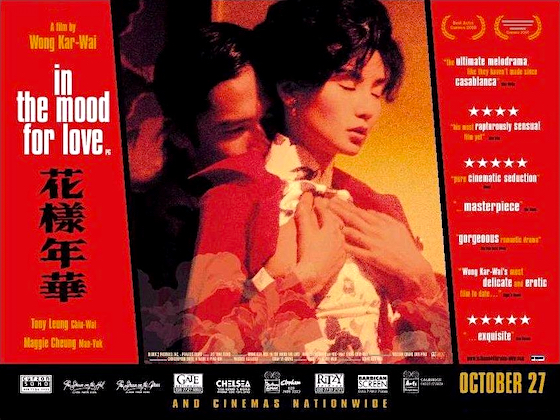
    In the Mood for Love

    If my four-years-late review of Us was hampered by largely-negative notes, my four-years-late review of In the Mood for Love is in even worse shape: no notes at all. Some trivia? I can do that! An interesting quote from the director? Got it saved! But anything on my own thoughts beyond settling on a five-star rating? Nope. I would try to repurpose my Letterboxd review, but all I wrote was: “I mean nothing but respect when I pithily describe this as Brief Encounter in Hong Kong.” Accurate but, indeed, pithy.

    On the bright side, this is a widely-acclaimed film, so if you’re after in-depth writing I’m certain you’ll find some somewhere else. Indeed, even if I did have more fulsome notes, I doubt I’d contribute anything more insightful. This is a subtle, almost delicate work, and that’s the kind of thing I feel I often struggle to properly get to grips with in my short, usually spoiler-averse reviews. Suffice to say, I concur that this is a very good film indeed; although, as with any understated work, some might prefer if the feelings and emotions were more overt. Each to their own.

    5 out of 5

    In the Mood for Love was #200 in my 100 Films in a Year Challenge 2020. It was viewed as part of Blindspot 2020.

  • Diamonds Are Forever (1971)

    The 100 Films Guide to…

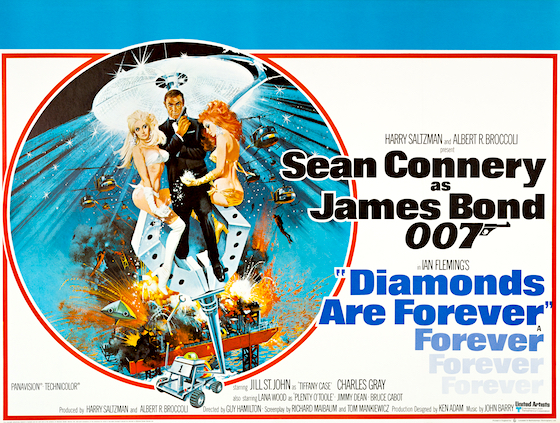
    Diamonds Are Forever

    You’ve been waiting for him…
    Asking for him…
    Now he’s here.

    Country: UK
    Language: English
    Runtime: 120 minutes
    BBFC: A (cut, 1971) | PG (1987) | 12 (2012)
    MPAA: PG

    Original Release: 14th December 1971 (West Germany)
    UK Release: 30th December 1971
    Budget: $7.2 million
    Worldwide Gross: $116 million

    Stars
    Sean Connery (Marnie, The Untouchables)
    Jill St. John (The Lost World, Sitting Target)
    Charles Gray (The Devil Rides Out, The Rocky Horror Picture Show)
    Lana Wood (The Searchers, Grayeagle)

    Director
    Guy Hamilton (Battle of Britain, Evil Under the Sun)

    Screenwriters
    Richard Maibaum (Ransom!, Licence to Kill)
    Tom Mankiewicz (The Sweet Ride, Ladyhawke)

    Based on
    Diamonds Are Forever, the fourth James Bond novel by Ian Fleming.

    The Story
    After finally assassinating his nemesis, Blofeld, Bond is assigned to investigate a diamond smuggling operation in Holland, but following the trail leads him to the glitz of Las Vegas — and a familiar foe.

    Our Hero
    Bond, James Bond, agent 007 of the British secret service. He may be looking a little older than when we last saw him, but he’s still capable of wooing all the ladies and scaling the outside of skyscrapers.

    Our Villains
    We so much focus on the Dr Nos and Auric Goldfingers of the early Bond films — plus the ever-changing roster of villains he’d face in later movies — that it’s easy to forget Blofeld has a presence in almost every Bond movie before Diamonds Are Forever (indeed, Dr. No (which only mentions SPECTRE) and Goldfinger (which has no ties whatsoever) are the only exceptions), so it’s no real surprise that he’s not just confined to the pre-titles here. It certainly wouldn’t have been to audiences in 1971, either: he’s prominent in the trailer, and Charles Gray is rather highly billed for someone who’s only in the opening minutes. That said, Lana Wood is fourth billed and she only has about three scenes, so… Until he’s properly revealed, however, we have overtly homosexual assassins Mr Wint and Mr Kidd to tide us over. Considering they’re shown as creepy and murderous, it’s hardly an enlightened portrayal of homosexuality; but then it is from 1971, so what do you expect?

    Best Supporting Character
    Tiffany Case is Bond’s way in to the diamond smuggling operation. She’s a self-assured and capable woman… for about the first half of the film, before she sharply descends into a stereotypical Bond Girl bimbo. Oh well, they tried.

    Memorable Quote
    “That’s quite a nice little nothing you’re almost wearing. I approve.” — James Bond

    Memorable Scene
    Bond travels to Amsterdam under the identity of a diamond smuggler they’ve captured, but when he escapes and to Amsterdam too, Bond must intercept the chap before his cover’s blown — which he does in a small lift, leading to a brutal close-quarters brawl that’s almost as good as the famous train carriage one in From Russia with Love.

    Write the Theme Tune…
    One of the most famous of the Bond title tracks, its music was written by the film’s — and, by this point, the series’ incumbent — composer, John Barry. It was his fifth Bond theme song (seventh if you include Mr. Kiss Kiss, Bang Bang and We Have All the Time in the World). The lyrics were by Don Black, returning for his second theme after Thunderball.

    Sing the Theme Tune…
    This is also the second Bond theme for singer Shirley Bassey, after (of course) Goldfinger. Apparently co-producer Harry Saltzman hated the song, objecting to the innuendo in the lyrics, and it was only saved by his fellow producer, Cubby Broccoli. That said, Saltzman may have had a point: in a later interview, Barry revealed that he instructed Bassey to imagine she was singing about… a penis. “They are all I need to please me / They can stimulate and tease me … Hold one up and then caress it / Touch it, stroke it and undress it…” Whew, crikey!

    Making of
    By this point in the Bond series (this is the seventh film, remember) a lot more original thought was going into which direction to take things than just “adapt a Fleming novel”. For one thing, they were worried Bond’s British style was becoming passé, so they decided to set the movie in glamorous Las Vegas — which, let’s be frank, has dated far, far more than the classier style of the earlier films. Anyway, they went even further than that: with Lazenby having deserted them, a new leading man was required, and so they cast… an American! *gasp* Unthinkable today. The man in question was John Gavin, best known for playing Sam Loomis in Psycho. He’d also played France’s answer to Bond, agent OSS 117, in a film just a couple of years earlier, which is either good training or a weird conflict, depending how you look at it. Not that it mattered anyway, because United Artists insisted they get Sean Connery back, and they did — albeit for a then-extraordinary $1.2 million salary. To Connery’s credit, he gave every cent of it to a Scottish education charity he’d established.

    Previously on…
    Connery played Bond in five movies between 1962 and 1967, eventually becoming bored of the role and quitting. They replaced him with an unknown Australian model, who promptly got too big for his boots and ran off after just one movie. It just so happens that the films’ storylines lend credence to the theory that James Bond is a codename that goes along with the 007 designation — normally I hate that theory, but the way it explains the events of OHMSS and Diamonds Are Forever is quite neat. (Basically: Connery-Bond retires and is replaced by Lazenby-Bond (hence the “this never happened to the other fella” line), but when Lazenby-Bond’s wife is killed he quits and Connery-Bond comes out of retirement to avenge her for him (hence him tracking down Blofeld at the start of DAF, but not seeming all that emotional about it).)

    Next time…
    Connery said he’d never play Bond again… which became the inspiration for the title the next time he did. But that really was his last hurrah in the role. As for the official Bond movies, they finally did the inevitable and cast Roger Moore. The rest is history.

    Awards
    1 Oscar nomination (Sound)

    Verdict

    Well throw me out a window and call me Plenty if Diamonds Are Forever isn’t actually a really enjoyable Bond movie. Okay, it’s probably still the worst (official) Connery movie, thanks to a few daft bits (the elephant playing the slot machine; Blofeld in drag; etc), and because it simply doesn’t have as many standout sequences or memorable lines as his other five. But, on its own merits, it’s good fun. The first 45 minutes or so are played admirably straight and serious; the car chase around Vegas is rather good; and while those bits of silliness do creep in, they’re only fleeting (albeit a precursor to where the whole series would go in the Moore years). I’d previously remembered Diamonds as a real nadir; a blight on the name of the series. Now, while I wouldn’t rank it among my most favourites, I found a lot to like.

    (For the sake of comparison, I previously gave five stars to From Russia with Love, Goldfinger, You Only Live Twice, and On Her Majesty’s Secret Service, and four stars to Dr. No and Thunderball. This would be three-and-a-half, but I’ve never done half stars on this blog. If I did, perhaps one or two of those others would’ve been marked down by half-a-star too.)