
Richard Burton & Nevill Coghill | 92 mins | DVD | PG
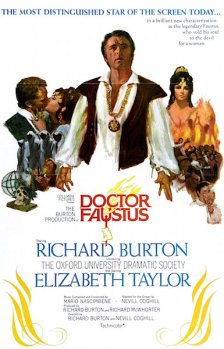 Despite the numerous film versions of the Faust story, this is the only one that adapts Christopher Marlowe’s A-level-favourite 1588 play. It’s a shame, then, that it’s heavily edited from the original text and, despite also being a filmed version of the Oxford University Dramatic Society’s 1966 stage production, has clearly been inappropriately chosen as a vehicle for then-couple Richard Burton and Elizabeth Taylor.
Burton plays a suitably reverent version of Faustus, though is never less than able to convey his varied moods, from confidence, often underscored with insecurity, to repentant regret, to childish tomfoolery. Stuck with numerous long speeches, however, there are occasions when his delivery — and consequently the film — slip briefly into insomnia-curing monotony.
Meanwhile, the play’s lack of a significant female role makes Elizabeth Taylor’s presence rather unusual. Marlowe’s text has been tweaked to allow Taylor to crop up frequently as ‘Helen of Troy’. As well as appearing in original scenes that feature Helen, co-writers/directors Burton and Nevill Coghill have inserted her into any scene that would allow it. Such casting across several inconsequential roles, some not even in the original text, effectively creates a new character. Perhaps this adds an extra dimension to Faustus and his goals — attempting to imply a romantic angle — but it comes across as a desperate and unwarranted attempt to make this a Burton/Taylor film.
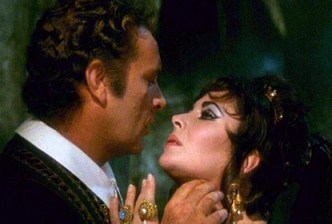 Elsewhere, Burton and Coghill’s vision of Faustus is stylistically reminiscent of a Gothic Hammer Horror, which is either wholly inappropriate or an ingenious genre mash-up — after all, such a genre-mashing trick has been pulled many a time with Shakespeare over the years. There are repulsively horrific corpses, a harem of naked ladies, an array of special effects, plus a medieval-styled gothic atmosphere to all the sets and costumes, though the scene where Faustus mucks about with the Pope feels more Carry On. Using inanimate objects in the roles of the Good and Evil Angels — respectively, a statue of Christ and a skull — is a small but inspired touch.
These aside, there’s a surprising emphasis on special effects: a skeleton that turns into a rotting corpse (click the link at your own discretion); skulls that pour imagined gold and pearls from their mouths; cuckold horns that retreat into nothing; and so on. One might think this is purely to buoy up the Elizabethan language for a wider audience, and one isn’t necessarily wrong, but considering Elizabethan theatre-goers enjoyed their gory effects as much as modern audiences clearly do, their inclusion isn’t incongruous. There’s certainly some visually impressive stuff on show, much of it suitably horrific — one often wonders about the PG certificate.

An even greater deviation than the effects is how much has been cut out — in a word, loads. Most of the comic scenes are gone (some of their humour wouldn’t translate today, making those a wise excision, but others are missed), and much of what Faustus does during his 24 extra years on Earth is missing too. Some of the cut scenes are among the most easily-enjoyed parts of the play, though would certainly lighten the tone. Perhaps they just didn’t have any money left for the further special effects required. The trims extend as far as the final scene, which also loses some of the play’s best bits. It’s unlikely anyone unfamiliar with the play would notice the omissions (having not read it for a good few years there weren’t many I missed), but returning to the text after seeing the film I realised how disappointing some of the cuts were.
Perhaps they were designed to focus the film more closely on the Faustus/Mephistopheles relationship,  perhaps just to heighten the presence of Helen by losing scenes she couldn’t have been shoehorned into; but in the process it both loses some of the best material and destroys any hope the film had of being a definitive filmed version of the play. Ultimately, such oversights proved to be the final straw for the film’s already-tenuous grip on a three-star rating.

 First, a little note on that aka: technically — and, I believe, legally — no such title is attached to this project. However, the initial idea was developed by Koontz and, after he left the project, adapted into his Dean Koontz’s Frankenstein series of novels. Despite the ‘creative disagreement’ (or whatever they chose to call it) that led him to walk away, the film retains significant similarities to the first book. More on these in a moment.
 100Films.co.uk