Gareth Edwards | 134 mins | cinema | 2.35:1 | USA / English | 12A / PG-13
 The first live-action non-saga movie to take us to a long time ago in a galaxy far, far away, this initial entry in what is sure to be a never-ending series of so-called “Anthology” movies really puts the “War” into Star Wars.
It begins without the traditional opening crawl, which is somewhat ironic when you consider that, of all the Star Wars movies, this is the one that would most benefit from some scene-setting — fans are on a fairly sure footing, but casual viewers who still expect to see the further adventures of Rey, Finn, and BB-8 may be a little baffled. (And if you think the saturation media coverage will have prepared everyone, you’re underestimating Normal Folks’ capacity to be completely oblivious to movie news.) Anyway, where we actually are is 30-something years before The Force Awakens… but as this is a spoilery review you don’t need me to recap the plot, because you’ve not read this far if you haven’t seen the movie. Right? Good.
As I was saying, Rogue One is really a war movie, and is at its best when it’s consciously riffing off other (i.e. non-sci-fi) genres, like gritty World War 2 epics or daring heist thrillers. These are some new flavours for a franchise which has produced seven films in the action-adventure mould. Rogue One doesn’t deviate so far from that path — it’s a bit like Disney stablemate Marvel in that it mixes other-genre spice into the familiar recipe rather than striking out in a wholly different direction — but it’s enough to taste different.
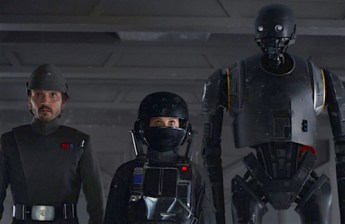 Unfortunately, the plot starts off almost as jumbled as my mixed metaphors there. “Jumbled” may be unfair, but it’s a little scrappy, initially jumping around all over the place in a way that’s tricky to follow even if you’ve read up on the film and have an idea who you’re being introduced to and why. It must be a right pain for neophyte viewers. There can be a fine line between praising a film for requiring its viewers to pay attention and do some work, and criticising it for being disarrayed and not making things clear. Personally, I thought Rogue One was sat right on that line for much of its first act, until a few big expositional infodumps come along to explain the storyline.
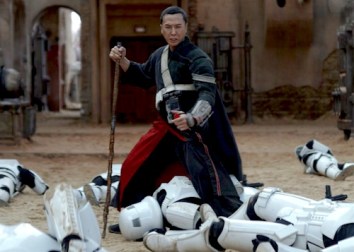
A primary cause of this is the number of characters we need to be introduced to. Presumably aiming for a Dirty Dozen / Magnificent Seven / men-on-a-mission… people-on-a-mission… beings-on-a-mission vibe, it leaves things occasionally a little scattered until the team comes together. The resultant volume of heroes means the movie is arguably a little short on the kind of memorable characters Star Wars is loved for, although that doesn’t mean there isn’t good work here. Felicity Jones makes Jyn a likeable, moderately complex heroine, at least when she’s not delivering cheesy speeches. Ben Mendelsohn produces a reliably snake-like villain as Imperial Director Krennic, while Riz Ahmed once again injects a lot of personality into a somewhat underwritten supporting role. Donnie Yen and Jiang Wen make a solid double act who it would’ve been lovely to see more of in a sequel, and Alan Tudyk gets all the best lines as snarky droid K-2SO. Most ill-served are Diego Luna as a conflicted Rebel captain whose internal struggles aren’t fully brought out, Forest Whitaker as an ageing extremist, and Mads Mikkelsen, who is lumped mainly with exposition. The latter two at least bring extra-textual gravitas to their smaller roles.
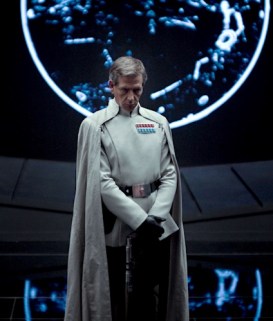 Then we come to perhaps the film’s most discussed character: Grand Moff Tarkin, played by Peter Cushing’s computer-generated face overlaid on the motion capture and voice of Holby City’s Guy Henry. Leaving aside the ethics of the enterprise, I found the character’s presence to be pretty distracting: you know it’s CGI and you can’t stop focusing on just Tarkin’s face, trying to judge how effective or not it is. For me, it proves that CGI isn’t yet quite up to creating a fully plausible human being. Your mileage will vary on whether it’s suitably competent nonetheless or an ill-conceived failure.
Elsewhere, there are tons of little nods to the wider Star Wars canon, including the animated series: Whitaker’s character actually comes from The Clone Wars, where he appeared in four episodes; and there are half-a-dozen background references to ongoing series Rebels, most prominently the ‘Hammerhead’ ship, which was introduced there. Lucasfilm do seem very keen to emphasise that all these different media really are one interconnected universe, unlike so many other cross-format franchises, which accept everything as canon until the main series decides they want to contradict it. For example, while I was on holiday recently I visited the Star Wars exhibition they currently have at Disney’s Hollywood Studios, which features various displays of, say, villain’s lightsabers or pilot’s helmets that put real-life recreations of ones from The Clone Wars and Rebels right alongside those from the original trilogy and the prequels as if that’s exactly where they belong. I must commend Lucasfilm for such an unusual commitment to institutionally tying these things together, rewarding the investment fans will inevitably make in doing the same. It does mean I feel I need to get on with watching the six seasons of Clone Wars and three (or more) seasons of Rebels, though.
 Continuing such comparison to the wider Star Wars galaxy, some have said Rogue One is the Empire Strikes Back of Disney-era Star Wars, because it’s the darker second (on the release schedule) film. Of course, the main reason it’s dark is that every major (new) character dies. You know what’s unique about Empire in the context of the entirety of live-action Star Wars movies? It’s the only one where no major character dies. Death isn’t the only signifier of darkness, of course, but my point is rather that I think people are grasping at straws if they think anyone inside Lucasfilm has consciously positioned Rogue One to serve an Empire-like role in their revived franchise. That doesn’t mean they’re not treating it seriously, mind: director Gareth Edwards has already revealed that the first draft had Jyn and Cassian survive the battle of Scarif, purely because the writers thought the execs would never agree to all the heroes being killed off, but those execs immediately suggested that everyone should die and that element was never questioned again. Yes, sometimes studio suits are actually on the side of narrative truthfulness.
Even if that got locked early on, other things certainly didn’t. The film’s reshoots made big news for no particularly good reason (it’s par for the course on blockbusters these days), but their results are easy to see thanks to the film’s trailers: there are a number of significant shots present there that didn’t make the final cut, suggesting some radically different events in the third act. You can watch a short compilation of those here. As far as I’m aware neither Edwards nor anyone else has said what was actually changed by the reshoots, but it would be interesting to find out. Considering the Scarif-set portion of the film is probably its most successful part, and that’s where the reshoots seem to have been focused, it might make a good defence of a process that is often seen as a sign of disaster (sometimes for good reason).
 Much discussion of Rogue One seems to have revolved around whether it’s better than The Force Awakens. At the risk of sitting on the fence, I can see both sides. On the one hand, Edwards is a much more interesting filmmaker than J.J. Abrams. The latter is adept at aping the work of others, having now been in charge of multiple movies that are mostly derivative but nonetheless entertaining. Edwards’ career is still a little fresh and blockbuster-centric to risk describing him as an auteur, but his debut film was more indie than anything Abrams has even thought of creating, and his take on Godzilla attempted to be more interesting than the rote monster blockbuster it could’ve easily been. He brings similar qualities to Rogue One. On the other hand, that riskier take has resulted in a few fumbles, whereas The Force Awakens was a polished, crowd-pleasing entertainment. I’d hesitate to say I prefer one to the other because they provide slightly different thrills, but on a first viewing I did find Force Awakens more satisfying. Given time and distance, however, I wouldn’t be at all surprised to find Rogue One leapfrogging it in my estimations.

 Ten years after the events of
  Let’s start with some other reviewers’ problems. An oft-cited one is the initial moral repugnance of the characters, but is it a valid criticism to say a movie about a bunch of macho dicks presents its characters as macho dicks? Because let’s not be kidding ourselves, the American military is not full of Guardian-reading lefties; it’s full of vulgar, unreconstructed young Blokes… like these fellas. Now, I’m sure I’m generalising — I’m sure they can’t all be like this — but I can believe plenty of them are. No doubt elements of their behaviour are more “macho fantasy” than reality (a hookers and coke party the night before shipping out?), but the fundamentals of their attitude are plausible.
 And just as it looks like we’re about to get a truthful, if obvious, moment where the characters admit that, no, this war is utterly pointless and has absolutely nothing to do with America or keeping Americans safe, the first guy answers, “yes, I do.” Really? Really?! At that moment it just feels queasily like right-wing propaganda, especially as the two characters in question have been positioned as our de facto heroes.
 Later, in the war zone, there are more horrific situations and imagery that will certainly test your perspective. For example, the guys come across a school bus that was caught in an attack on some monsters. The bus is full of dead children, but our guys need to search it for water nonetheless. Is this unflinching in its realism of the brutality of war, or a step too far and just sick? Perhaps the sci-fi context again undermines the movie, because you can’t apply the “this is really happening” argument when there are giant monsters involved. But if the giant monsters are a MacGuffin to reflect real, current conflicts, then does this become something that is happening? Perhaps it’s a circular argument.
 Dark Continent is the debut feature of director (and, here, co-writer) Tom Green, who previously helmed half-a-dozen episodes of E4’s excellent “superheroes with ASBOs” drama
 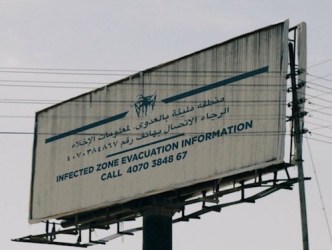 I do think Dark Continent is better than most reviews give it credit for, but it’s not exactly a movie of the greatest or most original insight, and — their added visual interest aside — it didn’t need to be a Monsters movie. Indeed, if it had just been a straight Middle East war movie, perhaps some critics would’ve been kinder, because at least they would’ve known what they were getting. If you liked the first film then there’s absolutely no guarantee you’ll enjoy this — it’s not the same kind of film at all — but the worst sequel of the decade? Not even close.
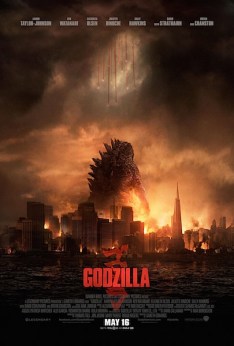 The second attempt at a US re-imagining of Godzilla received mixed reviews last summer, though there can be little doubt that it’s much more successful than the first,
  He’s denying us shots of it not to punish the viewer or to trick us, but literally to tease us, to build excitement and suspense and desire for the final battle. Too many people aren’t used to this — modern blockbusters have trained them for non-stop show-us-all-you’ve-got action from start to finish — and that’s a shame, and their loss, because Edwards’ method is superior to, and ultimately more entertaining than, 95% of other similar blockbusters.
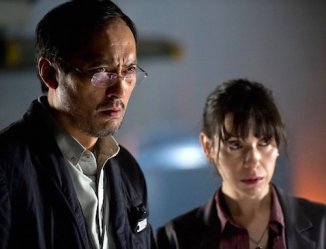 that simply aren’t present in the functional dialogue they have to work with, simply in the way they stand, the way they look at things… It’s not the focus of the film, it’ll pass many people by (indeed, it has), but I think there are some fine performances here. Not awards-winning ones, obviously, but in the hands of lesser actors, they would’ve been so much poorer.
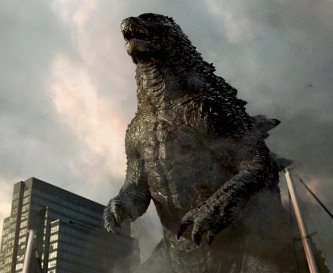 later, he slips quietly into the bay). Maybe, maybe not, but they always look big — more importantly, they feel big. There are various reasons for this, including Edwards’ shot choices: we often see them from a human perspective on the ground; when we do see wider shots, they’re from suitably far away, or high up, like a helicopter shot (if it were real…) Too many directors shoot their giant monsters with angles and perspectives as if they’re human-sized, which makes them come across as human-sized even when there’s a building next to them, never mind when they’re in places without reference points (coughatsea,PacifcRimcough). Edwards never does this, and it pays off. More than once I regretted that I can never be bothered to go to the cinema any more, because I bet this looked stunning on the big screen (I know I’m certainly
  most present big-budget summer tentpoles. That it got a little lost and under-appreciated in a summer of mega-hits is a real shame — it may not quite match summer 2014’s high points of
  100Films.co.uk