Black Girl (1966)

aka La Noire de…

Ousmane Sembène | 59 mins | Blu-ray | 1.33:1 | Senegal & France / French | 15
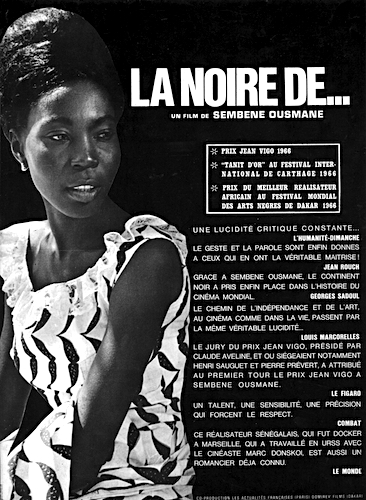
Black Girl

Let’s be upfront about this: I’m a middle-class Western white man who herein will be critiquing a film made by a black African filmmaker about the life of a black African character. I’m stating this baldly because I wouldn’t want anyone to think I wasn’t aware of the potential connotations and pitfalls of that situation, especially as I’m about to challenge (what seems to me to be) the accepted reading of the work in question. Spoilers follow.

Believed to be the first feature film made by an indigenous black person from sub-Saharan Africa, Black Girl is the story of Diouana (Mbissine Thérèse Diop), a Senegalese women who is looking for work as a maid and finds employment babysitting the children of a French family. When they return to France, she is the only servant to travel with them; but the glamorous life on the Riviera that she’d imagined turns out to be one of drudgery, confined to the couple’s apartment, the children now nowhere to be seen.

What little I’d read about Black Girl beforehand led me to expect something about modern slavery; the eponymous black girl being mistreated by her white employers in such a way that, even though it’s the 1960s, she’s still basically a slave. Most of what I’ve read since viewing has confirmed that as the standard reading of the film. I’m not going to dispute that that’s one aspect of what’s there, but only the sum total of it if we take Diouana’s reactions and narration at face value. I mean, life in France is clearly not all she was promised; but she was looking for work as a maid and, while that wasn’t what she was doing for the family initially, the tasks they’re now asking of her don’t seem that out of step with a maid’s duties. And she gets paid for doing them. There is a period when Diouana complains (in her internal monologue) that she’s not getting paid, but the film is a little unclear on timescale — when the husband eventually gives Diouana her wages, it feels like payday has finally arrived, rather than that she’s been denied them for an unfair period of time.

Equally, there’s no denying that the wife is a demanding and demeaning bitch; and when they have some guests round for a meal, there’s the kind of casual racism that white people like to dismiss as “fun and games”, but is still degrading in its own way. So, I’m not saying Diouana is wrong to be upset with how things have turned out, but I do think the interpretation that she’s subjected to modern slavery — as opposed to just unfavourable employment — is taking things a little too far.
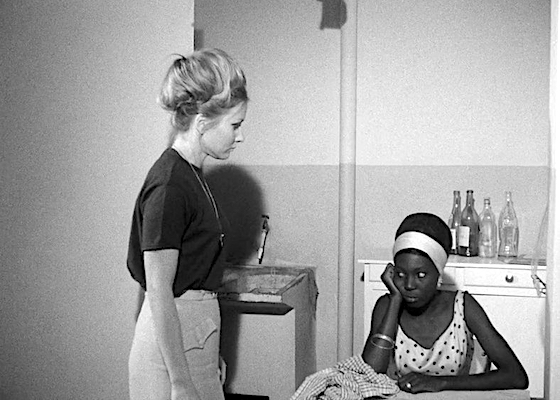
White bitch

The key to how I interpreted the film is to realise that Diouana is more than upset — she’s depressed. Taken as a portrait of Diouana’s failing mental health, the film makes much more sense to me. Stranded in France with no one but her employers — thus, no one she can talk to honestly — her thoughts spiral round and round in her head, sinking lower, like some kind of self-fulfilling negative prophecy. It also made me wonder if we should consider Diouana an unreliable narrator. Almost the whole film is presented from her perspective, much of it via her thoughts in voiceover. So, for example, we’re told a lot about how bad her employer is before we see any sign of it; and we’re told what she was promised about France, but we never see those promises being made. Could it be she was offered to go to France, which she interpreted it as “you’ll get to see France”, but her employer never actually promised that? We don’t see the offer being made; we only have Diouana’s word for what she was promised.

Going back to my opening clarification, I appreciate that this kind of analysis might lead some to accuse me of unconscious racism — as a white person, thinking the black character might be lying and the white people are alright really, despite the evidence. But I’m not saying they are alright — they’re clearly not treating Diouana with as much humanity as she deserves — and I’m not saying she is lying, just that the film doesn’t give us hard evidence to confirm it; we only hear her memory of events. Even then, I wouldn’t say she was “lying”, just that she’d misinterpreted the situation.

Personally, that’s the only way what unfolds makes sense to me: that Diouana is misunderstanding things due to being mentally unwell. This is most relevant in how the story ends, with Diuoana taking her own life as her only route of escape — but, also, it’s the first route she takes. She doesn’t try to speak to her employers and improve her situation. Okay, maybe they wouldn’t listen, or she thinks they wouldn’t — it’s understandable not to even try under those circumstances. But she also doesn’t ask to be sent home. There’s no reason to think they wouldn’t agree to that — they’re not actually imprisoning her. They might not be pleased about it — they’ve brought her with them to do a job she was employed to do, after all — but that doesn’t mean they wouldn’t agree. Even if she thought they were holding her captive, she doesn’t attempt to escape. Sure, she’s in a foreign country and doesn’t know who to turn to — escape might not be easy — but it’s an option that doesn’t seem to cross her mind.
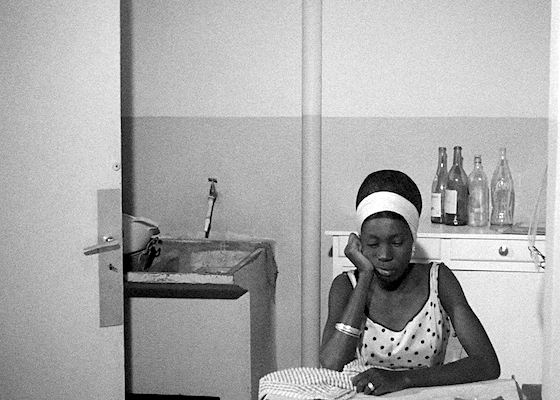
Just upset, or clinically depressed?

No, instead of any of that, she turns straight to death. As I see it, that’s the ‘logic’ of someone who’s mentally ill. That’s not someone who is merely unhappy with their situation and decides it needs to change; that’s someone who is mentally unstable and makes a bad choice. If she was genuinely enslaved — if her life was abusive and miserable and there was genuinely no other way out— then you could make an argument that, in those circumstances, taking your own life is a viable choice for escape. But that’s not the situation she’s in. Her life is not nice — it’s certainly not what she was hoping it would be — but it’s… fine? Like, other people might be content with that setup, especially if it was only temporary (we don’t know how long they’ve been in France, but the implication is weeks or a couple of months, at most; and it comes up that they might just go back to Dakar soon anyway). But instead of waiting it out, or asking to change it, or asking to leave, or running away from it, Diouana goes directly to the most final option.

Now, maybe I’m projecting a modern understanding of mental health onto the film; but the alternative (that we’re supposed to think Diouana is wholly in the right and her actions are reasonable given the circumstances) doesn’t add up for me. This also raises the question of authorial intent: was Sembène intending to explore mental health, or was he focused on racism and colonialism? I haven’t read any direct statements from him, but certainly most critics assume the latter. Normally I’m happy to write off authorial intent (“death of the author” ‘n’ all that), but I think authorship is particularly important in this case (being that it’s the first film by a black African director about the black African experience). To be honest, I don’t know for sure what he was intending — I haven’t seen any direct statements by Sembène — but the film as a whole is well-made, nicely shot and intelligently constructed (for example, using flashbacks for a nonlinear narrative), with characters who seem plausible rather than caricatures in aid of a political point. All of which is a roundabout way of saying that I think it stacks up as a psychologically-accurate depiction of someone in that situation, whether it was consciously made to be about mental health or not.

4 out of 5

Black Girl is the 7th film in my 100 Films in a Year Challenge 2023. It was viewed as part of Blindspot 2023.

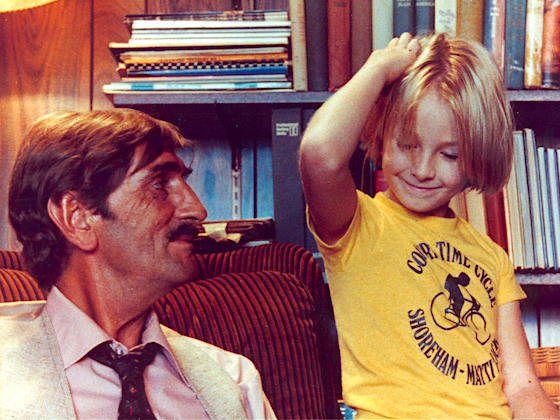
Paris, Texas (1984)

Wim Wenders | 146 mins | digital (HD) | 1.66:1 | Germany & France / English | 12 / R

Paris, Texas

This was my first experience of a Wim Wenders film, so I wasn’t quite sure what to expect, other than knowing it’s an acclaimed classic that features on many “great movies” lists (albeit usually a bit further down than many of the most famous “great movies” on such lists).

It starts out almost Lynchian, with a man, Travis (Harry Dean Stanton), wandering out of the desert. Where’s he been? How long’s he been there? No one knows. He ends up in the care of a quirky doctor in the back of beyond — it’s not even your typical American “small town”, but a trailer and a shack in the middle of nowhere. Then his brother (Dean Stockwell) comes to get him, and it becomes a bit Rain Man (a film released four years later, so certainly not an influence) as two estranged and mismatched adult brothers embark on a cross-America road trip because one of them objects to flying. Then they get home, and it becomes a domestic comedy-drama about an absent father trying to reengage with his preteen son, Hunter (Hunter Carson). And then they go off in search of the boy’s mother, Jane (Nastassja Kinski), and it becomes something else again… It almost circles back round to Lynchian, in fact, with a couple of extended sequences in a surreal, almost otherworldly place of work.

But to keep calling it “Lynchian” is to do Wenders’ work a disservice, because it’s not a copy — indeed, in 1984 Lynch was releasing his Dune, and had yet to embark on most of the films that define “Lynchian” for us. An alternate comparison might be the Coen brothers, at least for the opening section: it’s of a piece with their heightened worlds (the weirdo doctor living in the middle of nowhere) and semi-outlandish stories (Travis reappearing from nowhere). But this was released the same year as the Coens’ debut, Blood Simple, so, again, it’s not exactly a fair comparison. Or if it is fair, it’s backwards: if anyone influenced anyone, it would be Lynch and the Coens drawing on Wenders.

Father and son

Setting simple (and kinda inaccurate) comparisons aside, in parts this is a magnificent film. The scene where Travis and Hunter walk home after school ‘together’ borders on magical; a truly superb sequence of father-son bonding. The bit where we first enter Jane’s place of work feels like descending into some previously-unknown alternate world that exists adjacent to our own (as I say: Lynchian). Then the ‘conversations’ with Jane through the oneway glass, especially the first one, are subtly powerful in how they’re shot and performed. When it works, this is a striking, memory-searing movie.

But then, overall, I found it kinda… not slow, exactly — and I couldn’t necessarily point at which bits I’d cut — but I did wonder if it might benefit from being tighter. Especially the first hour or so, which is mainly about Travis and his brother in a way that doesn’t ultimately feel too relevant to what the film really wants to dig into, which is Travis’s relationships with his son and ex-wife. Of course, his relationship to his brother is adjacent to that, but it’s not as vital. That portion of the film does serve to build up mystery and delay certain revelations, but I wonder if the film wouldn’t be just as effective if that section were pared back somewhat. Apparently filming started without a completed screenplay, the intention being to film in story order and write the ending when screenwriter Sam Shepard had an understanding of how the actors were portraying the characters. That methodology might explain why the narrative shifts and changes so much, I think.

Through all of this, the film really rests on the shoulders of Harry Dean Stanton. Even when he’s initially taciturn, it’s clear he’s the man to watch; the enigma we must solve. And when we finally learn his history — which is completely at odds to the calm, composed, quiet man we’ve followed throughout the film — it’s… well, I’m not sure what it is. Not necessarily what I was expecting; and yet, what was I expecting? Part of the point of the whole thing, surely, is how much he’s changed, and how that facilitates his final choices. But then, his choices seem based in the man he was, not the man he’s become, so is he right? Maybe; maybe not. I suppose there’s stuff to debate and talk about here, which is often a signifier of a Great Movie.

An adjacent world?

As to that, I won’t be adding it to my personal favourites pile right now. But it’s a fascinating, at times incredible, film. I can understand its appeals to a certain kind of cinephile.

4 out of 5

Paris, Texas was re-released in UK cinemas at the end of July by Curzon, with the UK debut of a 4K restoration (which is the version I watched. It looks good). There are still some screenings going on, and it’s available to stream on Curzon Home Cinema for £3.99. If you prefer your films free, it’s also on All 4 until the middle of September, but I don’t know if that’s the new restoration or not.

I do know it was the 40th film in my 100 Films in a Year Challenge 2022, and was viewed as part of Blindspot 2022.

Portrait of a Lady on Fire (2019)

aka Portrait de la jeune fille en feu

2019 #137
Céline Sciamma | 122 mins | cinema | 1.85:1 | France / French & Italian | 15 / R

Portrait of a Lady on Fire

Now, here’s a film I really need to see again. Not to affirm whether I liked it or not — in fact, I loved it; enough to rank it the #1 film I saw in 2019 — but to fully assess and analyse and process it. This admission is not the best way to begin a review — reviews are meant to be assessment and/or analysis, after all — but, nonetheless, it indicates the kind of effect I felt from the film.

What is that effect? In my best-of-year piece I said it was “the kind of film that casts a spell”, by which I’m referring to how it sweeps you in; how it engages you in such a way that you’re just experiencing it, almost with analytical functions switched off; or if not “switched off”, turned down low enough so as not to be a distraction. Maybe this is how ‘normal people’ see all films, but as someone who actively studied cinema for six years and has spent nearly a decade-and-a-half reviewing every new thing he sees, it’s rare to find something so engrossing that the mental deconstruction while viewing stops almost entirely. That — in its own, somewhat ephemeral way — is as good a testament to the film’s power and quality as any.

Of course, to say it turned off my analytical brain entirely is not completely truthful — this is a long way from a Michael Bay-esque “leave your brain at the door” kind of entertainment. What I mean, I suppose, is that I was engaged more purely by the characters and their story, rather than becoming distracted by pondering the filmmaking choices or structural decisions or acting ability or what have you. (The difference here is perhaps a fine line to quantify, I grant you. If you’ve ever studied film in an academic context, I hope you’ll know what I mean. If you haven’t, I’ve done my best to convey some of the difference.) In this instance, I’m thinking specifically of the film’s leanings towards a sense of Gothic. This element isn’t overt — as it is in, say, Crimson Peak — but it is there, and so my analytical brain was ‘on’ enough to spot that and think it through. while watching. I mean, I’m not claiming that I’m some genius for getting it — there’s a bloody great apparition that’s presented like a key to unlock this facet of the film — but, even with that pointer in hand, it’s not an out-and-out traditionally Gothic tale.

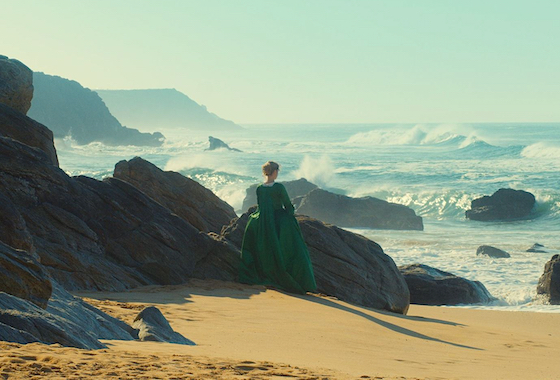
Oh I do like to be beside the seaside

Here I’m not talking about Hammer-like ‘Gothic horror’ but ‘Gothic Romance’ (see my Crimson Peak review if you need a refresher on the difference), and ‘romance’ is an even more operative word for Portrait of a Lady on Fire as it’s about two women who realise they’re in love. That realisation takes a while to manifest, so if you’re a total spoilerphobe then you might argue I’ve just ‘ruined’ the movie; but eh, it’s kind of the point (just look at all the publicity materials!) Much has been made of the fact that it’s a lesbian love story told with the female gaze, as writer-director Céline Sciamma is, indeed, a woman. This is not an insignificant factor, but also not one I feel massively qualified to discuss in depth. I do think the way the relationship is handled and depicted comes with a different perspective than you’d expect if there was a man in the director’s chair, though. It’s not so simplistic as the attitude to sex and nudity, though that is part of it (such scenes are not shot with the same lasciviousness you might expect from a male hand on the tiller) — it’s the overall attitude and focus. Plus subplots, including a significant one with a maid, the delve into Women’s Issues with a level of understanding that, again, might be different under a male director.

The notes I made for myself when I saw the film back in November are frustratingly brief. They include “the music!” and “the sound!”, so let’s take a moment to acknowledge that they are clearly striking elements, while also damning my memory for embarrassing me by not remembering many specifics. That said, the film’s use of music is deliberately sparse, for reasons connected to the story, and so when it is used it’s all the more effective. For some reason my notes don’t mention the cinematography, but maybe I thought that went without saying. It looks gorgeous, with cinematographer Claire Mathon enacting a painterly regard for composition and colour that is wholly appropriate. The rest of my notes conclude with a request: “all the awards for Adèle Haenel please”. Which is to do no disservice to her co-star Noémie Merlant — the film is about their relationship, and so its quality rests on both their shoulders — but in some respects Haenel has the more obvious journey and change.

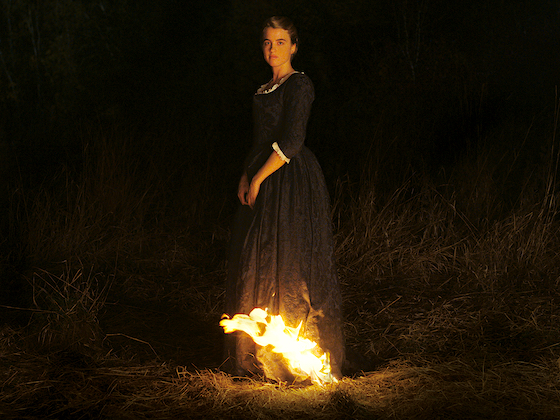
This girl is on fire

The story comes to a head in a moment near the end which made me well up inside. It’s a visual clue that I spotted just ahead of most of the audience I saw it with — I don’t wish to sound boastful here, because I certainly wasn’t the only one even just in that room to spot it ‘early’, but it meant I could also enjoy the audible gasps when the remainder saw it a moment later. My point being: it’s the kind of moment that can provoke an involuntary vocalisation of surprise and delight, and it’s not just me it worked for that way.

I appreciate that this is another vague kind of appraisal. I feel like I want to abandon a lot of this review and just scream “see it, then you’ll know everything I want to say and everything I feel!” But, of course, art and criticism don’t work like that. You won’t experience the film the exact same way I did, even if I could tell you exactly what I experienced and thereby influence your own experience. And there are even people who dislike this movie, which couldn’t be more opposite to my experience (one of the specific criticisms I’ve seen is that it’s slow, and while it’s true that it moves at a very particular pace, I thought it was just right). But, in the end, that is what this review is for: to urge you to see it, because it is a beautiful, absorbing, moving piece of art.

5 out of 5

Portrait of a Lady on Fire is in UK cinemas and on Curzon Home Cinema from today.

It placed 1st on my list of The 15 Best Films I Saw For the First Time in 2019.

Persepolis (2007)

2018 #27
Marjane Satrapi & Vincent Paronnaud | 92 mins | streaming (HD) | 1.85:1 | France & Iran / English | 12 / PG-13

Persepolis

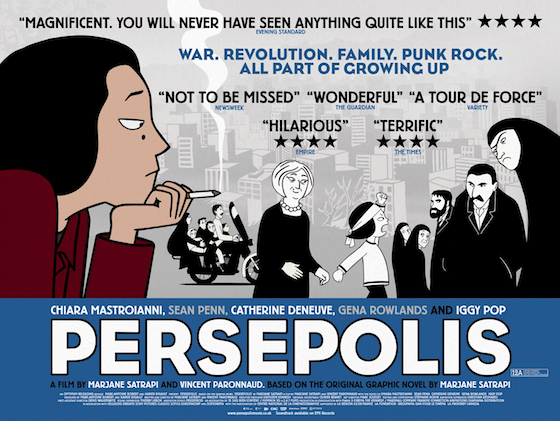
Adapted from co-director Marjane Satrapi’s autobiographical graphic novel, Persepolis is the story of an Iranian girl coming of age in the ’70s and ’80s, during and after the Iranian Revolution. Such a broad description is probably the only way to succinctly summarise it, because it’s kind of a sprawling film, about many different things — just like a life, I suppose. As well as being part biography, it’s also part history lesson, with a normal-family’s eye-view of the revolution and what followed.

Some of the events we’re shown are crazy-specific to her life (Satrapi has certainly lived a life!), and some of it is very specific to her background (i.e. all the Iranian Revolution stuff), but some of it is also very universal. For example, a sequence where she falls in love with a guy sees him depicted as a perfect, angelic boyfriend that she spends many magical times with… until he sleeps with someone else, then when she reflects on their relationship he’s an ugly ogre, and all those wonderful memories have a rotten mirror. Plenty of us have been through something akin to that, right?

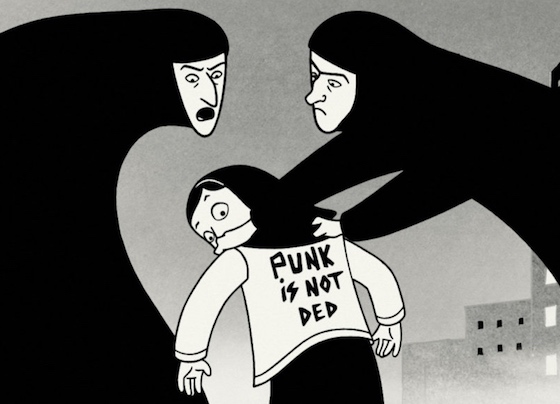
Such subjective depictions are one of the benefits of the film being animated. Drawn in a simple, cartoonish style and mostly presented in black-and-white, the visuals are striking and sometimes very effective, but can also have something of a distancing effect — the atrocities of the revolution don’t hit home in quite the same way when, say, they’re executing a black-and-white cartoon rather than a real girl. Conversely, it was Satrapi who insisted on adapting her novel in animated form, with the goal of keeping it universal — in her opinion, “with live-action, it would have turned into a story of people living in a distant land who don’t look like us. At best, it would have been an exotic story, and at worst, a ‘Third-World’ story.” I suppose there’s some truth to that.

Punk is probably ded in Iran

I believe the film was produced in French, but the copy I had access to only offered the English dub. Unfortunately, this is frequently quite poor — the actors sound like they’re reading out slabs of text as quickly as they possibly can, rather than really delivering the lines. I can only presume this was necessary to fit the animation, but the end result leaves the audio feeling like a bad school presentation. I don’t hold this against the film itself, but it’s a word of warning if you have a choice of audio.

Persepolis is only an hour-and-a-half, but it’s a long one thanks to the scope of what it covers. It’s a frequently dark and bleak film too, taking in not just a violent revolution but also things like depression and attempted suicide. Frankly, it’s the kind of film which I don’t know if I’ll ever bother to watch it again, but it’s also a fascinating and informative experience that I’m unquestionably glad I’ve seen.

4 out of 5

My Life as a Courgette (2016)

aka Ma vie de Courgette / My Life as a Zucchini

2018 #3
Claude Barras | 66 mins | streaming (HD) | 1.85:1 | France & Switzerland / English | PG / PG-13

My Life as a Courgette

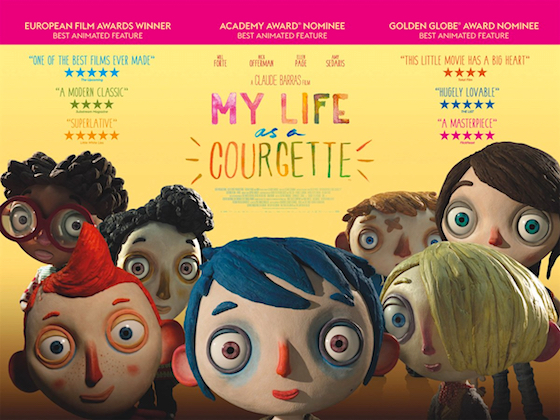
My Life as a Courgette (or, to use the American name for the vegetable, Zucchini) is the story of young lad Icare — who prefers to be called “Courgette”, his mother’s nickname for him — and his life after he is taken into an orphanage. If you’ve heard of it, it’s most likely because it was nominated for Best Animated Feature at the 2017 Oscars.

It’s adapted from the novel Autobiographie d’une Courgette by Gilles Paris, which was apparently a realistic portrayal of the lives of orphans in France. As you can see, the film takes a more cartoonish style, at least on the surface. In fact, the whimsical production design belies the very serious nature of the story — it’s not as monumentally grim as it could be, given the subject matter, but it doesn’t shy away from some very dark areas. It handles these with an understated, calm maturity that is both befitting and refreshing. The animation itself is equally sophisticated, with innumerable little touches that add finesse and richness to the work.

Orphaned

I watched the English dubbed version, because Amazon Prime gave me no choice (the original French version is available on Amazon Video, but for some reason not also included with Prime). Fortunately, despite having a US voice cast, they stuck with “Courgette”, meaning there’s no constant annoyance of the main character being called the wrong thing. (I do wonder, though: did they have to record it all twice, or did the American release rename the film My Life as a Zucchini but then call the kid Courgette anyway?) Fortunately, the dubbing wasn’t at all bad. Of particular note is Nick Offerman, giving a remarkable restrained performance as the gentle and kindly cop Raymond. As for Courgette and his fellow orphans, I don’t know if they cast actual kids or used adult soundalikes, but they also provided uniformly strong voice work.

My Life as a Courgette is one of those “weird foreign animations” that often manages an Oscar nod but doesn’t stand a snowball’s chance in Hell of winning thanks to the conservativeness of Oscar voters — there’s no way a mature, restrained animation with a quirky visual style is going to beat the latest shiny-CGI fun-time from Pixar or Disney. For those with broader tastes, however, it’s definitely worth a look.

4 out of 5

Long Way North (2015)

aka Tout en haut du monde

2017 #33
Rémi Chayé | 78 mins | streaming (HD) | 2.35:1 | France & Denmark / French | PG / PG

Long Way North

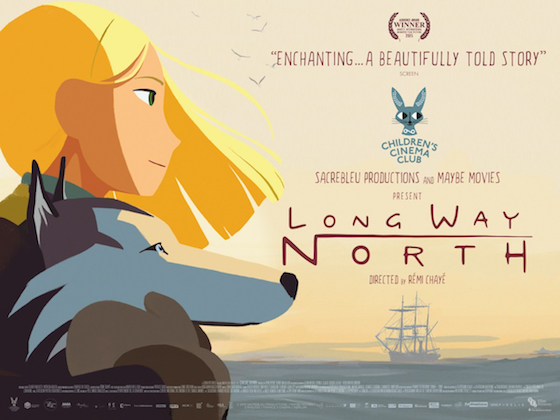
I can’t remember what brought this French-Danish animation to my attention, but I’m glad something did because it’s a beautiful little film that deserves to be better known. Set in the late 19th century, it’s about a young Russian girl, Sasha, who embarks on an adventure to the North Pole, following in the footsteps of her missing grandfather.

Regular readers may recall I ranked it among the top movies I saw last year, when I cited the “understated beauty in its deceptively simple visual style”. Indeed, the animation initially seems so plain that it feels like watching a draft animatic, but that conceals its ability to reveal subtleties when needed. In the end, the distinctive look is part of the film’s considerable charm.

I also mentioned its “equally subtle but strong feminist streak”, another positive aspect. Sasha is strong-willed and capable, but not without her faults, which makes her an engaging heroine. The film doesn’t overplay its “girls can too” side, which only makes it more successful, I think.

There’s none of the epic action sequences or broad humour that most English-language animation assumes kids need to keep them engaged, but instead Long Way North offers good characters on a proper old-fashioned exploration adventure. Highly recommended.

5 out of 5

Long Way North placed 13th on my list of The 17 Best Films I Saw For the First Time in 2017, which can be read in full here.

The Love Punch (2013)

2018 #7
Joel Hopkins | 94 mins | streaming (HD) | 2.35:1 | France & UK / English | 12 / PG-13

The Love Punch

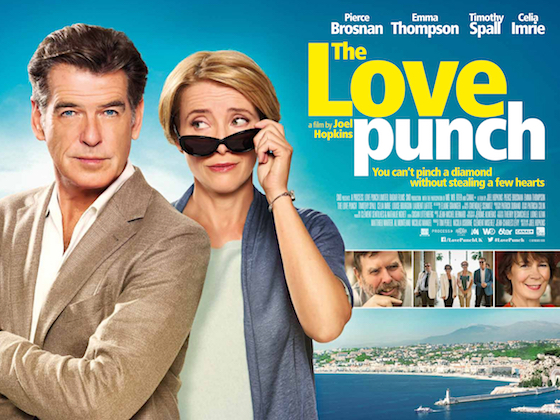
In this very daft comedy heist thriller (calling it a thriller is a bit of a stretch, but anyway), Pierce Brosnan plays Richard, a businessman whose company is bought out by mysterious others, only for them to strip its asset and sink the employees’ pensions — as well as that of Richard’s ex-wife, Kate (Emma Thompson). When the man behind the buy-out, Kruger (Laurent Lafitte), refuses to play fair, Richard and Kate team up with their neighbours, Pen (Celia Imrie) and Jerry (Timothy Spall), to pilfer the extraordinarily expensive diamond Kruger has bought his fiancée (Adèle Blanc-Sec’s Louise Bourgoin).

The Love Punch flirts with seriousness in its setup — what could be more current than unscrupulous moneymen buying a company and screwing over people’s pensions? — but quickly reveals its true nature as an implausible farce. Despite the lead cast, it seems to have been a French-driven production (even the UK-set scenes were filmed over there), so I suppose that style is only appropriate. While never scaling the heights of genuine hilarity, I don’t imagine anyone thought they were making anything other than a light romp.

So if you like any (or all) of Brosnan, Thompson, Imrie, and Spall, as well as the idea of a bit of gently-farcical gadding about in the south of France, then The Love Punch is amiable fluff to while away 90 minutes on a Sunday.

3 out of 5

Review Roundup

In today’s round-up:

  • Partners in Crime… (2012)
  • Charlie Bartlett (2007)
  • Florence Foster Jenkins (2016)


    Partners in Crime…
    (2012)

    aka Associés contre le crime… “L’œuf d’Ambroise”

    2016 #189
    Pascal Thomas | 105 mins | streaming (HD) | 1.85:1 | France / French & Italian | 12

    Partners in Crime…

    André Dussollier and Catherine Frot star as Agatha Christie’s married investigators Tommy and Tuppence (here renamed Bélisaire and Prudence) in this third in a series of French adaptations of Christie stories (best I can tell, the first two aren’t readily available in English-friendly versions).

    Based on the short story The Case of the Missing Lady, it sees Tommy and Tuppence Bélisaire and Prudence investigating the disappearance of a Russian heiress at a suspicious health farm, while also quarrelling about their relationship. It’s very gentle comedy-drama, even by the standard of Christie adaptations, with a thin mystery, thin humour, and thin character drama, which all feels a little stretched over its not-that-long-but-too-long running time. I shan’t be seeking out its two antecedents.

    2 out of 5

    Charlie Bartlett
    (2007)

    2017 #9
    Jon Poll | 97 mins | streaming (HD) | 1.85:1 | USA / English | 15 / R

    Charlie Bartlett

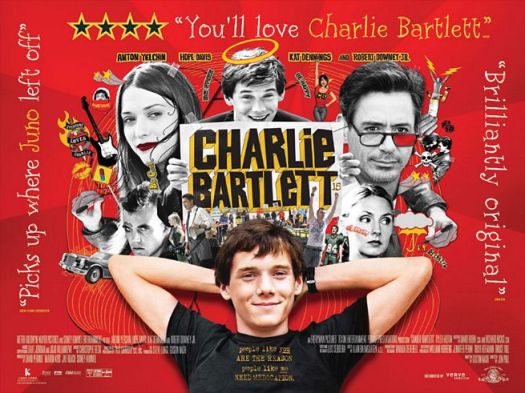
    Anton Yelchin is the eponymous rich kid trying to fit in at a regular high school, which he does by becoming an amateur psychiatrist to his classmates, in a comedy-drama that plays as the ’00s answer to Ferris Bueller. It starts out feeling rather formulaic and predictable, running on familiar high school movie characters and tropes, but later develops into something quite emotional. It’s powered by excellent performances from Yelchin and Robert Downey Jr, as the school’s unpopular and unprepared principal.

    4 out of 5

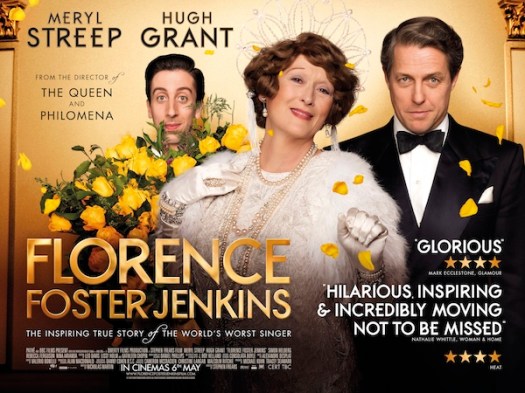
    Florence Foster Jenkins
    (2016)

    2017 #34
    Stephen Frears | 106 mins | streaming (HD) | 2.35:1 | UK / English | PG / PG-13

    Florence Foster Jenkins

    Try to ignore the fact Meryl Streep nabbed an Oscar nomination away from someone more deserving (for example, Amy Adams. Well, no, definitely Amy Adams), and she gives a good turn as the titular society lady who couldn’t sing for toffee but thought she was fantastic, and used her wealth and influence to launch a concert career. She’s only enabled by her doting… assistant? Lover? Husband? You know, the film blurs that line (deliberately, I think) and I’ve forgotten what he was. Anyway, he’s played by Hugh Grant, who is also good.

    It’s a gently funny comedy, as you’d expect from the subject matter, but one that reveals a surprising amount of heart and depth through Florence’s attitude to life, as well as how her men (who also include The Big Bang Theory’s Simon Helberg as the third lead; also good) attempt to care for her needs.

    4 out of 5

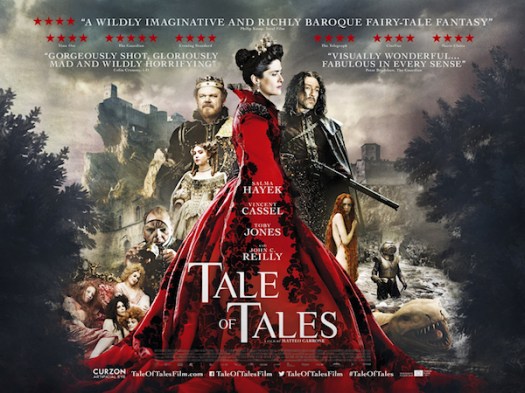
  • Tale of Tales (2015)

    aka Il racconto dei racconti

    2016 #148
    Matteo Garrone | 134 mins | streaming (HD) | 2.35:1 | Italy, France & UK / English | 15 / R

    Tale of Tales

    Based on 17th Century Italian fairytales by Giambattista Basile, Tale of Tales relates three interlocking stories of dark fantasy. If there’s one thing that really connects them, it’s thematic: essentially, “be careful what you wish for”; or maybe “be grateful for what you’ve got”. There are primary characters in each tale who go to disgustingly extraordinary lengths to achieve what they desire — eating a sea-monster’s heart raw, breeding a giant flea, self-flaying — and it rarely turns out for the best.

    If you can stomach the contents, there’s a quality cast, and the locations, production design, and cinematography are simply gorgeous.

    4 out of 5

    The Transporter Refuelled (2015)

    aka The Transporter Refueled

    2016 #166
    Camille Delamarre | 96 mins | streaming (HD) | 2.35:1 | France, China & Belgium / English, Russian & French | 15 / PG-13

    The Transporter RefuelledI kind of knew The Transporter Refuelled was going to be bad before I even began, but I watched it anyway because, well, I watched the first three Transporter movies and I really liked one of them, so… It’s just the completist in me, really; though why I was able to ditch Transformers when they semi-rebooted after three films and not this I don’t know. Possibly because the Transporter films have never been good, just entertaining trash, and even though Refuelled’s acting looked terrible and I can’t even remember if the trailer gave any indication of the plot, if it had half-decent action scenes then I’d be passingly happy for 90 minutes of entertainment (unlike Transformers 4, which runs the best part of 3 hours).
    So imagine my surprise when, actually, I rather enjoyed it; way more than I probably should have, in fact. I mean, whenever it slows down for some plot or (especially) character stuff, it begins to go awry; but the action is pretty good, with some impressive car stunts and some neatly choreographed punch-ups. That’s all I expect or want from a movie like this, really, and even though it may not be an exceptional example of the form, the fisticuffs entertained me. I’ve certainly seen far worse. It helps that the over-reliance on CGI seen in the second two Statham instalments has been tempered. It’s still used to make us think the actors are in the actual car when they’re clearly on a soundstage, but all the flips and crashes look to have been done for real. Director Camille Delamarre previously edited several EuropaCorp movies, including Transporter 3, Colombiana, and Taken 2, and consequently he seems to know his way around an action sequence.

    Like father like sonUnfortunately I wasn’t wrong about the acting, which is indeed pretty shit. Ed Skrein was truly dreadful in Game of Thrones (until he was thankfully recast) but was passable as the villain in Deadpool. As this film’s Statham-replacement hero he charts a course somewhere between those two stools. The supporting cast aren’t much better, with the notable exception of Ray Stevenson as Skrein’s dad, who brings much fun whenever he’s on screen. If anything makes Refuelled work as entertainment away from the violence, it’s the father-son dynamic. I want a sequel just to get another dose of that.

    Sadly, poor critical reception may have scuppered this attempted reboot at the first hurdle. True, we don’t need more Transporter movies, but they provide a kind of simple but well-made action charm that sometimes hits the spot. I’d say Refuelled is more-or-less as good as any of its franchise brethren.

    3 out of 5