
Adam Wingard | 89 mins | streaming (HD) | 1.85:1 | Canada & USA / English | 15 / R
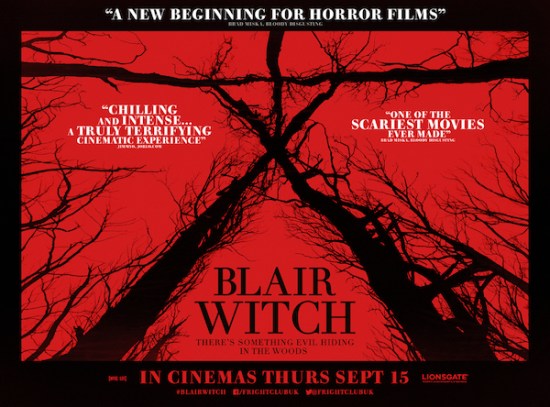
Twists in movies come in all shapes and sizes, but rarely do they come in the marketing. This latest film from the writer-director team behind You’re Next and The Guest was initially promoted as The Woods, only for its true name to be revealed at the first public screening. Quite neatly, during said screening they switched all the posters in the lobby for ones featuring the real title. It’s a shame it wasn’t possible to give every viewer that “oh shit, it’s a sequel to The Blair Witch Project!” surprise, because it’s probably the most interesting thing about the film.
Set however-many years after the original movie (and ignoring the first sequel, just like the rest of us have), it’s about the younger brother of one of the original missing documentary-makers, who comes to believe that his sister is still alive, somehow, in those woods, all these years later. So he sets out with a couple of friends to investigate, and of course one of them documents it, using all sorts of cameras — handheld, body mounted, even a drone. So, yes, this is once again a found footage movie. Well, they are all the rage.
In fairness, the first Blair Witch was the father of found footage, so it only makes sense to retain the form. However, I’d argue that everything that worked about the original movie did so because of how it was filmed — that the cast had been put in that situation ‘for real’ and the filmmakers were fucking with them. It gave it all a rough plausibility, which is largely what made it scary. Conversely, this Blair Witch feels scripted and constructed from the off. That’s fine for most movies, even found footage ones, but here it stands in sharp contrast to how the original worked, and I think it undermines this movie. Almost everything feels inevitable, and you know all the important stuff will be captured on camera (at least one major stunt in the original film was missed because the scared actors didn’t happen to point the camera at it).

As a horror movie, it does achieve moments that are kind of scary, but they’re undercut by a certain obviousness. I mean, of course a deserted house in the woods is scary when you know there’s a murderous witch inside and you’re limited to seeing it only from one character’s torchbeam-lit perspective. The whole movie is powered by similarly cheap jump scares: friends creeping up on each other; cameras glitching whenever they’re turned off; or, indeed, on — that kind of thing. The only genuinely terrifying bit, at least to me, was a final-act crawl through an underground tunnel. This is not a good movie for claustrophobics. And it only gets worse when you learn they made the actress do it for real.
In some ways Blair Witch is just a remake — a bunch of young people running around in the woods from something scary that we don’t see. Early on it seems like it will bring something interesting to the party with its use of new technology to update the concept: whereas in the original they had one simple video camera, here there are ear-cams with GPS, webcams they can mount in trees, even a drone. Sadly, none of these contribute anything except more angles for the editor to use. Plot-wise there’s a shiny new twist, though I wonder how many people guessed it a long time before the end. Credit to the filmmakers for not overplaying it — it’s there just to be noticed; it’s not highlighted when it’s revealed — but I was so expecting it that such credit doesn’t get them far.

According to, er, themselves in their commentary track, director Adam Wingard and screenwriter Simon Barrett actually had a lot of interesting ideas about and explanations for the inexplicable stuff that’s going on in the movie. Unfortunately, they buried these notions so deeply in the finished work that it feels as if they’re not there at all; and now there’ll be no sequel to expound upon them, and the guys were in such a bitter mood when they recorded the commentary (within days of the film being a critical and box office flop) that they don’t explain them, apparently out of spite. Well, I guess we’ll have to take their word for it, then.
Maybe if they had bothered to explore the implications of their new tossed-in ideas then there’d be something to appreciate here, but instead it’s just 80 minutes (and it feels longer) of shaky footage of people running around in the dark. I suppose that, as a horror film, some of it works in the most literal sense of being scary in the moment. But it doesn’t feel earned; it doesn’t feel like it’ll be haunting me later, in the way the most effective horror movies do — in the way the ending of the first Blair Witch did.

Blair Witch will be available on Netflix UK from tomorrow. It’s also currently available to rent on Amazon UK at a discount for Prime members as part of Prime Day.
 After a sidestep into big-budget director-for-hire movies that brought him even less acclaim than his last couple of self-penned efforts, once-fêted director M. Night Shyamalan goes back to basics with this low-key found-footage horror.
 Of course, there’s a big reveal to explain everything that’s been going. People call it a “twist” because it’s a Shyamalan movie, but it’s more of an explanation. I mean, what was going on had to be explained somehow, and the explanation comes at the point where you’d expect the explanation to be. I’m not saying it’s not a twist, because it does change what you think you’ve been seeing, but it’s also not a be-all-and-end-all kind of failed-rug-pull, which Shyamalan’s worst twist-obsessed efforts have been. This one works. Or, it did for me.
 I don’t think anyone paid writer-turned-writer/director David Ayer much heed when he was one of a pack of people penning historically-inaccurate submarine thriller
  it would wash as a stylistic choice; because he attempts a diegetic explanation for why it’s shot this way, but then breaks the rules of that explanation instantly (and continues to do so, with increasing frequency), it turns a valid stylistic choice into an irritating, ill-thought-out distraction. Plus: you want to be innovative and shoot an L.A. cop movie on digital video? Too late! Michael Mann already got there… in 2006.
 Although there are things to commend End of Watch — in particular the performances, and even a couple of tense sequences when the filming style actually pays off — I can’t get on board with it being a best-of-year-type movie. Even if it could’ve been more — and, in spite of that varied CV, isn’t the best thing Ayer’s done (I very much liked his next movie, Brad Pitt WW2 tank movie
 Astronauts head to a Saturnian moon to examine its water in this scientifically-accurate drama.
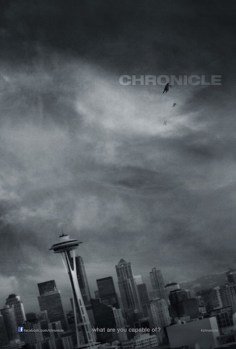 The birth of the “found footage” sub-genre and the resurgence of the superhero movie began around the same time, the former with
 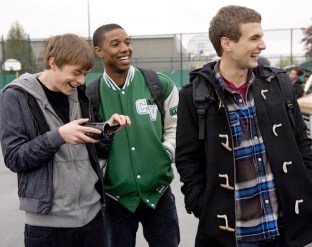 The story sees high school senior Andrew (Dane DeHaan) decide to start filming everything in his life, thanks to his borderline-abusive alcoholic father (Michael Kelly) and terminally ill mother (Bo Petersen). The same day (what a coincidence!), his cousin and only friend, Matt (Alex Russell), takes him to a party where, along with most-popular-kid-in-school Steve (Michael B. Jordan), they discover a hole in the woods with mysteries inside… Days later, all three begin to develop telekinetic powers, which they learn they can levy in various incredible ways — those ways being super, but largely without the heroic…
 This is even more pronounced in the extended version (“extended director’s cut” in the US), which includes over five minutes of extra bits that, in my opinion, make it a superior edit. Some are minor in impact, true, but there are a couple of short sequences with Andrew and Steve that deepen their relationship further, which enriches events at the end of act two. There’s also a moment that subtly prefigures the climax, and an extra bit in said finale that seems nigh-on essential to me. Considering the film still runs (just under) 90 minutes even with these additions, it’s difficult to see why they were cut in the first place. “Pace” is usually the rational for that, but if this is indeed a Director’s Cut then clearly Trank didn’t think they were an issue; equally, I can’t see why Fox would have objected. Still, they’re here to enjoy on Blu-ray…. though not on DVD… and I guess they’re not in TV screenings… Tsk.
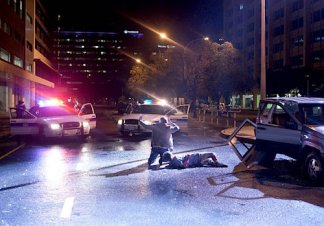 That said, spectacle it has. You wouldn’t expect that from a $12 million found-footage movie, but an epic duel through the streets of Seattle is one of the strongest climaxes to any superhero movie I can remember. It’s kind of like
  In the hands of many a desperate-to-get-noticed filmmaker, a found-footage superhero movie would likely have been a straight-to-DVD affair that could at best be described as “mediocre”. In Chronicle, however, Trank and co have crafted one of the best movies produced in either sub-genre. Most of the people involved — as well as the film they’ve all come from — can be classed as “one to watch”.
 100Films.co.uk