
Guillermo del Toro | 123 mins | Blu-ray | 1.85:1 | USA / English, American Sign Language & Russian | 15 / R

 2018 Academy Awards
13 nominations — 4 wins
Nominated: Best Actress (Sally Hawkins), Best Supporting Actor (Richard Jenkins), Best Supporting Actress (Octavia Spencer), Best Original Screenplay, Best Cinematography, Best Editing, Best Costume Design, Best Sound Mixing, Best Sound Editing.
I still can’t quite believe a creature-feature fantasy romance won Best Picture. It remains surreal to see a genre movie conquer the Oscars like that. Even The Lord of the Rings, for all its so-Fantasy-it-defined-the-genre-ness, has a lot of the “historical war epic” in its form (not to mention the genre-transcending cultural impact that film trilogy had), and so its win seems less striking than this out-and-out monster movie. Naturally, The Shape of Water doesn’t actually conform to the commonly-understood connotations of what a “monster movie” is, and therein lies what makes it something fresh, and therefore Best Picture material.
In fact, even “Fantasy” isn’t quite the right term for The Shape of Water — “fairy tale” is nearer the mark. It begins with voiceover narration talking about a princess as the camera glides underwater into a room where everything is afloat, including a sleeping woman… until everything gradually settles to the floor, an alarm goes off, and she wakes up — and now it’s just a real room. Except, even then, it’s not really real — it’s storybook-real; movie-real. Almost literally, in the sense that her apartment is above an old-fashioned movie palace. It’s a gorgeously designed set, but it doesn’t feel like somewhere someone would actually live — but it’s only just out of kilter, which is part of why it’s so fantastic. In case you missed it up top, the film also won an Oscar for production design, and that was certainly deserved.

Anyway, the woman in question is Elisa (Sally Hawkins), whose reality could hardly be more distant from that of a fairytale princess: she’s working nights as a cleaner at a government facility, wiping up the splattered piss of “clever men”. She’s also mute, communicating via sign language to her friends, coworker Zelda (Octavia Spencer) and down-on-his-luck neighbour Giles (Richard Jenkins). Things change when a mysterious new project arrives at the facility. Well, it’s no surprise to say that turns out to be a… kind of… merman… human/fish… being… It’s accompanied by head of security Strickland (Michael Shannon), who hates its guts and desires nothing more than to inflict pain, and scientist Dr. Hoffstetler (Michael Stuhlbarg), who is more sympathetic, for his own reasons. But it’s Elisa who, almost accidentally, comes to bond and communicate with the creature, in secret; but as their connection grows, she realises something must be done about its predicament.
I’ve read some reviews that berate Shape of Water for its straightforward storyline — I’ve described a fair chunk of the plot just getting to that point of conflict, and you can probably infer much of the rest. But I think such criticisms miss the point. For one thing, it is not fiction’s only goal to shock us with plot twists. There’s more to storytelling than just surprises, and Shape of Water certainly has more to it. For another, it is quite clearly a fairy tale — albeit an adult-minded one — and those go more-or-less one way. And even then, the events that I thought would form the film’s climax happen at the halfway point, so this viewer was at least somewhat surprised.

So what is there instead? Characters, for one. We don’t get too much backstory on any of them — which is interesting, because apparently del Toro wrote lengthy summaries for the main characters, some running to 40 pages, which were provided to the actors to read and use if they wanted. Whether they embraced them or not, they are all well-judged performances. Hawkins, Spencer, and Jenkins got the nomination nods, but it would’ve been equally at home in the hands of Shannon or Stuhlbarg. And that’s not to mention Doug Jones, who conveys the creature’s emotions with physicality and movement alone — aided by superb prosthetic and CGI technicians, of course. But while the film’s primary focus is on the interspecies love tale he features in, each supporting character has their own subplot to help sketch their personality, and provide meaning and resonance to the main story.
That’s where theme comes into it — intricately linked to the characters, because this is all about outsiders and otherness. The fish-man is the most obvious “other”, with Elisa positioned second (as alluded to earlier, she seems to only have two or three friends and acquaintances she can actually communicate with); but there’s also Zelda, a black woman, and Giles, a gay man — and this is ’60s America, making those statuses even ‘lower’. Plus there’s Dr. Hoffstetler, but that would be a spoiler. Suffice to say, his unique predicament is given a more nuanced portrayal than you’d normally find in American media. All of this exists in counterpoint to Strickland, who’s basically the physical embodiment of toxic masculinity. For a film set in the ’60s, with a lot of Cold War overtones — and in a Fantasy environment, with a supernatural romance at its core — The Shape of Water certainly has a lot of timely relevance.

But, while you can hold it up as a mirror to the here and now, it also has a timelessness — like all the great fairy tales, of course. It transcends its ’60s setting and its 2010s production to really be about values of humanity — of acceptance —that are always pertinent. By tucking these messages into a fantasy that is most assuredly aimed at adults (it practically contains a laundry list of “things not suitable for children”), del Toro has given depth and meaning to an outlandish movie that, yeah, fundamentally, as the jokes all go, is about a woman fucking a fish.

The Shape of Water is available on Sky Cinema from today.
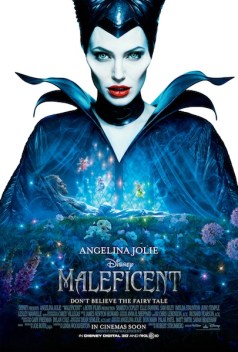 Disney seem to be embarking on a project to remake all of their most beloved animated movies in live action,
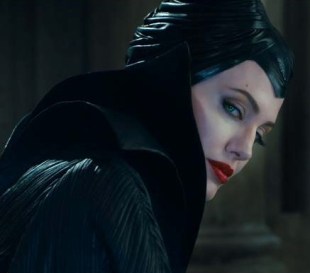 However, this is a Disney movie — you don’t get to turn a villain into the central character and have her be evil throughout. This is where the film gets really revisionist, because Maleficent keeps an eye on cursed Princess Aurora (Elle Fanning) as she grows, doing more to keep her alive than the trio of fairies she’s supposedly in the care of, and her heart is gradually warmed to the girl. Unfortunately, Maleficent was too good at the cursing malarkey: unable to lift her own spell, it plays out regardless, and the film serves us new renditions of the impassable thorns, giant dragon, and true love’s first kiss. It’s in the last where Maleficent is thematically revisionist rather than just a massive rewrite. Your mileage may vary on whether this version is obvious and cheesy, or actually more meaningful and (for the primary audience of little kiddies) more thought-provoking than the original’s — I’d go with the latter.
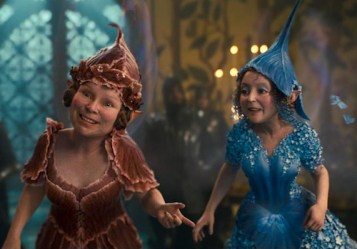 Parts of the film test-screened poorly — mainly the first act, with audiences wondering why it took so long for Jolie to turn up. Consequently, the whole thing was thrown out and reshot; in the process, Peter Capaldi and Miranda Richardson were deleted (and after they’d had to endure hours of transformative prosthetics for their roles, too), and Maleficent was given a new backstory. How far this extended into the rest of the movie, I’m not sure, but at times it feels like stuff has been cut or rearranged. Certainly the story flies past — if it wasn’t trimmed down in the edit, it needed expanding back at the screenplay stage.
 and even
 The word “prequel” was first coined in the ’50s, arguably entered the mainstream in the ’70s, and was firmly established as a term everyone knew and used in the ’90s by the Star Wars prequel trilogy. Works that can be defined as prequels predate their naming, however, and surely one of the earliest examples in the movies must be this silent German horror.
 Regarded as one of the first horror films, The Golem is more of a moderately-dark fantasy, or a fairytale-type myth. There are clear similarities to Frankenstein, though I don’t know if either influenced the other. However, it does feature what I presume is one of first instances of that most daft of horror tropes: running upstairs to escape the monster. It goes as well here as it ever does, i.e. not very. Said monster looks a bit comical by today’s standards. Built by the rabbi to defend the Jewish people, he immediately uses the hulking chap to chop wood and run errands — he doesn’t want a defender, he wants a servant! A terrifying beast nonetheless, it’s ultimately defeated because it picks up a little girl for a cuddle and she casually removes its magic life-giving amulet.
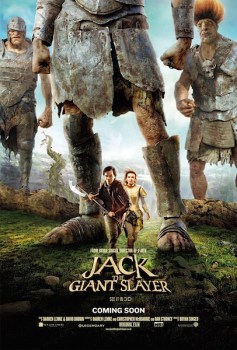 The influence of Peter Jackson’s
 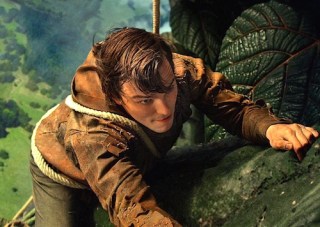 A computer-animated prologue wants to be the one from
 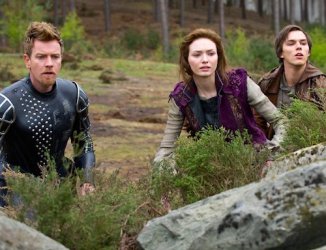 overacted characters, and bright-and-cheerful CGI are more or less acceptable, in a “it’s no classic but it’ll pass two hours just fine” kind of way. Produced on those kinds of terms, this might have passed muster for some. Might.
 So states Geoffrey O’Brien in his essay “Dark Magic” (included in the booklet for
 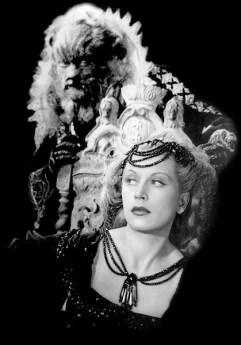 here the characters’ relationships are more complex and ambiguous, particularly at the climax. It isn’t a simple “see the true beauty behind the ugly exterior” moral fable; indeed, if anything, Marais’ Beast is more beautiful than the man he becomes.
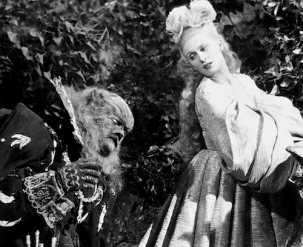 That final idea, of the erotic or sexual in the film, seems a favourite theme for critics: O’Brien reckons “the magic is sexual throughout — a fantastic… sex magic”, and I think we’ll skip Warner’s lengthy discussion of the feelings the film elicits in her. How prevalent such undercurrents are is surely in the eye of the beholder — O’Brien notes that “it is so chaste that no censor could have ever assailed it”, and I suspect many a viewer would feel the same. That said, the soft-lensed scene in which the Beast gently laps water from Belle’s delicately cupped hands may make viewers with a particularly-disposed mind think of certain other acts.
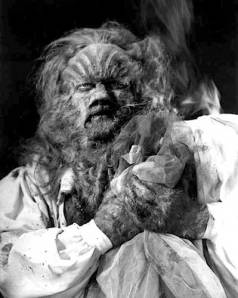 Cocteau was trying to move away from a wishy-washy kind of fantasy — indeed, he says as much in the press book for the film’s US premiere (a piece entitled “Once Upon a Time” and also included in Criterion’s booklet): “To fairyland, as people usually see it, I would bring a kind of realism to banish the vague and misty nonsense now so completely outworn.” In these respects you could probably draw a line from Cocteau to something like
 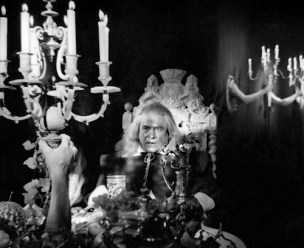 It’s in the Beast’s castle that the most enduring images of the film are played out, most famous among them being Belle’s father’s arrival, with the candles igniting themselves and the hands pointing the way, and Belle’s own arrival, a slow-motion run with billowing dress and curtains — if you haven’t seen the original, you’ve surely seen an advert inspired by it. For all the groundedness Cocteau and co may be bringing to the fantastical, it’s still a strange realm; one rendered with loving beauty in its design and photography, but with an unsettling effect. Right on the money, then.
 Good moral message, but isn’t the “superior” Beast the same fella as Prince Charming? The way a felled Avenant is transformed into the Beast at the same time as Charming is unveiled as a more-perfect duplicate of Avenant (it’s Marais in all three roles, of course) suggests some kind of parallel should be drawn. Warner wonders, “Has the Beast taken on [Avenant’s] appearance because [Belle] admitted to him that she was fond of Avenant?” Could be, but isn’t that a bit simple? She has another theory: “does Cocteau want to suggest that a ne’er-do-well like Avenant can also be transformed by love?” Could it be Avenant is about to get a lesson in how to be a better person, as Charming has already endured?
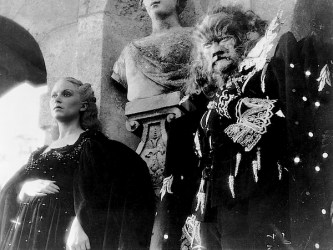 There’s a cheery message to end on. But then, this is “a fairytale for grownups” — a quote from Warner, but, to an extent, it would seem Cocteau agreed (by implication, with his statement at the start of the film urging the audience to embrace child-like acceptance of the story they are about to see) — and the resolutions of grownup stories are rarely “happy ever after”.
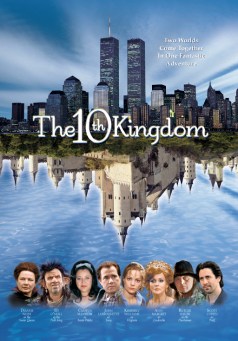 Created by British screenwriter Simon Moore (writer of
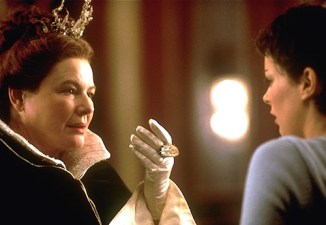
 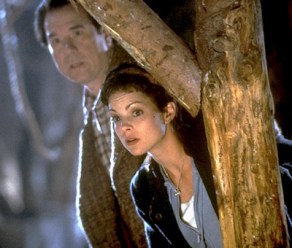 Anyway, the Nine Kingdoms is the place all our fairytales come from — the part of the narrative set there takes place “almost 200 years” after the “Golden Age”, when the events we know from stories actually happened. We’re led into this world by Virginia (Kimberly Williams) and her dad, Tony (John Larroquette), after indolent monarch-to-be Prince Wendell (Daniel Lapaine) flees to our world while escaping the Evil Queen (Dianne Wiest) and winds up taking the two New Yorkers back to his world. Along with Wolf (Scott Cohen), a chap with animalistic tendencies, the quartet try to stop the Evil Queen’s evil machinations.
 It also means the way it’s been edited into one long movie on DVD feels quite natural: it’s one long story with arbitrary breaks, not a series of finite episodes. (If you’re thinking, “of course it’s one story, it’s a miniseries”, plenty of single-narrative series and miniseries still function as discrete episodes that build to a whole.)
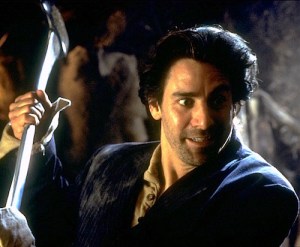 This gives the whole thing a heightened comedy tone, emphasised by many of the performances. A gaggle of troll siblings are irritatingly over-played, but Cohen’s meat-obsessed Wolf is a hammy delight (pun very much intended). The entertainment value means we quickly warm to the characters, so that when more perilous aspects of their quest do come into play later on, we care what happens. Plus, like most of the original fairytales (as opposed to Disney-style sanitised re-tellings), there’s the odd darker undercurrent. For instance, you may think the story of Snow White ends with a kiss and “happily ever after”, but here we’re told how the stepmother who poisoned Snow White was made to wear fire-heated iron shoes and ‘dance’ at the wedding until her feet were burnt raw, before being thrown out into the snow. Very dark and grim (and possibly from the original tale, for all I know).
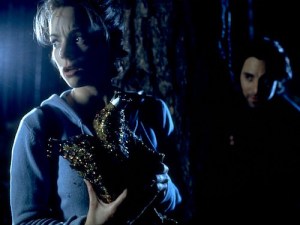 Little details in this vein abound: an apple tree has grown by Snow White’s cottage (don’t eat those apples!); the site of her glass coffin is now a tourist attraction; if you break a mirror, you genuinely get seven years’ bad luck… There’s also a pair of golden shoes that can turn you invisible, but the more you wear them the more you desire to use them all the time — what a precious idea (wink wink nudge nudge). These subversions also manifest in a strain of pleasant practicality; for instance, the abundant magic mirrors aren’t “just there”, but instead have been manufactured by dwarves. It lends the feel of a fully-conceived and rule-bound world, rather than an “anything can happen”, “just because” environment.
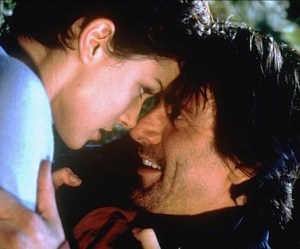 a world away from being locked in a castle until you change your mind. If this sounds like criticism, it isn’t. I’m not arguing the love story element of the series is unsuccessful — I’m sure it engages plenty of fans as the series’ primary attraction, even — but, on reflection, I’m not sure reading it as a Beauty and the Beast variation is actually that illuminating.
 Disney’s 50th animated feature is Rapunzel in all but name, for no particularly good reason. It seemed to be met with universal praise on its release last year, critics hailing it as a return to Disney’s previous quality after a run of lacklustre releases, in particular the underwhelming return to 2D in the year before’s
  a number I usually particularly enjoy. It has one, I suppose, but it’s one of the weakest examples I’ve ever heard.
 You’ve probably heard about Enchanted: it’s the one that starts out as a traditionally animated Disney film, before The Normal Girl Who Will Marry A Prince is thrown into a Magic Portal by The Evil Stepmother and finds herself in present-day New York. It’s one of those concepts so good it just makes you think, “why haven’t they thought of that before?”
 100Films.co.uk