
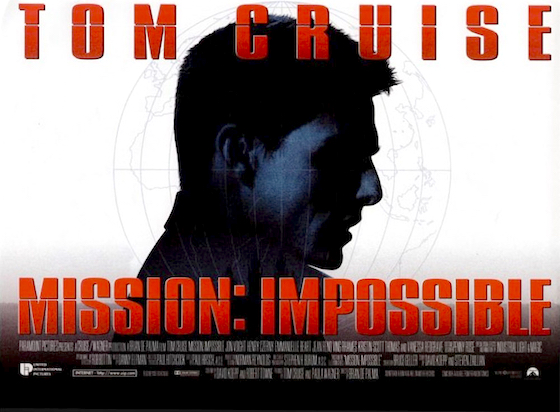
Country: USA
Language: English
Runtime: 110 minutes
BBFC: PG
MPAA: PG-13

Original Release: 22nd May 1996 (USA & Canada)
UK Release: 5th July 1996
Budget: $80 million
Worldwide Gross: $457.7 million
Stars
Tom Cruise (Top Gun, Minority Report)
Jon Voigt (Midnight Cowboy, Superbabies: Baby Geniuses 2)
Emmanuelle Béart (Manon des Sources, 8 Women)
Henry Czerny (Clear and Present Danger, The Ice Storm)
Jean Reno (Léon, Ronin)
Ving Rhames (Pulp Fiction, Dawn of the Dead)
Director
Brian De Palma (The Untouchables, Snake Eyes)
Screenwriters
David Koepp (Jurassic Park, Spider-Man)
Robert Towne (Chinatown, Tequila Sunrise)
Story by
David Koepp (Death Becomes Her, Panic Room)
Steven Zaillian (Schindler’s List, Gangs of New York)
Based on
Mission: Impossible, a TV series created by Bruce Geller.
The Story
When a covert mission goes sideways and the rest of his team are killed, agent Ethan Hunt is blamed for their murder. On the run from his CIA employers, he sets out to prove his innocence and bring the real culprit to justice.
Our Hero
Mission: Impossible may be meant to be a team exercise, but as most of them get killed we’re focused on surviving member Ethan Hunt, an exemplary agent who must figure out what happened and track down who’s responsible.
Our Villain
The CIA man, Kittridge, who thinks Hunt is responsible for killing his team and is determined to bring him in. Of course, Hunt’s innocent — so is Kittridge really behind it all?
Best Supporting Character
Needing a new team, Hunt recruits a couple of disgraced IMF agents. One is Luther Stickell, a stylish computer expert and hacker. Despite his initial doubts, he’ll become one of Ethan’s loyalest team mates.
Memorable Quote
Kittridge: “I can understand you’re very upset.”
Ethan Hunt: “Kittridge, you’ve never seen me very upset.”
Memorable Scene
Ethan and his team need to retrieve a computer file from the only place it exists: a highly secure room in the centre of CIA headquarters. Access is controlled by voice print identification, a six-digit access code, a retinal scan, and a double electronic key card — none of which they have. In the vault itself, security measures include sensors for pressure (anything on the floor sets if off), noise (anything above a whisper sets it off), and temperature (a rise of a single degree sets it off). All of which leaves Ethan with only one option: to lower himself in from the ceiling, staying calm and cool enough not to raise the temperature, while not making any noise — all while hoping the guy who works in the room doesn’t come back. The resulting heist scene is a fabulous bit of suspense moviemaking.
Memorable Music
Danny Elfman provides a good score for the main body of the film, but the shining star remains Lalo Schifrin’s main theme, as iconic a piece of spy-fi music as the James Bond one. The new version featured here wasn’t produced by Elfman, however, but by the less famous half of U2, Adam Clayton and Larry Mullen. It was also released as a single and became a sizeable hit, reaching #7 in both the UK and US charts (where it received a gold certification) and even making it to #1 in some countries.
Technical Wizardry
The main title sequence is a modern do-over of elements from the TV series: a fast cut (even by today’s standards) montage of scenes from the film to come, plus a burning fuse, all scored by that updated version of the peerless theme music.
Making of
Jon Voigt, as pudgy “getting soft in his old age” Jim Phelps, was 57 years old when they made this film. For the new one, Tom Cruise learnt to fly a helicopter so he could do it all himself throughout a major stunt sequence, and actually performed hundreds of tricky HALO skydives for another major sequence, not to mention sundry other bits of running around and jumping off buildings — most of it while recovering from a serious leg injury. He is 55. How times change.
Previously on…
The original Mission: Impossible TV series was a popular and long-running part of the James Bond-provoked spy-fi craze of the ’60s. It was revived for two seasons in the ’80s. Although the film might look like a reboot, it kind of isn’t: there’s supporting material (such as the character bios on the film’s DVD and Blu-ray releases) that reconciles both TV series into the same continuity as the movie.
Next time…
Multiple never-less-than-entertaining sequels, starting with the standalone M:i-2, before becoming increasingly serialised through M:i:III, Ghost Protocol, and Rogue Nation. This summer’s sixth instalment, Fallout, promises to bring them all to some kind of head.
Awards
1 Saturn Award nomination (Action/Adventure/Thriller Film)
1 Kids’ Choice Award nominations (Favourite Movie Actor (Tom Cruise))
1 MTV Movie Award nomination (Action Sequence (for the train-helicopter chase) — it lost to Twister)
1 Razzie nomination (Worst Written Film Grossing Over $100 Million — it lost to Twister, again)
Watching Mission: Impossible now, it’s funny that people used to regard it as unfollowably complex. I’m not saying the plot is straightforward, but if you pay attention then it’s all there. Obviously it can’t be that there were no complicated movies made before 1996, but I guess because at the time it was a summer blockbuster (not enough CGI or superpowers for that nowadays, of course) people didn’t expect to have to think about the story. Arguably it displays the kind of intricacy and complexity we specifically praise in spy thrillers, meaning the film has actually aged very well indeed. Well, it’s always been popular (it was the third highest grossing film of ’96), so I guess it just took a while for its reputation to catch on.

The world premiere of the new Mission: Impossible, Fallout, is in Paris today. It hits UK cinemas on 25th July and US theaters on July 27th. It’s not actually released in France until August 1st.
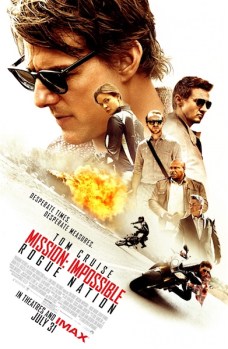 It’s an overcrowded year for spies on the big screen (as
  Obviously this uncertainty is also thanks to the story constructed by writer-director Christopher McQuarrie. Some automatically dismiss the plots of the Mission films, saying they’re just an excuse to link some death-defying stunts performed by Mr Cruise. Although there may be an element of truth to that, I don’t think this is a bad storyline by any means. As I said, it’s fairly straightforward (there’s no mole in IMF! Hurrah!), but the intricacies keep it engrossing and keep you guessing. And anyway, the action sequences it ties together are first-rate. You’ve pretty much seen the opening plane stunt in the trailer — heck, you’ve seen it on
  As alluded to above, this is probably the most globetrotting Mission film yet: it starts in Belarus, before taking in Washington D.C., Cuba, Paris, Vienna, Casablanca, and London. It’s things like this that lead me to describe it as a James Bond film. There’s also the balance of a serious plot line with plenty of humour, the use of outlandish just-ahead-of-reality gadgets, and the fact that the series can’t retain a female cast member for more than one film (though that last one isn’t a positive). For all the effort Spectre made to bring classical Bond elements back into the fold, Rogue Nation arguably feels more like a classically-styled Bond movie. It’s not a faultless like-for-like comparison — one of Rogue Nation’s best points as a Mission movie is that the whole team are necessary to complete the mission, a defining factor of the TV series that many felt went awry in the movies, with their focus on Cruise — but the almost-indefinable sensation of this experience is Bondian. It’s not stealing that style, though: considering Ghost Protocol had it too, and Craig-era Bond has abandoned it for a ‘classier’ action-thriller mode, it’s something the M:I series has come to own.
 So on the one hand the recent news that McQ (as current regular collaborator Cruise calls him) is returning to write and direct the sixth Mission is a shame, because it breaks a twenty-year rule; but on the other, I’m not sure it matters. Plus, by taking on the dual role of sole writer and director, you could argue McQ’s Missions are the most auteur-y of the lot, even in spite of the lack of a terribly unique visual style. Which is all a very long-winded way of saying that I was a little disappointed when it was announced there wouldn’t be a sixth director for the sixth film, because I always thought that was a neat idea; but as the idea hasn’t actually had much effect, who better to ask back than the man who wrote and directed arguably the best Mission: Impossible film of them all?
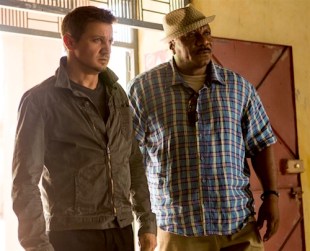
 The cast are liable to get lost among all the grandiose goings-on in a film like this, so its a testament to the skilled team that’s been assembled over the past few movies that they absolutely do not. Cruise is Cruise — surely by now you know whether you like him or not. I always feel like I should dislike him, especially given his crazy real-life religious views, but on screen I find him very entertaining. Rogue Nation is no different. Hunt is on the back foot for a lot of the film, and Cruise is at his best when he’s playing someone who’s almost the underdog. He’s also a more talented comic actor than he’s normally given credit for, and that glimpses through here too. Most of the time comedic duty is handled by Pegg, of course, who provides a good foil as Hunt’s sidekick for much of the film. More surprising, perhaps, is the amount of humour Jeremy Renner brings. It’s much less obvious, dryer and more sarcastic, so the contrasting tone is fun. He’s paired with Ving Rhames for a long stretch, who returns wholesale after sitting out Ghost Protocol but for a cameo. The pairing may come up just short of feeling inspired, but nonetheless makes for an entertaining change. Elsewhere, Baldwin offers a neat, not-too-clichéd turn as the CIA ‘villain’, while Tom Hollander pops in for a funny cameo-level turn as the British Prime Minister.
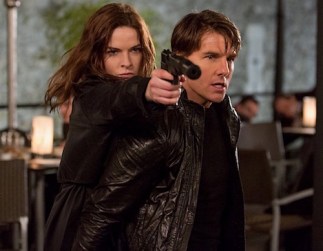 As the fifth film in a franchise that has always carried a slight “pretender to the throne” air, Rogue Nation should feel played out and tired. Instead it seems fresh and invigorated, with a spot-on tone, likeable and fun characters, a real sense of jeopardy and menace (missing in so many modern action films), and some of 2015’s very best action scenes — and in the year of Fury Road, that’s really saying something. McQuarrie has
 100Films.co.uk