
Edgar Wright | 113 mins | cinema | 2.35:1 | UK & USA / English & American Sign Language | 15 / R
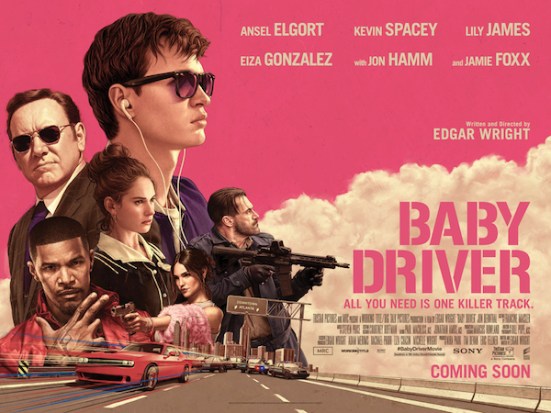
It felt like half (at least) of the film-loving internet had somehow had a chance to see Baby Driver before its release on Wednesday, but I’m going to throw my two cents into the ring anyhow. Not that it makes a great deal of difference because, like most other folks, I bloody loved it.
Written and directed by Edgar Wright, director of the Cornetto trilogy and not of Ant-Man, the story focuses on getaway driver Baby (Ansel Elgort), a fundamentally good kid who has ended up suckered into a life of crime, working for robbery kingpin Doc (Kevin Spacey) and a rotating array of criminal compadres. An accident as a kid left Baby with “a hum in the drum” — tinnitus, if you want to get medical about it — meaning he listens to music all the time to drown it out, and also choreographs his daring drives (not to mention his walks down the street, etc) to the music he hears. One day he bumps into Debbie (Lily James) and falls in love, which happily coincides with his “one last job” for Doc. But once you’re in it’s hard to get out, and Baby again finds himself doing one more “one last job”, with a particularly volatile crew…
Baby Driver is a movie about three things: driving, music, and love. As Guillermo del Toro put it, it’s a kind of fable, or fairytale, with Baby as the prince and Debbie as the princess. In this respect it’s a change of pace for Wright, ditching the almost-spoof comedy of his previous successful movies for something more emotionally earnest. Not in a bad way, but in a kind of pure way, like a fairytale. This fairytale world isn’t all castles and dragons, of course — instead it’s full of violent criminals and fast cars; but it’s also a world where you can synchronise your getaway driving to the music on your iPod, so it’s hardly mired in gritty realism.

There’s a definite edge of Wright’s buddy Quentin Tarantino to this world: a cast of crooks delivering snappy, quotable dialogue to a near-constant soundtrack of deep cuts selected from the director’s music collection (plus a few familiar tunes for good measure) — the style of QT comes to mind more than once while watching. Fortunately Baby Driver’s style is more than homage or copycatting. Although it’s not a straight-up comedy, Wright does bring his own comedic touch (there are several big laughs), and the purity of emotion — that fairytaleness again — isn’t from Tarantino’s wheelhouse either. Plus, visually it presents a brighter and more colourful space than Tarantino normally inhabits. Most of the action takes place in the golden daylight of Atlanta and is filled with popping primary colours. There’s much great work by DP Bill Pope.
Though the soundtrack may have a Tarantino feel in its construction, that’s less prevalent in its usage. Characters communicate through song — not by singing them (most of the time — Baby first notices Debbie because she’s singing “B-A-B-Y”), but by connecting through them (that singing is followed by a discussion of songs featuring her name — both of them). The songs Baby chooses for boogieing around his small apartment, or for dancing down the street on a coffee run (in a title sequence that is marvellously choreographed, with dozens of small details timed perfectly to the track), help illuminate his true character — sweet and romantic — which is hidden by the sullen silence he adopts whenever around criminals.
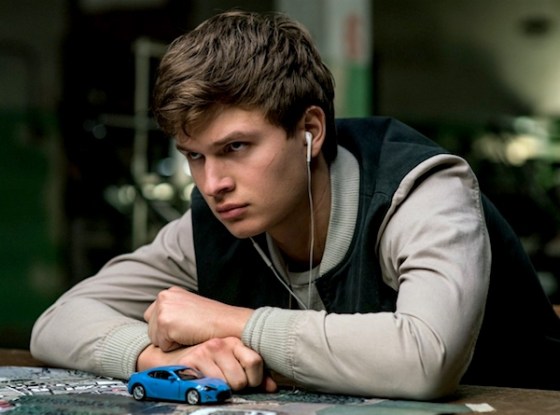
Some have criticised the film for a lack of character, reckoning Baby’s silence distances him from the viewer so we never build a connection and don’t root for him. Frankly, I’m not sure what film they were watching. No spoilers, but Baby first opens up with something endearing and ingratiating in scene one. Right at the start. It could barely be any closer to the studio logos (and it kinda wouldn’t work if it were). I’m not arguing he’s the most charismatic lead ever to grace the silver screen, but Elgort makes fine fist of selling Baby as both a quiet, focused driver and a sweet, likeable, cheer-on-able hero.
And if you want character in general, the rest of the cast has it in spades, with an array of supporting roles that are as colourful as the cinematography. Recognisable faces like Spacey, Jon Hamm, Jamie Foxx, and John Bernthal get to cut loose as crooks who each have their own kooks, while lesser-known names like CJ Jones (as Baby’s foster father) and Eiza González (as the Bonnie to Hamm’s Clyde) make a mark too. Lily James may be placed in a dream-figure damsel role, but that doesn’t mean she can’t hold her own at times too. She’s not Wonder Woman, but she’s not a Manic Pixie Whatever That Phrase Was either.

So, the one major thing I’ve only touched on fleetingly thus far is the main thing the film has attracted attention for: the driving. Done for real by stunt drivers with not a lick of CGI, that knowledge means it packs a viscerally real punch. But it’s not just snobbery: this is genuinely breathtaking action, slickly planned, masterfully performed, magnificently shot and edited. It’s this year’s Fury Road — a kinetic action spectacle made with skill rather than hand-waiving fast-cuts. Even more impressively, it’s been choreographed to music, but not in a draw-attention-to-itself dance-routine-y way. Perhaps saying it’s been synced to the music would be more accurate. Either way, it only heightens the effect. This extends beyond the car chases, too, including one marvellously musical shootout, the gunfire serving as percussion. The sound design throughout is exemplary. This is a movie that deserves to be remembered come awards season. Perhaps, again like Fury Road, some love will extend beyond the technical categories, too. Wright seems deserving of Best Director recognition, just like George Miller was.
But such back-patting is for much later in the year. For now, just revel in the gleeful moviemaking verve of a flick that already seems destined to be remembered as one of the greatest car chase movies ever produced.

Baby Driver is in cinemas many places right now, but not everywhere. It’ll be worth the wait, guys.
It placed 2nd on my list of The 17 Best Films I Saw For the First Time in 2017, which can be read in full here.
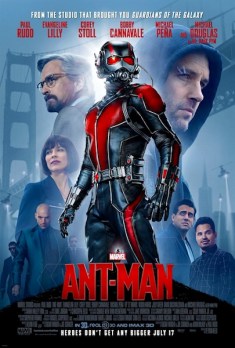 The final film in ‘Phase Two’ of the Marvel Cinematic Universe is perhaps the most fun Marvel movie since
 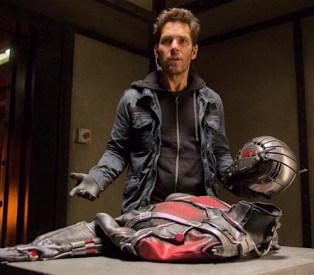 Nonetheless, some have criticised the film for not being especially original. I mean, originality’s good ‘n’ all, but c’mon, what do you expect when you sit down to a superhero movie from the primary purveyor of superhero movies? Ant-Man may blend elements from a few other genres into the superhero mix, but, yeah, it’s a superhero movie that, at times, plays like a superhero movie — just like everything else Marvel Studios has produced (with the possible exception of
  It remains tough to talk about Ant-Man without referencing The Edgar Wright Situation. I mean, you could ignore it, but then it becomes the elephant in the room. If you somehow missed it: writer-director Edgar Wright pitched Ant-Man to Marvel as a movie before Marvel Studios even existed, back in 2003, and had been developing it on and off ever since. The ideas he brought to the table — an action-adventure-comedy style, being a special effects extravaganza but with a lighthearted tone — influenced how the studio approached Iron Man and, consequently, the whole MCU. Nonetheless, Ant-Man wound up positioned as the 12th film in the studio’s slate, finally going into production after a decade of prep. Wright had a script almost finalised, he’d cast the film, a release date was set… and then he left due to “creative differences”. And the internet was on his side because Edgar Wright has made
 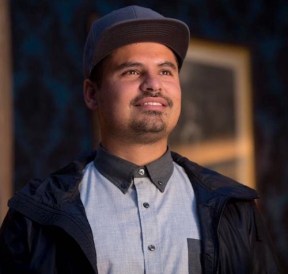 After Wright left, the screenplay was rewritten by a host of scribes (far more than the two extra writers ultimately credited). Other things they’re responsible for include bulking up the supporting characters, especially Hope, which works pretty well, and Lang’s friend Luis (Michael Peña), which we should all be thankful for: Peña’s Luis is one of the best things in the movie, an enthusiastic motormouth who’s consistently entertaining whenever he’s on screen. He’s the standout from an ensemble that is generally strong, with Rudd proving a likeable lead and Douglas committing to the material in a way you wouldn’t necessarily expect an older actor to with ‘just a comic book movie’.
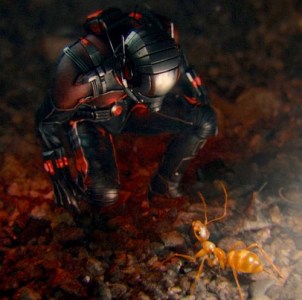 That doesn’t mean it’s a story that doesn’t have stakes, they’re just different stakes. It’s a refreshing change of pace at this point. It’s also pretty much standalone, with nice nods to the shared universe but without being dependent on other films (either before or to come) for its story. Guardians of the Galaxy did that too, but how many other recent Marvel movies is it true of? Even the highly-praised
 1981: Steven Spielberg reads a French review of his movie
  Apparently some Tintin purists weren’t so keen on the actual adaptation — elements of The Crab with the Golden Claws have been mixed in to a plot primarily taken from The Secret of the Unicorn, the sequel/second half of which, Red Rackham’s Treasure, is reportedly used sparingly. Plus, in the original tale Sakharine is a minor character who wasn’t responsible for much, apparently. As someone who’s only read one of those three volumes, and even then not since I was young, such things didn’t trouble me. What superstar screenwriters Steven “
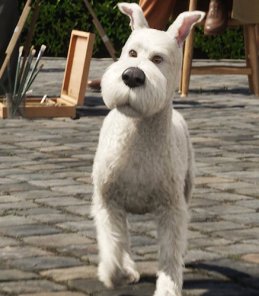 The slapstick is mainly hoisted by Simon Pegg and Nick Frost as the physically-identical Thomson and Thompson — a true advantage of animation, that. I imagine some find their parts tiresome because of their inherently comic role, but they’re likeable versions of the characters. Even more joyous is Snowy, though. Well, I would like him, wouldn’t I? His internal monologue, such a memorable part of Hergé’s books, is omitted (as it is from every film version to date, I believe), but he’s full of character nonetheless. Some of the best sequences involve Snowy running in to save the day. I don’t think they quite got the animation model right (the one glimpsed in test footage included in behind-the-scenes featurettes looks better, for my money), but his characterisation overcomes that.
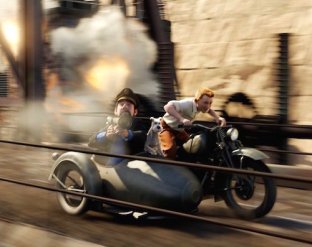 Of course, one very important person is neither British nor Belgian: Spielberg. The screenplay’s balance between peril and comedy is spotlessly enhanced by his peerless direction. In a world stuffed to the gills with lesser blockbusters that palely imitate the groundwork Spielberg and co laid in the ’70s and ’80s, work like this should remind people why he’s still the master of the form. The film is shot with an eye for realism (so much so that some viewers have been convinced it was filmed on real locations with real actors, with some CG augmentation for the cartoonish faces, of course), which helps lend a sense of plausibility and also genuine jeopardy. It’s easy to get carried away when working in CG animation, but often the most impressive works are ones that behave as if they’ve been shot largely within the limitations of real-world filmmaking technology.
 The tone on the whole is resolutely PG — actually, like many an action-adventure blockbuster used to be before everything went slightly darker and PG-13. So, for example, Tintin wields a gun on occasion, but never at another human being. The focus is on the story, which happens to lead to some adrenaline-pumping sequences, rather than a lightweight excuse to link together a bunch of punch-ups and chases. Ironically (though, for anyone who knows what they’re talking about, entirely expectedly) this makes the action all the more exciting. It also mean there’s a lighter touch than many current blockbusters offer; a greater presence for humour, including among the action. I guess that’s not fashionable these days, when everyone’s become so po-faced about their big-budget entertainment. However, with the likes of
  but some viewers would have seen it (even subconsciously) as more of a “real movie”.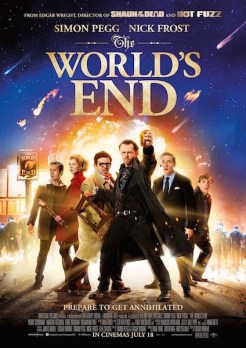
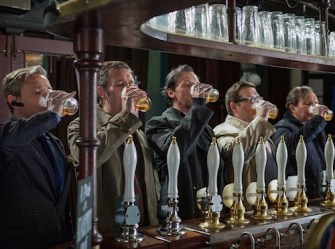 “zombie movie” or “Hollywood action movie”, and occasionally co-writers Pegg and Wright have substituted character development and thematic points for send-up. It may not play to the genre-loving fan-audience that the trio’s previous work has accumulated (demonstrably so, based on many a viewer review), but it does make for a more grown-up film.
 It will definitely reward multiple viewings: it’s littered with signs, omens and portents (in fairness, a good few can be grasped on an attentive first go). There’s a featurette on the BD (but not the DVD) which helps point out any major ones you may’ve missed; though I have to say, even at seven minutes long, and even with it pointing out some that felt too obvious to be worth mentioning, I swear it left some stuff out. That could be a deliberate decision of course, to leave some things for people to just spot.
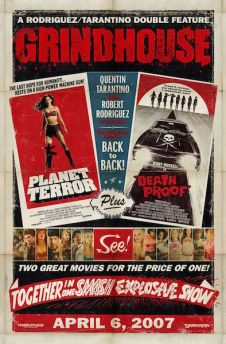 Infamously, on its release in America the much-hyped Rodriguez/Tarantino double bill was an almighty flop, so much so that it wasn’t properly released in its full form outside the US. Which is a bit ironic, if you think about it, because the US is the market least likely to respond to something a little bit experimental.
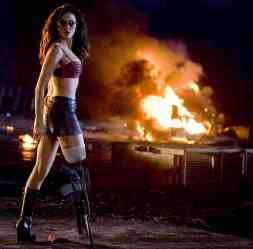 Chances are, if you don’t find this opening salvo entertaining in some way the rest of the film is going to prove a struggle.
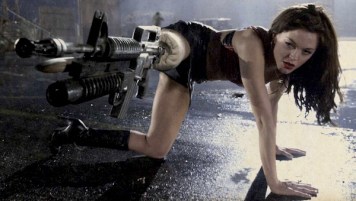 It probably works better in context than described on the page, but Rodriguez has marshalled every disparate element to create a cohesive whole that’s exciting and funny. At this point, Grindhouse is firmly headed for a full five-star conceptual success.
 though Roth can’t resist adding his own especially twisted brand of humour (I shan’t describe the final shot here).
 But it’s not just the increasing lack of dilapidated print quality that prevents Death Proof from selling its concept. The screenplay is clearly a QT work, much more so than most of
 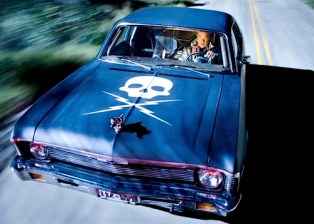 and if he chooses to create some more action-centric pictures in the future it would be no bad thing.
 In fact, it might’ve played better if the films were the other way round, as it means Death Proof must be set before Planet Terror. I’d approve of this switch not only for chronological reasons, but because seeing one-scene bit-parters turn up in the-same-but-larger roles in the second film seems like it would be more satisfying as a viewer, rather than re-encountering these (in any case, minor) characters the way we do.
 But Tarantino’s entry lets the side down by seeming to fail in its execution of the film’s conceit. I’m not convinced it would be any better viewed as a standalone Quentin Tarantino Film, but in context it certainly disappoints.
 100Films.co.uk