The Eggy Monthly Review of March 2024

In case you somehow missed it, it’s Easter weekend. That’s the only reason for the title. There are no eggs involved anywhere else in this post.

In terms of observations actually related to the blog, I only managed to keep one of my two main viewing goals ticking over — that is to say, I hit my “ten new films per month” target, but fell short of keeping my 100 Films Challenge on track (more detail in Viewing Notes, as usual). That said, I’m pleased to have achieved even that much in March, when films have found themselves competing with an uncommon amount of other stuff for my entertainment time. To be specific, I’ve started a rewatch of the ’90s X-Men animated series (I’m ten episodes in, which adds up to 3½ hours); finally been playing point-and-click adventure classic Broken Sword: The Shadow of the Templars (for about 11 hours); and, most consumingly of all, found myself somewhat obsessed with cult-phenomenon actual-play Dungeons & Dragons series Critical Role (I’ve watched 26½ hours, plus untold more spent reading around it, and barely made a start on it); and that’s without counting up sundry other bits and pieces, like reading books and comics, or slowly rewatching Blackadder.

Anyway, to get back to the films (though there’s always the comment section if you’d like to talk about the other stuff), here’s, um, the films…


This month’s viewing towards my yearly challenge

#17 Dune: Part Two (2024) — New Film #3
#18 Maestro (2023) — 50 Unseen #4
#19 The Inspector Wears Skirts (1988) — Genre #2
#20 Black Tight Killers (1966) — Failures #3
#21 My Darling Clementine (1946) — Blindspot #3
#22 My Father and My Son (2005) — WDYMYHS #3


  • I watched 11 feature films I’d never seen before in March.
  • Just six of them counted towards my 100 Films in a Year Challenge.
  • That means (as I said at the start) that I exceeded my “ten films per month” minimum target — for the first time this year; also, that’s the fourth month in a row, which is the most consecutive ten-film months since a pandemic-aided run of 21 months in 2020/21. (The all-time record remains 60 months, aka five solid years.)
  • But (as also mentioned at the start) I fell short of where I should be in my Challenge — but only by two films. I’ve got the rest of the year to catch that up, so it’s far from a disaster. Yet.
  • This is also the first month of 2024 without any rewatches; although I did still manage two short films (I don’t think I’ve mentioned it, but I’m aiming to watch at least one of those each month too. That’s sort of an “unofficial” goal, though, in that I’m not exactly tracking it… except I am, because I keep records of all these things).
  • In terms of history and percentages and stuff, this is the best March since 2021, but because it’s still below March’s all-time average of 14.9, it brings it down to 14.6.
  • Conversely, being higher than last March means it does increase the rolling monthly average of the last 12 months, bringing it from 8.8 to 9.1. If I can continue my ten-films-per-month streak, eventually it’ll get above 10.0 again…
  • I posted my Dune: Part One review right at the end of February, fully intending to quickly follow it with my Dune: Part Two review in early March. That didn’t happen, obviously.
  • I’ve been buying Radiance releases since they sprung into existence back in mid-2022 (indeed, I’ve got 30 of the 37 titles they’ve released to date, plus several of their “partner label” releases too), but Black Tight Killers is the first one I’ve actually watched. I’m not one of those collectors who buys stuff just to keep on his self unopened… but I do have a bunch of stuff on my shelf unopened, because I am one of those collectors who’s interested in almost everything but can’t find the time to watch it all.
  • This month’s Blindspot film was John Ford’s version of the Wyatt Earp / gunfight at the O.K. Corral legend, My Darling Clementine.
  • Letterboxd informs me that My Darling Clementine was the first film I watched on a Tuesday this year. So there you go.
  • This month’s WDYMYHS film was Turkish intergenerational family drama My Father and My Son.
  • From last month’s “failures” I watched Black Tight Killers.


The 106th Monthly Arbitrary Awards

Favourite Film of the Month
I confess, I didn’t have any particular expectations of John Ford Western My Darling Clementine. Not that I thought it would be bad, but — despite it clearly having enough acclaim to get onto my Blindspot list — I didn’t sit down expecting a masterpiece or something either. Perhaps that’s what allowed it to blow me away, first from a visual standpoint (this is a film where even the day-for-night photography looks good) and then by… well, everything else.

Least Favourite Film of the Month
This has to be Alan Bennett adaptation Allelujah, which for much of its running time is an amiable-enough pro-NHS / anti-cutbacks polemic, before a final-reel twist threatens to undermine the whole thing. What a way to mangle your own point.

The Audience Award for Most-Viewed New Post of the Month
Now, technically — technically — the winner for this month was February’s Failures, which was way down the overall chart. I stress technically because I’m going to say the award actually goes to something I posted in February… but I posted it on February 29th, so it didn’t have much of a chance last month; and February 29th isn’t a real day anyway, so it’s sort of part of March. Very tenuously sort of. Anyway, that makes the winner my review of Dune: Part One, which actually cracked the overall top ten (at #8).


Every review posted this month, including new titles and the Archive 5


What balance will my entertainment choices level out at in April? Find out next month!

The Leaping Monthly Review of February 2024

It’s coming up to nine years since I started naming these monthly progress reports, which means this is the third leap year they’ve existed in, and yet it’s the first time I’ve thought to reference that in the name of February’s update. I don’t know if I should be ashamed of that because I didn’t do it sooner, or because it suggests I’m running out of fresh ideas. Either way, clearly it’s not good. Or maybe it just doesn’t matter. (Yeah, that’s the one.)

Anyway, on to the films…


This month’s viewing towards my yearly challenge

#10 The Kitchen (2023) — New Film #2
#11 Despicable Me 3 3D (2017) — Series Progression #2
#12 RRR (2022) — 50 Unseen #3
#13 Ambulancen (2005) — Failures #2
#14 Dune: Part One 3D (2021) — Rewatch #2
#15 The Innocents (1961) — Blindspot #2
#16 Wild Tales (2014) — WDYMYHS #2


  • I watched 10 feature films I’d never seen before in February.
  • That makes this the third month in a row with ten new films. Compared to my history, it’s baby steps (the record is 60 months), but it’s two years since I last managed three consecutive months, so it is worth noting.
  • Six of the ten counted towards my 100 Films in a Year Challenge, along with one rewatch.
  • The usual monthly average for the Challenge is eight, but February being short (even with the extra leap day) means it only needs seven, so I remain on target.
  • This month’s Blindspot film was classic British Gothic (in the true sense) horror The Innocents. Maybe I should have tried to save that for October, but any intentions I have to watch horror movies in October usually fail to pan out. To be honest, I chose it now because it’s the only film on this year’s Blindspot that I don’t own on disc, so I thought I’d free up some space on my TV hard drive for other stuff I’ve downloaded. Sometimes my viewing decisions are as pragmatic as that.
  • This month’s WDYMYHS film was Argentinian revenge anthology Wild Tales. That’s another one deleted off the hard drive.
  • From last month’s “failures” I watched Ambulancen and The Kitchen.
  • Also this month, in aid of my Genre category, I compiled a list of all the martial arts titles I own that I haven’t seen (it’s on Letterboxd here) and it came to… 213 films! And I’ve got more on preorder, and even more that are coming out soon that I will order; and I even left some off that I wasn’t sure counted (although I also included some I wasn’t sure about, so maybe that part balances out). Anyway, my point is: setting a target of “ten” barely scratches the surface here — even less than it did last year with giallo, where my similar list featured just 50 titles. Maybe, rather than try to think of more genres for that Challenge category, I’ll just set it on a triennial loop of noir, giallo, martial arts…


The 105th Monthly Arbitrary Awards

Favourite Film of the Month
I enjoyed most of the films I watched this month, some very much, but nothing came close to the marvel that is RRR.

Least Favourite Film of the Month
Proving that star ratings aren’t everything (or possibly that I need to rethink mine), I rated My Son two stars, but its three-star The Kitchen that I feel I enjoyed least from this month’s viewing. I’ve been assigning ratings to films solidly for over a decade-and-a-half now (the blog passed its 17th anniversary this week, by-the-by) and yet how many stars I should give a film, and how my ratings compare to one another, still regularly gives me pause for thought.

The Audience Award for Most-Viewed New Post of the Month
Now that I’m getting back into the swing of reviewing (touch wood), there’s more stuff to compete in this category — that makes a nice change from most of last year. And yet, despite that, it’s my monthly review of January that comes out on top here. It even cracked the overall top ten for the month, which is an uncommon achievement for a new post. (In second place, the highest charting film review was Barbie.)


Every review posted this month, including new titles and the Archive 5


Returning to the cinema* to return to Arrakis.

* shockingly, it’ll be my first visit since Oppenheimer last July.

Dune: Part One (2021)

aka Dune

Denis Villeneuve | 155 mins | cinema | 2.39:1 | USA & Canada / English | 12A / PG-13

Dune: Part One

Trying to write about a film like Dune in a critical context over two years after it was released feels a bit… pointless. I mean, the film was a hit (albeit by mid-pandemic standards); and if you did miss it first time round, the hype around the sequel has surely already piqued your interest and/or left you cold, in which case what I say isn’t likely to be a deciding factor. Of course, yay/nay recommendations are not the only reason for critical writing — far from it — but, if you’re looking to do more than that, you better have something to say. So I confess here and now, for the sake of any readers looking for that kind of article, that I don’t think I have a unique or revelatory or even particularly insightful take on Dune — or Dune: Part One, as I’ve insisted on calling it ever since the wonderful surprise of seeing its opening title card (and sites like IMDb have finally got on board with too). All I can offer is how the film struck me personally, from my particular perspective; which is not nothing, but is what it is.

So what is my perspective? Well, I’m far from a newbie to the world of Arrakis, though I can’t now remember in what order I first encountered the various texts related to it that I’ve experienced. So, going chronologically, I have read Frank Herbert’s original novel. Famously, it’s a doorstop of a tome, so I must have been relatively young because, for whatever reason, I’ve struggled to get through long books for the past couple of decades (I’ve tried Lord of the Rings two or three times and never got much further than Tom Bombadil; I started Shogun over four years ago and my bookmark still sits about halfway through it — and I did enjoy both of those! I just don’t have the staying power to get to the end). But I can’t have been that young, given the book’s subject matter and style, and the fact I enjoyed it. Indeed, I’d go so far as to say it’s one of my favourite novels. I’ve never read the sequels. I’ve long intended to (see: previous comments about lack of staying power when reading).

I’ve also seen the 1984 David Lynch film, naturally — an interesting but fundamentally flawed endeavour — and the 2000 miniseries (and its 2003 sequel), which I remember being widely acclaimed — and I would have agreed with that sentiment — but it does look rather dated now, and so I’m somewhat wary of rewatching it (though I recently bought an expensive Blu-ray edition imported from Australia, so I certainly intend to at some point). The point of listing all that is this: I do not approach Dune free of expectation. Quite the opposite. And yet, I also didn’t have a specific vision in mind. And when you’ve got a director like Denis Villeneuve in charge — a director with a very definite and particular style — you know you’re going to get his interpretation of the material, so the more open-minded and receptive you are to that, the better. I mean, unless you’re on his exact wavelength, your imaginings are not likely to be the same as his, especially if you’ve allowed them to be shaped by one of the previous films, or even the concepts from unmade versions, like the one so interestingly documented in Jodorowsky’s Dune.

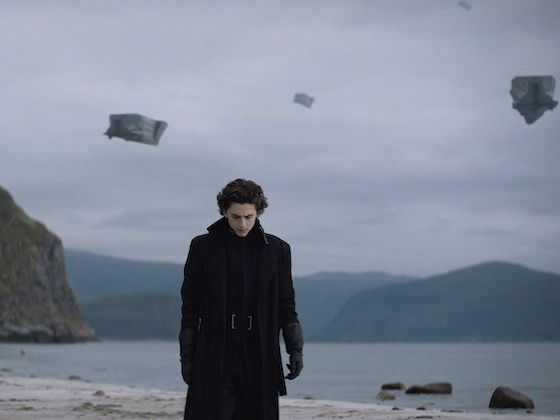
Moody Messiah

All of this a very long-winded and self-centred way of arriving at my point that, on first viewing, Villeneuve’s Dune took some adjusting to, because it wasn’t quite… right. Having said I went in with no expectations, clearly I had some, buried somewhere in my mind. And yet, the film also felt like exactly what one should have expected from Villeneuve if you’d seen his previous work, not least the sci-fi film he made immediately before this, Blade Runner 2049. The worlds of Blade Runner and Dune are very different, but, as filtered through the mind of Denis Villeneuve, there are distinct aesthetic similarities, most apparent in the brutalist influence in much of the world design. That starkness is quite at odds with the fanciful, sometimes even downright weird, takes on the material that came from the minds of creatives like David Lynch and Alejandro Jodorowsky; or even the miniseries, which, while I little more staid and constrained by a TV budget, is seemingly as influenced by fantasy TV of the period as by its science-fiction stablemates. With most previous visualisations of Dune leaning into such fantastical choices, Villeneuve’s (for want of a better word) realist take was, initially, a shock to the system.

That’s a slightly disorientating feeling to be dealing with when watching a film for the first time. Thanks to the story and characters and scenes being so familiar, the mind is freed up to focus more on the surrounding decisions. Even when trying to be open-minded about them, there’s then some kind of disjunct between things that are very recognisable being presented in a very unrecognisable way. There’s also a kind of tug-of-war going on between the feeling that Villeneuve has been allowed to interpret the text exactly as he sees fit, and that’s a good thing because we’re getting his vision across the project, and the sense that it’s something of a shame to miss out on the craziness present in previous interpretations. After all, Dune is set 20,000 years in the future (you may recall it’s set in the year 10,191, but that’s not AD, it’s numbered from an in-universe event — look, let’s not get into the backstory here; but when you see articles mindlessly parrot “Dune is set 20,000 years in the future in the year 10,191”, know that the article writer is mindless because they haven’t bothered to query the maths, not because they’ve done the maths dramatically wrong) — think how different technology has made our world from three or four thousand years ago, so how much wilder and weirder could things get if you multiply that by a factor of five or six? None of which is to say Villeneuve’s choices are wrong, or even that I don’t like them, but they took some getting used to. On my recent second viewing, with the benefit of awareness of what I was about to see, I was able to enjoy the overall experience much more; it settled the qualms I had from my initial viewing and made it easier for me to appreciate the magnificence of the achievement.

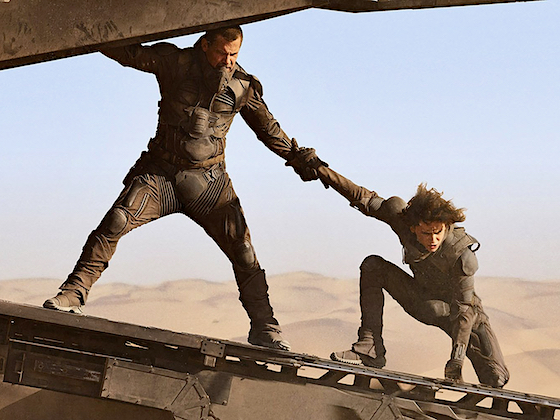
Desert power

Another point of contention (if we can go as far as calling it that) was where the film broke off. I’ve read some retrospective reviews recently that expressed their disappointment when the film suddenly ended mid-story, which I guess goes to show how not all marketing and information reaches all people — I thought it was well-known that this was to be Part One, and that a followup conclusion was dependent on its box office success (hence my pleasant surprise when the film so brazenly declared it was just Part One on its opening title card, not even saving that fact for a ‘surprise’ reveal on a closing title card, a la It), but there were definitely people who went in not knowing that and found it frustrating. Should it have been made even clearer? Should the film have formally been titled Part One in its marketing? Well, the reaction to various “Part Ones” released this year (like Mission: Impossible – Dead Reckoning, Fast X, and Across the Spider-Verse) suggests that audiences don’t really like only getting “Part One” ever; but, conversely, their acceptance of it depends on how it’s handled — how satisfying the movie leading up to the break is, and how the moment it stops is handled. But this is a whole side debate that I’ve stumbled into without adequate preparation (I’ve not even seen two of the three films I just mentioned), so I’m going to swiftly redirect us to Dune.

Where Dune: Part One ends is, frankly, where I always thought it would. Other fans were more surprised by its choice, so perhaps it’s just too long since I’ve read the novel or watched another version and I just couldn’t remember a better break-point at approximately the halfway mark. The screenwriters could, though, because apparently the film originally carried on a little further in the story, before the endpoint was moved in the edit. It’s not the most dramatic place to pause the story or end a film — it doesn’t come after some big action sequence or major plot twist, nor on a cliffhanger of any kind — but I think it largely works. It reminded me of The Fellowship of the Ring, possibly the greatest “Part One” film of all time, in that in no way whatsoever does it feel like the end of the story — we’re definitely only in the middle somewhere, and there’s clearly a whole lot more to come — but it feels like a solid place to pause; like we’ve experienced the whole of a part, if that makes sense.

There was some minor brouhaha the other day during the press for Part Two when someone asked Villeneuve about telling the story over two films — I didn’t pay it too much heed and it didn’t really blow up, so I forget the precise question and answer — but, as many pointed out, adapting Dune in a single film has been attempted before and famously didn’t work out, so doing it in two on this re-attempt shouldn’t really come as a surprise. Certainly, as a fan, I’d rather a two-part adaptation that gives the story the necessary screen time, even if that means a somewhat limp end to Part One, rather than have the whole book in a rushed three-hour single shot. And if early reviews of Part Two are to be believed, it’s paid off overall.

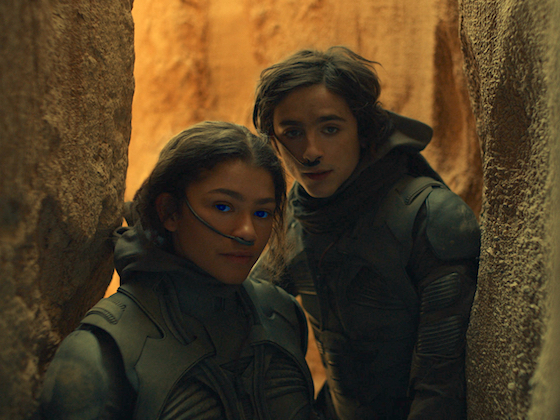
Visions of the future

But more on that ‘next time’, when I see Part Two myself and offer my verdict — hopefully in a more timely fashion than this, rather than waiting several years until the hoped-for Dune: Part Three, aka Dune Messiah (I’m not sure which title I’d rather they go with if/when it happens…)

5 out of 5

Dune: Part One was #176 in my 100 Films in a Year Challenge 2021. It placed 5th on my list of The Best Films I Saw in 2021.

Dune: Part Two is in cinemas worldwide from tomorrow and will be reviewed in due course.

The Below Par Monthly Review of October 2021

As you attentive readers will no doubt already be aware, during October I posted my first new review for almost five months — whoop whoop! Only the one, though. Indeed, if you wanted to read new writing by me, you’d be better off attending FilmBath Festival and trying to guess which of the Film Notes handouts I completely rewrote (if they appear online this year, I’ll let you know and you can indulge in this fun game).

Yes, despite having a day job, I also served as Copy Editor for FilmBath once again — so at least this month I have an excuse for not writing anything here. It’s also the reason why this month’s viewing is way down, as you will now see…


#171 Appointment with Death (1988)
#172 Everybody’s Talking About Jamie (2021)
#173 Raffles (1939)
#174 A Little Chaos (2014)
#174a Sherlock Holmes Baffled (1900)
#175 Capernaum (2018), aka Capharnaüm
#176 Dune: Part One (2021), aka Dune
#177 Sylvia Scarlett (1935)
#178 Going in Style (2017)
#179 Search for Danger (1949)
Dune: Part One
.


  • I watched 9 feature films I’d never seen before in October.
  • It’s the first month in which I’ve fallen short of 10 films since December 2019.
  • That means last month concluded a 21-month 10+ streak — not even close to the longest (60 months, from June 2014 to May 2019), but well beyond the previous second best (just seven, from September 2009 to March 2010).
  • As for averages, obviously it brings everything down. The worst affected is the average for 2021 to date, which falls a whole film from 18.9 to 17.9. The rolling average of the last 12 months drops from 18.00 to 17.25, while October’s average shifts slightly from 13.21 to 13.54.
  • I should’ve saved Frankenstein to be this month’s Blindspot film (for hopefully-obvious reasons). As it was, I didn’t watch any of the remaining three, meaning I need to watch two next month. That’s okay: I also missed one in August and managed to catch it up in September, so I’ve got form.
  • From last month’s “failures” I watched Everybody’s Talking About Jamie… twice (see Rewatchathon).


The 77th Monthly Arbitrary Awards

Favourite Film of the Month
I liked a few films this month, but there’s no real debate that this belongs to Dune: Part One (as I was insisting on calling it even before the sequel was greenlit, a piece of good news that has only made me more insistent).

Least Favourite Film of the Month
The pairing of Katharine Hepburn and Cary Grant should be a great one — it gave us the likes of Bringing Up Baby and Holiday, after all — but their first film together, Sylvia Scarlett, just doesn’t work, on the whole.

Worst Accent of the Month
Dick Van Dyke gets a lot of stick for his Cockney in Mary Poppins, but perhaps he just watched Cary Grant in Sylvia Scarlett for research. Yes, it is comparably poor… but that also means it has the same kind of perverse entertainment value.

Completed Film Series of the Month
Just over nine years since I watched the first one, I finally finished off The Falcon series of ’40s detective mysteries with Search for Danger. Well, it depends how you count it. Really, I think there are 13 films, ending with 1946’s The Falcon’s Adventure; but some say there are 16 films, bundling in the three made a few years later by a different studio with a different star. I’d argue those are more of a ‘reboot’ series than a true continuation. They’re also trickier to track down — while I saw the first 13 thanks to the BBC airing them, the later three most assuredly weren’t included — but I finally bothered to find them, and so now, whichever way you cut it, I’m done.

The Audience Award for Most-Viewed New Post of the Month
For the first time in a while there were actually two new posts this month, although it wasn’t much of a battle — No Time to Die romped away with the victory, besting even my ever-popular old TV reviews to be the month’s most-viewed post overall. It’s already in the top five new posts for the entire year, too, although its chances of overtaking the most popular TV posts are slim.


So, I think it’s now pretty clear I’m not going to make my goal of 50 rewatches in 2021 — I’d need to watch ten a month to get there, which isn’t impossible (I normally watch more new films than that… though not this month, obviously), but I know I just won’t do that (I’ll focus on the unseen stuff). Ah well, it’s only a target. Maybe next year… or maybe next year I’ll have a new goal…

Anyway, this month’s sole rewatch was…

#30 Everybody’s Talking About Jamie (2021)

…which I’d only first seen earlier in the month! When I rewatched it I knew I’d only recently seen it, but I didn’t realise it was within the same month until afterwards. That had more to do with watching it with different people than rushing to rewatch it quickly. I do like it quite a bit, though.


Anyone would think the pandemic was over, the way cinemas are back in full flow (and doing fairly good business, based on my personal experience on the two trips I’ve made so far). Films hitting the big screen this past month that I’ve skipped ‘til disc or streaming include Ridley Scott’s acclaimed The Last Duel, Edgar Wright’s divisive Last Night in Soho, Wes Anderson’s The French Dispatch, plus franchise sequels Venom: Let There Be Carnage, Halloween Kills, and The Addams Family 2. Also the sequel to The Boss Baby (I enjoyed the first one a surprising amount, so maybe I’ll make time for the sequel one day) and Dear Evan Hansen, which I’ll have to watch just to see how much of a train wreck it actually is.

Talking of the big screen, FilmBath Festival is currently mid-flow. I don’t think I’m going to be able to make any screenings this year, unfortunately, and films I’ve already missed include Mothering Sunday, Céline Sciamma’s Petite Maman, Lamb, and Palme d’Or winner and French Oscar contender Titane.

The streamers continued to premiere new movies too, of course. Sky Cinema got UK exclusivity for sci-fi Voyagers (which suggests it’s not very good); Netflix had the English-language remake of thriller The Guilty (I watched the original back in February and it’s currently on All 4 again, FYI); MUBI had a Halloween premiere for BBFC-themed horror movie Censor (which I’ve heard good things about); and earlier in the month Amazon offered Bingo Hell (I like the sound of the concept, but I don’t think it’s been well reviewed). I guess Amazon’s big film was meant to be Infinite starring Mark Wahlberg, though I heard nothing about it until a big promo image popped up on Prime Video’s front page. Low marks on Letterboxd suggest it isn’t worth investigating.

Elsewhere on streaming, if I ever decide to embark on the Conjuring franchise, they’ve got me covered: the first two are on BBC iPlayer, while the third has arrived on Sky Cinema already (I’ve no idea about the spinoffs). Older titles bulking out my various watchlists included period lesbian drama Ammonite, Amsterdamned, David Cronenberg’s Fast Company, anime Mirai, and the 1990 Witches on Amazon Prime; Judas and the Black Messiah, The Little Things, Billie Piper’s Rare Beasts, and Nic Cage in Willy’s Wonderland on Sky Cinema; Halloween I to V (in particular, I want to see III), Honey Boy, Kung Fu Hustle, and Last Christmas on Netflix; The Arbor, The Love Witch, intriguing new animation Cryptozoo, and The Reluctant Fundamentalist on MUBI; and, on iPlayer, Barry Jenkins’s If Beale Street Could Talk, Daniel Craig and Anne Reid in The Mother, Horrible Histories: The Movie, and one I’d never heard of before: A Woman’s Secret, which is apparently a noir-style melodrama starring Gloria Grahame. Whew.

Of course, that’s as nothing to my ever-growing pile of new purchases. Where to begin? How about my latest 4K acquisitions: M. Night Shyamalan’s newest, Old, and his best, Unbreakable; Second Sight’s luxurious new edition of The Guest (which you may remember was my sort-of-joint-first favourite film of 2015); StudioCanal’s latest swish 4K box set, for Joe Dante’s The Howling; plus Arrow’s edition of Oldboy, and The Shining, which features the longer US cut that I’ve not seen. New or recent releases in good ol’ 1080p included Another Round, Masters of Cinema’s second volume of Early Universal silents, Eureka’s release of the Sabata trilogy of Spaghetti Westerns, and Edgar Wright’s documentary The Sparks Brothers. I also finally got hold of Shout’s release of David Cronenberg’s The Dead Zone, and another Eureka release of a Spaghetti Western, Sergio Corbucci’s The Specialists.

And to round things off, I tried to limit my purchases in Arrow’s Shocktober sale… and failed spectacularly. Some of them were recent-ish titles (Sam Peckinpah’s Major Dundee, still available as a multi-disc special edition, and Japanese corporate thriller Giants and Toys), and some they released so long ago they’re dual-format editions with DVDs (remember those?), like 52 Pick-Up and Howling II (which for some reason doesn’t feature its fab subtitle on the cover: Your Sister is a Werewolf). Rounding things out: more Japanese crime in Detective Bureau 2-3: Go to Hell Bastards!; another Spaghetti Western, The Grand Duel; a couple of gialli (The Forbidden Photos of a Lady Above Suspicion and The Pyjama Girl Case); and, released by Second Run but in Arrow’s sale, one of Letterboxd’s 250 greatest films of all time, The Shop on the High Street. Whew, again.


2021’s on the home stretch now — perhaps it’s time to start thinking about where my final tally will end up…