Meat Loaf: In Search of Paradise (2007)

Bruce David Klein | 88 mins | DVD | 16:9 | USA / English

Meat Loaf: In Search of Paradise

The singer Meat Loaf was very protective of his creative process, and apparently this documentary was the first time he’d allowed cameras behind the scenes to document it. Certainly, he’s frequently uncomfortable with or begrudging of their presence, although he seems to get used to them over time, allowing us some rare insights.

The film follows Meat and his band as they prepare for and commence a mammoth 18-month world tour following the release of Bat Out of Hell III. Despite the lengthy schedule, a DVD recording of the concert is scheduled for just a few gigs in. It’s never mentioned who was responsible for booking that, but it clearly causes added stress for everyone: rather than allowing the show to become refined and polished over a long series of gigs, it’s got to be good enough to be documented almost as soon as it starts. No one here is ever pretentious enough to refer to the recording as an “historical record”, but that’s what it will be. This is the first tour in which Meat will perform songs from the entire Bat Out of Hell trilogy, and the gig that’s recorded for DVD is the one that will endure as the record of this tour. It’s got to be right.

Perhaps the biggest obstacle is the fact that Meat Loaf is never satisfied. At one point, Meat’s mate Dennis Quaid is in town and pops by to watch that evening’s gig. Afterwards, he describes it as “an incredible show”. “It wasn’t one of my favourites, but thank you,” replies Meat. So Dennis asks, “how many times are they your favourite?” “Never,” Meat answers, “I hate ’em all… I’m waiting for the perfect show.” Of course, the perfect show never comes, and so Meat never feels it’s gone as well as it could have; he’s always apologising to fans that it won’t live up to expectations. But it’s not that the tour is genuinely coming up short — the band are happy; the crowds are certainly entertained — it’s just something in Meat Loaf’s character. He pushes himself so hard — too hard, given how exhausted it makes him, to the point he physically collapses after most shows. Whether you like his music or not, this film leaves you in no doubt about his dedication to his craft; to trying to give his fans exactly what they want.

Looks like paradise to me

That desire comes to a particular head in one of the film’s major subplots: the show is generally well reviewed in the press, but every critic takes issue with the staging of Paradise by the Dashboard Light, a number about teenage sex in which 59-year-old Meat duets with 28-year-old Aspen Miller — who looks a lot younger, especially in her skimpy cheerleader outfit. Frankly, I reckon the critics were at least partly jealous that Aspen Miller wasn’t writhing all over them, but maybe that’s just giving away something about me… Anyway, the number should be one of the highlights (as guitarist Kasim Sulton says, he’s been touring with Meat for decades and they’ve never done a show without it), but the criticisms are a cause of irritation backstage. Importantly, Miller doesn’t share the critics’ concerns; indeed, she seems to find it frustrating that they’re dismissive of her part in the performance, writing her off as a victim of it, when she’s an adult involved in the planning of what is a fully-choreographed routine. But the criticisms get to Meat even more — it’s not meant to be a song about a handsy old man attempting to assault a young girl, after all — and so various fixes are attempted to improve the song’s reception. It’s like a case study in revising a work while it’s already in performance, and shows that these tours don’t go out on the road locked and unchangeable — or, at least, they don’t when Meat Loaf is involved.

The film’s final line is given to Meat Loaf himself. As he walks away after that all-important gig filmed for the DVD, he repeats several times: “I tried.” That’s his attitude in summation: he never thought it was good enough, but he always gave it his all.

4 out of 5

Meat Loaf: In Search of Paradise is the 10th film in my 100 Films in a Year Challenge 2022.
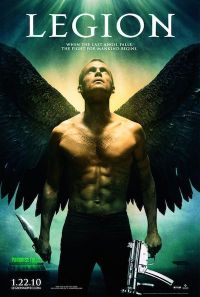
Legion (2010)

2012 #21
Scott Stewart | 96 mins | TV | 2.35:1 | USA / English | 15 / R

LegionThe first of two Christian-themed action movies directed by former visual effects man Scott Stewart (this his first feature as director) and starring British thesp Paul Bettany (here he plays a gun-toting angel, next time it’s a warrior monk) — I don’t know if that’s a conscious theological choice of some kind (there’s no Book of Eli-style heavy-handed God-bothering in either film) or just an almighty coincidence. Even if not, the quality of the pair is consistent, for better or worse.
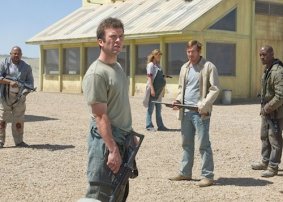
In the first of the Stewart-Bettany diptych, we find that for some reason it’s the end of days, and for some reason there’s a diner in the middle of nowhere, and a deliberately fallen angel turns up to defend the inhabitants of said diner from the celestial forces that are for some reason gathering to kill them. Something like that, anyway.

It doesn’t really matter, it’s all rubbish. It’s penned by writers who think speechmaking equates to character. All of the dialogue is appalling; even Big Lines — just before a heroic death, that kind of thing — are irredeemably bad. It’s performed by actors who aren’t even capable of delivering that tosh. They all overact in one way or another, especially a gurning turn from Dennis Quaid. Later on it aims for some kind of epic fantasy stuff, but it manages to be both underdeveloped and overplayed. The ending shoots for a ‘the story continues’ vibe, though goodness knows where anyone thought the story had to go.

LegionersEven the action sequences not up to much, just guns firing and things exploding in the dark with almost no choreography. As an action movie you might forgive it some of the plot and character points if it could manage that, but it can’t.

Also, there’s a character called Jeep… who’s a mechanic! Oh come on.

There are some scraps of good bits. The beginning is moderately cool, if a bit of a rip from the Terminator franchise. There’s some good creepy villains — to say how or who would ruin some of the film’s rare good bits, should you for some reason decide to watch it. Which you shouldn’t.

Legion is disappointing on pretty much every level. There’s some potential in the basic idea, but it’s not even close to being realised. Even the siege-based rendering of it they’ve gone for feels half baked.

Avoid.

1 out of 5

Legion featured on my list of The Five Worst Films I Saw in 2012, which can be read in full here.

The Right Stuff (1983)

2009 #49
Philip Kaufman | 181 mins | TV | 15 / PG

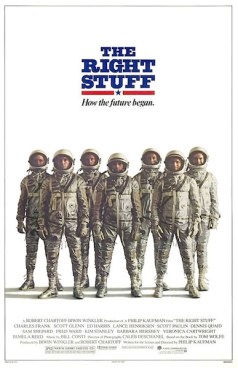
The Right StuffThe Right Stuff ostensibly dramatises the story of the ‘Mercury 7’, America’s first group of astronauts, but in fact equally concerns itself with the tale of test pilot Chuck Yeager. But I’ll get to him.

I’ve recently steeped myself in dramas and documentaries relating to the US space program, from For All Mankind’s contemporary footage to In the Shadow of the Moon’s retrospective interviews, from Moonshot’s earnest docudrama account of Apollo 11 to From the Earth to the Moon’s thorough chronicling of events. But all of these have one thing in common: they cover the Apollo missions alone. Mercury came first, America’s initial attempts to put men into space before Apollo’s grand mission to the Moon.

In this context it’s nice to actually get some coverage of these earlier, vital missions, though such an in-depth knowledge of what was to follow has its problems for The Right Stuff’s narrative, just as knowing the facts always does for a historical movie. Equally, it gives the emotional resonance a helping hand — knowing Gus Grissom’s tragic fate lends the poor treatment he received following his unfortunate splashdown an extra poignancy; or when Alan Shepard asserts he’s going to the Moon you know he’ll make it (eventually).

Exposure to other such works makes quality comparisons inevitable too, though the only one of serious relevance here is From the Earth to the Moon. It’s an unfair one, of course: despite The Right Stuff’s epic running time, it’s nothing to the twelve hours afforded to an HBO miniseries. Conversely, where the miniseries is effectively twelve one-hour plays, shifting focus every episode, director Philip Kaufman’s film does follow a more linear — albeit wide-reaching — progression. While Yeager may disappear for long stretches, for example, his story is revisited and continued; while Gordon Cooper isn’t introduced until after we’ve had plenty of Yeager, the film closes on his first spaceflight. Flitting from character to character could make the film feel fragmented — and the brevity in dealing with many of the supporting characters, especially the wives, does suggest this — but the missions move ever on and take the narrative with them.

The other effect of having seen so much about the space program of late is that the trips to space lose some of their wonder. The handful of spaceflights actually depicted here are often praised, both for their special effects and their pure effect on the viewer, but having seen many others recently does tarnish the sense of wonder somewhat. The effects work is faultless however, as is the integration of footage of the real missions, and the unique qualities of John Glenn’s flight make it stand out regardless of how many other real spaceflights one’s seen recreated on screen.

A handful of these sequences aside, Kaufman leaves the technical aspect of proceedings alone. The various test flights and rocket launches we do see are undoubtedly important set pieces, but they’re not a thorough catalogue of events. Attention is only lavished on the scientific and engineering challenges when it has some direct impact on the characters, and just as often Kaufman is concerned with the family — specifically, the wife — behind the astronaut. These touches of family drama are well played, most affectingly with Glenn and his shy, stuttering wife, but each astronaut’s tale comes and goes, not even one relationship going through an arc that lasts more than two or three scenes. Even when powerfully portrayed, these are portraits not stories.

There are some injections of humour and symbolism too, but again in keeping with the piecemeal style. A pair of NASA recruitment officers, played by Jeff Goldblum and Harry Shearer, provide some comic relief early on for quite a sustained stretch, but then more or less disappear — excepting a recurring motif of Goldblum telling a room of Important Men news they already know. Similarly, the film opens with a fantastic image of Death, a black-clad preacher arriving to inform a wife and child of their husband/father’s fiery death. He crops up again, demonstrating his presence as symbol and not character, but is too often forgotten about. Plaudits are due for not overusing him, naturally, but a few more appearances wouldn’t have gone amiss.

And so what of Yeager? Why so much of a test pilot who was denied the chance to apply to be an astronaut, even if he’d wanted to? It’s hard to disagree with the assessment of screenwriter William Goldman, who left the project over disagreements with the director: it seems Kaufman, for whatever reason, is set in a belief that Yeager had ‘the right stuff’ pumping through his veins, while those chosen to be astronauts were just ordinary guys who got lucky; that Yeager was a pilot proper, brave and skilled, while the Mercury 7 were little more than living computers to perform a handful of tasks atop a huge rocket. If this is Kaufman’s belief it isn’t overbearing, but you can see where Goldman’s coming from. After all, if this is purely the story of the Mercury 7 and their trips into space, why is Yeager there at all, never mind so prominently?

By eschewing a straight trotting out of facts and incidents, even a dramatised one, for a selection of events and experiences, Kaufman made a film that is perhaps less about the real-life story and more thematic — that theme being, primarily, heroism. If he winds up uncertain whether or not the Mercury 7 were heroes, perhaps that’s the point: these were just ordinary men, thrust into an extraordinary situation. Except Yeager, of course, who is never anything less than the flawless embodiment of the titular virtue.

4 out of 5

The Right Stuff is on ITV4 tonight at 10:35pm.