
Ron Howard | 121 mins | Blu-ray | 1.85:1 | USA & Hungary / English, French, Italian & Turkish | 12 / PG-13
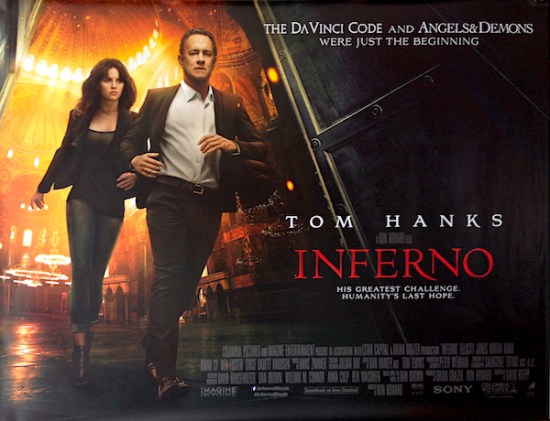
Tom Hanks returns as Robert Langdon, Dan Brown’s symboligist-cum-crime-solver (that’s the main character from The Da Vinci Code, for everyone who’s forgotten in the decade-ish since that book was at the top of the cultural zeitgeist) for his third adventure (they made a second, remember?) based on the fourth novel, after the first film was based on the second novel and the second film was based on the first novel (not that that matters, it’s just kinda funny).
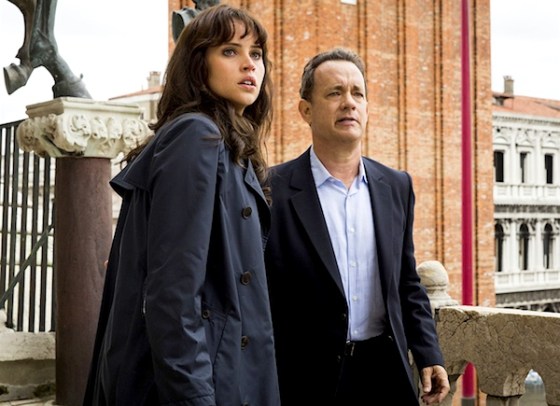
This time, Langdon wakes up in a hospital bed in Florence, with a gunshot wound to his temple that has caused him to both forget the last two days and have terrifying hallucinations of Hell. When an assassin turns up trying to kill him, he escapes with Dr Sienna Brooks (Felicity Jones). Still unable to recall how he ended up in this predicament, Langdon discovers a small projector in his pocket, which contains what will be the first clue to another scavenger hunt of famous old artworks and the like. At the end of the trail: a man-made pathogen that could wipe out 95% of humanity. Pursued by several groups who want the virus for their own nefarious (or not) ends, Langdon and Sienna race against time to save the world.
If you haven’t guessed yet, Inferno is a bit silly. Not utterly silly, but silly in the kind of way the previous Dan Brown movies have been silly — pretending they’re taking place in a plausible real world, when they’re not. The kind of silly where a villain leaves a trail of clues for someone to follow and make sure his scheme is executed, rather than, I dunno, putting a timer on it. (Incidentally, this is a change from the novel, where (based on what I read on Wikipedia) his plan makes marginally more sense.) The kind of silly where apparently the World Health Organisation is some international enforcement agency with gun-toting special ops units and the power to override local police. (I don’t know much about the real WHO, but I find this version very hard to believe.)
On the bright side, Inferno is not nearly so po-faced as the previous Langdon movies. If you suspend your disbelief, it’s a reasonably compelling mystery (or set of mysteries), where for once the ultimate solution doesn’t feel obvious from the get-go. The same goes for the issue of who to trust. As you’d expect from a race-against-time thriller with an everyman hero, there are multiple different forces in pursuit of Langdon, and you know that one of those groups will turn out to actually be on his side, because that’s how these things always go — but which? Well, I thought it was less blatantly obvious than normal, anyway; though I did guess one other huge twist almost from the start (and I’m sure most viewers who are reasonably versed in this genre of movie will too).
That’s another point that’s been tweaked from the novel, it turns out. In spite of being a film that is considered pretty faithful to its source, they do seem to have shaved off any detail or plot development that was a little outside the norm of a Hollywood blockbuster thriller, which is rather disappointing in a way. It was the ghost of 82’s review that alerted me to these changes, through the fact that the novel even has a different ending. I looked it up and it sounds much better. It’s totally unHollywood, and I bet the studio vetoed it as soon as they heard it, but it’s more interesting and complex than the standard fight-over-the-MacGuffin climax used here.

The whole style of the film is similarly standardised. The use of a 1.85:1 ratio and Ron Howard’s unremarkable direction make it all feel very televisual, the only giveaways to its big-screen budget being the stunning locations and the presence of Tom Hanks, Felicity Jones, et al. There are also hand-holding flashbacks and intercuts to things we saw five minutes ago, just like you get on TV dramas that feel uncertain about whether you’re paying full attention or have perhaps tuned in halfway through. Langdon’s gory visions lend a bit of visual spice, but that’s also what they feel like — an attempt to liven things up.
For all these faults, I actually enjoyed Inferno a fair bit. It’s a decent, pacy thriller; completely implausible, both in its overwrought story and frequently leaden dialogue, but as a race-against-time mystery in beautiful locations, it’s an entertaining 120 minutes. I’d give it 3½, but I don’t do half-stars, so let’s be generous and round it up.

Inferno is available on Sky Cinema from today.
 Back in this blog’s early days, I established the rule that where a different cut of a film was not significantly different to the original version it wouldn’t be counted towards my total (assuming I’d seen the original, that is — if it’s the first time I’ve seen any version of the film, it still counts). There’s no hard criteria for what counts as “significantly different” though. A couple of additional minutes? No. A lot of additional minutes? Yes. Where’s the line between “a couple” and “a lot”? No idea. Thus far, I’ve left it up to “a feeling”, perhaps not always correctly (the
  but other than that if you’d told me this was the cut I watched in cinemas I’d believe you. This longer cut doesn’t make the film better or worse, just less suitable for younger viewers.
 It’s still riddled with flaws, mind. Some of the dialogue is fairly atrocious (but at least it’s only some); exposition is often blatant and repetitive (we’re told what the preferiti are three or four times in as many minutes); some of the deductive leaps are a bit much; and the whole antimatter bomb still seems scientifically suspect. It all depends how much you’re willing to forgive, really. In a similar vein, one of the most contentious issues of Dan Brown’s novels is his use of “truth”. He mixes well-researched fact with his own creation at will, often leaving you to wonder if what you’re hearing is pure truth, truth bent to the plot, or a total fabrication. But then this isn’t a history or art lesson, it’s a mystery thriller, and if one wants to know more I’m sure there are books to read and documentaries to watch.
 100Films.co.uk