October’s Failures

Let’s start with what is easily this month’s biggest failure: Poor Things. No, it’s not out in the UK until January, but it was the highest-profile film screening at this year’s FilmBath Festival, and I had a ticket, but in the end I couldn’t make it, primarily thanks to lingering effects from when I had Covid. Damn. Other films of particular interest at the festival that I didn’t see for one reason or another included The Bikeriders (well received at other festivals and, just before its Bath screening, its general release was pushed back from December to sometime in 2024) and the new film by Carol Morley, Typist Artist Pirate King, which is now on general release. And… it’s not that there weren’t other interesting films screened at the festival this year, but nothing much major enough to warrant a mention.

On general release, the biggest news has to be the latest from Martin Scorsese, Killers of the Flower Moon. Unless you’re of a certain age, that is, because apparently Five Nights at Freddy’s is a phenomenon-sized franchise to kids (so I’m told) and thus the (first) film did stonking business (in the US, at least — I’ve no idea if this is one of those genuine worldwide phenomenons or one of those US-centric ones that The Internet therefore portrays as global). Other big screen releases — of varying size, quality, and success — included legacy sequel The Exorcist: Believer, Michael Caine’s final role in The Great Escaper, kiddy franchise entries Paw Patrol: The Mighty Movie and Trolls Band Together, emotional sci-fi Foe, and the latest attempt at reviving the Hammer brand, a modern reimagining of the sci-fi/horror classic, Doctor Jekyll. Allegedly there was also a theatrical release for David Fincher’s latest, but as that’s from Netflix it isn’t screening anywhere round me, so I shan’t deign to mention it by name. It’ll be in next month’s column, unless I actually watch it (I intend to, but my intentions often mean nowt).

Speaking of Netflix, I think their primary original this month was Pain Hustlers, which is almost notable for being director David Yates’s first non-blockbuster work in 18 years… except, after gradually eroding his talent/promise on seven Wizarding World movies, I’m not sure anyone particularly cares about Yates as a director anymore. Plus this new movie’s meant to be a bit shite, so that won’t help. Whatever happened to the guy who directed the original State of Play and Sex Traffic miniseries? Well, the Wizarding World / two decades of blockbuster work, I guess. Also new to Netflix were Fair Play, another attempt to revive the erotic thriller subgenre that apparently fails due to modern prudishness, and Ballerina — not the long-awaited John Wick spinoff, but another action movie; a Korean one, to be mildly more precise. The fact I’ve not seen anyone on Twitter going, “hey, you should check out this new Asian action movie on Netflix that you probably missed!” suggests it probably isn’t that great (because most new Asian action movies on Netflix seem to attract that kind of recommendation from someone).

I think Amazon were the only steamer to put any effort into providing a horror-themed original for Halloween, with time travel-themed ’80s throwback Totally Killer. Not that other streamers opted out entirely, mind, be it streaming premieres — the new Haunted Mansion on Disney+; the likes of Infinity Pool, Pearl, and The Pope’s Exorcist on Sky Cinema; Talk to Me on Netflix — or older fare… which, frankly, are too numerous to mention. As I said in my September review, I’ve never been one to spend all of October watching horror, but I’m sure I could’ve done, and one day maybe I will.

There were some other themes to this month’s streaming offerings, though, like original shorts: Disney’s official 100th anniversary celebration, Once Upon a Studio, and Pedro Almodóvar’s gay Western, Strange Way of Life, on MUBI. BBC Four have been having some kind of Shakespeare season, which then extends onto iPlayer. It’s largely been TV adaptations, but a few films have come through too, like the 1950s Julius Caesar with Marlon Brando, James Mason, John Gielgud, and Deborah Kerr; Laurence Olivier’s Richard III; and Kenneth Branagh’s Henry V (which I’ve seen but have long intended to revisit).

There also seemed to be an exceptional number of films I already own (or, erm, have downloaded) coming to streaming before I could watch them. As usual, that was mostly on Sky Cinema, with titles like of Cocaine Bear, The Fabelmans, Puss in Boots: The Last Wish, and Searching sequel Missing. To be honest, I think this says more about my recent (as in, year-long) failure to keep up with newer releases/purchases than it has anything to say about an abundance of new stuff on streaming. That’s without even counting titles further into the back catalogue, or that have been around for long enough to leave streaming and come back, like Licorice Pizza (formerly of Amazon Prime, now on iPlayer), or the Candyman legacy sequel (also on iPlayer), or Another Round, Boiling Point, and Censor (all streaming on Channel 4). Heck, even purchases that haven’t arrived yet are getting in on the act: the day I placed an order for the US 4K release of The Train, it popped up on iPlayer. Well, at least I’ll get to watch it in 4K. One day (expect to see it in next month’s failures. Or maybe I’ll watch my 4K disc to cross off this month’s mention of it from streaming…)

Talking of things I’ve bought, no impairment can slow down my insane rate of disc purchases! Where to begin? Let’s sort them by label, starting with the large package that turned up this month from Australia’s Umbrella — large in part because of multiple titles, and in part because some of those titles are of the “lavish box set” variety. I mean, Razorback is not only a single film in a box roughly the depth of four regular Blu-rays, it also came with a T-shirt and an action figure. Although, the action figure — of the eponymous boar — doesn’t have any articulation, so maybe “in-action figure” would be more accurate. Not that it’ll ever leave its packaging. Also in that box from Oz, listed in order of decreasing thickness of edition: Peter Weir’s The Last Wave, Indiana Jones rip-off Sky Pirates, low-budget horror Undead, and Weird: The Al Yankovic Story, which at one time looked like the only disc release for that Roku-exclusive film, but now it’s coming in the US with new extras being worked on, so I may slightly regret that purchase. Oh well.

There was also a sizeable pile from Radiance, headlined by sold-out-on-preorder horror Messiah of Evil and accompanied by The Horrible Dr. Hichcock, The Hot Spot, The Iron Prefect, and Visible Secret, plus partner label title The Night of the Devils. I may not watch many horror movies in October, but clearly I do buy them (well, it’s what the labels choose to put out, isn’t it?) That continued with my latest acquisitions from Indicator, including the two new additions to their Jean Rollin collection, Fascination and Lips of Blood, plus pre-Code crime drama Thunderbolt, and the second six-film set in their Universal Noir range.

Another multi-film set was Criterion’s release of Tod Browning’s Sideshow Shockers, headlined by his famous Freaks but accompanied by lesser-known silents The Mystic and The Unknown. For some reason I assumed it wouldn’t get a UK release, so I was pleasantly surprised when it did. Even better, in some respects, was Martin Scorsese’s After Hours — Criterion’s first 4K release in the UK market. Hurrah!

A more recurring theme amongst my purchases is classic Asian action movies, thanks to several labels doing grand work in that field nowadays. The regulars are 88 Films — who this month delivered a fancier re-release of Jackie Chan’s Battle Creek Brawl; a similarly lavish edition of Chan’s Twin Dragons; a film labelled Hard Boiled II over here but that really has nothing to do with John Woo’s classic, The Last Blood; and, last but not least, The Postman Fights Back — and Eureka, with James Bond spoof From Beijing with Love and epic Beach of the War Gods.

But it was another title from Eureka, this time in their sporadic Masters of Cinema line, that was my most anticipated this month — indeed, it fills the “disc” slot on the post’s header image (has anyone noticed that the three images up top come from the same specific media each month? I doubt it). That’s silent era classic Pandora’s Box, making it’s long-awaited debut on a UK Blu-ray (it’s over 20 years since there was a DVD release here, and Criterion’s DVD is out of print and thus goes for silly prices). I’ve waited so long for that to come out, and now I can… proudly put it on a shelf and not get round to it, knowing me. I despair of myself.

Safety Last! (1923)

2020 #172
Fred Newmeyer & Sam Taylor | 74 mins | Blu-ray | 1.37:1 | USA / silent | U

Safety Last!

I’ve seen films by Charlie Chaplin and Buster Keaton, so it’s overdue that I acquaint myself with the so-called “Third Genius” of silent comedy, Harold Lloyd. I would say that, of those three, Lloyd is considered a distant third place today: Chaplin is a name that transcends cinema to be known in the general consciousness; Keaton has accrued fame down the years for his still-impressive stunts; but Lloyd, I feel, has faded from consciousness a bit. If everyone’s heard of Chaplin, and a lot of people have heard of Keaton, I feel like only those in the know even consider Lloyd. But that wasn’t always the case. In fact, some would assert that, in their day, Lloyd was the most successful of them all — per Wikipedia, he made $15.7 million to Chaplin’s $10.5 million. (Nothing is ever as straightforward as all that, of course. Here’s a good article at Silentology all about the history of popularity of the silent comedians, which ultimately makes it quite clear that (a) Chaplin was the biggest; (b) Lloyd and Keaton were the runners-up; and (c) the pack of other comedians was far behind that trio.)

The dwindling of his reputation seems to be at least partly his own fault: according to revered film historian Kevin Brownlow (paraphrased in this article), “Lloyd was so nervous about how audiences would react to his later movies that he withheld the films from distribution, so that only some very early pictures (made before his talent blossomed around 1920) were widely available for viewing. An effort to reintroduce his work after his death in the early ’70s was also botched, adding narrations and showy music scores to movies that don’t need extra gimmicks.” Nowadays, silents are re-released with more respect to their original presentations, but, for whatever reason, I think Lloyd still awaits the reappraisal that the other two have enjoyed and/or never even needed. Indeed, if we look at their current availability on disc in the UK, Chaplin has several extensive Blu-ray sets to his name; Masters of Cinema have made a fine fist of getting Keaton onto Blu-ray, with four box sets so far; and Lloyd… has a total of two films. And one of those (this one) is only out today. (I’ve focused on the UK because that’s where I am, but it’s not a whole lot better in his native US, where a total of four of his films are on Blu-ray.)

What a way to make a living

My opinion on the three is still forming — as I said, this is the first Lloyd film I’ve seen, so it wouldn’t be fair to base an entire comparison off it. But I have now seen the majority of Chaplin’s most-acclaimed features, and a couple of Keaton’s too, so a view is beginning to coalesce. And that is that, either I’m always in the wrong mood when I watch a Chaplin film, or I just completely prefer Keaton, and now Lloyd too. Aside from The Great Dictator, I’ve found every Chaplin I’ve seen to be a bit of a slog. That’s not to say I dislike them — I can see admirable stuff aplenty, and greatly enjoyed some of the exceptionally amusing sequences — but they always feel very long to me. That’s not a sensation I’ve yet experienced during a Keaton film, nor with Safety Last. But who knows, maybe Safety Last is Harold Lloyd’s Great Dictator in terms of how my opinion pans out. Only time, and more films, can tell.

But, for now, Safety Last is why we’re here. It’s the story of a small-town boy (Lloyd) who travels to the city to find employment, planning to have his girl (Mildred Davis) follow him out just as soon as he makes his fortune. His letters home inform her of his increasing success, but in reality he works a lowly job at a department store, rushed off his feet to serve the baying mass of consumers. The ensuing century has conferred on that a degree of timelessness: working hard to appease others but getting nowhere yourself. It’s not the American Dream, but, for many low-level workers, it’s the American Reality. Replace working on the fabric counter of a department store with filling packages at an Amazon warehouse and, really, how much has changed?

This is the milieu the film plays in for the first 50-or-so minutes, more or less. There are digressions outside the workplace, the best being a fateful morning commute that sees Lloyd accidentally bundled into a van heading further and further in the wrong direction, leading to an array of tricks and stunts to head back to work on time. Keaton may be the more famed daredevil, but here Lloyd appears every bit his equal.

Climbing a building? Sounds like an impossible mission...

And never more so than in the film’s final act. A series of events leads us to the point where Lloyd has to climb the sky-scraping outside of the department store building in order to earn the big payday he’s been needing. What follows is a 20-minute climb; a phenomenal extended sequence that is both funny and tense. It was shot on location, on fake buildings built atop real buildings — not as dangerous as fully doing it for real, but not exactly health-and-safety conscious (if Lloyd had fallen, he would’ve dropped only a storey or so onto a mattress; but if he bounced off that…) It has the same kind of thrill that Tom Cruise employs today when he climbs skyscrapers or dangles off the side of planes, only with more humour. You might think that would undercut the tension, but, if anything, it exacerbates it. You can push things closer to the edge when being funny, and, boy, does Lloyd get close to the edge…

The first two-thirds of the film are a very solid 4-out-of-5 farce, but the final act mixes laughs with thrills in a perfectly executed, constantly escalating sequence that is a 6-out-of-5-level climax.

5 out of 5

The Criterion Collection edition of Safety Last! is released in the UK today.

Me and Earl and the Dying Girl (2015)

2016 #137
Alfonso Gomez-Rejon | 101 mins | streaming (HD) | 2.35:1 | USA / English | 12 / PG-13

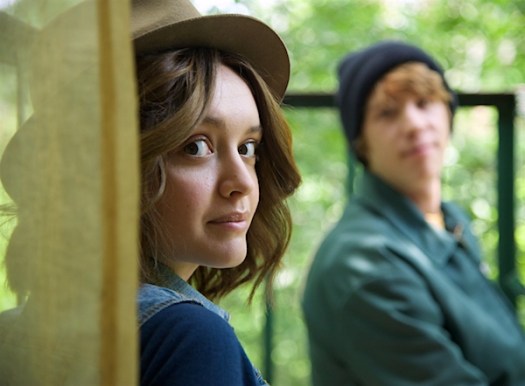
Me and Earl and the Dying Girl

This is a film about a high school student who makes movie parodies for fun, who befriends a dying girl. It won the Audience Award at Sundance. I’m not sure there’s any other knowledge you need to judge if you’ll like this movie or not. Except normally that’d have me thinking “oh God, here we go,” but I liked it enough to put it in my Top 20 of last year.

So, I admit, I went into the film feeling pretty cynical about it. I was expecting to find a movie tailor-made to be an indie cinephile’s dream comedy-drama. There are elements of that about it, but I must also admit I ended up being won round and affected by the film, to the point of feeling quite emotional and often a little teary for, ooh, most of the second half. Was I just manipulated into feeling that way? Well, that question is a fallacy. All film is emotionally manipulative, because it has been constructed to achieve a purpose, and the people who complain about feeling manipulated by sappy dialogue or heavy-handed music or whatever have just seen behind the curtain, as it were. For these reasons it kind of annoys me when critics or ‘film fans’ get annoyed about a film being “manipulative”, but maybe that’s a rant for another time.

Me and Earl and the Criterion Collection

Anyway, as I was saying, I kind of didn’t want to like Me and Earl and the Dying Girl because I didn’t want to fall into the obvious trap of “this movie totally gets me because I love Criterion editions too!” But I thought it worked in spite of those pandering affectations. Or maybe I just couldn’t resist them on a subconscious level? In some respects it doesn’t matter how it achieved it: the film wanted to make me feel a certain way, and I did feel that way — success.

Perhaps another reason it worked for me was the positioning of Greg (the titular “Me”) as a high school “Everyman”, not affiliated with any of the school’s multitudinous social groups. I don’t think I’ve seen that in a film before. What movies (and TV) have taught us about American high schools is that they are chocka with rigid cliques, and everyone belongs in one group or another. Is that true? I have no idea — but as far as movies (and TV) are concerned, yes it is. I don’t think it’s the case out in the rest of the world (well, at least not in the UK); not so rigidly and antagonistically as it’s depicted as being in US high schools, anyway. Nonetheless, I could identify with Greg’s status as someone able to drift around groups being generally well-liked but also almost entirely unnoticed, which perhaps helped me buy into him and his emotional journey a little more, thereby explaining the film’s ultra-effective emotional manipulation effect.

The Dying Girl

A lot of what works lies in the performances. As “the dying girl”, Rachel, Olivia Cooke is fantastic. She’s got the showy role, but manages to play it with subtlety. Instead of the usual indie movie Manic Pixie Dream Girl, the lead character / narrator is the Quirky one and she’s a cynical girl who undercuts him, which is kinda fun. Nonetheless, as the film’s “Me”, Greg, Thomas Mann has a less obviously showcasing part, but the way he handles it — especially as the film moves away from the “he’s a Quirky film fan who’s uncomfortable in high school just like you” aspect — is essential to how the film’s relationships and emotions function.

Nowhere is this better exemplified than in a two-hander between the pair: achieved in a single static shot that lasts five minutes, they don’t look at each other while they argue and their friendship struggles. It’s a frankly stunning scene from all involved: kudos to Jesse Andrews (who wrote both the original novel and the screenplay) for the plausible and complex dialogue; kudos to Alfonso Gomez-Rejon for the confident blocking of both actors and camera; kudos to both of the actors for their layered, emotive, but not grandiose, performances.

Several supporting cast members are also worthy of note: Jon Bernthal as a cool teacher; Molly Shannon as Rachel’s mom; and Nick Offerman for once again perfectly judging the level of funny his character needed to hit to be comic relief but also stay tonally consistent with the rest of the film.

Fake Criterions

A final stray thought before I wrap up this rather bitty review: I’ve read a few comments that make a point of mentioning this is not like all those other “teen death” movies, or that if you’re sick of all those then this one’s still good, and so on. I’m kind of aware these “teen death” movies exist and that there’ve been a few, but I’ve never bothered to watch one (because, frankly, they’ve all sounded rubbish), so I am immune to any overkill other viewers may experience. But if there’s a lesson here (and I’m not saying there is) it would be that you don’t have to watch every high-profile film that comes out (unless you’re a critic and being paid to do it).

4 out of 5

Me and Earl and the Dying Girl placed 14th on my list of The 20 Best Films I Saw For the First Time in 2016, which can be read in full here.