July’s Failures

Welcome to my monthly “Failures” column, where I look back at some of the films I could, would, maybe even should have watched last month… but failed to.

The current big news on the big screen is undoubtedly Deadpool & Wolverine, which I might have actually gone to see if I hadn’t been busy this past weekend. Social media reaction seems divided: the fanboys love it (of course they do), while more serious-minded critics are cautious bordering on negative. I might still make the effort this coming weekend, or it might join the long list of post-Endgame MCU titles I just haven’t got round to. The fact it’s something oaan capstone to the Fox era of superhero movies sways me more in its favour, but still, we’ll see.

Also filling multiplexes were routine animated sequel Despicable Me 4 and belated, nostalgia-fuelled blockbuster sequel Twisters. I’ll inevitably catch both eventually, but I still haven’t seen the last Minions film and it took me a couple of decades to get round to the first Twister — which is no more than a perfectly adequate film — so I’m hardly in a rush. Of more interest are Kill, an Indian action film that I’ve heard is very good (to the extent that John Wick’s Chad Stahelski is already working on a US remake), and I Saw the TV Glow, which feels like it’s been attracting praise on Letterboxd forever but has only now made it to UK screens. Nonetheless, I’ll wait for discs on both of those (not least my local isn’t screening them). And further down my future watchlist, a pair of horrors: Longlegs, which seems to have provoked a lot of chatter, mainly about Nic Cage’s performance, which makes it interesting to me; and MaXXXine, but I’ve not seen X or Pearl yet so that one’s a ways down the list.

In theatrical-adjacent news, Amazon Prime Video finally brought Guy Ritchie’s The Ministry of Ungentlemanly Warfare to the UK. All of Ritchie’s films seem to go direct to Amazon here these days, for good or ill. It’s a bit of a coin-toss whether I’ll get round to it anytime soon or not, but it’s definitely on the watchlist. Amazon seemed to be leading the way with original premieres this month, also debuting sequel My Spy: The Eternal City (I never caved to watching the original, even during the pandemic, so this is hardly a priority for me) and Space Cadet (this sounds kinda like “Legally Blonde in space”, which mildly tempts me, but reviews are terrible). All I have noted down for Netflix, on the other hand, is original anime The Imaginary. Sky / NOW also got in on the action with a modern-day kid-friendly spin on the Robin Hood legend, Robin and the Hoods; while I do believe Disney’s Young Woman and the Sea had some kind of theatrical release, but it was so limited that its Disney+ debut is basically a premiere.

Other films making their way to streaming post-theatrical included Wicked Little Letters on Netflix, which looks fun; The Iron Claw on Amazon, which seemed to attract positive buzz when it was in US cinemas; and on Sky / NOW, box office surprise smash romcom Anyone But You, the musical remake of Mean Girls, and Chinese animation (that I saw recommended somewhere) Deep Sea. Also Jericho Ridge, which I’d not heard of before it popped up on NOW, but its Assault on Precinct 13-esque premise sounded neat. And I don’t imagine it had a theatrical release, but it’s out on disc, so Amazon saved me having to pay for Bruceploitation (i.e. Bruce Lee exploitation) documentary Enter the Clones of Bruce. I say “saved” — that’s relative to me actually watching it before it’s inevitably removed one day…

There were back catalogue comings and goings a-go-go, of course, though what caught my eye this month was a large vein of things I’ve upgraded to 4K on disc but not (re)watched yet. Those included (deep breath) The Babadook, Black Hawk Down, Crouching Tiger, Hidden Dragon, Deep Impact, Dr Who and the Daleks and its sequel, Daleks – Invasion Earth: 2150 AD, Drive, Enter the Dragon, the original Ghost in the Shell, Gladiator (really should revisit that before its sequel lands), The Green Mile, The Revenant, RoboCop (more on that later), RoboCop 2 (that too), The Shawshank Redemption, Top Gun: Maverick (which I also should’ve reviewed by now), and Training Day. Not to mention all the stuff I’ve just straight up bought on 4K and not watched yet, like Elvis, Possessor, The Sisters Brothers, and The Batman (it’s absolutely ridiculous that I still haven’t watched that). I expect I could generate a similarly lengthy list of films I own on unwatched Blu-rays that are now ‘free’ on streaming — though one that did stand out to me was Gravity, because it’s currently on both Amazon Prime and BBC iPlayer and it reminded me I’ve never watched it in 3D, despite owning a 3D TV for over seven years now. Same goes for Dredd (which was streaming on Channel 4 this month) and… well, plenty of other things (that aren’t currently streaming; and probably some that are).

None of which stops me buying piles of new discs, of course, including several that could feature in the above list — indeed, two do: RoboCop, which I finally picked up in Arrow’s recent sale; and the recently-released RoboCop 2 (from the US, because I did one of my bulk orders again). Other upgrades thanks to the Arrow sale included Time Bandits (it would’ve been neat to watch that before the new TV version started, wouldn’t it?) and Videodrome; while other 4Ks in that US order included giallo The Case of the Bloody Iris, an upgrade all the way from DVD for The Departed, and Criterion editions of I Am Cuba, McCabe & Mrs Miller, and The Red Shoes.

Back in the UK, 4K new releases included both brand-new titles like Alex Garland’s Civil War and Dev Patel’s Monkey Man (both of which I’m keen to see, so it’s daft they’re having to be featured here), plus new releases for older titles, like Second Sight’s A Bittersweet Life, Indicator’s Bruiser (which means I now own all of George A Romero’s feature films in HD or 4K), Arrow’s The Man from U.N.C.L.E., and Curzon’s Memories of Murder.

Comparatively, I have very few regular ol’ HD titles to note. From Radiance’s latest slate, I limited myself to just Tai Kato’s Eighteen Years in Prison (yes, this is me trying to cut back), plus their partner label Raro Video’s release of Michael “Witchfinder General” Reeves’s Revenge of the Blood Beast (more commonly known online as The She Beast). I also finally upgraded classic TV series The Prisoner to HD, importing the recent Imprint release from Australia — it surely cost more than Network’s release would have back in the day, but that’s out of print (RIP Network) and at least this one comes with more special features (overall — it is missing a couple). Along with that, I finally stumped for an HD copy of the 2003 Zatoichi (there have been various releases, none of which seem to have the quite right PQ, but most of which do look better than my old DVD) and my most ridiculous purchase of the month, David Lynch’s Dune — ridiculous because I already own Arrow’s 4K release, but I bought this version for feature-length behind-the-scenes documentary The Sleeper Must Awaken: Making Dune. Was that a reasonable purchase? I guess it depends how good the doc is. I’ll have to actually watch it to find out.
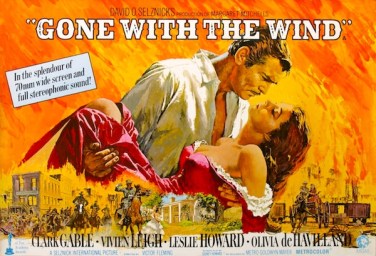
Gone with the Wind (1939)

100 Films’ 100 Favourites #41

The most magnificent picture ever!

Country: USA
Language: English
Runtime: 233 minutes
BBFC: A (cut, 1940) | PG (1988)
MPAA: G (1971)

Original Release: 15th December 1939 (premiere in Atlanta, Georgia, USA)
US Release: 17th January 1940
UK Release: 18th April 1940 (premiere)
First Seen: TV, c.2005

Stars
Clark Gable (It Happened One Night, Mutiny on the Bounty)
Vivien Leigh (Fire Over England, A Streetcar Named Desire)
Leslie Howard (Of Human Bondage, 49th Parallel)
Olivia de Havilland (The Adventures of Robin Hood, The Dark Mirror)
Hattie McDaniel (Show Boat, Song of the South)

Director
Victor Fleming (The Wizard of Oz, A Guy Named Joe)

Screenwriter
Sidney Howard (Arrowsmith, Dodsworth)

Based on
Gone with the Wind, a novel by Margaret Mitchell.

The Story
The American South, 1861: wealthy teenager Scarlett O’Hara spends her days attending parties and flirting with her many admirers, though she only really has eyes for her neighbour, Ashley. After he declares his intention to marry his cousin Melanie, a furious Scarlett meets Rhett Butler, a practically-minded gent who only serves his own interests. When the American Civil War breaks out, Scarlett has to apply her manipulative nature to survival, as down the years she engages in a love/hate relationship with the similarly-tempered Rhett.

Our Heroes
Scarlett O’Hara is the perennial belle of the ball in her Southern community, until the American Civil War comes and she’s forced to grow up. Her innate selfishness and tendency to manipulate people (or try to, at least) helps her survive the conflict in more-or-less one piece. Equally self concerned is Rhett Butler, a gentleman not afraid to stand up to Scarlett, which is why they clash, and why they’re probably made for one another.

Our Villains
Those damn Unionists, with their trying to get rid of slavery and everything!

Best Supporting Character
Hattie McDaniel is memorable, likeable, and Oscar-winning as the O’Haras’ maid, Mammy. Whether her performance was a good thing for the African American community or just an ‘Uncle Tom’ is another matter.

Memorable Quote
“As God is my witness, as God is my witness they’re not going to lick me. I’m going to live through this and when it’s all over, I’ll never be hungry again. No, nor any of my folk. If I have to lie, steal, cheat or kill. As God is my witness, I’ll never be hungry again.” — Scarlett O’Hara

Quote Most Likely To Be Used in Everyday Conversation
“Frankly, my dear, I don’t give a damn.” — Rhett Butler

Memorable Scene
In the streets of Atlanta, Scarlett comes across the casualties from the battle. First we only see her face as she comes upon a shocking sight. Then it cuts to a long-shot: Scarlett stood by some soldiers, a couple of wounded men on the ground before her. The camera tracks back as Scarlett walks forward, gradually revealing the field of wounded soldiers she’s walking among. It continues to pull back, up into the sky, for a full 55 seconds, the injured stretching as far as the eye can see as a damaged Confederate flag flutters into view in the foreground.

Technical Wizardry
The Technicolor photography by Ernest Haller is absolutely gorgeous, and looks better than ever nowadays thanks to new restoration techniques developed in 2004 (12 years ago?! Where does time go?) That restoration is where the real wizardry lies. Gone with the Wind was shot with Technicolor’s three-strip process, in which a prism split the light entering the camera into its green, red and blue parts, which were each exposed on a strip of black-and-white film. These strips were then dyed the appropriate colour, before being combined onto a new film to create the final full-colour print. Naturally this process was liable to human error: misalign one of the strips by even the slightest amount and you get errors; small and almost unnoticeable, maybe, but less than perfection. In 2004, they went back to the original three strips and, using complicated new computer programs, realigned them from scratch. This perfect alignment revealed details that have always been on the film but would never have been seen before, meaning these movies (they also did it for the likes of The Wizard of Oz, Singin’ in the Rain, and The Adventures of Robin Hood) literally looked better than they ever had. Magic.

Letting the Side Down
There are a raft of criticisms that can be levelled at Gone with the Wind, from its depiction of black characters, to making the South seem not so bad, to the faithfulness of its adaptation (too much). The second half is certainly less focused and less memorable than the first, but the whole overcomes that, for me.

Making of
The search for an actress to play the leading role of Scarlett O’Hara is legendary — it was even dramatised in an Emmy-winning TV movie in 1980. In all it lasted two years, including an open casting call that interviewed 1,400 unknowns (useless for casting, great for publicity), and the formal screen-testing of 31 actresses, including the likes of Lucille Ball, Clara Bow, Joan Crawford, Bette Davis, Katharine Hepburn, Ginger Rogers, Barbara Stanwyck, and many more. In the end, it of course went to a young British actress, then unknown in America, called Vivien Leigh. The rest is screen history.

Next time…
Fans and filmmakers alike tried to get Margaret Mitchell to write a sequel until her death in 1949. In the ’70s, her brother agreed a deal with MGM and Universal under which a novel would be written and simultaneously adapted into a film. Despite a 775-page manuscript being produced, the deal fell apart. Numerous sequel novels have been published, and in 1994 one of these, Alexandra Ripley’s Scarlett, was adapted into a miniseries starring Joanne Whalley as Scarlett and Timothy Dalton as Rhett, with a supporting cast that includes Sean Bean, John Gielgud, and Ann-Margret. Apparently it’s not very good.

Awards
8 Oscars (Picture, Actress (Vivien Leigh), Supporting Actress (Hattie McDaniel), Director, Screenplay, Color Cinematography, Art Direction, Editing)
1 Honorary Award from AMPAS (for “outstanding achievement in the use of color for the enhancement of dramatic mood”)
1 Technical Achievement Award from AMPAS (for being “pioneering in the use of coordinated equipment”)
5 Oscar nominations (Actor (Clark Gable), Supporting Actress (Olivia de Havilland), Score, Sound Recording, Special Effects)

What the Critics Said in 1939
“There has never been a picture like David O. Selznick’s production of Gone With the Wind. It is so true to Margaret Mitchell’s novel of the Civil War, as it was fought in and around Atlanta, that the film is of the same epic quality as the book. […] Vivien Leigh, the little English girl imported to play the role of Scarlett, gives a magnificent performance. No other actress in Hollywood, or on the New York stage, could have come close to equalling it. […] She is pert and beautiful, lacking in erudition but the possessor of all the arts and allure of the vital female. She is quick-tempered, selfish, untruthful, sturdy and wilful as a lioness. No attempt has been made to gloss over Scarlett’s weaknesses and sins. As she is, she dominates the picture from its gay and light-hearted beginning to its tragic close.” — Kate Cameron, New York Daily News

What the Critics Said in 1973
“The most interesting way to consider GWTW today is in comparison with the film that may eventually surpass it in profits, The Godfather. Look at the similarities. Both originated in best-selling American novels. Both are very long. Both are about predators. Both are ultra-American yet are very closely allied to Europe (Walter Scott and Sicily). And, most important, both live within codes of honor, and both codes are romances. William R. Taylor has shown, in Cavalier and Yankee, that the ‘Walter Scott’ antebellum South was largely a literary fabrication, concocted at the time, not retrospectively; as for The Godfather, our newspapers show us daily that ‘They Only Kill Each Other’ is just another escape hatch to allow us to blink facts. ‘Us,’ by the way, means the world, not just the United States, since the whole world flocks to both films. And that’s interesting, too, because it leads to a difference, not a likeness. In a new age, when the ‘realistic’ Godfather is packing them in, the romantic GWTW is still popular. There’s a crumb of comfort in that: at least culture is still more pluralist than some of our propagandists would have us believe.” — Stanley Kauffmann, The Atlantic

What the Critics Said in 2015
“Its stereotype of happy slaves and kindly masters has never been more wince-inducing […] But no one watches Gone with the Wind for historical accuracy. What keeps us coming back is four-hours of epic romance in gorgeous Technicolor. Slavery, the Civil War, the burning of Atlanta, a street knee-deep in dead soldiers—all just a backdrop to the main event, Scarlett ’n’ Rhett. The feminist jury is still out on Southern belle Scarlett O’Hara (Vivien Leigh). Nothing but a serial husband-thief? Or a resilient modern woman doing what she can to survive? You decide.” — Cath Clarke, Time Out

Score: 94%

What the Public Say
“What’s striking almost 75 years on is how fresh and modern both Rhett and Scarlett remain. Gable’s eyes twinkle as he rolls Sidney Howard’s dialogue around his mouth, but there’s also a sadness there and a resignation that, no matter how hard he tries, he and Scarlett can never last. Leigh, who came through a tortuous audition process to land the part, positively crackles. Although still one of the feistiest and most driven female parts committed to screen Scarlett is, for the most part, pretty damn annoying and does little to enamour herself as the film progresses. […] Rhett sums Scarlett up perfectly when he remarks that she’s ‘like the thief who isn’t the least bit sorry he stole, but is terribly, terribly sorry he’s going to jail’.” — Three Rows Back

Elsewhere on 100 Films
I briefly reviewed Gone with the Wind after a re-watch way back in 2007, when I assessed that “the direction is brilliant, displaying styles you think weren’t invented for another 20 years; all of the design work is gorgeous; and the story is epic and expertly told, moving across genres (romance, war, melodrama, comedy) with ease. It’s easy to see why this is the most popular film ever made.”

Verdict

Last week I wrote about the enduring mass popularity of The Godfather, and here’s another case in point. Gone with the Wind may not rack up the ratings in the same circles as Coppola’s opus, but it has consistently been voted America’s most favourite movie, and its numerous massively successful re-releases mean that, adjusted for inflation, it’s still the highest grossing movie of all time. It’s an epic in the truest sense of the word, with a story spanning many years and many miles, passing by historical events in the process. However, at its core it’s the story of a tumultuous romance between two people, who may love each other or may hate each other, but who, with their unique, selfish, manipulative perspectives, are surely perfect for each other.

#42 will be… #42 will be… #42 will be…

C.S.A.: The Confederate States of America (2004)

2007 #79
Kevin Willmott | 89 mins | DVD | 12

C.S.A.: The Confederate States of AmericaMockumentary about the history of America had the South won the civil war.

While an intriguing idea, in practice it’s disappointing. Apparently such a victory would have led to everything the nation did since being in order to maintain slavery. There are some neat ideas (a Cold War with Canada) and some genuinely amusing or cleverly satirical bits, but the focus is too narrow and, consequently, unbelievable and sometimes dull. It also seems unable to break away from reality far too often: Wall Street still crashes, JFK becomes President and is assassinated, etc.

The acting is frequently dodgy and it all has a very amateurish feel. To top it off, considering it’s pretending to be a British documentary, the style is too like cheap American TV documentaries.

All in all, a disappointment.

2 out of 5

C.S.A. featured on my list of The Five Worst Films I Saw in 2007, which can be read in full here.