
Don Hall & Chris Williams | 102 mins | Blu-ray | 2.39:1 | USA / English | PG / PG
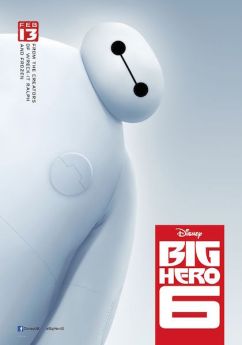 This year’s Best Animated Film Oscar winner is not this year’s best animated film. Not by a long stroke. What it is is one great character, one great emotional plot/subplot, and a lot of stuff that feels like every other big-budget action-orientated CGI animation of the past few years. Most succinctly, this is little more than (as a reviewer on Letterboxd dubbed it) “How to Train Your Baymax”.
Set in a world where teenage kids seem to be constantly inventing groundbreaking robotic tech that multinationals spending billions on R&D haven’t come up with, the plot sees 14-year-old genius Hiro (Ryan Potter) bonding with his brother’s invention, a medical diagnosis/treatment robot called Baymax (Scott Adsit), while they investigate the theft and abuse of Hiro’s own invention. After stumbling across a mysterious masked supervillain, they team up with a gaggle of equally-skilled college friends to transform themselves into a superhero team.
Adapted from a Marvel comic book — albeit so loosely that Marvel didn’t even feel they could justify issuing a tie-in edition of the original — this is “Disney does superheroes”. Unfortunately, that’s not what Disney does best. The real meat and fun of the film comes in earlier sections, where Hiro and Baymax bond, where the emotional storyline is explored. I’m working hard not to spoil the latter plot — other reviews merrily do, because it’s kicked off in act one, but I went into the film blind and think it worked better for that. Based on interviews, some of the filmmakers seem to be under the impression that part of the film is up there with the infamous “Bambi’s mother” narrative. I don’t think it’s that striking, nor that universal, but it’s a bolder move than you normally see in kid-focused US animations.
 The element that is an unequivocal success is Baymax. A soft robot — made of inflated vinyl so as to be genuinely huggable — he’s sweet, funny, and always entertaining. Memorable moments abound, in particular a sequence where his batteries run low, and his interpretation of a fist-bump (a recording booth improvisation by Adsit that was worked into the film). The movie truly comes alive whenever he’s on screen, but conversely loses some magic whenever he’s pushed into the background.
Otherwise, there’s some nice animation and design. It’s set in the city of San Fransokyo, which is imagined as what San Francisco would be if Japanese immigrants had rebuilt it following the 1906 earthquake. The design work is top-notch and the amount of world they built incredible, but it then goes underused, only glimpsed as background detail during one flying sequence. Worse, much of the movie’s story is sadly derivative, especially towards the end. It’s a bit hole-y too, and uncomfortably pushes at the boundaries of plausibility — I know it sounds silly to say that about a future-set superhero movie for kids, but c’mon, the way our young heroes can just merrily invent all kinds of super-advanced stuff just doesn’t make sense.
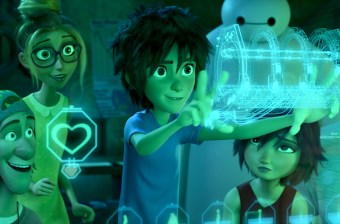 Big Hero 6 is by no means a bad film. It will certainly entertain its target age group, especially if they haven’t seen the other CG spectacles it nabs from. That aside, the entire thing is worth a look purely for Baymax and a few stand out moments — all of them involving the aforementioned vinyl robot, of course. Otherwise, it’s pretty by-the-book. The five-star-level praise it’s attracted in some quarters is completely unwarranted.

Big Hero 6 is released on US DVD and Blu-ray this week, and is still in UK cinemas.
 Bolt is the 48th film in Disney’s animated canon (whatever the official name for that is these days), from their CG-only era that filled most of the ’00s. It’s a period already remembered as When Disney Lost Its Way, after the second (or is it third? I forget) ‘golden era’ of the early ’90s; the time that produced flops like
 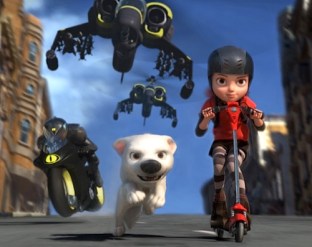 Also noteworthy are the action sequences. Far from being perfunctory attempts at liveliness, these are properly exciting, making full use of 3D CGI to create exciting and dynamic sequences. I’m not just talking about the couple we get from the TV-series-within-the-film either, but also the ‘real world’ ones as Bolt, Mittens and Rhino jump onto trains, out of moving vans, escape from a pound, etc. Of course, the TV-series-within-the-film is completely implausible — like you could film a TV show with massive action sequences in such a way that you only ever do a single take, never mind achieve all those effects on a TV budget. But then this is a film where a talking dog, cat and hamster work together to travel from New York to Hollywood entirely of their own volition — I think it’s safe to say no one’s aiming for documentary levels of realism.
 It would be easy to dismiss Bolt as part of Disney’s CG folly, especially as it stars Miley Cyrus and is immediately followed by their return to 2D animation, but I think that would be a mistake. It’s a fast-paced and fun adventure, with accurately-captured animals meaning it’s especially likely to appeal to dog lovers. Disney’s next golden era just might begin here.
 100Films.co.uk