
William Wyler | 222 mins | Blu-ray | 2.76:1 | USA / English | PG / G
 1960 Academy Awards
12 nominations — 11 wins
Nominated: Best Adapted Screenplay.
“All that you have read about Ben-Hur, all that you have heard about Ben-Hur, is surpassed by the actuality.”
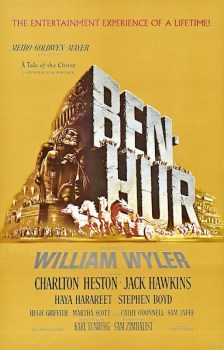 So claims Ben-Hur’s 1961 trailer. They were cocky back then, weren’t they?
The third (of, to date, six) screen adaptations of Lew Wallace’s 1880 novel Ben-Hur: A Tale of the Christ, the 1959 version is certainly the most famous, in part because it was the sole holder of the title “winner of most Oscars” for 38 years (until Titanic equalised, followed by Return of the King just six years later), and also because of its chariot race climax — which comes almost an hour before the end, because it’s also really bloody long (over 3½ hours even without counting the overture, intermission, and entr’acte). It’s also really rather good, though it’s a tale that would be better without the Christ.
Although it begins and ends with that Jesus fella, it’s really the story of Judah Ben-Hur (Charlton Heston), a Jewish prince of Roman-occupied Jerusalem in 26AD. When Messala (Stephen Boyd), Judah’s childhood friend (and, possibly, lover — I’ll come to that), returns as head of the city’s Roman garrison, he asks for Judah’s help in capturing dissident Jews. Judah refuses, his loyalty more aligned to his faith and countrymen than the glory of the Roman Empire. Consequently, a spurned Messala uses a slip-up during the arrival of the region’s new governor as an excuse to arrest Judah, condemning him to slavery. Cue a couple of hours of desert treks, rowing, sea battles, ethnic dancing, a blackface Sheik, gambling, that chariot race, leprosy, and Jesus getting crucified (spoilers!)
I’m being flippant, but most of this is suitably dramatic. It’s a proper epic, a grand story with huge set pieces and world-changing events, and it’s executed with a scale suitable to that narrative. Despite the length, it’s almost constantly engrossing. I had planned to split it over two nights at the intermission (despite the imbalance that causes — Part One is an hour longer than Part Two),  but was so invested that I stuck with it regardless. There are things that have aged poorly, be that the model effects in the sea battle or using a white actor in heavy make-up to portray an Arab, but I think you have to take these things with a certain element of the spirit of the era — I’m sure no offence was intended (see also: Lawrence of Arabia).
More harmful to the film’s quality is the Christ element. I guess this is seen as an integral part of the story by some people: it’s the subtitle of the original novel and the 1925 film; this version includes it on screen right after the title card; and both this film and the novel have received rare approval from the Vatican. Knowing this, I was prepared to be open-minded about it. At times, it’s fine. Jesus’ life is going on at the same time as Ben-Hur’s, and occasionally it intersects in ways that bolster the film’s story or help reflect some of its themes, like forgiveness (or otherwise). The problem comes at the end: the story climaxes, and then the narrative toddles on with what you might kindly call an extended epilogue that sees Judah realise Christ’s importance as he witnesses the crucifixion. Perhaps this could work in itself (though, without wanting to spoil developments, the way it’s used to solve some problems is incredibly pat), but it runs on too long with too little direct relevance. Apparently director William Wyler, who was Jewish, was keen to make a film that would appeal to all faiths, and insisted that it was the personal story of Judah Ben-Hur that was largely responsible for the film’s enduring success. I think he’s absolutely right about that: the story — the actual story — is wrapped up about half-an-hour before the film itself ends. It doesn’t prevent what comes before from being highly enjoyable, but it’s so tangential and long-winded that it becomes a problem. Ultimately, I knocked a whole star off because of it.
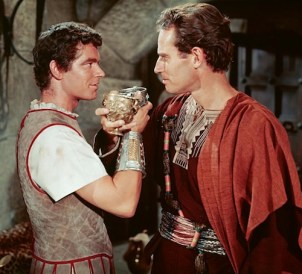 This Christian aspect contrasts sharply with the other subtext I alluded to earlier: the possibility that Judah and Messala were once lovers. The claim originates with screenwriter Gore Vidal, who may or may not have written some or all of the screenplay that was used for shooting. According to Vidal, he and Stephen Boyd discussed the idea before shooting began, and then Boyd played the scenes with it in mind. However, it was kept hidden from Charlton Heston because he’d never agree to it, and when the notion was put to him later he naturally denied there was any homosexual subtext. Whether this tale is true in the literal sense of that subtext being written into the screenplay and Boyd choosing to incorporate it into his performance, I don’t know, but the content of the film makes it easy to believe — the scenes between Messala and Judah, especially when they’re first reunited, absolutely play like there’s a romantic history between them. Bear that in mind and it seems to reoccur later, too: when the story returns to Jerusalem after several years, Messala seems particularly close to his deputy; and there are a couple of shots of Judah being chummy towards a random stableboy (I mean, they’re not much, but if you watch it with the assumption that Judah is gay or bi…) What does this signify? Perhaps not a great deal. I’m sure you can choose to completely ignore it. I imagine some would passionately deny even the possibility it’s there. Personally, I think it adds something to the characters’ relationship.
Believe that subtext or not, Boyd is excellent as Messala. He was overlooked at many awards in favour of Hugh Griffith as the aforementioned Sheik. Not that Griffith is bad, but there’s far more nuance, variety, and power to Boyd’s performance. He’s much more deserving of a gong than Heston, even, who’s a very capable leading man type, but I’m not sure his performance has the kind of depth that would pass muster for Best Actor today. That said, Mike at Films on the Box makes a good case for his defence! Either way, 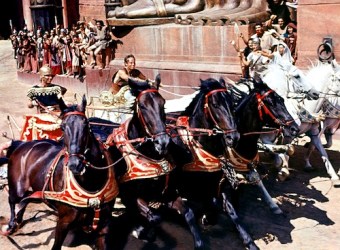 the technical awards the film scooped up are certainly merited. The cinematography is fantastic, with the landscape shots making particularly excellent use of the extra-wide frame. As for the chariot race, it stands up as an incredible action sequence even today, driven by thrilling camerawork and editing, and showcasing some daring stunt work.
When it’s dealing in this kind of material, the actuality of Ben-Hur does indeed surpass its reputation. It’s a shame there’s that other stuff that spoils the party.

The new, sixth screen adaptation of Ben-Hur is released in the UK later this week.
Ben-Hur was viewed as part of my What Do You Mean You Haven’t Seen…? 2016 project, which you can read more about here.
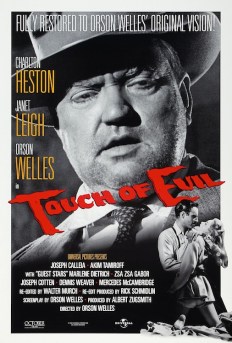 A bomb is stuck to the underside of a car. As the vehicle pulls away, the camera drifts up into the sky, and proceeds to follow the automobile through the streets of a small Mexican border town, until it crosses the border into the US… and explodes. It’s probably the most famous long take in film history, and probably the thing Touch of Evil is most widely known for; that, and it being one of the most commonly-cited points at which the classic film noir era comes to an end.
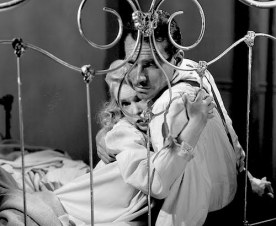 It’s like a terrible fever dream, with events and characters that sometimes seem disconnected, but nonetheless interweave through a dense plot. In this sense Welles puts us quite effectively in the shoes of Vargas and his wife — out of our depth, out of our comfort zone, out of control, struggling to keep up and keep afloat. It might be unpleasant if it wasn’t so engrossing.
 Quinlan at all… there is not the least spark of genius in him; if there does seem to be one, I’ve made a mistake.” You can get pretentious about it all you want, and bring to bear political views that the film doesn’t support (after all, within the film Quinlan is punished for his crimes and the “mediocre” (Truffaut’s word) moral hero triumphs), but sometimes a spade is a spade; sometimes a villain is a villain; sometimes your disgusting moral perspective isn’t being covertly supported by a film that seems to condemn it.
 Notably and obviously absent from that list is Touch of Evil. It was taken away from Welles during the editing process, and though he submitted an infamous 58-page memo of suggestions after seeing a later rough cut, only some were followed in the version ultimately released. Time has brought change, however, and there are now multiple versions of Touch of Evil for the viewer to choose from; but whereas history often resolves one version of a film to be the definitive article, it’s hard to know which that is in this case. Indeed, it’s so contentious that Masters of Cinema went so far as to include five versions on their 2011 Blu-ray (it would’ve been six, but Universal couldn’t/wouldn’t supply the final one in HD.) The version I chose to watch, dubbed the “Reconstructed Version”, tries to recreate Welles’ vision, using footage from the theatrical cut and a preview version discovered in the ’70s to follow his notes. Despite the best intentions of its creators, this can only ever be an attempt at restoring what Welles wanted. Equally, although it was the version originally released, the theatrical cut ignores many of the director’s wishes — so as neither version was finished by Welles, surely the one created by people trying to enact his wishes is preferable to the one assembled by people who only took his ideas on advisement?
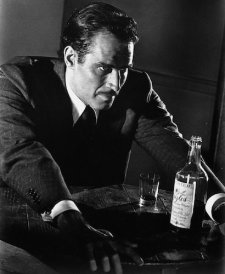 To quote from Master of Cinema’s booklet, “the familiar Wellesian framing appears in 1.37:1: indeed, the “world” of the film setting emerges with little or no empty space at the top and bottom of the frame, almost certainly beyond mere coincidence.” There are things to recommend the widescreen experience (“a more tightly-wound, claustrophobic atmosphere”), and undoubtedly the debate will continue… and such is the wonders of the modern film fan that, rather than having to make do with someone else’s decision on what to put out, all the alternatives are at our fingertips.
 Following his success with
  100Films.co.uk