

The 60th film in Disney’s animated canon was, despite that status, sent straight to streaming in the midst of the pandemic. Possibly because of that, it seemed to catch on quite quickly as their latest major success. Case in point: one of the songs — We Don’t Talk About Bruno — ended up having greater chart success than Frozen’s notorious Let It Go.
(I’ve got to take the time to say that I find this quite baffling. I don’t love Let It Go (I’m a 36-year-old man, not a six-year-old girl in 2013), but it’s clearly a catchy tune with lyrics that transcend its place in the film — you can understand how it became such a huge hit. But for the life of me I can’t work out why We Don’t Talk About Bruno has surpassed its success. It’s a likeable song that plays well in the movie — and I think hearing it in place is important, because the first time I heard it was on the radio and I couldn’t even work out what they were singing about. So, there’s nothing going on lyrically that makes it applicable in any other context, and I don’t think the underlying tune is so earwormy as to warrant play merely for that reason. Or maybe it is if you’re the right age, because clearly something made it a massive hit.)
Anyway, the film itself is about a family, the Madrigals, who live in a magical house in an isolated part of Colombia and all have magical powers — except Mirabel (Stephanie Beatriz), for reasons no one understands. But when the family begin to lose their abilities, finding out what’s going on and fixing it falls to Mirabel. Because of course it does.

Encanto doesn’t look like your typical Disney Princess movie, but it’s not functionally different to them. The Madrigal family’s powers mean they effectively rule over their small town, albeit in a benevolent way, which makes Mirabel a de facto Princess; and she has the usual Disney Princess hangups about feeling under-appreciated and needing to find her self-worth. But hey, at least she doesn’t also need to find a husband! Nonetheless, it’s welcome that the film is less traditional is its setting — present-day South America, rather than the typical fairytale land of historical Europe — and the pace is also up-to-date. In fact, it’s quite frantic. Like, okay, calm down a bit; take your time occasionally; let stuff stay on screen long enough for us to appreciate how good it looks. And the animation does look great, with detailed designs, fluid movement and dynamic camerawork, and an incredibly colourful palette, especially when fired up by HDR/WCG.
The songs are by Hamilton’s Lin-Manuel Miranda, unmistakably so. It’s something about the phrasing, the rhythm, the rhyme patterns… I’m no musicologist so I can’t adequately explain it, but they’re distinctively his work. But that’s what you want when you hire someone, right — their own voice. If you don’t like this style from his other work, chances are the music here won’t appeal to you either. If you do like it, there’s much to enjoy, from the opening number, The Family Madrigal, which introduces us to the large cast of characters at whipcrack pace, to my personal favourite, Surface Pressure, about one family member’s struggle with all the weight on her shoulders. And yet they put Dos Oruguitas up for the Original Song Oscar, apparently trying to emulate the success of Coco’s Remember Me. Oops. (Obviously they should’ve gone with breakout hit Bruno, but I reckon either of the other songs I’ve mentioned would’ve stood a better chance.)
One of Encanto’s directors is Byron Howard, whose previous work for Disney has encompassed Bolt, Tangled, and Zootropolis — three films I’d class as among the very best of Disney’s current purple patch. It’s a helluva record. Happily, Encanto continues it. I might rank it a little behind the other three when all is totted up, but being next in line to such strong movies is nothing to be ashamed of.

Encanto is the 28th film in my 100 Films in a Year Challenge 2022. It placed 4th on my list of The Best Films I Saw in 2022.
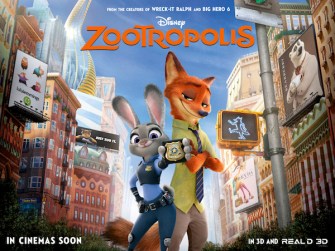 Disney’s 55th Animated Classic is their second highest-grossing ever, the 25th film to take over $1 billion at the worldwide box office, which makes it a hit of
  I think Zootropolis may be the first time they’ve attempted a neo-noir crime thriller, though. And I bet no one ever thought they’d see a Disney film with a sequence set at a nudist resort. Or in a drugs lab, for that matter. Or one with a substantial parody of
  However, that’s not to say kids can’t get enjoyment out of it: there are plenty of colourful characters and locations, relatable situations, cross generational humour, and a moral lesson young’uns will understand. There’s the DMV sequence, for instance, which is grounded in an adult experience but so funny it must cross over. Considering all the praise I’ve heard for that one scene, it’s also a feat it lives up to the hype. It’s gorgeously animated throughout, bolstered by a world that has been magnificently realised, with all the different themed districts of the city. (After all the Disney movies that have had contrived TV series spin-offs, this is a film that actually feels like it deserves one. The setup is obvious — a police procedural — and the world the film suggests is big enough to warrant it. Heck, it practically demands it — there’s so much more of this world, you want to see it explored.) Michael Giacchino’s score is different too: memorable and fun, in part thanks to using a cornucopia of unusual instruments to provide a ‘world music’ sound that’s in-keeping with the movie.
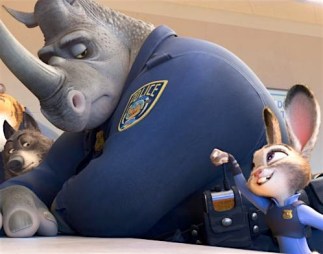 too, but that doesn’t mean the journey getting there is any less fun.
 Disney’s 50th animated feature is Rapunzel in all but name, for no particularly good reason. It seemed to be met with universal praise on its release last year, critics hailing it as a return to Disney’s previous quality after a run of lacklustre releases, in particular the underwhelming return to 2D in the year before’s
  a number I usually particularly enjoy. It has one, I suppose, but it’s one of the weakest examples I’ve ever heard.
 Bolt is the 48th film in Disney’s animated canon (whatever the official name for that is these days), from their CG-only era that filled most of the ’00s. It’s a period already remembered as When Disney Lost Its Way, after the second (or is it third? I forget) ‘golden era’ of the early ’90s; the time that produced flops like
 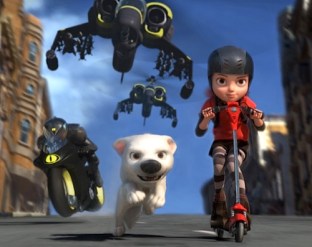 Also noteworthy are the action sequences. Far from being perfunctory attempts at liveliness, these are properly exciting, making full use of 3D CGI to create exciting and dynamic sequences. I’m not just talking about the couple we get from the TV-series-within-the-film either, but also the ‘real world’ ones as Bolt, Mittens and Rhino jump onto trains, out of moving vans, escape from a pound, etc. Of course, the TV-series-within-the-film is completely implausible — like you could film a TV show with massive action sequences in such a way that you only ever do a single take, never mind achieve all those effects on a TV budget. But then this is a film where a talking dog, cat and hamster work together to travel from New York to Hollywood entirely of their own volition — I think it’s safe to say no one’s aiming for documentary levels of realism.
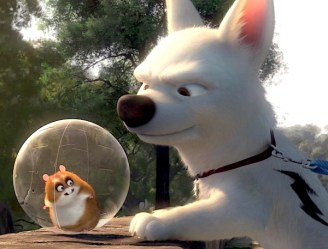 It would be easy to dismiss Bolt as part of Disney’s CG folly, especially as it stars Miley Cyrus and is immediately followed by their return to 2D animation, but I think that would be a mistake. It’s a fast-paced and fun adventure, with accurately-captured animals meaning it’s especially likely to appeal to dog lovers. Disney’s next golden era just might begin here.
 100Films.co.uk