Culloden (1964)

2009 #48
Peter Watkins | 69 mins | TV | 12

CullodenCulloden tells the story of the 1746 battle — famously, the last fought on British soil — and the events that followed it, as if it were covered by a modern TV news report (albeit a feature-length one).

This adopted style — a first — makes for an effective presentation. As a form it obviously foreshadows the docudrama, a method of presenting history which is so popular today, though not quite in this way. Writer/director Peter Watkins gratifyingly refuses to break from his premise: the whole film is very much like an extended news piece, featuring interviews, facts, and the famous BBC objectivity — at no point does the narration inform us who is good and bad, right and wrong, yet leaves us with little doubt about Watkins’ opinions (which are pretty low of just about everyone).

In fact, the film is fuelled by much youthful righteous indignation from Watkins, in his late 20s when Culloden was made. That said, his (perhaps unrealistic) idealism is still in evidence in every interview I’ve seen with him from decades later (though in those cases applied to what TV is and should be). But he allows it to dominate proceedings here, too often focusing on the awful conditions of the poor or the wrongs committed against them by Nasty Rich Folk. Should we be cross about this? It is 1746 after all — of course life was awful for common folk and the upper classes were rich twits who rode roughshod over them. That’s how things were in The Past, for thousands of years before it and hundreds of years after. With our modern developed sense of morality it all looks Nasty and Wrong, but we can’t go back and change it so why get so upset about it? Surely such vitriol is better directed at places where this is still the case?

While Watkins’ righteousness is clearly present before and during the battle, it’s really let loose in the aftermath, as English soldiers commit all sorts of atrocities to the Highlanders. Perhaps this was genuinely shocking and deserved in ’64, and it’s still true that the actions taken were unforgivably horrid, but it’s no longer shocking — not because we’re desensitized to violence at this point, but because we’re now very aware that we have done horrendous things throughout our history even while painting ourselves as the good guys (as we still do today, of course). Early on he describes the workings of the clan system, ostensibly factually but with a clear undercurrent of its unfairness; yet at the end bemoans its destruction by the English. Maybe this is why Watkins struggles to find anyone likeable in the film: they’re all as bad as each other.

Even if his overly moral stance falters, Watkins’ filmmaking techniques rarely do. The use of ordinary people as actors works fine most of the time, though occasional performances or scenes show off the cast’s unprofessional roots. Watkins’ theories about how TV should be run and the involvement of the public in the way he did here may be romanticised and impractical, but it’s hard to deny that his application of them worked wonders. Performances frequently aid the documentary effect by seeming just like those in genuine interviews or news footage, whereas even the best professional actors trying to emulate such reality are usually mannered enough for the viewer to realise they’re acting.

Best of all, however, is the titular battle. These scenes are extraordinary, creating a believability even the largest Hollywood budget has often failed to challenge. It’s epic but also involving, disorientating but clearly told, brutal without needing expensive prosthetic effects or an 18 certificate. It’s a brilliant example of camerawork, sound design and editing combining under inspired direction to create a flawless extended sequence.

Culloden was a bold experiment in filmmaking — indeed, the notion of a distant historical event being presented as if covered by news cameras still sounds innovative — and Watkins mostly pulls it off, with stunning battle sequences, effective performances and a high concept that is never betrayed. A few minor weak points aside, the only serious flaw is that Watkins lets his overdeveloped morality run unchecked. His application of a modern outrage to what seems a typical historical situation grates quite quickly but never abates, ultimately reclaiming a star from what is nonetheless an exemplary effort.

4 out of 5

Culloden placed 8th on my list of The Ten Best Films I Saw For the First Time in 2009, which can be read in full here.

Seance on a Wet Afternoon (1964)

2009 #64
Bryan Forbes | 111 mins | TV | PG

Seance on a Wet AfternoonDespite being an early-60s British domestic drama, Seance on a Wet Afternoon has a plot that one might describe as high-concept: a medium kidnaps a little girl so she can prove her abilities by revealing where the girl is. But, unsurprisingly, the execution is more in line with its roots: more drama than overblown thriller, not so much about the kidnap plot as the psychological state of Kim Stanley’s medium, Myra Savage, and her downtrodden husband, played by Richard Attenborough.
It certainly doesn’t start high-concept either, beginning with a near-15-minute dialogue-driven enigmatically expository two-hander. Some would consider the whole film too slow, I’m sure, but once it gets past this (to be frank, over-long) opening it maintains an appropriate pace. It never threatens to become a thrill-a-minute rollercoaster ride, but what it does do is build tension and gradually unveil the true natures of the two leads. In this regard it becomes something of a showcase for Stanley and Attenborough.

In a word, Stanley’s performance is stunning. Initially just a Hyacinth Bucket-esque overbearing wife, as the film continues we learn more about her almost solely from what Stanley brings to the role. By the final scene, when the truth of her character is laid bare, there’s little doubt that she’s given an extraordinary performance. She was Oscar-nominated for her role, losing out to Julie Andrews in Mary Poppins. I love Mary Poppins as much as the next well-adjusted human being, but Andrews’ relatively simple role isn’t a patch on the complexity Stanley has to offer.

In the face of this stiff acting competition, Attenborough holds his own throughout. His transformation is more understated perhaps — the ‘revelation’ here being that he is not downtrodden but in fact incredibly supportive, something that will only dawn on the viewer late on but shed a subtly different light on what has gone before — plus there is a degree of skill in portraying a character doing reprehensible things but who remains the audience’s surrogate ’til the last.

Bryan Forbes’ direction is also first-rate. He keeps things clear and simple during dialogue scenes, but adds scale with location work in busy London streets, and flair during a few tense sequences. The best of these is the second seance, where the kidnapped girl sleeps in a room next door. As she begins to stir, the viewer is torn between wanting the Savage’s plan to succeed and wanting the girl to be rescued from their misguided scheme. Such a dichotomy of feeling is entirely reliant on the skill displayed by Stanley, Attenborough and Forbes up to that point, building our allegiance to these characters in spite of what they’ve done.

Unfortunately, the film isn’t without its flaws. The story doesn’t always hold up — some of the police procedure is dubious at best, while the Savages’ scheme comes off as much through chance and luck as planning. In fairness, our ability to spot the former is probably in part thanks to decades of police procedurals filling the TV schedules, while the latter actually fits the under-confident, ill-prepared, dubiously-sane protagonists, and coincidence is mostly confined to the plot’s early stages. Some elements of the plan make you wonder how they ever thought they’d get away with it, though at the same time you have to allow that maybe they just weren’t that self-aware.

The real key to the film, however, is what’s slowly revealed over its course: Myra Savage’s mentality, as well as the truth about the history of her abilities and marital situation. To reveal any details would ruin the carefully controlled slow explanation of who these people are and what background they come from, all of which builds to a beautifully performed final few scenes. Seance on a Wet Afternoon may have a high concept driving its plot, but the true delights are to be found in its characters and the actors’ performances of them.

4 out of 5

Red Riding: 1983 (2009)

aka Red Riding: In the Year of Our Lord 1983

2009 #52
Anand Tucker | 100 mins | TV (HD) | 15

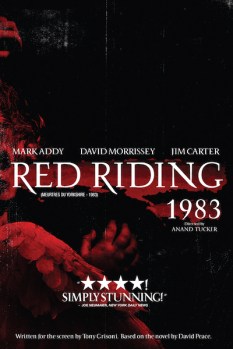
Red Riding: 1983The Red Riding Trilogy draws to a close with its finest instalment, a superior work in just about every respect.

From the off, 1983 returns to the story of the previous films, showing events from different perspectives. It’s dominated by a new story — the search for a child kidnapper in the titular year — but even this harks back to the past, the actual kidnapping closely resembling the one that kick-started 1974. Indeed, it’s 1974 that’s primarily drawn upon, confirming 1980 as little more than an aside in the scope of the trilogy.

1983 doesn’t just reiterate, however, but builds on previously-seen events and characters, both overtly — showing the police investigation into Clare Kemplay, which was the story of 1974 — and more subtly — Hunter’s apparent sidekick being present at secret meetings of the Evil Policemen in 1974. Despite clear links to the past, 1983 may also work well enough on its own. It’s undeniable that there’s more depth when viewed in light of the first two films, but most (perhaps all) of it would be comprehensible simply from what’s presented here.

Tucker’s film bests its predecessors in almost every assessable value. The story and characters have more genuine surprises and suspense than ever, while the performances are at the very least the equal of what’s gone before. Unlike the other two films, where the corrupt cops were little more than cartoon villains despite claims to the contrary, 1983 makes their brutality really felt; here, for the first time in the trilogy, their disregard for the law and their vicious methods made me feel sickened and angry, just as they should.

But best of all is the stunning sepia-tinged cinematography, which uses the popular RED cameras to amazing effect. The instances of beauty are too numerous to mention, from obvious moments such as the final scenes of white feathers drifting in slow motion through shards of sunlight as part of a heroic closing image (even if one finds it tonally incongruous, which some surely will, it looks gorgeous), to low-key scenes like Jobson lost in contemplation, the sepia-toned foreground standing out from the blues of the background. The omnipresence of lens flare, an idea that was so annoying when liberally sprinkled across Star Trek, seems to work perfectly here. Perhaps it’s due to consistency: every light source seems to cast streaks across the frame, not just the occasional flourish. The trilogy isn’t yet available on Blu-ray, but for some of the images in this film alone it really should be.

Sadly, 1983 still isn’t perfect. Many plot threads are tied off, or we can infer our own explanations for the missing bits, but significant others are left hanging, not least what happened to the numerous corrupt police officers. We don’t necessarily need to see them come to justice — though that might be nice, obviously — or even a summary of the rest of their life, but some nod of a conclusion to their stories would be appreciated. Elsewhere, BJ’s narration is slightly twee, which is a shame because his story is both compelling and one of very few that is actually told across all three films, even though he’s barely noticed at first, rather than just starring in one and cameoing in the others.

I enjoyed 1983 immensely, much more so than either of the preceding films, so it’s only minor flaws like these that hold it back from full marks.

4 out of 5

Red Riding: 1980 (2009)

aka Red Riding: In the Year of Our Lord 1980

2009 #51
James Marsh | 93 mins | TV (HD) | 15

This review contains major spoilers.

Red Riding: 1980The second instalment of the Red Riding Trilogy sets out its stall with a stunning opening montage, covering six years of the Yorkshire Ripper case in as many minutes through news footage and faux news footage. In one fell swoop this establishes its own storyline, fills in some of what’s happened since 1974, and sets itself apart from its predecessor: this one’s based on fact. Well, a bit.

Unfortunately, a factual grounding hasn’t helped the story one jot. Where the first idled, this meanders, flitting between the Yorkshire Ripper, the investigation into the Karachi Club shooting (which closed 1974), and the private life of lead character Peter Hunter. It’s the cover up surrounding the middle of these that’s the most interesting, but that’s also the bit with the least time devoted to it. Most is spent on Hunter’s investigation into the investigation of the Ripper case, though by the end it becomes apparent this exists to cover the ‘real’ story — which is, of course, the Karachi Club cover up. Consequently neither are covered with the appropriate depth: the Ripper investigation is never a serious thread, the team we follow uncovering nothing significant and the Ripper himself captured by chance, off-screen, by a previously-unseen regular constable; and the incidents at the Karachi Club, and their lasting impact, are just about clarified but given no serious weight before a last-minute explanation.

If that sounds complicated, it isn’t. As in 1974, it’s all too straightforward: the people you suspect did it actually did, as it turns out, and there’s no serious attempt to conceal that. In fairness, it just about manages one surprise, right at the end, and the moment after this — where Hunter’s murderer shows remorse with one brief, subtle facial expression — is by far the best bit of the film. Worse than the lack of suspense, 1980 seems to forget its own plot all too often. Hunter is employed by the Home Office, for example, and told to report directly to them and them alone. But then we never see those characters again, not even when he’s later dismissed by lower-ranked officers — why not return to the men he was, supposedly, actually employed by? Other plot points are pushed aside too soon, forgotten about or just abandoned.

Characters and locations resurface from the first film — an unsurprising continuity, but pleasingly almost all appear in a context that’s actually relevant to the plot, rather than a mere catch-up on a previously-known person. Some of them have great import now, their role in the trilogy apparently fulfilled, while others remain little more than cameos with no bearing on the story, suggesting an even bigger part still to play. This works quite well, creating a real world where characters come and go rather than one that is obsessively — and unrealistically — interconnected.

The same can be said of the cinematography. Marsh frequently finds a beautiful or unusual shot, enlivening proceedings considerably. The 35mm glossiness doesn’t evoke the feel of a grimy past quite so thoroughly as Jarrold’s hazy 16mm, but as this is now the ’80s perhaps that’s the point. Nonetheless, the setting conveyed is still a drab, dreary — and constantly damp — North.

Underscored by a plot that doesn’t really come together, and largely bears little relation to the other two films, 1980 is the weakest entry in the trilogy.

3 out of 5

Red Riding: 1974 (2009)

aka Red Riding: In the Year of Our Lord 1974

2009 #50
Julian Jarrold | 102 mins | TV (HD*) | 18

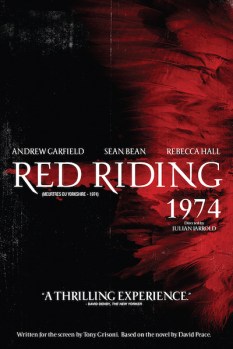
Red Riding: 1974The Red Riding Trilogy covers nine years of police corruption and child kidnap/murder in Yorkshire, amongst one or two other things, and begins here with a very film noir tale, courtesy of author David Peace and screenwriter Tony Grisoni, slathered in neo-noir stylings, courtesy of director Julian Jarrold.

Jarrold is most recently responsible for Kinky Boots, Becoming Jane and Brideshead Revisited, all of which stand in a sharp juxtaposition to the style and content of Red Riding. But turning from his lovely English-as-they-come costume dramas to something altogether nastier should come as no great surprise, for Jarrold is merely returning to his TV roots: in the mid ’90s he directed episodes of Cracker, Silent Witness and Touching Evil.

He certainly seems to know his territory, but perhaps he knows it too well — though this is also the fault of Grisoni and, perhaps, Peace — as the plot that he unfolds is not only familiar but told as if he’s all too aware we know what’s coming. The feeling one gets is of a British James Ellroy, albeit a low-rent, less complex version. (The same is true of 1980, though for me 1983 manages to escape such comparisons.) The story idles along, not exactly slow so much as in no hurry, full of near-clichéd plot points and an unrelentingly standard structure. These things aren’t necessarily a problem, but when you’ve got as big and bold a reality claim as the Red Riding Trilogy they feel out of place.

Another recent point of comparison would be David Fincher’s Zodiac — young newspaperman on the hunt for a serial killer in an inspired-by-fact ’70s setting — though this does 1974 no favours. It may be grittier than Fincher’s film, but it lacks the polish, the originality, and manages to feel slower, despite being a whole 50 minutes shorter. However much arty photography, disjointed storytelling, relatively dense accents and ‘gritty reality’ is plastered over the barebones of the tale, the familiarity of it — to both viewers and the makers, who don’t even seem to be trying — means there’s not an ounce of suspense or surprise to be had.

The cast is made up of established names, familiar faces and rising stars, many of them unfortunately stuck in familiar roles or otherwise left stranded by the unrewarding material. If they’re not quite stereotypes it’s because they’re too bland, lacking enough discernible character traits to reach such lofty heights. Occasionally this is because, with two films to come, some minor parts here have a major role later, but this can’t be said of them all. As the lead, Andrew Garfield’s journalist is as much of a stock character as the plot he finds himself in: a young reporter type, idealistic among journalists who no longer care (if they ever did), hunting to expose The Truth. Again, it could work, but is belied by the insistence — in both promotion and filmmaking style — that Red Riding is something more than Another Murder Mystery. Only Rebecca Hall, as a mother whose young daughter went missing years earlier, is granted the material to give an outstanding performance — which she does, easily justifying her recent BAFTA Rising Star nomination.

Besides Hall, the best thing about 1974 is its dull, desaturated photographing of grimy, desolate locations, where any colour that isn’t beige desperately wants to be. It suits the story and era perfectly, and the choice of 16mm seems to add a level of haziness that is equally appropriate. It’s perhaps indicative of everything this is aiming for that the most beautiful imagery is of an incinerated gypsy camp. Rendered almost black and white by the soot and desaturisation, ash floats through the air like snowflakes as Garfield stumbles through it, the whole picture a vision of Hell. It’s a kind of perverse beauty, true, but that’s also entirely in keeping with Red Riding.

1974 is a stock noir tale, dressed up with fancy filmmaking techniques and claims of realism to look like something more truthful, more real, more Important. And it makes me a little bit angry because of it. Maybe the violence is more realistically depicted than your average genre entry, maybe the police corruption is a little more plausible — then again, maybe it isn’t — but the real story here is so familiar they haven’t even bothered to hide the plot beats and twists properly, no doubt assuming a “gritty” veneer plastered over the top would do the job for them. It doesn’t. Maybe 1974’s grimy setting, brutal violence and unbeatable police corruption are all true to life, but the familiar and predictable plot leaves the realism feeling like no more than a pretence.

I was enjoying 1974 a lot more by the time the unexpectedly satisfying conclusion came around, but the sense that it had tried to pull the wool over my eyes throughout — and not in the good way a thriller should — just leaves a bitter taste.

3 out of 5

* Though I watched Red Riding: 1974 on 4HD, it’s my understanding that it was upscaled. ^

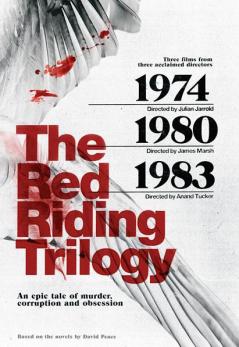
The Red Riding Trilogy

Red Riding Trilogy UKYou’d think Red Riding was a TV miniseries, wouldn’t you? After all, it was on Channel 4 on the same day for three consecutive weeks (recently repeated over three consecutive nights).
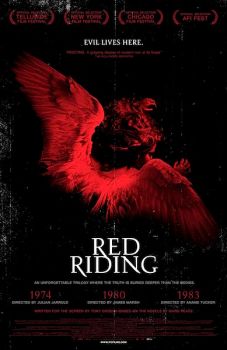
But the promotion — on iTunes, for example, or of Silva Screen’s soundtrack releases — is very keen to make reference not to “Red Riding” — as in, the title of a TV series — but “The Red Riding Trilogy” — as in, a series of films. Indeed, they are frequently referred to as “the films” (and similar variations thereof) in promotion and press, have received screenings at various film festivals and cinema releases in much of the rest of the world, including the US, and several other production and style points could also be rallied to confirm them as a film trilogy rather than miniseries.

As that’s how the makers would most like them to be regarded, then, it seems only fair to treat them as such. And so:


“The feeling one gets is of a British James Ellroy, albeit a low-rent, less complex version. The story idles along, not exactly slow so much as in no hurry, full of near-clichéd plot points and an unrelentingly standard structure. These things aren’t necessarily a problem, but when you’ve got as big and bold a reality claim as the Red Riding Trilogy they feel out of place.” More…

3 out of 5


“Where the first idled this meanders, flitting between the Yorkshire Ripper, the investigation into the Karachi Club shooting, and the private life of lead character Peter Hunter. Most time is spent on Hunter’s investigation into the investigation of the Ripper case, though by the end it becomes apparent this exists to cover the ‘real’ story — which is, of course, the Karachi Club cover up. Consequently neither are covered with the appropriate depth.” More…

3 out of 5


“Tucker’s film bests its predecessors in almost every assessable value. The story and characters have more genuine surprises and suspense than ever, while the performances are at the very least the equal of what’s gone before. Unlike the other two films, where the corrupt cops were little more than cartoon villains despite claims to the contrary, 1983 makes their brutality really felt.” More…

4 out of 5


Red Riding Trilogy USMy final thoughts about Red Riding — other than “that was disappointing” — are stuck on the reality (or not) of the police corruption it portrays. It’s difficult to know whether anyone who believes our police were never so nasty as this is naive, or whether anyone who believes they were quite this bad is paranoid. The truth no doubt lies somewhere in between.
Despite my disappointment with the majority of the Red Riding Trilogy, I intend to return to it some day: considering my enjoyment of the third instalment and the adjusted expectations that come from being disappointed first time round, the potential inherent in the trilogy means it certainly merits revisiting.

Cut (2009)

2009 #20a
Joe Wright | 2 mins | streaming

CutIs Cut an advert or is it a film?

On one hand, websites featuring it always refer to it as a “short film”; it stars film star Keira Knightley; is directed by BAFTA-winner Joe Wright; tells a story in a film (as opposed to advert) style; and is a whole two minutes long.

On the other, it’s paid for by Women’s Aid to front a campaign to raise awareness of domestic violence; it ends with a message to this effect, also featuring no title card or credits; it’s not listed on IMDb; it’s been shown for free among adverts in cinemas and online; it would’ve appeared on TV too if Clearcast hadn’t banned it for being “too violent”; and it’s only two minutes long.

It’s an advert, isn’t it? But it shouldn’t’ve been blocked from TV, which has incensed me enough to pretend it’s a film for the purposes of my little corner of the Internet.

Or half pretend, because purely as a film it isn’t great. It’s well shot by Wright, but some of the dialogue is too on-the-nose to convince and it’s actually slightly padded near the start — so slightly that in anything longer it wouldn’t be noticeable, but when something’s only 125 seconds, every one counts. On the other hand, it tells its story economically, using single shots to establish a lot of detail about characters, their lifestyles and their relationships, aided by Knightley playing a version of herself. In this the length and depth of story chosen are well-balanced.

When the violence comes, it’s moderately brutal. And here’s the rub — it’s arguably not brutal enough to cover the horrid reality of what some people have to suffer. It’s been made suitable to be shown on TV in a slot where people will see it — which, for its aims as an awareness advert, is completely appropriate. In the wake of Clearcast’s stupid ban I was expecting something more severe, which counterintuitively means the violence is more shocking for what it isn’t. Maybe whoever makes the decisions at Clearcast should watch Hostel: Part II before any appeal — or, to be honest, the 12A-rated Dark Knight might suffice.

With a brief running time and an important message to put across, Cut is a 5-out-of-5 advert, if only for the amount of talk and awareness it’s achieved. But I said I was trying to judge it as a film, so I’ll be a little tighter:

4 out of 5

Cut is available to stream for free on YouTube. More information about the campaign’s impact can be found on Wikipedia.

Gasman (1997)

2008 #76a
Lynne Ramsay | 15 mins | DVD | 15

“Gritty”, “realist” and “indie” are just some of the stock terms that immediately jump to mind when watching this short, which directly enabled Ramsay to make her first feature, Ratcatcher.

Films with such words attached are not automatically to my liking, but Gasman succeeds in using the associated techniques to tell a simple story of complex emotions and meaning for the characters involved. There are times when its documentary-like style is indulgent — the opening goes on too long, for example, and some shots seem deliberately obscure — but it also relates the story effectively and produces a few beautiful views too.

Even cleverer is the use of sound: there’s virtually no dialogue, so the occasional half-heard splashes, often amongst background chatter, are all the more telling. Mostly this is in a subtle fashion, though the key phrase that reveals all is both pretty blunt (though not inordinately so) and repeated an awful lot in a very short space of time.

Gasman is not wholly successful, then, though it does have an interesting story with a strong ending, dialogue-free, that both completes the plot and leaves you wondering what happens next.

4 out of 5

This short is available on the DVD Cinema16: British Short Films, as well as the Criterion Collection and Pathe/Fox releases of Ratcatcher.

Clockwise (1986)

2008 #76
Christopher Morahan | 92 mins | DVD | PG / PG

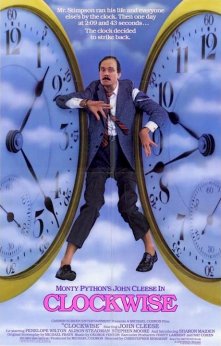
ClockwiseClockwise, so I’m told, was written after John Cleese (who, I should point out, isn’t credited as the writer) attended Robert McKee’s famous screenwriting seminar. What this means for your average viewer is that Clockwise is expertly constructed. More importantly, it’s also very funny.

The first 15 minutes are a little dubious, but it soon becomes apparent that some of McKee’s principles are being followed (if you’re aware of them, of course) as this opening serves to establish the everyday life of Cleese’s character, headmaster Brian Stimpson. The point of this soon becomes apparent: when everything goes to hell over the next hour-and-a-quarter, the viewer can fully appreciate the impact on Stimpson’s existence. And all go wrong it does, in a manner that’s rather reminiscent of Fawlty Towers — not in the sense that Cleese is repeating himself, but rather that you could replace Stimpson with Basil Fawlty and merrily carry on along much the same path; though, I hasten to add (to this over-punctuated sentence) that Stimpson is not a clone of Fawlty, but he is prone to ending up in similar accident-and-misunderstanding-based farcical situations.

I imagine that Clockwise is less well known than it deserves because it is so very British. The humour — largely based around issues of punctuality, politeness, and social custom — is particularly British, as are the countryside settings and the finale set at a public school conference. And, in the first instance, everything goes so spectacularly wrong thanks to our wonderful language’s multiple meanings for the word “right”. From this point Cleese & co escalate the hopelessness of the situation beautifully (and very much in keeping with McKee’s ideas of good structure), gradually crafting more absurd events and dragging in more and more characters, most of whom come together in that finale. This final section perhaps goes on too long, with a rather inconclusive ending, and it lays on the anti-public school gags with a trowel — though that suits me just fine.

Some have argued that Clockwise is more like a series of sketches than a cohesive whole, but all the independent scenes are connected by a common goal, meaning very few (if any) feel genuinely out of place or inelegantly shoved in. The calm pauses between the comic scenes also allow it to remain hilariously funny so consistently — an all-out assault of comedy, no matter how good, can become rather wearing. Again, this ebb-and-flow is something the filmmakers may well have picked up from McKee.

While you could probably use Clockwise as a mini masterclass in applying some of Robert McKee’s structural principles, that’s thankfully not the be-all of it. Very funny once it gets going, this is one that fans of Fawlty Towers will likely especially enjoy — and, really, who with a sense of humour isn’t a Fawlty Towers fan?

4 out of 5

Inside-Out (1999)

2008 #66a
Tom & Charles Guard | 7 mins | DVD | 12

This charming little short stars Simon McBurney as a hapless market researcher on a busy London street, failing to get a single passerby to complete his survey — perhaps the film’s greatest achievement is making a market researcher sympathetic. Anyway, he’s quietly observed by a woman, played by Lena Headey (yup, Mrs. Leonidas and the new Sarah Connor [and now Cersei Lannister, of course]), who’s dressing the window of a clothing/department store on the street. She notices his failed attempts, which amuse her; he notices her laughing, and begins to muck around to entertain her.

It’s a simple premise, but one that’s executed with comedic flair and a surprising amount of emotion. The music and lack of dialogue evoke an old-ish French mime comedy, making a nice contrast with the modern-day London setting, but it’s the relationship that silently develops between the two characters that provides the heart around the humour. And the ending, as carefully constructed as any moment of humour in the short, is painfully heartbreaking.

However many times you might want to re-watch this — and I think you would want to — you’ll always wish for the same outcome, and always be let down. It’s a sweet kind of pain and longing that, in spite of that French style, is very British.

4 out of 5

This short is available on the Cinema16: British Short Films DVD, and online free at Total Short Films or YouTube.