
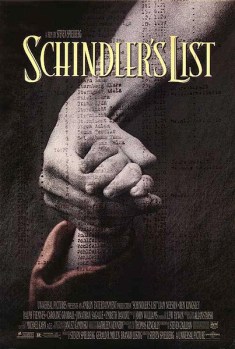
saves the world entire.”
Country: USA
Language: English, Hebrew, German & Polish
Runtime: 195 minutes
BBFC: 15
MPAA: R

Original Release: 15th December 1993 (USA)
UK Release: 18th February 1994
First Seen: VHS, c.2001
Stars
Liam Neeson (Darkman, Star Wars: Episode I – The Phantom Menace)
Ben Kingsley (Gandhi, Iron Man 3)
Ralph Fiennes (The English Patient, The Grand Budapest Hotel)
Director
Steven Spielberg (Amistad, Lincoln)
Screenwriter
Steven Zaillian (Awakenings, Moneyball)
Based on
Schindler’s Ark, a Booker Prize-winning novel (released in America as Schindler’s List) by Thomas Keneally.
The Story
In occupied Poland in the early days of World War 2, German businessman Oskar Schindler opens a factory supplying the German military, staffed by Jewish workers. As the Nazis begin to close the ghettos and ship Jews to concentration camps, Schindler uses his connections and profits to surreptitiously save as many as he can.
Our Hero
Oskar Schindler is a self-interested businessman, womaniser, and member of the Nazi Party. Initially employing Jews merely for financial reasons (they’re cheaper than Polish workers), his innate humanity begins to come to the fore.
Our Villain
Nazis! But in particular Amon Goeth, the sadistic commander of the Paszów labour camp, who’s fond of executing Jews at random, amongst other horrors. Nonetheless, Schindler has to deal with him to ensure the (relative) safety of his workforce.
Best Supporting Character
Schindler’s contact on the local Jewish Council, Itzhak Stern, who becomes essential to making his business a success, and facilitating his operation to save the workers.
Memorable Quote
“I could have got more out. I could have got more. I don’t know. If I’d just… I could have got more.” — Oskar Schindler
Memorable Scene
During the destruction of the ghetto, Schindler sees a little girl in a red coat (the one splash of colour in the body of the film), wandering alone through the devastation. Later, as the Nazis burn piles of the dead, corpses are ferried to the pyres on small wagons. On one, Schindler sees a small body in a red coat… (There’s a good piece on the psychology of why these scenes are so effective here.)
Technical Wizardry
Spielberg chose to shoot in black-and-white to match actual documentary footage of the era, which was how he ‘saw’ the events. It was also shot without storyboards, Steadicams, cranes, or zoom lenses, and about 40% was filmed using handheld cameras, to emphasise a documentary feel. For a similar level of realism, Spielberg originally intended to make the film entirely in German and Polish with English subtitles, but changed his mind because he thought he wouldn’t be able to accurately direct performances in foreign languages.
Making of
Acting as producer, Spielberg initially tried to attract another director because he felt he wasn’t capable of doing the story justice. Martin Scorsese turned it down because he felt it should be done by a Jewish director, and Roman Polanski rejected it because it was too personal (he lived in the Krakow ghetto, only escaping on the day of its liquidation, and his mother died at Auschwitz). Finally, there was Billy Wilder — depending which version you believe, he either wanted to direct but Spielberg was already prepping the shoot, or he actually convinced Spielberg to direct it. Ultimately, Spielberg waited ten years between acquiring the rights and making the film, when he finally felt capable of tackling it.
Awards
7 Oscars (Picture, Director, Adapted Screenplay, Cinematography, Editing, Score, Art Direction-Set Decoration)
5 Oscar nominations (Actor (Liam Neeson), Supporting Actor (Ralph Fiennes), Costume Design, Sound, Makeup)
7 BAFTAs (Film, Supporting Actor (Ralph Fiennes), Director, Adapted Screenplay, Cinematography, Editing, Score)
6 BAFTA nominations (Actor (Liam Neeson), Supporting Actor (Ben Kingsley), Costume Design, Make Up Artist, Production Design, Sound)
What the Critics Said
“If E.T. The Extraterrestrial is Steven Spielberg’s fantasy masterpiece, and Jurassic Park is his commercial masterpiece, then Schindler’s List is certainly his artistic masterpiece. It’s an extraordinary work of vision and passion that raises even the gifted Spielberg to a new level of artistry. And like all great works, it elevates everyone who views it.” — Dennis King, Tulsa World
 Score:
 96%
96%What the Public Say
“It’s very, very hard-going and not an easy film to watch, but its importance is unparalleled. You sit there for three hours feeling uncomfortable – because these monstrosities really happened, because we live in a world where people are capable of these acts of inhumanity – and you still can’t even begin to imagine what it must have really been like, to live through that, to see your family and friends shot dead in the street or transported away en masse to the gas chambers. And yet, despite all that, you end the film feeling inspired. Someone made a difference.” — Millicent Murdoch, Millie’s Movie Reviews

Schindler’s List wasn’t Spielberg’s first ‘serious’ film, but I think it shows a marked increase in quality over his good-but-flawed previous efforts, The Color Purple and Empire of the Sun. Liam Neeson gives a commanding performance as the imperfect hero, while Ralph Fiennes finds what little humanity there is in Goeth (and there isn’t much) to pull him short of being an Evil Nazi caricature. The stark black-and-white cinematography acknowledges the incomprehensibly horrific events, while Spielberg’s divisive penchant for sentimentality seems well-matched to the tale, offering a measure of hope from humanity’s darkest days.

What’s in #81? What’s in #81?
 Adapted from the classic young adult sci-fi novel by Orson Scott “bigoted idiot” Card, Ender’s Game is the story of Andrew “Ender” Wiggin (Asa Butterfield), who displays uncommon aptitude in a military programme to train children to fight against an alien race that attacked Earth decades earlier. Sent to a training centre in space, Ender must battle his fellow candidates to prove their worth to their hardened commander, Colonel Hyrum Graff (Harrison Ford), ready for the real battle to come.
 It tips its hat to things like drone warfare, child soldiers, and understanding our enemy, but that’s all it does: acknowledge those parallels exist, then refuse to explore them. Conversely, the music is too heavy-handed, taking on the burden of providing emotion that’s lacking from the screenplay.
 Sadly, after all that training fun, once the cadets jet off to the other side of the galaxy for a rushed third act, interest evaporates speedily. It even has to work hard to sell its own twist as a twist! (Spoilers follow in this paragraph.) In a simulation for a war, Ender does what he’d do to win that war. Then he’s told it wasn’t a simulation, it was the actual war… and he’s all cross. I mean, okay, the fella kinda has a point when he gets angry afterwards: they’ve lied to him, and maybe he would’ve behaved differently if he’d known. But the point of the training was to teach them what they needed to do to win, and it taught them that, and he did it. Maybe this twist works in the book, but in the film it felt somehow unearned.
 100Films.co.uk