Archive 5, Vol.1

Part of the impetus behind this new era of 100 Films was to solve ‘problems’ like my repeated failure to post reviews. Hopefully my plan for regular groups of capsule-sized reviews will solve that going forward. But this has been an issue for a while, and that’s led to a huge backlog of unreviewed films from 2019 to 2021 — it totals a ridiculous 449 feature films (counting shorts too, it goes over 500). Rather than abandon those to the mists of time, I present a new weekly (more or less — let’s not overcommit myself) series: Archive 5.

Essentially, it’s the same format as new viewing: each post is a collection of short reviews; but here they’re five titles plucked at random from my archive of unreviewed films (and I’ve used a random number generator, so it’s genuinely unmethodical). If I can keep this up weekly, it will take me just under two years to clear the backlog — which means I could still be reviewing stuff from 2019 in 2023. Hahaha… haha… ha… ugh.

With that in mind, there’s no need for further ado. This week’s Archive 5 are…

  • Never Too Young to Die (1986)
  • Bachelor Knight (1947)
  • Little Women (2019)
  • Aniara (2018)
  • Who’s Afraid of Virginia Woolf? (1966)

    (I Care a Lot was originally intended to be part of this post, but then the review turned out a little long, so I spun it off by itself. That’s the kind of thing I’ll probably keep doing, too.)


    Never Too Young to Die

    (1986)

    Gil Bettman | 97 mins | digital (HD) | 1.85:1 | USA / English | 18 / R

    Never Too Young to Die

    If you dropped A View to a Kill, Rocky Horror, WarGames, and Mad Max 2 into a blender, the end result might be Never Too Young to Die. And if that sounds like a ludicrous, unpalatable mash-up… yep, that’s Never Too Young to Die.

    This direct-to-video action-adventure stars a pre-Full House John Stamos as Lance Stargrove, a teenage gymnast whose dad is a secret agent (played by George Lazenby — aged 47 at the time, but looking at least 20 years older). When daddy is killed, Lance teams up with his partner (singer turned actress Vanity) to go after the culprit: gang leader and wannabe terrorist Velvet Von Ragnar (Gene Simmons (yes, from Kiss), chewing scenery as if he’s not been fed for months).

    If you’ve never heard of this film… well, neither had I, until a Cracked article suggesting comical substitutes for Covid-delayed blockbusters. But what really convinced me to watch it is that it has The Greatest Trailer Ever Made. If you set out to make a spoof ’80s trailer, I’m not convinced you’d be able to beat that. Unfortunately, neither can the film as a whole. It’s fun at times (the boob-biting final fight, or a scene where Stamos tries to distract himself from Vanity’s sexuality by… eating multiple apples), but it’s not quite camp or daft enough to really earn a place as a cult classic.

    I’ll say this for it, though: rewatching that trailer has made me really want to watch the film again…

    3 out of 5

    Never Too Young to Die was #70 in my 100 Films in a Year Challenge 2020.


    Bachelor Knight

    (1947)

    aka The Bachelor and the Bobby-Soxer

    Irving Reis | 91 mins | digital (SD) | 4:3 | USA / English | U

    Bachelor Knight

    If you ever need to name an obscure Oscar winner for some reason, you could do worse than Bachelor Knight — or, to give it its even-dumber-sounding original title, The Bachelor and the Bobby-Soxer. Yes, this won the Oscar for Best Original Screenplay (the other nominees aren’t the greatest field you’ve ever seen, but altogether they’re either better-remembered or were considered good enough to nominate for other gongs that evening, so quite how this took the prize, I don’t know).

    The plot also stretches credibility: after high schooler Susan (Shirley Temple) becomes infatuated with artist Richard Nugent (Cary Grant), she sneaks into his place to model for him, much to the disapproval of her older sister Margaret (Myrna Loy), who also happens to be a judge; and when Nugent ends up in her court room, she sentences him to date Susan until her infatuation inevitably wears itself out. I know things are different in the US, and also in the past, but did/do judges there really have the power to hand out any crazy made-up sentences they like?

    On the bright side, the film moves sprightly through its plot. Perhaps that’s because it takes a whole 40 minutes to get through the basic setup, even while running at a pace, means there’s less screen time left to dwell on all that follows. Not that some individual bits don’t go on a tad, like a picnic sequence; but others work very well, like a scene in a nightclub that is a nicely-written bit of escalating farce.

    It’s not the best work of anyone involved, but Bachelor Knight belies its iffy title (both of them) to be a likeable-enough 90 minutes of screwball comedy.

    3 out of 5

    Bachelor Knight was #70 in my 100 Films in a Year Challenge 2021.


    Little Women

    (2019)

    Greta Gerwig | 135 mins | cinema | 1.85:1 | USA / English | U / PG

    Little Women

    Writer-director Greta Gerwig’s adaptation of Louisa May Alcott’s beloved novel was greeted in some quarters by questions of if it was necessary: it’s the sixth big-screen version of Alcott’s book, and came just two years after a major new BBC adaptation. Well, I don’t know if it was ‘necessary’ or not, but Gerwig’s version is definitely a very good film.

    A key point that marks it out from other adaptations is that Gerwig has restructured the story: instead of playing out in a straightforward chronological fashion, it flashes back and forth in the sisters’ lives, starting with them as young women in 1868, with Jo in New York and Amy in Paris, before mixing in events from their childhood, seven years earlier, when the four sisters lived together in Massachusetts. This might seem like a rejig for the sake of differentiation, but Gerwig uses it to create interesting juxtapositions or to reframe plot points. For one example (spoilers follow, if you’re not familiar with the story), I felt it made Laurie and Amy’s relationship less creepy. Told chronologically, they first meet when he’s a young man and she’s a child, and he only moves his affection to her after Jo’s rejected him and Amy’s grown up. In Gerwig’s version, we first meet them together in Paris, and they seem more destined for each other, with a genuine spark between them as individuals, rather than a nagging sense of “if I can’t have one sister, this other will do”. It’s only later we learn the full backstory of Laurie and Jo — and, for that matter, of Jo and Amy — which, yeah, is obviously still a bit creepy, when you think about it.

    Whichever way you cut it, Gerwig seems to really get to the heart of the meaning in the story and characters, as well as giving it a lightly feminist polish (misogynists would probably consider it Terribly Feminist and Evilly Revisionist, if they watched it, which I don’t imagine they would). A star-studded cast ensure the whole thing is well acted, and it’s beautifully shot by cinematographer Yorick Le Saux. Questions about ‘necessariness’ are particularly irrelevant when the work is this good.

    5 out of 5

    Little Women was #4 in my 100 Films in a Year Challenge 2020.


    Aniara

    (2018)

    Pella Kågerman & Hugo Lilja | 106 mins | digital (HD) | 2.35:1 | Sweden & Denmark / Swedish & English | 18 / R

    Aniara

    A sci-fi movie based on, somewhat oddly, a 1950s Swedish poem, Aniara is about a spaceship transporting migrators from Earth to Mars that accidentally veers off course and heads irretrievably into deep space. Rather than the kind of action-adventure this might provoke if it were a Hollywood production, Aniara follows how the passengers and crew attempt to cope with their new lives.

    It’s a premise interesting enough that you feel it could fuel a TV series — how this mass of people, forced together by accident and terrible circumstance, comes to function (or not) as a society. Or maybe the remake of Battlestar Galactica already nailed that kinda thing. Either way, here it’s condensed into about 100 minutes; and because it has such a long-term view of what it wants to pack in, there are some surprisingly large time jumps (by the half-hour mark we’ve already reached Year 3). It takes some odd detours when it does that (society completely breaks down into weirdo cults… then a probe that might allow them to return home is discovered, at which point everything goes back to normal), but overall it has a pretty clear thesis about humanity and how we cope with things — “not well”, fundamentally.

    The final act kind of rushes a similar point, skipping ahead (several times) to how things are even worse without really tracking the descent. Maybe that’s why I liked the idea of a series version so much: to fill in all those blanks. But I don’t want to take this criticism too much to heart. If anything, the fact I wanted more detail is a compliment. It’s not the film bungling developments and me searching for justification, but rather that I’d be interested in seeing the themes and characters explored in even more detail. As it stands, Aniara is an epic-scale story told well in a somewhat condensed fashion.

    5 out of 5

    Aniara was #65 in my 100 Films in a Year Challenge 2020. It placed 21st on my list of The Best Films I Saw in 2020.


    Who’s Afraid of Virginia Woolf?

    (1966)

    Mike Nichols | 131 mins | Blu-ray | 1.85:1 | USA / English | 12
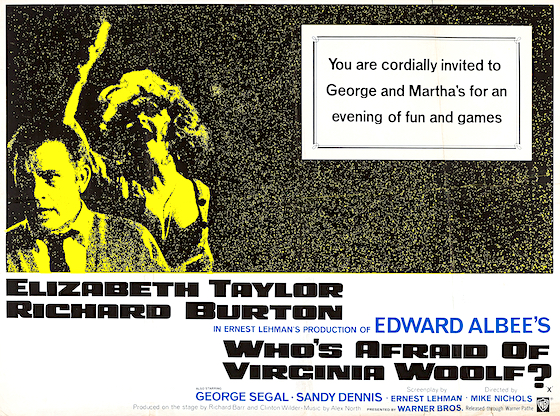
    Who's Afraid of Virginia Woolf?

    When a middle-aged college professor (Richard Burton) and his wife (Elizabeth Taylor) have his new young colleague (George Segal) and wife (Sandy Dennis) around for drinks one evening, the occasion soon degenerates into a verbal slanging match between the elder couple, the younger inescapably caught in the middle.

    And as the film takes place in almost-real-time, in just a couple of locations, it feels like we’re trapped with them. With a running time north of two hours, the film’s drunken sardonicism almost becomes an endurance test, particularly when it goes on a bit too long in the middle. But it’s carried through by some magnificent performances. Everyone talks about Taylor — just 33 at the time, she wasn’t sure she could play the part of a bitter 52-year-old, but she’s excellent — or they talk about Taylor and Burton — similarly, he wasn’t sure he could play a beaten-down failure of a man, having been used to taking dashing heroic roles — but Sandy Dennis is great too, and deserved her Oscar. Of the four actors, its George Segal who draws the short straw, not really getting the material to truly stand toe-to-toe with the other three (he still got an Oscar nom, though).

    Director Mike Nichols insisted the film be shot in black & white, which helps it to pull off Taylor’s ageing makeup, but was also intended to stop it seeming too ‘literal’ and instead give an abstract quality. That fits the material, because the characters, events, and revelations are all pretty odd; the way it plays out pretty strange. Plus, the pitch-black darkness of the night fits the film’s themes. Cinematographer Haskell Wexler does a superb (indeed, Oscar-winning) job, the photography looking more striking than you might expect, or even need, for such an actor-focused character piece.

    A whole featurette on the film’s disc release discusses how it was “too shocking for its time”, mainly because of the language used (the fact the film was made relatively unedited set a ball rolling that, just a couple of years later, saw the Production Code replaced by the modern MPAA classification system). While such concerns are no longer really relevant (once-controversial terms like “screw” and “goddamn” are hardly “fuck”, are they?), that the film is still powerful shows it was never truly about what was said, but who said it and how they said it. I don’t mean to say that it would still be offensive today, but rather that it still packs an emotive punch.

    5 out of 5

    Who’s Afraid of Virginia Woolf? was #22 in my 100 Films in a Year Challenge 2021.


  • The Locked Down Monthly Review of April 2020

    In 2002, Blue got the city on lockdown.
    In 2020, Boris Johnson got the country on lockdown.
    Your move, noughties boy bands.

    One thing this stressful time has been good for is my film viewing. After a 2019 that saw some of my lowest months in years — indeed, ever — I’m pleased to say that April 2020 is a record breaker:

    100 Films has a new Best. Month. Ever!


    #59 Rang De Basanti (2006)
    #60 The Kid (1921/1971)
    #61 The Three Caballeros (1944)
    #62 Stop Making Sense (1984)
    #63 Burning (2018), aka Beoning
    #64 The Karate Kid Part III (1989)
    #65 Aniara (2018)
    #66 The Man Who Shot Liberty Valance (1962)
    #67 The Diamond Arm (1969), aka Brilliantovaya ruka
    #68 I Am a Fugitive from a Chain Gang (1932)
    #68a The Devil’s Harmony (2019)
    #69 The Next Karate Kid (1994)
    #70 Never Too Young to Die (1986)
    #71 It Chapter Two (2019)
    #72 Andrei Rublev (1966)
    #73 Dune: The Alternative Edition Redux (1984/2012)
    #74 Rambo: Last Blood (2019)
    #75 K-19: The Widowmaker (2002)
    #76 Near Dark (1987)
    #77 The Thin Red Line (1998)
    #78 Jumanji: The Next Level (2019)
    #79 Superman IV: The Quest for Peace (1987)
    #80 6 Underground (2019)
    #81 The Secret Life of Pets 2 3D (2019)
    #82 Look, Up in the Sky! The Amazing Story of Superman (2006)
    #83 Long Day’s Journey into Night 3D (2018), aka Di Qiu Zui Hou De Ye Wan
    #84 End of the Century (2019), aka Fin de siglo
    #85 Men in Black: International (2019)
    #86 The Sheik (1921)
    #87 The Son of the Sheik (1926)
    #88 Extraction (2020)
    #89 The Wedding Guest (2018)
    #89a The Escape (2016)
    #90 Ready or Not (2019)
    #91 Bill & Ted’s Excellent Adventure (1989)
    #92 The Two Popes (2019)
    #93 Ice Age: Continental Drift 3D (2012)
    #94 The Lunchbox (2013)
    #95 Zatoichi in Desperation (1972), aka Shin Zatôichi monogatari: Oreta tsue
    #96 Bill & Ted’s Bogus Journey (1991)
    Aniara

    I Am a Fugitive from a Chain Gang

    Dune: The Alternative Edition Redux

    Jumanji: The Next Level

    Ready or Not

    The Lunchbox

    .


    • I watched 38 new feature films in April.
    • As I said at the start, that’s my most ever in a single month, beating the previous record holder (May 2018) by four films. That’s noteworthy because May 2018 is only one film ahead of the month that’s now in 3rd, which is only two films ahead of the month now in 4th, which is only three films ahead of the months now in =5th. So, four is a pretty healthy margin.
    • Obviously, as my best month ever, April is going to smash any comparisons I care to make. So let’s start with the only thing it wasn’t guaranteed to do, but it has done nonetheless: #96 is the furthest I’ve reached by the end of April (next best is #90 in 2018).
    • Averages: it increases April’s average by two whole films, from 12.8 to 14.8; increases the rolling average of the last 12 months from 13.3 to 14.8; and increases the average for 2020 to date from 19.3 to 24.0. If I maintained that average until December, 2020 would become my biggest year ever (but things never work out like that).
    • It’s my 21st month with 20+ films, and my 4th month with 30+ films.

    Alright, now some notes on the films within those 38…

    • Back in February, I noted that I’d somehow never seen a film from 1932. That’s now changed, thanks to I Am a Fugitive from a Chain Gang. Now, since the year of the first feature films being produced in the UK and USA (1912), there are only four years from which I’ve not seen at least one feature-length film: 1912, 1914, 1915, and 1923. I have at least one title picked out from each of those years that I could use to settle this matter, so I ought to get on with them…
    • I’ve seen David Lynch’s Dune before, but it was over 20 years ago and it was the theatrical cut. The fan edit I watched adds material from a longer TV cut and deleted scenes, plus generally rearranges and rejigs stuff, so I figure it must be substantially different enough to count as new.
    • Having watched 92% of the alphabet in January, February, and March, only X and Z remained — with the latter now claimed by Zatoichi in Desperation. X will go whenever I get round to watching Dark Phoenix — I think that’s literally the only X film I have in my collection or on Netflix/Amazon/etc.
    • This month’s Blindspot films: Andrei Tarkovsky’s biopic of 15th century religious icon painter Andrei Rublev. I found it as dry as that sounds. Also, from my ‘overflow’ list, Terrence Malick’s The Thin Red Line, which I was also underwhelmed by. I knew it would be more Malickian than your typical war movie, but still, something about it didn’t connect with me.
    • From last month’s “failures” I watched Aniara, End of the Century, It Chapter Two, Rambo: Last Blood, Ready or Not, and The Secret Life of Pets 2, plus The League of Extraordinary Gentlemen (see Rewatchathon). That’s a record haul, besting the five failures I watched last April. It was driven by most of those being time-limited Amazon rentals.


    The 59th Monthly Arbitrary Awards

    Favourite Film of the Month

    How to define “favourite”? On the one hand you’ve got something like I Am a Fugitive from a Chain Gang, which is a weighty and still-pertinent condemnation of the American justice system. On the other, something such as Jumanji: The Next Level, which is just a whole lot of fun. More tickling my fancy in the former camp is Aniara, about the psychological strain of being stranded in space with little hope of ever returning home, some of which feels very pertinent to our current world situation (I know we’re all at home rather than far from it, but the cooped up with no hope of escape… yeah). And in the latter camp, Ready or Not is a deliciously gonzo horror-comedy, which didn’t quite push as many buttons as I’d hoped but is still massively entertaining. On balance, bearing in mind its unexpected timeliness, Aniara takes it.

    Least Favourite Film of the Month

    This is a more straightforward category… although, personally, I included Andrei Rublev on my shortlist, which is a Highly Acclaimed Movie (just check out how many Greatest Ever lists it’s on), but it bored me senseless. Still, it did have some parts I admired — I’m not sure I can say the same about Superman IV: The Quest for Peace. Actually, that’s not strictly true: Christopher Reeve was always perfect as Superman; but the film definitely lets him down.

    Best Musical Discovery of the Month
    I’d never consciously listened to Talking Heads before I watched Stop Making Sense. I recognised exactly two of the songs during that concert movie, and one of those I know best from a cover version. While I wouldn’t exactly call myself a convert to their music, I liked most of it well enough, with opening number Psycho Killer my favourite. In fact, I preferred the live version in the film to the original recording. Maybe it’s just because I heard that take first, I dunno.

    Best Audition to Be James Bond of the Month
    It never even crossed my mind that the skinny kid from Slumdog Millionaire could ever be considered for Bond, and I bet it didn’t yours either. It was David Ehrlich’s Letterboxd review of The Wedding Guest that first flagged up the idea for me, and, having seen the film, I can see what he means. Dev Patel as James Bond… it’d certainly be different.

    The Audience Award for Most-Viewed New Post of the Month
    The second half of last month’s TV review sat pretty atop the chart for most of the month (the Doctor Who half, meanwhile, wasn’t even close), but then Extraction came barrelling through my stats like Tyler Rake through an overcrowded Indian apartment block. Five older TV posts topped it overall, but it was by far my most-viewed new post.


    The name’s Connery, Sean Connery.

    Yes, there’s a distinct theme to this month’s rewatches. It wasn’t deliberate… well, not at first. Once I noticed it, obviously I had to maintain it.

    #15 Diamonds Are Forever (1971)
    #16 The Avengers (1998)
    #17 The Rock (1996)
    #18 The League of Extraordinary Gentlemen (2003)

    …and, if you want to take it further, you could argue they’re all movies where Connery returned to the role of James Bond. Sure, Diamonds Are Forever is the only one where that’s literally true, but there’s long been a fan theory that Connery’s character in The Rock is Bond under a pseudonym, and in The Avengers he plays an innuendo-spewing former British secret agent turned villain. As for LXG… yeah, okay, the idea runs out there.

    When I included The Rock in my 100 Favourites, I only rated it 4 stars. Now I feel like a fool — it’s easily a 5. Some thoughts as to why on Letterboxd. Mind you, that kind of thing cuts both ways: when I finally got round to rewatching Face/Off 18 months ago, I discovered I didn’t enjoy it as much as I used to, and if I’d done that before publishing 100 Favourites then I might’ve dropped it from the list entirely. I intend to update my favourites list someday, but I think I need to do a good deal more rewatching before then.

    My rewatch of LXG was prompted by this defence of the film. While I wouldn’t call the movie a masterpiece, I do generally agree with that article — the film has its moments (many of them thanks to Dorian Gray), and it’s certainly no worse than many other ’90s/’00s Hollywood blockbusters. Quite why it provokes such vitriol from anyone but fans of the book is beyond me. (Book fans have every right to be disappointed, because the film sanitises and Hollywoodises the concept. That said, as a fan of the books myself, I’m happy to take both forms as differing executions of the same idea.)


    This may be the biggest month in 100 Films history, but there was still plenty of stuff I failed to watch. Nothing in cinemas, obviously (though Trolls World Tour did get released direct to premium streaming, and consequently looks like it might change the world), but the other avenues for film viewing offered more than enough alternatives.

    For starters, Netflix completed their Studio Ghibli lineup with Howl’s Moving Castle (the only one I’d seen), From Up on Poppy Hill (which I own on Blu-ray), Ponyo (also on Blu-ray), When Marnie Was There (also on Blu-ray, jeez!), Pom Poko, Whisper of the Heart, and The Wind Rises. On the new films front there was CG animation The Willoughbys, which looks vaguely interesting, and for (relatively) recent releases they mustered the remake of Child’s Play. They also added the second Maze Runner film, The Scorch Trials. One day the whole trilogy will be available somewhere and I’ll give them a shot.

    Amazon actually had more to offer in terms of recent acquisitions, though the quality level is dubious — I’m talking of films like Angel Has Fallen (the second sequel to the less-good “Die Hard in the White House” movie), Playmobil: The Movie (a rip-off of The LEGO Movie that wasn’t as well received), 21 Bridges (which received middling notices), and The Current War (presumably in its director’s cut form, for which the most positive comment Rotten Tomatoes can muster is “a significant improvement over previous versions”). Additions from the archive include a handful of Hong Kong actioners, led by the appropriately-titled Police Story: Lockdown (the sixth film, and second reboot, in the Jackie Chan action franchise), plus unofficial prequel The Legend is Born: Ip Man (I believe Ip Man 4 is also now available to rent over here), and Donnie Yen in Legend of the Fist (a version of the story from Bruce Lee’s Fist of Fury and Jet Li’s Fist of Legend).

    Also new to Amazon was medical disaster movie Outbreak, which was already on Netflix; and they both added Contagion, after everyone was talking about it last month. I noticed it still made it into Netflix’s UK top ten, though.

    Over on Now TV, sequel-cum-reimagining Four Kids and It caught my eye because I remember enjoying the BBC’s 1991 adaptation of the original book when I was a kid, but this new one didn’t seem to go down terribly well (though the British critics collated by Rotten Tomatoes have got it to 61%, which counts as ‘fresh’). Other recent films now on Sky include Ma and Tolkien.

    Finally, I went a bit potty in Blu-ray sales again, this time mostly at Arrow, picking up a couple of Vincent Price horrors, Tales of Terror and Tower of London; a couple of artier titles from Second Run, Valerie and Her Week of Wonders and Ikarie XB 1; Third Window’s double-bill of The Whispering Star and The Sion Sono; and some Westerns and noirs and noir-Westerns that include The Ox-Bow Incident, My Name is Julia Ross, and Terror in a Texas Town. The latter pair were directed by Joseph H. Lewis, whose So Dark the Night I enjoyed last month, so I also bought his Gun Crazy in its HMV-exclusive edition, paired with their edition of Out of the Past in their 2-for-£25 offer. Meanwhile, Eureka tempted me with new releases, namely Zu: Warriors from the Magic Mountain and Masters of Cinema titles Rio Grande, Kwaidan, and their second box set of Buster Keaton features, which includes The Navigator, Seven Chances, and Battling Butler. International travel may be closed to humans, but it isn’t to Blu-rays, as evidenced by my imports of 3-D Rarities Volume II (which includes Mexico’s only 3D film, swashbuckler El Corazón y la Espada) and A Boy and His Dog (which I look forward to rewatching in good quality, unlike the print I saw on Prime Video a few years ago). I tried to resist the UHD upgrade of The Elephant Man, but then I saw the PQ comparisons and the limited-edition pop-up packaging (damn my love of a cardboard gimmick!) and caved.

    And, inevitably, I did purchase The Rise of Skywalker, in 3D. You know, I’ve never got round to rewatching The Last Jedi. The idea of pairing them up as a double bill should be the most natural thing in the world, but instead it feels like a bold experiment in combining chalk and cheese. Still, I might try it sometime.


    Barring any unforeseen circumstances (though, at the minute, who can accurately foresee anything?), I should definitely pass #100 early next month. As for my new-goal-I-keep-half-forgetting of #120, well, that’s within reach too. And then…

    In my final monthly review of 2019, I mentioned that “it’s entirely possible [2020 will] be the year I reach #2000”. Now, it’s all but certain that it will (unforeseen circumstances, remember). If May gets to 35 films (which, before this month, would’ve been a record for biggest month ever), that’ll be 100 Films’ #2000! Is it likely I’ll achieve two such huge months in a row? Funnily enough, the last couple of times I’ve set a new “best month ever” it’s been immediately beaten by the very next month: September then October in 2015; April then May in 2018.

    No pressure, May 2020…