
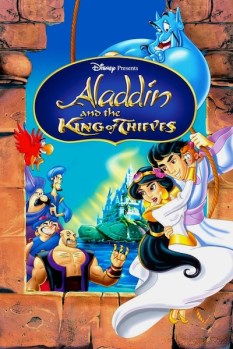
 For most of the ’90s and ’00s, Disney churned out direct-to-video sequels to many of their most beloved animated classics. They have a reputation for being unremittingly awful, hence why Pixar’s John Lasseter put a stop to their production after he became Disney’s Chief Creative Officer in 2006. Despite that reputation, however, there are those who say one or two are actually quite good. One of those (and the only one I’ve previously seen) is The Lion King 1½ (released as The Lion King 3 in the UK), which is a sort of a Rosencrantz and Guildenstern Are Dead to the original film’s Hamlet, re-telling the story from the perspective of Timon and Pumbaa. I saw it years ago but would vouch for its relative quality — when I first re-watched The Lion King after, I briefly thought some scenes were missing, which I guess is testament to how well it fits.
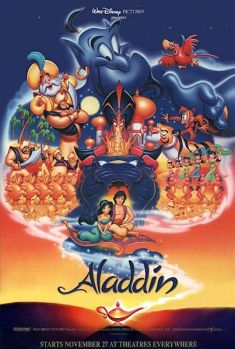
Another such-praised sequel is this follow-up to Disney’s 1992 Animated Classic. It’s actually the second sequel (the first was also the first of those Disney DTV sequels) and also follows an 86-episode TV series. Fortunately, the makers dropped an early idea to use one of the series’ main villains as the film’s antagonist, and so it functions perfectly as a direct sequel to the original movie. Which is nice, because that first sequel isn’t meant to be very good and I imagine the TV series is hard to come by nowadays. Plus, neither of those can claim an ever-so-important distinction that this can: it features the return of Robin Williams as the Genie.
The film begins on the wedding day of Aladdin (Scott Weinger) and Jasmine (Linda Larkin), which is interrupted by the mysterious Cassim, the King of Thieves (John Rhys-Davies), and his gang of forty thieves seeking to steal an oracle from among the wedding gifts. Although they fail, the oracle informs Aladdin that the answers he seeks about his long-departed father  are to be found with the forty thieves… I expect you can guess where that’s going. Fortunately the film gets there pretty quickly, then transitions into a story about the possible redemption (or not) of Cassim alongside the quest for the Hand of Midas, capable of turning whatever it touches into gold (natch).
The King of Thieves has a few things in its favour. It’ll come as no surprise that the biggest and best is Williams reprising his iconic performance, and consequently being responsible for most of the film’s humour. There are a couple of fun nods to some of Williams’ other best-remembered roles, and plenty to other Disney films too. The rest of the film offers a fast-paced, action-packed narrative, with a few musical numbers to boot. The songs are certainly not as memorable as those found in proper Disney movies, but most are decent while they last. Jasmine gets somewhat short shrift, but this is really a story about father and son.
Those who dislike Disney’s Aladdin won’t find anything to enjoy here, but for fans of the original, Aladdin and the King of Thieves is a solid, fun follow-up.

* The film was made for release on VHS, so it’s no surprise that the OAR is 1.33:1. The HD version is cropped for 16:9. It’s mostly alright, though anyone with an eye for composition will find it obvious at times. ^

 Score:



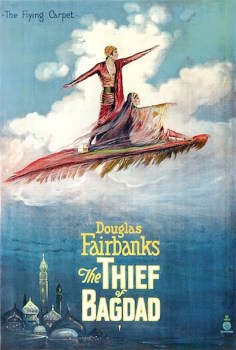 Douglas Fairbanks started out in comedies, where he was so popular he was quickly established as “the King of Hollywood”, which allowed him to attempt something different: an historical adventure film.
 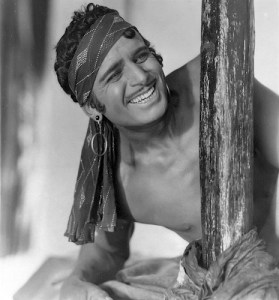 of course, which alerts the Mongol Prince to the attempted deception — though as he’s “the Governor of Wah Hoo and the Island of Wak”, he’s a fine one to talk. The thief manages to make it to see the princess anyway. She instantly falls in love with him, and he realises he loves her too, so can’t just kidnap her. His whole value system is undermined! But now he’ll have to win her hand by more honest means. Well, she already loves him, so he’s halfway there; but he’s an imposter, so there’s that to sort out yet.
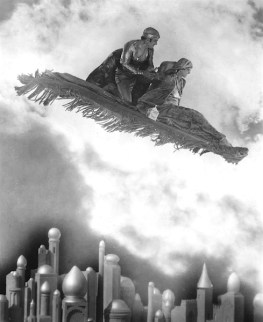 Even more impressive are the sets. The work of famed Hollywood designer William Cameron Menzies, at the time Fairbanks felt Menzies was too inexperienced to work on such a big project. Undeterred, he created a collection of detailed drawings and convinced the star/producer. No surprise that worked, because Menzies’ designs are extraordinary. His complex, detailed, unreal drawings are recreated accurately on screen (examples of this can be seen in the ‘video essay’ included on the film’s Blu-ray releases, for instance), using numerous techniques to create truly fantastical scenes: ginormous sets (they covered six-and-a-half acres), built on a reflective enamel floor (which had to be constantly re-enamelled throughout the shoot) and painted in certain ways to make them appear floaty; or glass matte paintings used to seamlessly extended or enhance shots. Reportedly 20,000 feet of film — that’s hours and hours worth — were shot just to test the lighting and painting of the sets.
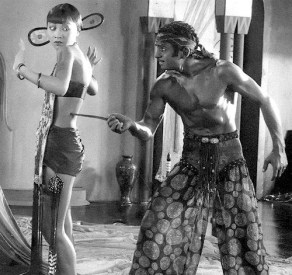 In a star-making supporting role, Anna May Wong is indeed memorable as a traitorous handmaiden. That’s more than can be said of her employer: Johnston is a bit of a non-starter as the princess, which I guess is what happens when you have to re-cast because your original choice departs part way through production. Comedian Snitz Edwards was also a mid-production replacement, drafted in to provide comic relief. It wasn’t necessary: he doesn’t add much, and Fairbanks had it covered.
 100Films.co.uk