
Gavin Hood | 114 mins | streaming (HD) | 2.35:1 | USA / English | 12 / PG-13
 Adapted from the classic young adult sci-fi novel by Orson Scott “bigoted idiot” Card, Ender’s Game is the story of Andrew “Ender” Wiggin (Asa Butterfield), who displays uncommon aptitude in a military programme to train children to fight against an alien race that attacked Earth decades earlier. Sent to a training centre in space, Ender must battle his fellow candidates to prove their worth to their hardened commander, Colonel Hyrum Graff (Harrison Ford), ready for the real battle to come.
Ender’s Game endured a pretty mixed reception a couple of years ago (not helped by the media exposure given to Card’s less-than-savoury personal views), and it’s quite a mixed film: for every positive, a negative follows close behind. It’s not helped by its first act, where the film seems to struggle with its own setup. After that, however, it’s a fairly well structured story, in which you can actually believe Ender is learning to be a better leader. Normally when a movie features “an excellent military strategist” we’re told that and never shown it, but here we see how Ender’s skills as a strategist develop and are exhibited.
The rest of writer-director Gavin Hood’s screenplay is, again, a mixed bag. The dialogue is frequently clunky, particularly struggling with exposition — there are utterly dead scenes where characters just explain the plot to each other — but, while it is at no point strong, it’s often serviceable. There are strong themes, however, several of which have relevance to our modern world. Unfortunately, none feel fully developed or explored.  It tips its hat to things like drone warfare, child soldiers, and understanding our enemy, but that’s all it does: acknowledge those parallels exist, then refuse to explore them. Conversely, the music is too heavy-handed, taking on the burden of providing emotion that’s lacking from the screenplay.
Most of the cast are very good. Asa Butterfield well conveys a moderately complex character, though I can believe others’ comments that Ender is more fully developed in the book. Hailee Steinfeld and Abigail Breslin offer able support; Harrison Ford proves he’s still awesome; Ben Kingsley battles what turns out to be a New Zealand accent (I’d assumed it was South African) in a cameo-sized turn; Viola Davis is ludicrously underused — she does basically nothing, then walks into Ford’s office and essentially declares, “I am no longer needed by the plot, I quit.”
At least there are solid action/sci-fi thrills on offer. The inter-student practice fights in the Danger Room (or whatever it was called) are really good — suitably exciting and fun, with impressive effects work. There are many good visuals in the film, but then strong CGI is par for the course these days. That’s why the space station stuff is best: the alien race and their planet are well-realised but also feel like nothing new; and the space station’s corridors, offices, and bunk room sets are well done, though as derived from familiar real-life and/or near-future styles as much as many other SF movies; but the station’s giant glass-walled zero-G training arena is stunning.
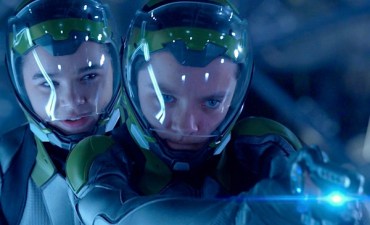 Sadly, after all that training fun, once the cadets jet off to the other side of the galaxy for a rushed third act, interest evaporates speedily. It even has to work hard to sell its own twist as a twist! (Spoilers follow in this paragraph.) In a simulation for a war, Ender does what he’d do to win that war. Then he’s told it wasn’t a simulation, it was the actual war… and he’s all cross. I mean, okay, the fella kinda has a point when he gets angry afterwards: they’ve lied to him, and maybe he would’ve behaved differently if he’d known. But the point of the training was to teach them what they needed to do to win, and it taught them that, and he did it. Maybe this twist works in the book, but in the film it felt somehow unearned.
Ender’s Game is not all it could be, but as a straightforward young-adult sci-fi action-adventure, I really rather enjoyed the majority of it.

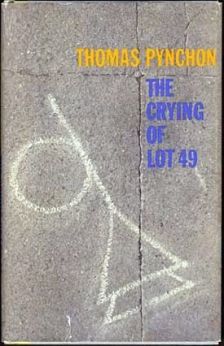 After watching
  It’s probably not fair to judge The Crying of Lot 49 by normal moviemaking standards. As a high school project to summarise a novel in a few minutes of video (which it may or may not be), it’s probably alright. Otherwise, though, it’s not worth the seven minutes; not even for die-hard fans of the author and/or novel. It is, you might say, a W.A.S.T.E. of time. #injoke
 If you’re not au fait with the
  as both sides attempt to rally ordinary people to their cause through the power of the media. It’s a tale that’s as timely as ever, surely.
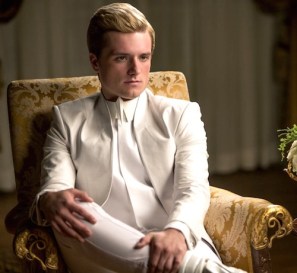 I must say that (as someone who hasn’t read the book) it didn’t feel overly like the first half of something longer to me. Of course there’s a cliffhanger and stuff, but there was at the end of the last film as well. This is no worse than that. If anything, I felt Mockingjay Part 1 built to its ending more successfully — I was quite surprised when
 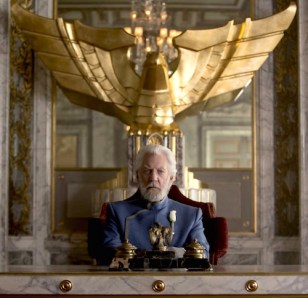 it may be your favourite instalment so far (and you wouldn’t be alone in that view). For me, Catching Fire is the best of the three because it crystallises both of those constituent elements; and if the first film was purely the action side (with a bit of the politics), then here we find its mirror image: purely politics (with a bit of action). Either way, perhaps the ultimate fate of all these films rests on how well
  Classic adaptation of the acclaimed novel. While my experience of Dickens is woefully limited to screen adaptations, this tale is one of my lesser favourites; the first act and elements of the climax are wonderfully Gothic (and here beautifully directed to that effect), but it seems to lack the depth or importance of works such as Bleak House, Oliver Twist or A Christmas Carol.

 100Films.co.uk