
Bennett Miller | 133 mins | streaming (HD) | 16:9 | USA / English | 12 / PG-13
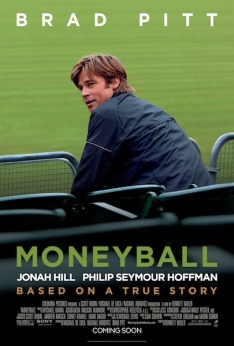 Based on a true story, Moneyball concerns the management of baseball team Oakland Athletics during the 2002 season. General manager Billy Beane (Brad Pitt) struggles to put a squad together due to a comparatively low budget for players, which has seen all his best ones drift off to richer contracts elsewhere. Fed up with the traditional scouting system, he recruits Peter Brand (Jonah Hill) to use statistical analysis to select a cheap team of quality players. The rest of his staff despair, including coach Art Howe (Philip Seymour Hoffman), who refuses to play the team as Beane and Brand suggest, which unsurprisingly leads to self-vindicating failure — until they force his hand…
So Moneyball is a movie about sports and statistics — a pair of topics that will bore some people to tears, while still others will enjoy one but not the other. Generally, I couldn’t care less about sport, but statistics? Well, maybe.
Unfortunately, despite what you might’ve heard, Moneyball is more about sport than statistics. Worse, it makes too few concessions to people who know fuck all about baseball. You can follow the general arc, but it’s like turning on a real game of any sport you know nothing about: you can discern some stuff, but the coverage is not being produced for you. At one point it cuts to a match and a caption informs us it’s the “bottom of the 9th”. I’m sure that means something to baseball fans, but I can tell you the rest of us haven’t got the foggiest. Is the “bottom” at the beginning or the end? Or somewhere in the middle? Or is it something to do with score rather than time? The 9th what? And is it the 9th of 9 or the 9th of 10? Or 12? Or 15? Or 18, or 25, or…? Or is it the fact it’s the 9th that’s significant here? Maybe there’s normally only 3 or 4 of whatever it is? For Moneyball as a movie in its own right, rather than some niche special interest thing, this attitude is a drawback.
 Problems extend beyond the sporting specifics. It’s quite some way into the movie before it gets stuck into the meat of the plan working, and before that it often throws in asides that meander around through Beane’s earlier playing career and current family life. The former has some bearing on the plot, though feels inadequately integrated — as one flashback it might work, but as a series of them it’s not enough to constitute a parallel story. The latter, his family life, provides character texture, but it’s slight, uninformative, and ultimately unnecessary. You could cut it and the film would lose nothing.
Moneyball was going to be directed by Steven Soderbergh, who apparently had some interesting ideas about how to present the wealth of statistical material — ideas that were too interesting for Sony, as it turned out, because they shut down production days before shooting was due to start and kicked Soderbergh out. He was replaced with Bennett Miller, who previously directed Capote, which was fine, and later did Foxcatcher, which I didn’t really like (I gave it 4 stars, but my review reads more like 3 and that’s how I remember it). I’m beginning to dislike the guy. According to IMDb his next project is A Christmas Carol, because we really need another version of that.
On the bright side, Soderbergh’s departure was when Aaron Sorkin came on to write a new version of the screenplay. Swings and roundabouts, eh? But this does not feel like a film written by Aaron Sorkin. Where’s the sparkling dialogue? Where’s the impressive structure? The former is perfunctory and functional; the latter is, if not a mess, then certainly lacking the rigour of his other work. Apparently Sorkin only agreed to do a re-write if previous screenwriter Steven Zaillian kept a credit, because Sorkin felt the script was great  and didn’t need any work, which probably explains why it’s not so Sorkin-y. Zaillian is not a bad writer — his credits include Schindler’s List and Gangs of New York, both of which are in my 100 Favourites, and the US remake of The Girl with the Dragon Tattoo, which I gave full marks — but I wouldn’t say he has a unique voice. Moneyball’s screenplay is fine for what it is, but it doesn’t have that frisson that Sorkin brings.
Baseball doesn’t interest me in the slightest, partly because I’m not interested in much sport, partly because I’m not American. So I watched Moneyball for three reasons: one, because it seemed like it might be more about the stats than a traditional sports movie. It’s not. Second, because it was written by Aaron Sorkin. But the screenplay displays little of his usual verve. And third, because it’s a Best Picture nominee from this millennium and I’m intending to tick all of those off eventually. In that respect, at least, it was a success — of course, it couldn’t fail to be.

 Unlikely stories can make great movies, or at least fun ones, and if this isn’t the former then it’s largely the latter.
 Written by Aaron Sorkin and directed by Danny Boyle, with a name cast and plenty of awards buzz, this biopic of the eponymous tech genius was an inexplicable box office flop on its release last year — proof if proof were needed that box office does not equal quality, because I thought it was thoroughly excellent.
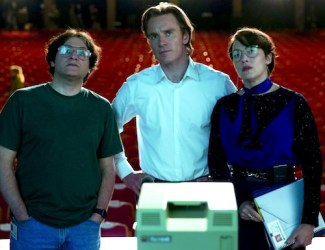 Boyle’s decision to use different film formats for each section — 16mm, then 35mm, then digital HD — helps delineate the eras and, in a way, reflect the products being launched (though I’ll instantly concede that last point may be a bit of a stretch). I imagine it’s too technical a concern to be noticed by your average filmgoer, but I’m sure it must have a subtle effect; and for those of us who are so minded to spot the change, it’s kinda fun and effective. Shot by Alwin H. Küchler, each section has its own charm, from the warm fuzziness of 16mm, to the gloss of 35mm, to the precision of digital. This is a mighty fine looking film, and while modern tech meant the 1080p Amazon Video stream I was watching looked darn near Blu-ray quality, I’m still miffed I didn’t just go straight for the disc, because now I’m going to have to pay for it again at some point.
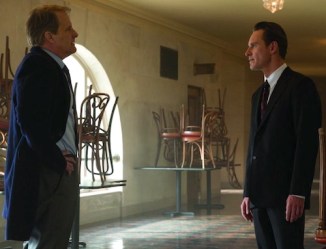 The dialogue they’re delivering is so Sorkin. Rearrange character names and you could drop this into
  In a similar vein, I suspect it would make a great companion piece to
 Sometimes you have to wonder where it all went wrong. I can only imagine how good things looked for Rob Reiner at the start of the ’90s, when he’d had an almost-interrupted near-decade-long run of acclaimed movies in the director’s chair:
  100Films.co.uk