
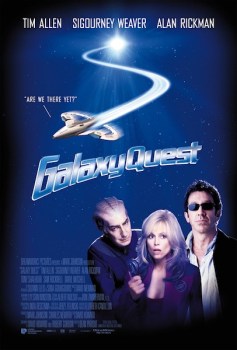
but the adventure has only begun.
Country: USA
Language: English
Runtime: 102 minutes
BBFC: PG
MPAA: PG

Original Release: 25th December 1999 (USA)
UK Release: 28th April 2000
First Seen: DVD, c.2001
Stars
Tim Allen (The Santa Clause, Christmas with the Kranks)
Sigourney Weaver (Alien, Avatar)
Alan Rickman (Dogma, Harry Potter and the Philosopher’s Stone)
Tony Shaloub (Men in Black, Pain & Gain)
Sam Rockwell (Confessions of a Dangerous Mind, Moon)
Director
Dean Parisot (Fun with Dick and Jane, RED 2)
Screenwriters
David Howard
Robert Gordon (Addicted to Love, Lemony Snicket’s A Series of Unfortunate Events)
Story by
David Howard
The Story
The cast of ’70s sci-fi series Galaxy Quest have been reduced to convention appearances and mall openings since their show was cancelled; but when a group of aliens, who believe the series was an historical document and have built the show’s spaceship for real, ask for the crew’s help to defeat a genocidal general, the actors must endeavour to become their characters for real.
Our Heroes
A ragtag gang of washed-up actors who used to star on a space opera TV series, now co-opted into being real heroes. They’re all based on the cast and characters of Star Trek, of course: Tim Allen’s Jason Nesmith, the ship’s captain, is obviously William Shatner/James T. Kirk; Sigourney Weaver’s Gwen Demarco, the token female, is Nichelle Nichols/Uhuru; Alan Rickman’s Alexander Dane, the classically-trained actor playing an alien science officer, is a combination of Leonard Nimoy/Spock and Patrick Stewart; Tony Shaloub’s Fred Kwan, a fake-foreign engineer, is a mixture of James Doohan/Scotty and Walter Koenig/Chekov; and Daryl Mitchell’s Tommy Webber, a young helmsman from an ethnic minority, is a mixture of George Takei/Sulu and Wil Wheaton/Wesley Crusher.
Our Villain
General Sarris, a reptilian warlord waging war against the kindly Thermians. No discredit to Robin “Ethan Rayne off Buffy” Sachs, but he’s kind of beside the point, really.
Best Supporting Character
Enrico Colantoni (Veronica Mars, Person of Interest) plays the leader of the friendly aliens, Mathesar, a naïve soul who speaks in a sing-song monotone.
Memorable Quote
“By Grabthar’s hammer, by the suns of Worvan, you shall be avenged.” — Sir Alexander Dane
Memorable Scene
Our heroes arrive in the bowels of their screen-faithful ship to find “a bunch of chompy, crushy things” impeding their path — for absolutely no reason. “We shouldn’t have to do this, it makes no logical sense, why is it here?… This episode was badly written!”
Making of
In cinemas, the film began with a 4:3 aspect ratio for clips from the old TV series, then widened to 1.85:1 for the Earth-based scenes, before widening again to a highly cinematic 2.35:1 once Tim Allen’s character realises he’s on a real spaceship. It was decided to ditch the middle stage for the home video releases, which I suppose makes sense, but is a lot less fun.
Previously on…
Galaxy Quest is an original creation, but it’s heavily inspired by the Star Trek franchise and its fans.
Next time…
A reboot TV series was supposedly in the works at Amazon, though comments made by co-star Sam Rockwell just last month suggest the project had developed into a direct sequel, which was then sadly scuppered by the untimely death of Alan Rickman.
Awards
1 Saturn Award (Actor (Tim Allen))
9 Saturn nominations (Science Fiction Film, Actress (Sigourney Weaver), Supporting Actor (Alan Rickman), Performance by a Younger Actor/Actress (Justin Long), Director, Music, Costumes, Make-Up, Special Effects)
Won the Hugo Award for Best Dramatic Presentation
What the Critics Said
“Whether you love Star Trek or laugh at it, your starship is about to come in, docking in the form of Galaxy Quest, an amiable comedy that simultaneously manages to spoof these popular futuristic space adventures and replicate the very elements that have made them so durable. […] If Galaxy Quest never attains consistently giddy heights as it plays out its combination of knowing satire and heroic adventure, it nevertheless keeps its tongue firmly in its cheek, offers a few genuine laughs, moves swiftly, if not at warp speed, and is led by a talented cast.” — Lawrence Van Gelder, The New York Times
 Score:
 90%
90%What the Public Say
“As a fan of the various science fiction classic series, like Star Trek and Star Wars, I’ve met most of the people parodied in Galaxy Quest – from the overzealous fans to the has-been and bitter celebrities making a living off a series’ memories. A movie like Galaxy Quest manages to poke fun at a wide range of people but still be loveable and sympathetic at the same time.” — Kevin Carr, 7M Pictures

What the Trekkies Say
In 2013, just after Star Trek Into Darkness came out, a massive convention of Trekkies decided to vote on the best Trek movies. Galaxy Quest muscled its way in to 7th place, besting six real Trek flicks. (Infamously, Into Darkness came dead last.)
Managing to satirise both classic sci-fi TV shows and their (shall we say) enthusiastic fanbase, while remaining relatively respectful to both, is quite a feat, and is surely one reason Galaxy Quest has proven so popular. Another is its accessibility: you don’t need to be a Trekkie to get all the gags. Combine those two and you have a film for fans and non-fans alike. To really cement the issue, it’s a solid adventure movie as well as a funny comedy.

#34 will be… what you get for the man who has everything.
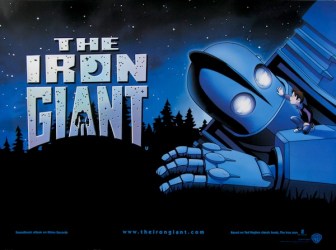 Adapted (loosely) from Ted Hughes’ children’s novel The Iron Man, the feature debut of director Brad Bird (
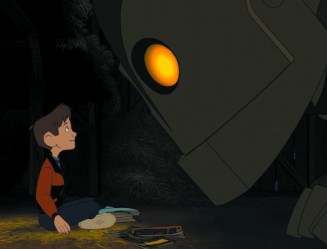 The story, as reconstructed by Bird and screenwriter Tim McCanlies, integrates influences from ’50s B-movies (very apt for a giant robot ‘monster’) and Cold War/Space Race paranoia for a potent storyline that has a different emphasis from the novel’s “world peace” finale, but nonetheless is promoting understanding of alien/foreign powers and, y’know, deep stuff like that. Alternatively — or, rather, concurrently — it’s an
  reputation it has gradually amassed — and which only continues to grow, I think. Last year saw the release of an extended Signature Edition, with a couple of short scenes added, which comes to US Blu-ray (alongside the original version) later this year. Just from reading about those new scenes, I’m not convinced they’ll improve the experience, but it’ll certainly be worth finding out.
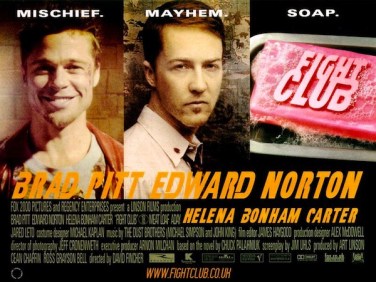
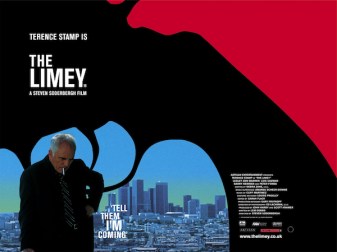 There’s an argument to be made that, from a cinematic perspective, mainstream US cinema these days is boring. Look at the kind of films American auteurs were producing in and around the studio system in the ’90s and early ’00s:
  This isn’t a conceit Soderbergh uses for one scene, or wheels out now and then, but an overall approach. Some sequences are more thick with it than others, but it’s always right around the corner. It creates a unique sensation. Not disconcerting, exactly, but mysterious and querying. It has you constantly question what you’re watching — is it a memory? A plan? A fantasy? A delusion? It draws connections back and forth across the timeline of the story, bringing out thematic angles. At its most key, it helps explain what happens at the end (too bluntly for some reviewers, I should add). This collage-like style — which unlike, say, Memento’s back-to-front narrative has no obvious in-story point — will certainly not be to everyone’s taste, but it presents an interesting challenge to our usual ideas of how a film should be constructed.
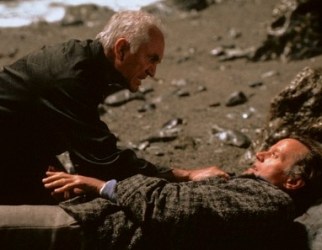 Despite the visual trickery, The Limey still works pretty well as a straightforward thriller. You have to be prepared to accept the slippery editing, because there’s no avoiding it, but the throughline of Stamp tracking down bad men and how he deals with them is still here. Personally, I’ve never much rated Stamp as an actor, but somehow he fits here. He’s a fish out of water, a man out of place — way out of place — and possibly out of time, too, seeming like a ’60s or ’70s British gangster transported to turn-of-the-millennium L.A. It’s no discredit to the supporting cast that they mainly exist to bob around in his wake.
 The third feature (but first you’re likely to have heard of) by writer-director Alexander Payne (



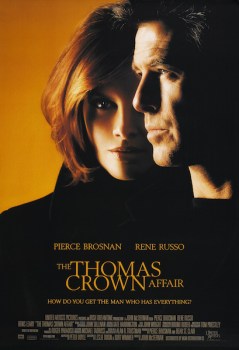 Once upon a time, John McTiernan was an action auteur, known for films that sat comfortably on the “mainstream modern classics” scale, like
 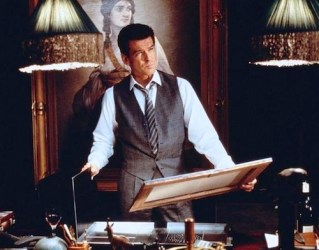 McTiernan’s action background comes to the fore in a pair of extended heist scenes at either end of the movie, which are surely the standout parts. The seductions and plot twists in between these bookends are certainly entertaining and may even keep you guessing, but it’s the heists that pack the most entertainment. They’re the kind of thing we don’t see so much nowadays, at least not in mainstream movies, because any sequence designed to provide excitement is a fight of some kind, and most of those are shot in the shaky-cam style. There’s none of that palaver here, just perfectly choreographed cutting between the various players in each heist, and some well-chosen music — as if being ably to do awesome stuff accompanied by the James Bond Theme wasn’t cool enough, here Brosnan gets to do the same to Nina Simone’s Sinnerman.
 The Thomas Crown Affair may not be the best film on any of its principals’ CVs (well, except perhaps for Russo’s), but it’s a consistently enjoyable light thriller with a couple of particularly memorable sequences and a fun central dynamic. Apparently it’s better than the original, too. There’s long been talk of a sequel, but it seems to have gone the way of McTiernan’s career, which is a shame.
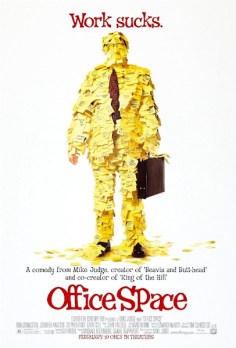 “From the creator of Beavis and Butt-Head” is not a designation that’s going to help sell a film to many people anymore. That the same fella also went on to write and direct the mediocre
 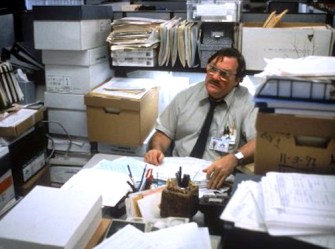 In truth, the plot doesn’t quite fill the slight running time, and Judge doesn’t seem to quite know how to end it — clearly he doesn’t want his hero figure getting caught out, but it can’t just go on forever. Fortunately, this is a comedy, and so plot matters only so much if the rest is funny. In some respects it’s a story of “first world problems” — these guys have decent jobs, making decent money, but it’s boring — but at least it finds the humour in this. Little vignettes of office life, a mix of light satire and gentle surrealism, keep the amusement ticking over too.
 100Films.co.uk