2016 #65
Zack Snyder | 151 mins | cinema | 2.35:1 | USA / English | 12A / PG-13
 With Warner Bros’ universe-launching superhero epic now in its second weekend (unless you live in Myanmar or Poland, anyway), you’ve probably more than had your fill of spoilerphobic reviews. So allow me to provide a spoiler-filled one. (There are a fair few of those around too, of course, but not all reviews can be beautiful or unique snowflakes.)
Despite being a sequel to Man of Steel and featuring a Superman-heavy supporting cast (from Batman’s world we have Alfred; from Superman’s we have Lois Lane, Jimmy Olsen, Perry White, Lex Luthor, Martha Kent, and (spoiler for something that was in the trailer) Doomsday), Batman v Superman is really a Batman movie. It begins with the latest recap of his origin story — pretty much a prerequisite for any new big-screen incarnation of the Dark Knight. But don’t give up on the film within the opening minutes, because BvS is actually going somewhere with this — the Bat’s backstory has a role to play in the climax. Anyway, after that we get a recap of the end of Man of Steel: as Zod and Supes turn Metropolis into rubble and slaughter untold thousands in the process, we see Bruce Wayne driving and running through the collapsing city streets, heading for a Wayne Financial building where he does superhero-y stuff like save a little girl’s life, and fix the flying Kryptonians with a glare that says, “you are my new enemies.” Central conflict, right there.
I say this is a Batman movie, but in many respects it’s actually a Bruce Wayne movie. Is there a difference? I suppose you could argue not, what with Bruce being the man inside the Batsuit, but I would say a “Batman movie” concentrates on what he gets up to in that suit — fighting crazy villains, essentially — while a “Bruce Wayne movie” would be more about the man, his decisions, his emotions. Now, I’m not about to claim BvS is big on its characters’ inner lives, but if it really taps into the thoughts and feelings of anyone, it’s Bruce. This is a Batman who has perhaps lost his way, scarred by too many tragedies in his life. There are unmissable references to his 20-year crimefighting career; 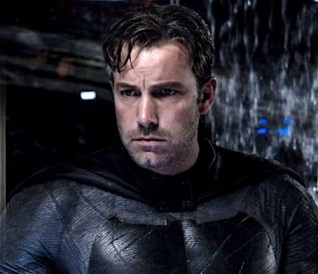 to good people turning bad; the Joker-graffitied Robin suit… This isn’t fan-pleasing/teasing background detail, it speaks to Bruce’s mindset. He’s become the kind of person who believes lines like, “if there’s a 1% chance he’s our enemy, we must take it as an absolute certainty.” He’s a bit of a right-wing nut, basically. If you want to find a character or emotional throughline to the movie, it’s Bruce learning to be a better hero again.
Of course, this being a Zack Snyder film, it often does a muddled job of presenting this kind of material to us. There’s also a heavy vein of what it means to be a hero, with Superman under constant scrutiny for his actions, with questions being asked about what rights he has to act the way he does, and whether methods are needed to stop him. These are potentially interesting themes to tackle, provided you buy into the whole superhero genre in the first place — they don’t really have any real-life equivalent, if that’s what interests you in movies; they’re predicated in the thought process of, “if Superman was real, what would it be like?”
So assuming we consider these as valid things to dig into, it’s a shame the film does a muddled job of it. There’s some grandstanding and speechmaking, and some heavily portentous dialogue, but what is it really saying? Good luck finding out. Maybe repeat viewings and some proper consideration will reveal more depth tucked away there. Certainly, I’ve been a bit annoyed with some of the glib online criticism of the dialogue and the ideas presented through it; commentary that chooses to focus on one sentence that comes at the end of a discussion, so the clever-clever internet person can laugh at the silliness of that line’s question or observation, ignoring the fact that there was a whole range of dialogue before that one line, and in that dialogue the idea was more fully considered or explained. But no, it’s easier to take a soundbite and analyse it as, “lolz, shit dialogue, dude.” I’m not saying BvS has a script of Oscar-worthy, polished, believable, insightful dialogue, but it’s not that poor, either.
 But if we are criticising the screenplay, let’s turn our attention to the story and its structure, which leaves something to be desired. This isn’t just the writers’ fault, of course, because myriad things affect a film once the screenplay is signed off. In the case of story structure, editing seems a likely culprit — not the actual cutting together of individual shots to craft a sequence or scene, which is as good here as in any action blockbuster, but in terms of storytelling. Frankly, that’s a bit of a mess. Or a lot of a mess, maybe. Whole scenes serve literally no purpose or are clearly in the wrong place — the bit where Perry wanders up to Clark Kent’s desk and wonders if he’s clicked his heels and disappeared back to Kansas, for example. What purpose does it serve? None. But where it might have a role is where it clearly belongs: a couple of minutes later, right before the scene where Superman is in Kansas, chatting to his mom. Why is it not right before that scene? It’s like someone accidentally dragged it out of place on their computer editing timeline and never noticed. Sure, this is a minor point in the grand scope of the film, but it belies a sloppiness to the entire storytelling.
That extends all over the place. Someone clearly thought the movie was short on action — it has a lot of plot to get through, and whereas once upon a time it would’ve just got on with that plot and happily let all the action sit at the end, that’s not allowed these days. So, unable to find a combat or chase within the real narrative, Bruce has visions of a possible future where Batman wears some kind of dusty trench-coat and battles Superman-symbol-emblazoned soldiers in a Mad Max-esque landscape. In itself it’s a neat, fanboy-pleasing “alternate world” idea, and it’s an exciting sequence with some excellent action choreography, and it certainly looked good in the trailers, but in the film it’s a total aside from anything.
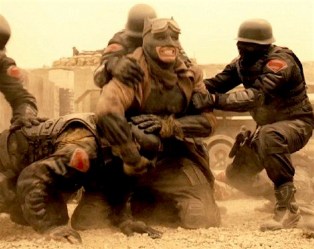 The only purpose it might serve is teasing the future — what is the giant Omega symbol? What are those flying devil-creatures? DC fans know that’s all related to alien supervillain Darkseid, and late in the film Lex Luthor makes a veiled reference to imply that some such alien badass is on the way. Yep, it’s Marvel-style foreshadowing, where every film is just a stepping stone to the next. Except BvS does it even more heavy-handedly than Marvel. As I said, the dream/vision is utterly unnecessary; Lex’s line is nonsensical (how does he know?); and the way other members of the Justice League are teased… You know, I don’t even want to discuss it. It’s a bad Marvel post-credit scene shoehorned into the middle of the movie. It feels like someone accidentally cut a teaser trailer into the actual print of the film. It’s not even so bad it’s good, it’s just tacky. And, I have to say, though I’m not the biggest fan of The CW’s Flash TV show (I think it’s been massively overpraised by some of superhero fandom), Cheery TV Barry Allen seems a much more likeable, comics-accurate version of the character than the movies’ Hipster Beard Barry Allen. Maybe it’s just the beard, I don’t know; but even if it is just the beard, it’s a hipster beard, and it’s wrong.
For a movie that critics stuck it to*, there’s an awful lot to say about BvS — genuine stuff, not just facile observations on hipster beards. This is not a film that needs an extra 30 minutes in an Ultimate Edition. It does need scenes re-arranging; it does need focusing in on its various plots — because there is actually a throughline here; a story that connects all the disparate strands together. Some people will miss it because those strands are so varied and so haphazardly put together, but there is a character who has an overarching plan and has engineered a lot of what’s going on — and as this is a spoilersome review, I can say that character is Lex. It surprised me a little that there was method to the madness; that someone had been orchestrating all these disparate elements. Surprise is good; surprise that makes you rethink the film even better — but you’re meant to rethink 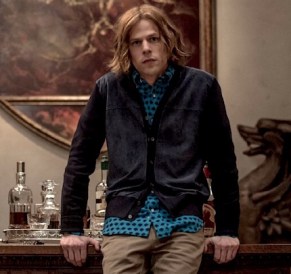 to look for clues you missed, not rethink to see if that even fits with everything we’ve seen. That’s because even if you do latch on to the almost-throwaway sliver of dialogue that indicates Lex put all of this together, the way it’s presented in this cut makes it come a little out of nowhere. However, I believe it’s a plausible explanation of events (within the realms of the version of the genre these films are in), and would tie the whole thing together neatly, were it just a little clearer.
So, saying “there’s an awful lot to say about BvS” and then not saying it is a cop-out, but we’re 1500 words deep into this review and I haven’t mentioned: the role of Lois Lane; the role of Wonder Woman; the role of Alfred; how good Ben Affleck is; how wasted Henry Cavill is; Jesse Eisenberg’s performance, for good or ill; what, if anything, the film is saying about government oversight and/or domestic terrorism; the car chase (purely as an action sequence, I liked it); the presence of Doomsday; the battle with Doomsday; the death of Superman and its almost-immediate sort-of-retraction, and whether that was a good idea or not, or if it even matters; why the “Dawn of Justice” subtitle is an accurate addition to the title, but also a pain in the ass to the “Batman v Superman” part; heck, I’ve said nothing of that titular duel itself. When it comes, the fight is inspired by — but not completely adapted from — Frank Miller’s The Dark Knight Returns, which should surprise precisely no one as, a) Snyder is an avowed Miller fan, and b) if you’re doing a Batman vs. Superman smackdown, that’s the one to do.
(I also wanted to write something about the film’s lack of attentiveness to cityscapes, because that’s something that interests me and I’ve not seen anyone else discuss it; but I’ve only remembered this after the entire review is finished, illustrated, and scheduled for posting, so it’s quite late at night to get my brain in gear and add it. But if anyone’s actually interested, there’s always the comments section.)
As to those other points… look, I don’t want to get too off-topic, but there’s a rant to be had about discussions of films stopping at opening weekend. “It was cool” / “it wasn’t cool”; “it was fun” / “it wasn’t fun”; “it was an irredeemable piece of crap and I hope it kills off the franchise” / “I can’t wait for Wonder Woman” — followed by, “done now, when’s Civil War out?” Hey, hang around for a minute! There’s stuff here. I know critics just want to barrel on to what’s next because they didn’t like it, but maybe if they stopped to discuss it they’d find there’s more to unpack than they’d like to think? Because yeah, you can see the movie as one long mess before Batman and Superman finally fight, at which point it degenerates into a mess of CGI and aural bombast (seriously, there’s too much noise during the climax), and ends with characters stood around having conversations where the pre-first-draft filler dialogue said,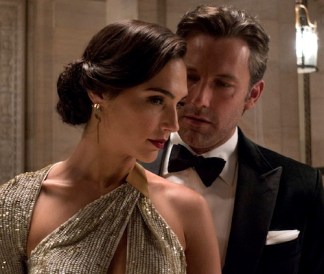 “Give audience an idea what future film(s) will be about while saying absolutely nothing concrete about what future film(s) will be about.” But in that mess (the mess I mentioned at the start of that last really long sentence, remember? OK,) there is stuff going on; there are ideas the filmmakers want to put across, possibly with the intention that they’ll actually be thought about.
And I know it’s just a superhero movie, and I know they’re just ideas about superheroes, and I know if you get into discussions of its representation of women or the legal/political system or any other real-world-connected points then you’re getting into a minefield that the film may not have fully-considered ideas about… but for all his faults as a filmmaker — for all his focus on visual Cool — Zack Snyder has now made at least three films where, buried beneath all that surface noise (both visual and aural), there are things to think about, but because that surface is so polished that it suggests the film must only be skin-deep, the ideas get ignored. The other two films, for what it’s worth, are Watchmen (where, yes, he’s given a leg-up by Alan Moore and Dave Gibbons’ uncommonly thoughtful graphic novel) and Sucker Punch — a movie even more dismissed than BvS has been, but which I maintain has a lot going on.
I’ve even lost myself at this point, so I’ll call it a day. Batman v Superman is a long way from being a perfect movie, and anyone who likes the lightweight fun of the Marvel Cinematic Universe is going to be ill-served here. (Oh man, there’s a whole other semi-off-topic discussion. Ten to fifteen years ago, the only things that could be Cool were dark-and-moody, self-serious, po-faced, grim-and-gritty films/games/whatever; nowadays, you do that and you get lambasted for not being colourful and humorous. Back then, I was miffed that everything had to be the former and when anyone did the latter it got shat on, and now I’m miffed that everything has to be the latter and when anyone does the former it gets shat on. I’m not contrary, I just think we can have, can enjoy, and can accept, both.)
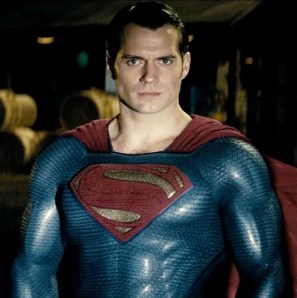 As I was saying: not a perfect movie, but one with a lot of material to provoke thought about both the inherent concepts of superheroes and, external to that, the genre itself, especially the way it’s presented in cinema. I’m not going to slag off the Marvel movies, because they are fun, but the entirety of the big-screen MCU** put together hasn’t given us even a fraction of as much stuff to consider, dissect, analyse, and process as this one bold, messy, controversial movie. I kinda love it for that.
Batman v Superman: Dawn of Justice is still on release everywhere. The 30-minutes-longer Ultimate Edition is scheduled to be part of the DVD/Blu-ray release, probably in July.
* I won’t trot them all out here, but there are interesting (if you’re into that kind of thing) stats about its critical drubbing vs. its box office performance — essentially, it’s far and away the worst-reviewed super-high-grossing movie ever, as if some omniscient power felt the point really needed ramming home that critics no longer matter to franchises that have what-they-call “pre-awareness”. ^
** “Big-screen” because, in fairness, Daredevil and Jessica Jones are a whole different kettle of fish. ^

 Scorsese tells the story of Jesus in this controversial epic adapted from Nikos Kazantzakis’ novel. I have no idea how much is actually rooted in scripture — a disclaimer is keen to establish the film isn’t based on the Gospels, but obviously that’s just to appease the devout.

 Score:



 Some say The Five Venoms is
 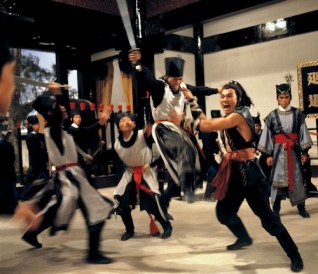 I keep reading things like “the concept of the five Venom styles is simply amazing”, or that “the mythology alone is exquisite”, but I just don’t buy it. There’s nothing wrong with it — it’s a decent setup — but to call it a “mythology” is bordering on grandiose. And whether it’s a full-blown mythology or just a high-concept setup, either way it’s not that incredibly mind-blowing a concept.
 I’ve observed before that the ’80s seem to be everywhere in film these days, and here’s another example: Turbo Kid is in every respect an homage to low-budget ’80s genre fare.
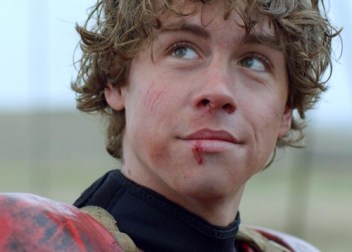 Then there’s the score, which is of course all ’80s synths, in a similar style to the score of


 2013 Academy Awards
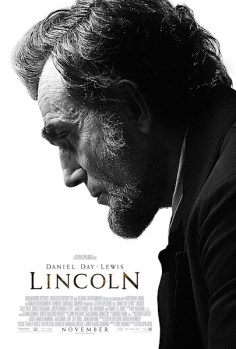 Daniel Day-Lewis allegedly stars in this account of the final months of President Abraham Lincoln’s life, which might more pertinently be called The 13th Amendment due to where its focus lies. I say “allegedly” because I’m not convinced they didn’t find a way to resurrect Lincoln to appear as himself, then just pretended it was Day-Lewis acting.
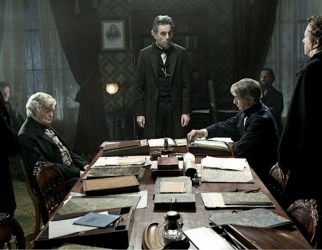 who might be persuaded to vote which way, and how they might be persuaded, and what they will want in return, and what deals need to be struck, and so on and so forth — sounds like it might make for an engrossing movie, then there’s a fair chance Lincoln will be your cup of tea. A not-insignificant proportion of viewers protest that it is boring, however, and while I in no way agree with them, your mileage may vary.
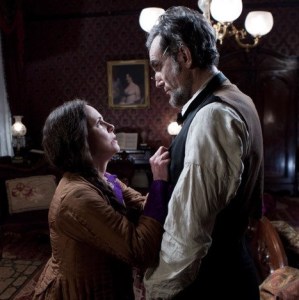 Not to do anyone else in the film — or, indeed, any other performance in any film ever — a disservice, but Day-Lewis embodies the President in a way few other actors have ever embodied a role. It’s quite remarkable.
 For me, there are few black marks (unfortunate choice of phrase…) to be held against Lincoln. Does it give in to Spielberg’s sentimentality? Yeah, a little — but it’s a long, long way from the worst case of that, and I think you’d be nitpicky (or have a different opinion on history, which, you know, is a matter of opinion) to criticise the film too harshly for that. As to whether it’s boring, that’s entirely a matter of preference. If you think The West Wing is boring, people who write lists of “the greatest TV shows ever” will disagree with you, and you also likely won’t like Lincoln. I like The West Wing, though.
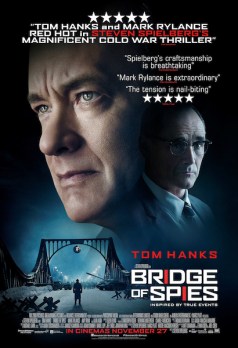 Steven Spielberg’s true-story Cold War drama stars Tom Hanks as insurance lawyer James B. Donovan, who is tapped to defend captured Soviet spy Rudolf Abel (Mark Rylance). After Donovan insists on doing his job properly, he manages to spare Abel the death penalty — which comes in handy when the Soviets capture spy-plane pilot Francis Gary Powers (Austin Stowell) and a prisoner exchange is suggested, which the Russians want Donovan to negotiate.
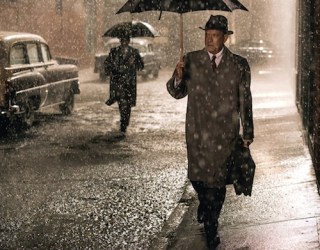 If we’re talking storytelling oddities, another is the manner in which Powers’ backstory is integrated. As Donovan continues to defend Abel, the film suddenly becomes subjected to scattered interjections, in which we see pilots being selected and then trained to fly secret reconnaissance missions in a new kind of plane. Any viewer who has read the blurb will know where this is going, but it’s so disconnected to the rest of the narrative that it felt misplaced, at least to me. The same is true when we suddenly meet Frederic Pryor (Will Rogers), an American student in Berlin who’s mistaken for a spy and arrested by the East. It turns out we need to know about him because Donovan attempts to use his negotiations to get a two-for-one deal, exchanging Abel for both Powers and Pryor. Knowing the stories of the men Donovan will be negotiating for is not a bad point, but I can’t help but feel there was a smoother way to integrate them into the film’s overall narrative.
 hints at emotions under the surface rather than declaiming them. A lesser film would’ve made a point of this — would’ve had Hanks’ lawyer struggling to understand and relate to his client’s low-key nature — but, instead, Donovan is a man who can identify with this mode of being, at least to an extent. There’s a reason they talk a couple of times about the ‘stoikiy muzhik’.
 allows the whole film to be equally as subtle, even as it remains gripping and entertaining. However, the storytelling quirks are a mixed success, the pace they sometimes lend offset by the almost non sequitur style of the captured Americans’ backstories. Nonetheless, this is a classy but still enjoyable dramatic thriller, which takes a seat among Spielberg’s better works.


 After martial arts student Fang Cheng is killed protecting his master, the latter takes in Cheng’s infant son, Fang Kang, as his student. Years later, Fang Kang is bullied by his aristocratic classmates and treated as a servant by the master’s daughter, Pei, though he’s a better student than any of them. Eventually goaded into leaving, his fellows corner him, challenge him, accidentally lop off his sword arm, and leave him for dead. Kids, eh? Fortunately, Kang is found by orphan Xiao Man, who nurses him back to health. With the help of an old textbook, he learns to fight left-handed, which is handy because there’s a conspiracy underway to kill all of his master’s former pupils…
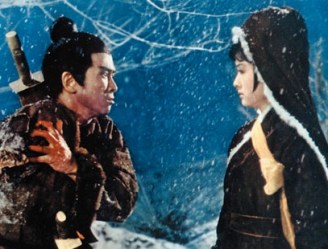 However, for me the film also worked very well as a drama, and even sometimes as a romantic drama. Fang Kang is an interesting protagonist. His lifestyle is torn from him, and rather than simplistically train to regain it or give up entirely, he battles with that decision. He returns to that way of life only to defend himself and his rescuer, and then out of a sense of loyalty to the master who raised him, but he’s also prepared to abandon the martial life to be a farmer… when the job is done, naturally. Jimmy Wang Yu, in a star-making turn, sells this character arc as well as anyone in a kung fu picture ever has. He’s also (somewhat) torn between two women, the kindly and supportive Xiao Man, and brat-with-a-heart Pei. While no one could truthfully call this a romantic picture, the love-triangle aspect also functions surprisingly well.
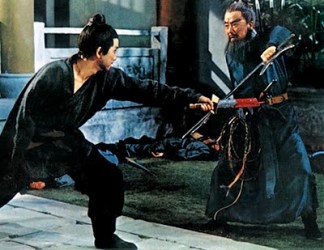 I disagree with that. Perhaps those lists are based on the abundance of action in these films, by which metric this probably has too much drama — though, as I said, it’s not devoid of fisticuffs and swordplay. Combine that with a solid story, engaging characters, and a brisk pace (even with its near-two-hour running time), and you have one of my favourite Shaw Brothers movies I’ve yet seen.
 100Films.co.uk