Home on the Range (2004)

2016 #32
Will Finn & John Sanford | 73 mins | streaming (HD) | 1.78:1 | USA / English | U / PG

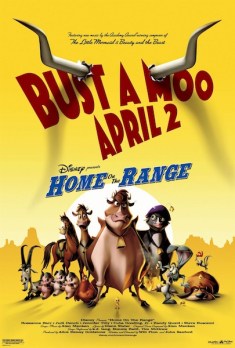
I have many goals within my film viewing, quite apart from trying to watch 100 films every year. Some I’ve completed (the Rathbone Holmes series), others are almost done (every Spielberg film), others not so much (every Hitchcock film), and others I’ve barely begun (the Zatoichi series). One of these goals is to watch every Disney Animated Classic, their canon of feature animations that currently sits at 55 titles (with another scheduled for later this year, in the US at least). I did a pretty good job on the real classics while growing up, and have since filled the gaps of the modern classics, so I’m left ploughing through their lesser periods: the content they pumped out in the war-affected ’40s, and the post-Renaissance pre-Lasseter clusterfrack that was their ’00s produce. My best hope is to uncover a hidden gem while I mop up this dross.

Home on the Range is not a hidden gem.

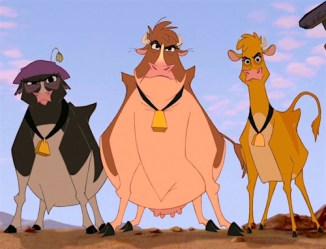
The plot, such as it is, locates us in the Old West, where a trio of singing cows hunt for an outlaw in order to save the farm they live on. The early ’00s box office was not a great place for musicals, Westerns, or traditional animations, so one does have to wonder what inspired Disney to make their 45th Animated Classic a traditionally-animated musical Western.

Still, box office failure does not equate to a lack of quality. No, the film achieves that all by itself. There’s a plodding, familiar, poorly-structured story, with dull characters, who spout flat dialogue, which does nothing to help their unoriginal relationships. The voice acting is irritating, with the exception of one or two over-qualified performers (Dame Judi Dench?!) The songs are weedy, repetitious, and unmemorable. The villain’s number is the best of a bad bunch, but only because it has a moderately amusing reveal in the middle of it. The animation is unremarkable, besides some terrible CG intrusions. It seems to be under the impression that “hog” is a word for “cow”, based on the number of puns. A couple of gags do land — I even laughed out loud once, though I’ve forgotten why — but the majority is resolutely uninspired.

It’s actually not the worst of Disney’s canon (as I mentioned, there’s the odd flash of enjoyment, which is more than can be said for Chicken Little), but it’s still one for aficionados — or completists — only.

2 out of 5

Face/Off (1997)

100 Films’ 100 Favourites #28

It’s like looking in a mirror — only not

Country: USA
Language: English
Runtime: 139 minutes
BBFC: 18 (cut)
MPAA: R

Original Release: 27th June 1997
UK Release: 7th November 1997
First Seen: TV, 22nd September 2002 (probably)

Stars
John Travolta (Saturday Night Fever, Hairspray)
Nicolas Cage (The Rock, Ghost Rider)
Joan Allen (Nixon, The Bourne Supremacy)
Alessandro Nivola (Mansfield Park, Jurassic Park III)
Gina Gershon (Bound, P.S. I Love You)

Director
John Woo (Hard Boiled, Mission: Impossible II)

Screenwriters
Mike Werb (The Mask, Firehouse Dog)
Michael Colleary (Darkman III: Die Darkman Die, Firehouse Dog)

The Story
FBI agent Sean Archer finally corners his nemesis, Castor Troy, knocking him into a coma in the process. Unfortunately, Troy has planted a bomb that will destroy Los Angeles, and the only other person who knows its location is his brother — and he ain’t talking. So Archer comes up with the perfectly sane and utterly foolproof plan to secretly have a face transplant and assume Troy’s identity. Unfortunately, the real Troy wakes up, takes Archer’s face, and kills everyone who knows the truth. Hilarity ensues! No, wait, it’s not that kind of movie — violent bloody action ensues.

Our Hero
Sean Archer, super cop. Looks like John Travolta, until he looks like Nicolas Cage. Don’t overthink it, it works just fine when you’re watching the film.

Our Villain
Castor Troy, super villain. Looks like Nicolas Cage, until he looks like John Travolta. Don’t overthink it, it works just fine when— wait, I did that bit.

Best Supporting Character
Castor’s brother, Pollux. Yes, that’s his name. Looks like Alessandro Nivola throughout.

Memorable Quote
Castor Troy: “Sean Archer here, who’s calling?”
Sean Archer: “Well if you’re Sean Archer, I guess I’m Castor Troy.”

Memorable Scene
The good guy’s teenage daughter — played by Dominique “Lolita” Swain, as if to ram the point home — is hanging out in her bedroom wearing next to nothing, when in walks the villain, who starts perving over her… oh, and he’s got her dad’s face at the time. This is the kind of scene you can have when your body-swap movie is rated 18, I guess.

Making of
According to IMDb, the studio wanted John Woo to take the slash out of the title, but he kept it so people wouldn’t think it was a hockey movie. I don’t know why you’d think it was a hockey movie without the slash, or why adding a slash magically stops it being a hockey movie, but that’s what it says.

Awards
1 Oscar nomination (Sound Effects Editing)
2 Saturn Awards (Director, Writer)
7 Saturn nominations (Action/Adventure/Thriller Film, Actor (both Nicolas Cage and John Travolta), Supporting Actress (Joan Allen), Younger Actor/Actress (Dominique Swain), Music, Make-Up)
2 MTV Movie Awards (including Action Sequence for the speedboat chase)
4 MTV Movie Award nominations (including Best Villain, shared between Nicolas Cage and John Travolta)
1 Golden Trailer Awards nomination (Best of the Decade)

What the Critics Said
“Travolta and Cage make superb adversaries, flip-flopping roles, first as hero, then as villain. What titilating fun to observe Cage seethe with venom and Travolta meet danger head-on, then see Cage become Travolta, as the latter adopts the unmistakable characteristics of the fiend. […] Face/Off is a masterpiece equal to the action classics Seven Samurai, The Wild Bunch and The Good, the Bad, and the Ugly.” — Roger Hurlburt, Sun Sentinel

Score: 92%

What the Public Say
“Gorgeously shot with lots of Ol’ West style close up on the eyes while silence is only interrupted by the sounds of gun magazines falling to the ground. Woo’s directorial vision and the clever exchange of snark and built up bitterness displayed in the dialogue are just two of the beautiful components displayed in the first 30 minutes of this film that set the tone of the fucking masterpiece that it is.” — Amy Seidman, This Film Is Better Than You, Deal With It

Verdict

After making his name as an “heroic bloodshed” director par excellence with films like A Better Tomorrow, The Killer and Hard Boiled, John Woo headed for Hollywood… and made Van Damme vehicle Hard Target and nuclear-warhead-theft thriller Broken Arrow. But after those he made this, surely one of the best action movies of the ’90s. Its sci-fi high-concept allows Travolta and Cage to have a whale of a time in each other’s bodies, and Woo’s trademark OTT action is as exciting as ever.

Next: #30, ah-ah! Saviour of the universe!

The Witches of Eastwick (1987)

2016 #47
George Miller | 113 mins | streaming (HD) | 2.35:1 | USA / English | 18 / R

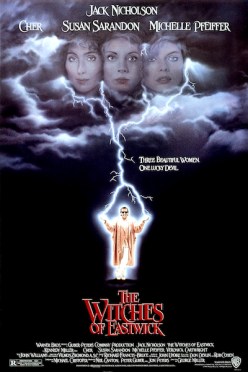
The first US feature from the director of Mad Max is an unusual affair. Three now-single women (Cher, Susan Sarandon, Michelle Pfeiffer) accidentally summon a man (Jack Nicholson) who lures them into a life of debauchery, while helping hone their latent magic powers.

Undoubtedly a comedy, Eastwick is less laugh-out-loud, more wryly amused by small-town tittle-tattle. Nicholson was made for devilish characters like this, but the rest of the film isn’t as focused. A presumed point about female empowerment gets lost in the mix, and it doesn’t know how to end, resorting to an effects-driven climax.

Still, it’s largely fun.

3 out of 5

For more quick reviews like this, look here.

The Color Purple (1985)

2016 #66
Steven Spielberg | 154 mins | streaming (HD) | 16:9 | USA / English | 15 / PG-13

These days, Steven Spielberg is as well-known for his Oscar-worthy historical prestige pictures as he is for his action-adventure genre movies, so it’s kinda strange (at least for me) to imagine the time in his career at which this film came about. I mean, it’s an adaptation of a controversial literary novel about the miserable lives of black women in the American South during the early decades of the 20th Century, directed by the white guy known for Jaws, Close Encounters, E.T., Raiders of the Lost Ark, and Temple of Doom. To give it a modern frame of reference, it must’ve been a bit like if Zack Snyder had made Precious.

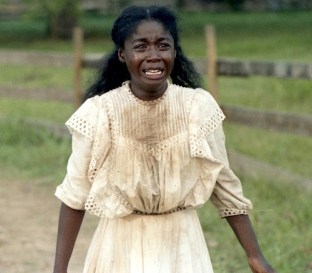
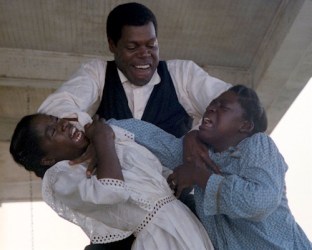
Beginning in 1909, the film tells the life story of Celie, played as a teen by Desreta Jackson and as a woman by Whoopi Goldberg, in her debut role. She’s surprisingly good, actually — often understated, doing a lot with just her eyes. Anyway, over the next 28 years Celie is systematically abused and downtrodden, first by her father, then by her husband Albert (Danny Glover) and his unruly kids from a previous marriage. Her beloved sister Nettie (Akosua Busia) disappears, never to be heard from, despite a promise to write. Various characters and their subplots weave in and out of Celie’s life, like Sofia (Oprah Winfrey), a strong-willed woman who one day slaps a white man and suffers for it; and jazz singer Shug Avery (Margaret Avery), the object of Albert’s affections, who eventually helps Celie find greater independence.

If it all sounds a bit grim then, well, it is. I’m sure it can’t’ve been a great time or place to be a black person (though any suffering at the hands of white folk doesn’t play into this particular narrative too much, aside from Sofia’s storyline), nor is it exactly the greatest period to have been a woman, so put the two together… Yet because it’s a Spielberg film, it never quite feels like we’re getting the full force of the story’s brutality. That’s a mixed blessing: as a viewer, we’re spared all the horrors you can infer from what actually happens; at the same time, how much should a story about such horrors be sparing us from them? Though as it was at one point advertised with the tagline, “Remember how good it made you feel… See it again.”, someone clearly thought it was meant to be a feel-good movie.

Nonetheless, the lack of gritty realism isn’t just Spielberg’s fault, I don’t think, but also the era of filmmaking. These days I imagine such a story wound make for a much grittier movie, like the aforementioned Precious, or 12 Years a Slave, but this comes from a ‘prettier’ time. Look at something like Once Upon a Time in America, released the year before: it’s a film about violent crime and associated dark deeds, but it’s also an historical prestige movie, tinged with nostalgia. There’s not a whole lot of nostalgia in The Color Purple, but there’s something of a similar tone.

That said, Spielberg’s handling of tone here is certainly not as accomplished as Sergio Leone’s in Once Upon a Time. The really grim stuff rubs up against slapstick comedy, and Spielberg’s patented sentimentality is unleashed in undiluted force in a final act where everything comes up roses, and even some of the grim stuff from earlier is retrospectively re-written (some of that is a fault inherited from Alice Walker’s novel, of course). It’s also far too long, in need of a good streamlining rather than losing any one part in particular. Famously, it’s the only Spielberg film not scored by John Williams (until he was too ill to do Bridge of Spies). Ironic, then, that Quincy Jones’ score often sounds quite Williams-y, particularly one motif that constantly feels like it’s going to evolve into the Jurassic Park theme.

Spielberg’s first foray into Serious filmmaking is a long way from being an unqualified success, but it’s not a bad movie either, and at least it was the gateway to him making some superior dramas. Bonus points, too, for a mainstream big name director tackling a story about the historical lives of black women — depressingly, that still feels like it would be a noteworthy move 30 years later.

4 out of 5

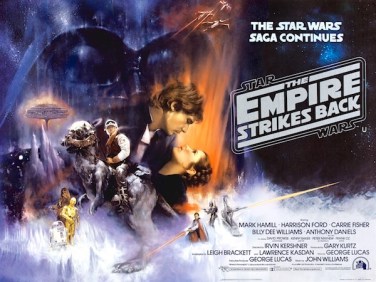
The Empire Strikes Back (1980)

100 Films’ 100 Favourites #27

The Star Wars Saga Continues

Also Known As: Star Wars: Episode V – The Empire Strikes Back

(I may be a young whippersnapper, but I’m old enough that, when I was a kid, we still called it just The Empire Strikes Back. I thought that would be a nicer place for it among my 100 Favourites, therefore.)

Country: USA
Language: English
Runtime: 124 minutes | 127 minutes (special edition)
BBFC: U
MPAA: PG

Original Release: 21st May 1980 (UK)
US Release: 20th June 1980
First Seen: VHS, c.1990

Stars
Mark Hamill (Star Wars, The Big Red One)
Harrison Ford (Raiders of the Lost Ark, Air Force One)
Carrie Fisher (Star Wars, Hannah and Her Sisters)
Billy Dee Williams (Mahogany, Batman)
Frank Oz (The Muppet Movie, Monsters, Inc.)

Director
Irvin Kershner (Never Say Never Again, RoboCop 2)

Screenwriters
Leigh Brackett (The Big Sleep, The Long Goodbye)
Lawrence Kasdan (Raiders of the Lost Ark, Wyatt Earp)

Story by
George Lucas (Raiders of the Lost Ark, Willow)

The Story
After the evil Galactic Empire uncovers the Rebel Alliance base on Hoth, our heroes flee for the stars. Guided by a message from beyond the grave, Luke heads to meet an old Jedi master. Meanwhile, Han, Leia, Chewie, and the droids hide for a bit, then go to meet the only black man in the galaxy…

Our Heroes
Luke Skywalker: ace pilot; Jedi in training.
Han Solo: reformed criminal.
Princess Leia: wait, hold on, her planet was destroyed — surely now she’s either Queen Leia or, y’know, nothing?

Our Villain
Darth Vader: daddy issues personified.

Best Supporting Character
R2-D2 is the best supporting character in every Star Wars film, but in this one we are introduced to Yoda. Looks like a Muppet, as cheeky as a Muppet, much wiser than a Muppet. Probably. It’s hard to be certain.

Memorable Quote
“Try not. Do, or do not. There is no try.” — Yoda

Quote Most Likely To Be Used in Everyday Conversation
Leia: “I love you.”
Han: “I know.”

Memorable Scene
After a dramatic lightsaber duel, Darth Vader lops off Luke’s hand, his weapon disappearing with it. As Luke dangles over an endless fall to Certain Death, Vader decides this is the perfect moment to impart a big secret…

Memorable Music
The Star Wars Main Theme is all well and good, but here regular composer John Williams introduces us to arguably an even more iconic tune — it certainly gets played outside of the films more often, as a universal signifier of evil. That’s right, it’s the Imperial March! All together now: dum dum dum dum-duhdum dum-duhdum…

Truly Special Effect
To animate the tauntauns, Phil Tippett and ILM pioneered the use of go motion, a version of stop-motion animation that moves the puppet while the frame is being exposed so as to create motion blur, thereby making the effects more realistic. (It purposefully wasn’t used for the AT-AT walkers, to emphasise their mechanical movement by keeping it slightly jerky.) Go motion would go on to be used on films including Dragonslayer, E.T., RoboCop, and Willow. It was going to be used for the dinosaurs in Jurassic Park, but then someone had another idea…

Letting the Side Down
Lucas’ Special Edition fiddling isn’t as prevalent in Empire as in its original trilogy compatriots. If anything, the big windows in Cloud City are a nice touch.

Making of
The crew took crates of simulated snow from the Hoth set to the shoot in Norway, in case there wasn’t enough real snow on location. Somewhat ironic, then, that the location was hit by a snowstorm, coating the region so thoroughly that some of the scenes set in Hoth’s wilderness were filmed right outside the crew’s hotel.

Previously on…
The story begins, of course, in Star Wars. There’s tonnes of other material set before Empire, not least the infamous prequel trilogy.

Next time…
The Star Wars universe is immense, so don’t expect me to even attempt a summation of it. At the most essential, Return of the Jedi picks up the dangling threads of Empire and completes the trilogy, while last year’s The Force Awakens continues the narrative decades later, with more instalments to come in 2017 and 2019.

Awards
2 Oscars (Sound, Special Achievement in Visual Effects)
2 Oscar nominations (Score, Art Direction-Set Decoration)
1 BAFTA (Music)
2 BAFTA nominations (Production Design, Sound)
4 Saturn Awards (Science Fiction Film, Actor (Mark Hamill), Director, Special Effects)
4 Saturn nominations (Supporting Actor (Billy Dee Williams), Writing, Music, Costumes)
Won the Hugo for Best Dramatic Presentation
1 WGA Award nomination (Best Comedy Adapted from Another Medium — yes, really)

What the Critics Said
“It’s almost too much to expect that a sequel can ever top the success of the original, and I suspect that this will prove the case with The Empire Strikes Back […] While Empire doesn’t quite measure up to Star Wars in the freshness and originality of its script, and the plethora of space operas that has been jamming the screens ever since Star Wars has somewhat lessened the novelty of city-sized ships sailing the stratosphere, nevertheless this 20th Century-Fox release remains a rattling good entertainment, a worthy successor to the original — and far and away the best of its kind since Star Wars itself.” — Arthur Knight, The Hollywood Reporter (This original 1980 review also mixes up Yoda and Boba Fett. Fun.)

Score: 94%

What the Public Say
“the movie suffers from as uneven a vibe as its forebear, with, especially, the midsection lacking in elements designed to wholeheartedly sustain one’s interest. This proves to be especially true of Luke Skywalker’s ongoing (and less-than-captivating) training at the hands of Frank Oz’s Yoda, as such interludes suffer from a lack of momentum that bring the proceedings to a dead stop at each and every turn. […] an erratically-paced yet consistently entertaining installment in a not-quite-great sci-fi series.” — David Nusair, Reel Film Reviews (This site gives Episodes III, IV, V and VI a rating of 3/4, but Force Awakens a full 4/4. Just so you know.)

Elsewhere on 100 Films
I’ve written about the original Star Wars trilogy twice before, both times back in 2007. Of The Empire Strikes Back’s modified DVD version, I said that “the big change comes in dubbing both Boba Fett and the Emperor with appropriate actors from the prequel trilogy […] Other than shunning the poor original actors in such a way, Empire is much the same as ever.” Then, treating the film as the fifth part of the saga, I wrote that “a variety of elements […] have a very different impact in light of what we’ve experienced in the first trilogy. The most obvious is the revelation that Vader is Luke’s father: it’s no longer a twist, of course, but the emotional impact on Luke still makes it an important moment. Yoda […] seems to have gone a little loopy after several decades alone on Dagobah”.

Verdict

What more is there to say about The Empire Strikes Back, really? According to some polls, it’s the greatest movie of all time; even if you don’t go that far, it’s a masterpiece of blockbuster science-fantasy adventure. Every moment is tuned to tickle the thrill-glands; every special effect a labour of love that, with their inventiveness and genuine physicality, remains largely impressive today. And it’s so well paced that most people completely overlook that the storyline is chronologically challenged (Luke travels to Dagobah, meets Yoda, learns a bunch of tricky Jedi skills, and heads off to Cloud City, all while the rest of the characters hide in an asteroid field and are locked up for about five minutes). Plus it has the audacity to end on an almighty cliffhanger/revelation double-header! And in that spirit: it’s not even my favourite Star Wars movie. But I’ll tell you about that another time.

#28 will star… Travolta/Cage.

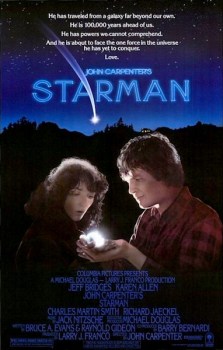
Starman (1984)

2016 #14
John Carpenter | 115 mins | streaming (HD) | 2.35:1 | USA / English | PG / PG

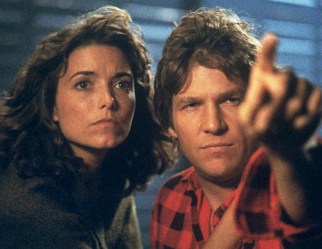
In this sci-fi romance, an alien intercepts the invitation included on the Voyager 2 space probe and tries to visit Earth, but is shot down. Taking the form of Karen Allen’s recently deceased husband, Jeff Bridges, he forces her to drive him to Arizona, where his people will rescue him in three days — if they can escape the attention of the government agents chasing them, anyway.

Starman can most pithily be summarised as “John Carpenter does Steven Spielberg”. Almost literally, in that it’s like a cross between E.T. and Always: Bridges’ comical alien learns Earth customs while trying to get home, and Allen’s widow deals with her bereavement while her husband is still ‘there’ (sort of). Of course, Always was actually made five years later, but Columbia Pictures in fact turned down the project that would develop into E.T. in favour of this movie. That’d be E.T., the highest-grossing film of all time for 11 years. Oops.

Although it may not have been the same box office hit or developed into the same cultural touchstone, Starman is certainly not a bad movie. Bridges negotiates a fine line between alien and mannered as the titular visitor who speaks faltering English and struggles with our ways, and I’d argue he always comes down on the right side of said line. Oscar voters certainly agreed, rewarding his performance with a Best Actor nomination (he lost to F. Murray Abraham for Amadeus). Allen is an engaging presence also, and between work like this and Raiders of the Lost Ark it’s a wonder she wasn’t a bigger star.

The film is an oddity on director John Carpenter’s CV, which came about due to The Thing being a box office disaster — Carpenter needed to make a very different kind of movie so he could keep getting work in Hollywood. Nonetheless, Carpenter’s horror roots are on display: there are stalking POV shots as the alien arrives at Allen’s house, and then it grows a human body, a sequence in which the ugliest (prosthetic) baby you’ve ever seen stretches and creaks as it grows into an adult in mere minutes. It’s pretty freaky. Indeed, as per the BBFC, Starman “contains mild language, sex, violence and sci-fi horror”, but is rated PG. Ah, the good old days!

Though it may not quite be a genre classic, the recently-announced remake from Shawn Levy, director of Night at the Museum, Date Night, and Real Steel (not to mention the lambasted Pink Panther reboot) seems ill-advised. While I liked the two of his movies I’ve seen well enough, Levy is a long way from being a John Carpenter, and I don’t envy whoever gets the lead role — copy Bridges and you’ll likely be a pale imitation; do something different and you’ve got to measure up to a very effective take on alienness.

On the bright side, maybe it will shine more attention on this half-forgotten original. I only watched it because I was on a bit of a Carpenter kick and it was available on Netflix, but I’m glad I stumbled across it.

4 out of 5

Starman is on Film4 at 6:45pm today.

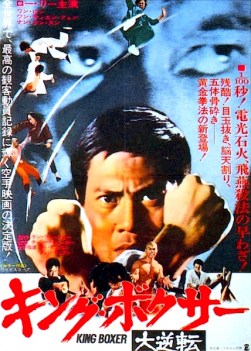
King Boxer (1972)

aka Five Fingers of Death / Tian xia di yi quan

2016 #12
Cheng Chang Ho | 98 mins | TV (HD) | 2.35:1 | Hong Kong / Mandarin | 15 / R

Released in the US as Five Fingers of Death, this popularised kung fu Stateside… before Enter the Dragon came along just a few months later and completely overshadowed it.

Viewed today, it’s a bit cheesy (which is par for the course, really), and does occasionally drag with the back and forth machinations of the rival schools. But there’s a good level of action (the primary reason to watch any kung fu movie worth its salt, surely), and a particularly stunning, casually inventive, multi-fight climax.

Also look out for “the Kill Bill sound effect” (actually from Ironside) and Evil Michael McIntyre.

4 out of 5

Film4’s Revenge of Martial Arts Gold season concludes tonight at 1:35am with The 8 Diagram Pole Fighter.

The East (2013)

2016 #30
Zal Batmanglij | 111 mins | TV (HD) | 2.35:1 | USA & UK / English & American Sign Language | 15 / PG-13

In this atypical espionage thriller, Brit Marling is a private security employee sent to infiltrate an underground activist group who are exposing the illegal activities of mega-corporations. Faced with the group’s honourable intentions vs. her employers’ indifference, will she go native?

Moral messages about capitalist evils sneak in none-too-subtly under the aegis of a spy drama, meaning your political leanings may affect how you feel about the film: dedicated right-wingers will grumble; lefties will nod in sage agreement. That aside, it’s a down-to-earth thriller, surely closer to what real-life secret agents do than any Bond or Bourne ever has been.

4 out of 5

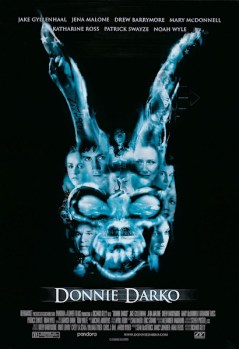
Donnie Darko (2001)

100 Films’ 100 Favourites #26

Twenty-eight days, six hours,
forty-two minutes, twelve seconds…
that is when the world will end.

Country: USA
Language: English
Runtime: 113 minutes | 134 minutes (director’s cut)
BBFC: 15
MPAA: R

Original Release: 26th October 2001
UK Release: 25th October 2002
First Seen: cinema, November 2002

Stars
Jake Gyllenhaal (Brokeback Mountain, Prince of Persia: The Sands of Time)
Jena Malone (Saved!, Batman v Superman: Dawn of Justice – Ultimate Edition)
Noah Wyle (A Few Good Men, The World Made Straight)
Drew Barrymore (Never Been Kissed, 50 First Dates)
Patrick Swayze (Dirty Dancing, Ghost)

Director
Richard Kelly (Southland Tales, The Box)

Screenwriter
Richard Kelly (Domino, Southland Tales)

The Story
Troubled teen Donnie Darko is saved from a jet engine falling on his bedroom by a vision of a grotesque rabbit that tells him the world will end in less than a month. Over the coming weeks, more strange and possibly supernatural events occur, and it all gets quite complicated and stuff.

Our Hero
“Donnie Darko. What the hell kind of name is that? It’s like some sort of superhero or something.” “What makes you think I’m not?” The eponymous teenager is a troubled young man, possibly suffering from paranoid schizophrenia, who begins to perform acts under the influence of his imaginary rabbit friend.

Our Villains
Who’s the greatest evil: Frank, the six-foot imaginary rabbit who proclaims the world is going to end; Jim Cunningham, the motivational speaker with dark secrets; or moral-crusading gym teacher Kitty Farmer?

Best Supporting Character
New girl in town Gretchen may be the only person who ‘gets’ Donnie. Bonus points to Kelly for writing a geek-fantasy girlfriend character who doesn’t conform to the Manic Pixie Dream Girl stereotype.

Memorable Quote
Donnie: “Why are you wearing that stupid bunny suit?”
Frank: “Why are you wearing that stupid man suit?”

Quote Most Likely To Be Used in Everyday Conversation
“Sometimes I doubt your commitment to Sparkle Motion.” — Kitty Farmer

Memorable Scene
Donnie wakes up in the middle of nowhere at dawn, in his pyjamas but with his bike discarded nearby. As he rides home, we see snapshots of his small town and his family, all set to The Killing Moon by Echo and the Bunnymen.

Memorable Music
The film makes strong use of contemporary pop music. It all seems to sit perfectly, which is a little ironic as a good number of tracks were changed because they couldn’t afford the rights on such a low budget. The director’s cut restores some of the original choices, which was a mistake. The film’s soundtrack composer, Michael Andrews, and his chum Gary Jules recorded a cover of Tears for Fears’ Mad World for the film, which wound up being the coveted UK Christmas number one for 2003 (beating the likes of The Darkness’ Christmas Time (Don’t Let the Bells End), and Bill Nighy’s Christmas is All Around from Love Actually).

Next time…
Whoever owns the rights attempted to cash in with sequel S. Darko, about Donnie’s younger sister. Richard Kelly wasn’t involved at all. It was not well received.

Awards
Toronto Film Critics Association Awards special citation for “the best film not to receive a proper theatrical release in Canada”.

What the Critics Said
“has a texture and tang all its own, despite its remarkable mixture of genres and expressive modes — horror, romance, science fiction, teen flicks, and Robert Bresson meets Generation Y, to name a few. There’s also a dry realism in its evocation of suburban life, which abrades nicely against the bouts of slow- and fast-motion photography that jiggle time and make the ordinary shiver. Kelly, who also wrote the script, has a great ear for family dinner-table arguments about politics, teenage debates about the sexual habits of Smurfs, and the quotidian absurdities of small-town colloquy. Local busybody Kitty Farmer’s near-hysterical complaint to Donnie’s mother, “Sometimes I doubt your commitment to Sparkle Motion” (the name of their daughters’ dance troupe), is for some unfathomable reason my favourite line of dialogue this year.” — Leslie Felperin, Sight & Sound

Score: 85%

What the American Critics Said About the Director’s Cut
“First-time writer-director Richard Kelly’s breathtakingly ambitious Donnie Darko was one of the best pictures released in 2001. Now that it has returned in a 20-minute longer — and richer — director’s cut, it seems sure to be ranked as one of the key American films of the decade.” — Kevin Thomas, Los Angeles Times

What the British Critics Said About the Director’s Cut
“If it’s your first viewing, you should still be wowed by an astounding masterpiece. But this is undoubtedly the lesser of the two cuts, and since you have the choice, you should stick with version one. […] All this director has done is cut a star off his five-star debut.” — William Thomas, Empire

Score: 91%

What the Public Say
“Maybe Richard Kelly’s fate is to be the cult circuit’s Michael Cimino — forever admired for one great film amid subsequent missteps, including a director’s cut of the same movie. Kelly has yet to match the mysterious mood or magnitude of his filmmaking debut […] a collision of time-travel sci-fi, commentary on ’80s Reaganomics malaise and teen angst that’s simultaneously witty and poignant. Non-Darkolytes should start with the enigmatic theatrical cut and proceed further if curious.” — Nick Rogers, The Film Yap

Verdict

When it finally made its way to UK shores, about a year after its initial US release, Donnie Darko was something of a hit — it made more money here than Stateside, in fact. I know several people who stumbled upon it “just because it was showing”. Conversely, I made a special trip to see it at a distant cinema at an inconvenient hour, having heard about it from US reviews. I would’ve been 16, which is probably the best kind of age to become enamoured of its misunderstood teen hero and its complicated, semi-inexplicable sci-fi story. I haven’t actually watched it for years, and never made time for the divisive director’s cut, but (whatever I’d think of it now) it remains a key touchstone in my teenage film experience.

#27 will be…

Of Human Bondage (1934)

2016 #68
John Cromwell | 83 mins | download (HD) | 1.33:1 | USA / English | PG
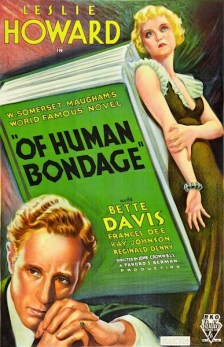
W. Somerset Maugham’s semi-autobiographical novel Of Human Bondage is, per Wikipedia, generally agreed to be his masterpiece, and regarded as one of the best English-language novels of the 20th Century. I’ve never read it, but I’m going to begin by recapping its plot (again courtesy of Wikipedia), the relevance of which will become clear after. Spoilers abound, should you be so concerned.

So, Maugham’s novel tells the life story of Philip Carey, a boy with a club foot who is orphaned and sent to live with his aunt and uncle. They quickly dispatch him to boarding school, where he struggles to to fit in due to his disability. Although groomed for an Oxford education, Philip insists on travelling to Germany, where he eventually takes an apprenticeship. Again he fails to fit in, his co-workers resenting him for being a gentleman. On a business trip to Paris, he decides to quit his job and become an art student. A fellow student falls in love with him; he doesn’t realise, and she eventually commits suicide.

(I know, you came here for a film review, not a plot summary, but bear with me.)

Realising he’ll never make it as an artist, Philip returns to England, eventually deciding to enter medicine. While struggling as a student, he meets a waitress, Mildred, who he falls in love with. She leaves him heartbroken when she announces she’s marrying another man. Philip begins seeing an author, but when Mildred returns, pregnant and unmarried, he breaks off the relationship and begins to support Mildred. Despite his kindness, she falls for one of Philip’s friends and runs off with him. Later she returns, now a single mother, and Philip takes her in again. This time she makes advances on him, which he rejects, so she destroys his belongings and disappears. Eventually he meets her again, when she’s in search of his medical opinion. She has contracted syphilis from working as a prostitute, but rejects Philip’s advice to quit. Her ultimate fate remains unknown.
(Nearly done…)

Meanwhile, Philip is left penniless by poor investments, and unable to complete his education. He’s taken in by the family of a patient, who find him a job at a department store, which he hates, although his talent for art earns him a promotion. After his uncle dies, the inheritance Philip gains allows him to return to his medical tuition and finally become a doctor. He takes a temporary placement at a hospital, where a senior doctor takes a shine to him and offers a stake in his practice. Philip declines. On a summer holiday with the patient who took him in earlier, he meets one of the man’s daughters, Sally, who likes him. She winds up pregnant, so Philip abandons his plans to travel the world, deciding to marry her and accept the doctor’s partnership offer after all. It turns out the pregnancy was a false alarm, but he decides to settle down anyway.

Phew! What a life.

All of that plays out over 700 pages. How do you adapt it into an 80-minute movie? The answer, at least for RKO in the ’30s, is that you cut most of it out.
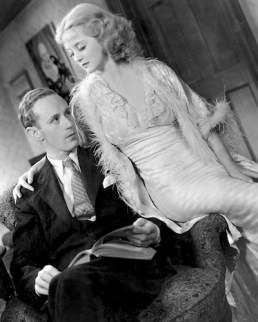
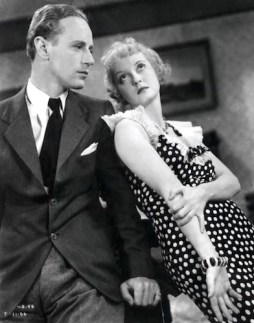
The film begins in Paris, with Philip (Leslie Howard) being told he’ll never make it as an artist. He instantly decides to become a medical student, during which time he meets Mildred (Bette Davis). From there, the rest of the film follows the plot described in the second paragraph, albeit with some notable modifications (which I’ll come to later), with parts of the third paragraph (the patient, his daughter, abandoning travel for marriage) surfacing during the third act.

As I said, I’ve never read the novel, but it strikes me this is less “an adaptation” and more “a partial adaptation”. I’m not sure how Maugham fans feel about that. Even more surprising, at least to me, is that it seems no one’s ever attempted a more faithful retelling. There were two more film adaptations, but the last of those was 52 years ago and, from a quick glance at some plot descriptions, it sounds more like they’re remakes of this film than fresh adaptations of the novel. Considering the book is so acclaimed, it’s a wonder someone like the BBC has never given it the miniseries treatment, especially considering it’s been so long since the last film.

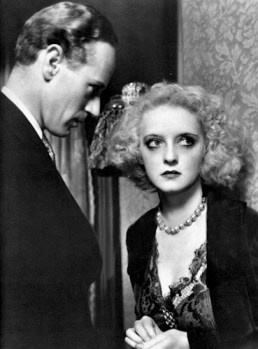
It would probably withstand a new treatment, too, because this version is not exactly highly acclaimed. Not that it’s a bad film, but there is only one real reason to watch it: Bette Davis, giving the performance that made her a star. She overcomes a terrible cockney accent (we’re talking Dick Van Dyke-level bad) to map out the sad decline of Mildred, starting out as a rude and dismissive waitress (it’s hard to see what Philip sees in her, but he’s a bit of a drip so we’re not exactly on his side), slipping to a struggling single mother desperately throwing herself at her one-time admirer, to a final terrible state: gaunt, dead-eyed, looking like she’s almost rotting away before our eyes. Maybe it’s not as gruesome as that sounds — this is a ’30s drama, not The Walking Dead — but it’s still striking.

In the film it’s not syphilis that does for her, but tuberculosis, and prostitution is never mentioned, or even really alluded to. The changes were no doubt due to the infamous Production Code. (There are paintings of naked French women all over Philip’s apartment, though, but I guess that counts as Art. Sadly, there’s no meta-funny dialogue about painting anyone like one of his French girls.) Of Human Bondage is often labelled as a Pre-Code film — as coming from that narrow era between the Code being invented and anyone seriously bothering to apply it. The latter came about in 1934, when an amendment to the Code stated that any film released after July 1st 1934 had to receive a certificate of approval before it could be released. Of Human Bondage premiered on June 28th, which I guess is why it gets labelled a Pre-Code film, but it went on wide release from July 20th, so fell under the Code’s new remit after all. The print held by the Library of Congress (used for the US Blu-ray release) even has the Code certificate at the start (it’s #53, if you’re curious).

Anyway, back to Mildred: her final degraded state is one of two parts that really mark Davis’ performance out. The other is a monologue delivered after Philip finally rejects her, a screaming force of nature that tears off the screen. Part of its effectiveness lies in the contrast to Davis’ work in the film up to that point, which has been calmer and emotionally reticent, her feelings concealed from Philip because, as it turns out, she has none for him. When she bursts forth with a tumult of fury, an explosive anger based in her lost ability to manipulate this weak man, it’s both a surprise and entirely expected of her selfish character.
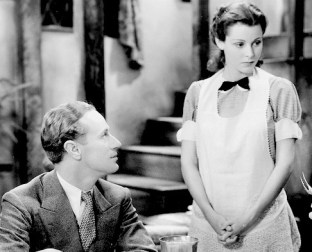
When Davis is off screen, it feels like the film is waiting for her to return. Her arc aside, it’s a take-it-or-leave-it damp squib of a drama — there’s nothing wrong with it, it’s just not all that engaging. Howard has definitely been better; his romance with Sally arrives too late to have much emotional weight, though it’s easy to believe he could fall in love with Frances Dee at first sight.

More interesting than the plot of the film is the behind-the-scenes story, which brings us back round to Davis. At the time she was a contract player at Warner Bros, and feeling her career was going nowhere. Of Human Bondage had been rejected by some major actresses due to Mildred’s distinct unlikeability, but Davis saw it as an opportunity. She begged Jack L. Warner to lend her to RKO, which he resisted because he believed it would tarnish her image. However, he ultimately relented when Warners wanted an actress from RKO (Irene Dunne for Sweet Adeline, if you’re interested), and because he believed she would fail. Obviously that didn’t happen, much to the chagrin of Warner executives, who were embarrassed by one of their actresses having such success in a rival studio’s film. When there was talk of her winning an Oscar, Jack Warner began a campaign to discourage Academy members voting for her. At that time the vote counting was handled internally by the Academy itself, so Warner was able to get his way, successfully keeping her off the nominations. However, outrage by voters led to a write-in campaign. Davis ultimately placed third, but the effects were longer lasting: write-in votes were banned, and independent firm Price Waterhouse were hired to manage the voting next year — a job they still do today.
That might make quite a good film, actually; the kind of thing that might win some Oscars…

Award-winning or not, Davis’ performance is the main reason to watch Of Human Bondage. Maybe the novel is a great work, but the film is little more than adequate, with one exception. It may take a while to get past that accent, plus the addition of some dramatic fuel to allow Davis to catch light, but when she does it’s clear how this was a star-making turn.

3 out of 5

This review is part of the Bette Davis Blogathon. Be sure to check out the many other fantastic contributions collated by host In the Good Old Days of Classic Hollywood.