High-Rise (2015)

2016 #123
Ben Wheatley | 119 mins | Blu-ray | 2.40:1 | UK & Belgium / English | 15 / R

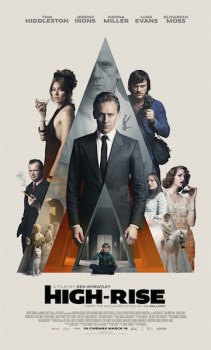
High-RiseI was looking forward to this sci-fi-ish ’70s social satire, but, having let it percolate for a few months, I still have no real grasp of what it was about. I mean, it’s obviously about society, but what its point about society is… I have no idea.

I will add it reminded me of Shivers. I didn’t like Shivers.

Technical merits are first rate — it’s magnificently designed, shot, and edited; a visual delight throughout. Plus it finds two fantastic uses for Abba’s S.O.S. But at a full two hours, pleasant aesthetics are slight sustenance.

Not so much disappointing as indecipherable.

3 out of 5

The Rock (1996)

100 Films’ 100 Favourites #75

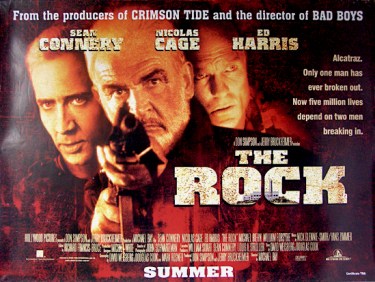
Alcatraz.
Only one man has ever broken out.
Now five million lives depend on two men breaking in.

Country: USA
Language: English
Runtime: 136 minutes
BBFC: 15 (uncut, 1996) | 15 (cut on video, 1996) | 15 (uncut on video, 2002)
MPAA: R

Original Release: 7th June 1996
UK Release: 21st June 1996
First Seen: TV, c.2000

Stars
Nicolas Cage (Raising Arizona, National Treasure)
Sean Connery (You Only Live Twice, The Untouchables)
Ed Harris (Apollo 13, A Beautiful Mind)

Director
Michael Bay (Bad Boys, Transformers)

Screenwriters
David Weisberg (Payoff, Double Jeopardy)
Douglas S. Cook (Holy Matrimony, Criminal)
Mark Rosner (Blanco, Empire City)

Story by
David Weisberg (Holy Matrimony, Criminal)
Douglas S. Cook (Payoff, Double Jeopardy)

The Story
When a rogue US General and his team of Marines occupy Alcatraz, threatening to launch a gas attack on San Francisco unless their demands are met, a field-inexperienced chemical weapons specialist is paired with the only man to ever escape from the prison to break in and prevent the attack.

Our Heroes
Dr Stanley Goodspeed is a mild-mannered vinyl-loving FBI chemist, as unlikely an action movie leading man as… well, Nicolas Cage once was. His new partner is John Mason, a former SAS Captain who’s been imprisoned without charge by the US for decades. He’s also clearly more skilled than both an entire squad of mutinous Marines and, therefore, the entire team of Navy SEALs who initially fail to stop them. That’s the SAS for you.

Our Villain
Brigadier General Francis X. Hummel, a covert ops commander who is seeking recompense for his men who were killed in action but have gone unacknowledged due to the secretive nature of their missions. Fundamentally a good man, driven to less good methods. A particularly effective villain because he’s relatively sympathetic to the audience. Not all the men on his team are so trustworthy, however…

Memorable Quote
Stanley: “You’ve been around a lot of corpses. Is that normal?”
Mason: “What, the feet thing?”
Stanley: “Yeah, the feet thing.”
Mason: “Yeah, it happens.”
Stanley: “Well I’m having a hard time concentrating. Can you do something about it?”
Mason: “Like what, kill him again?”

Memorable Scene
Flarey goodBelieving the mission lost, the military has launched its back-up plan: an airstrike that will destroy the poison gas but also kill everyone on the island. Naturally our heroes manage to complete their mission nonetheless, and as the jets streak across San Francisco Bay, Stanley attempts to signal abort with two green flares. In slow motion, of course.

Making of
The final screenplay actually has many more authors than credited — not unusual for a Hollywood blockbuster, but the uncredited ones are of considerably higher profile. David Weinberg and Douglas Cook penned the original spec script, but Jonathan Hensleigh worked closely with Michael Bay on the final shooting script. When Writers Guild arbitration awarded the credit elsewhere, Bay wrote an open letter calling the process a “sham” and a “travesty”. Others who worked on the screenplay included Aaron Sorkin and Quentin Tarantino, with British screenwriting team Dick Clement and Ian La Frenais brought in at Connery’s behest to rework his dialogue, though they ended up rewriting everyone else’s too.

Previously on…
There’s a theory that Connery’s character is actually an older James Bond, incarcerated under a pseudonym. Obviously that isn’t actually there in the text, but is kind of a fun idea.

Awards
1 Oscar nomination (Sound)
1 MTV Movie Award (On-Screen Duo (Sean Connery & Nicolas Cage))
2 MTV Movie Award nominations (Movie, Action Sequence (for the yellow Ferrari’s chase through San Francisco))
2 Saturn nominations (Action/Adventure/Thriller Film, Music)

What the Critics Said
“the movie’s best asset is the old-fashioned, buddy-movie interplay between Cage and Connery — Cage as the frantic, white-collar lab technician who doesn’t like guns, Connery as the weathered, resourceful old pro who’s escaped from three maximum-security prisons and has a one-liner ready for every big, scary guy he kills.” — Gary Thompson, Philadelphia Daily News

Score: 66%

What the Public Say
“The screenplay […] does a sneaky thing on the way to Alcatraz. The two heroes are developed, or at least as much as one can expect for a standard action film. The action is diverted to the streets of San Francisco and a first-rate car chase. After an hour into the running time, the focus switches to the site in the movie’s title. These things are important in that they keep the film from stretching out the time spent on Alcatraz and becoming bloated on unnecessary action scenes. The audience has invested its interest in the heroes and can enjoy the shootouts now that more is on the line.” — Mark Pfeiffer, Reel Times: Reflections on Cinema

Verdict

Michael Bay has become a bit of a joke, thanks to his tendency to let his movies get distracted by explosions, special effects, and young women, while not paying enough attention to the screenplay. However, earlier in his career — and sometimes in later years, too — he’s produced enough quality work to suggest he does know what he’s doing… or maybe he’s just lucked out a couple of times. Either way, this is probably the pinnacle of his oeuvre. While it functions well in Bay’s familiar wheelhouse of adrenaline-pumping action-thriller, it’s elevated by a screenplay that offers dialogue which, at times, can be witty and/or intelligent; and, most importantly, which creates sympathetic characters on both sides of the conflict. There aren’t many actioners where you can say “the writing’s the best bit”, are there?

#76 will be… just a jump to the left…

The Hunger Games: Mockingjay – Part 2 (2015)

2016 #59
Francis Lawrence | 137 mins | Blu-ray | 2.40:1 | USA & Germany / English | 12 / PG-13

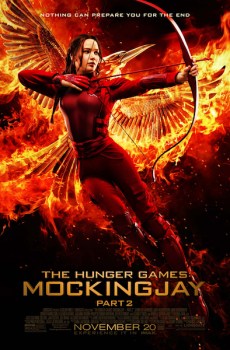
The Hunger Games: Mockingjay - Part 2The artificially-extended Hunger Games trilogy-turned-tetralogy climaxes here. Presumably you’ve seen the first three and so know what you’re into by this point — either you’re invested or you’ve given up. Unless you want to know “does it end well?” before embarking on the whole thing, of course. While Mockingjay Part 2 is not the series’ finest instalment, it brings things to a decent head… eventually.

In my review of Mockingjay Part 1, a film much criticised for feeling like half of a whole — or, rather, half of a part of a whole — I argued it does actually function as a film in its own right. I mean, all of these films are part of one long narrative, so that’s par for the course, and I didn’t feel like Mockingjay Part 1 was any less a ‘standalone’ chunk of that narrative than the two films that preceded it. Specifically, I asserted that “the focus on using Katniss as no more than a propaganda figurehead… has been fully explored — and so I think this instalment will feel much more like a fully-fledged film in its own right if they just move on. I hope the final film give us new themes, new subplots, new arcs to follow”.

With that in mind, Part 2 begins with a degree of disappointment, as it tackles some propaganda-related holdovers from the last movie. Maybe I was putting too much stock in the idea of them moving on from that theme and establishing something new, though — especially as it does soon do that anyway. What develops is a “men on a mission” war movie, as Katniss and a small band of soldiers make their way through the deserted-but-boobytrapped Capitol on a mission to assassinate President Snow.

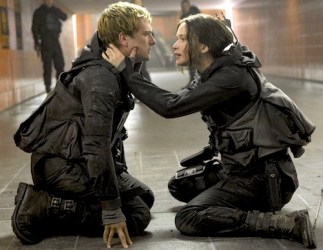
K and P, nutsWhat follows isn’t perfect — in particular, the storyline could’ve done with tightening up — but it does have a lot going for it. There’s strong characterisation: Katniss is as confused, conflicted, and incapable of engaging with her emotions as ever, while Peeta’s PTSD is well-handled, with an effective device where he repeatedly makes a statement before asking, “real or not real?” There are other nicely developed thematic points too, like expanding further on the rebels not being perfect good guys (as initiated in Part 1), which plays a central role in the denouement. The action sequences are well staged and occasionally inventive, but best of all is that the climax doesn’t lean on being the biggest fight scene yet — it’s driven by the story, and the characters and their decisions, rather than being a ginormous shoot-out.

Speaking of the film’s finale, complaints that the endings go on too long bug me, just as they bug me when people bring it up about Lord of the Rings. In both cases, you’re getting a capstone to a 9+ hour saga, not the 2- to 3-hour section of it you just watched. Rings’ endings feel completely suitable if you watch all 12 hours of the extended editions in one sitting, and I’d wager Hunger Games’ do too. Rush it and you end up with something like Harry Potter’s finale, which comes to a crushing thud of an ending as soon as the battle is won. What both Rings and Hunger Games are doing, actually, is showing that these characters are people who exist outside of the context of their war. They’re not just combatants, who evaporate into thin air once the battle’s lost or won; they’re people who have to either return to their old lives or establish new ones.* It’s a richer, more realistic, more human way to end a story than “plot’s over, action sequences are finished — we’re done here!”

Ready for the endMockingjay Part 2 is not the best instalment of the Hunger Games, a series whose second half didn’t quite live up to the developed potential of the excellent Catching Fire. That said, I think it largely works as a whole, with conflicted and complicated characters living in a world that initially seems straightforwardly dystopic but develops many moral greys. That’s particularly welcome from a Young Adult series, a sort-of-genre where some of the most famous examples are lacking in intellectual — or (considering the target audience) educational — heft. In fact, based on the scores and comments I’ve seen on some websites, Mockingjay Part 2 may yet turn out to be the most underrated of the Hunger Games films.

4 out of 5

The Hunger Games: Mockingjay – Part 2 is available on Netflix UK as of this week. Mockingjay Part 1 is also on there; the first two films are not.

* Potter does do the “back to a life” thing, but the details of it are found in ancillary texts. ^

Badlands (1973)

2016 #87
Terrence Malick | 94 mins | streaming (HD) | 16:9 | USA / English | 18* / PG

BadlandsThe debut feature of Terrence “four films in 30 years” Malick comes with a tagline-cum-plot-description so good I’m just going to quote it wholesale:

He was 25 years old. He combed his hair like James Dean. He was very fastidious. People who littered bothered him.
She was 15. She took music lessons and could twirl a baton. She wasn’t very popular at school.
For awhile they lived together in a tree house.
In 1959, she watched while he killed a lot of people.

As 60-word summaries go, that pretty fairly covers the characters, plot, and, to some degree, the film’s tone. It’s loosely based on a real-life killing spree (which also inspired several other movies, including Natural Born Killers), though it’s told with Malick’s style of cinematic poetry, rather than documentary realism or sensationalised violence. Malick has spoken of trying to give the story a fairy tale tone, to “take a little of the sharpness out of the violence but still keep its dreamy quality.” The latter is definitely true: the extended sequence where the young lovers live in a treehouse in the woods has an ethereal feel, like a daydream fantasy. For me it was probably the film’s most memorable section, though it’s the least related to the central criminal thrust.

As for removing the sharpness of the violence, I’d argue that, if anything, Malick has heightened it. When it comes it is short and shocking, kind of grubby and nasty. While the film may contain dreaminess and poetry, it’s not a pleasant experience. The shabby lives Crazy kidsthe leads start out from bleeds outwards into their time on the run, which Holly romanticises but feels constantly grotty. I suppose a film about killers shouldn’t be nice, but maybe this is why the time in the treehouse stood out for me — a little oasis of pleasantness; a break from the insalubriousness of the rest of the picture.

It’s fair to say I didn’t like the film very much, which is not the same as saying it’s not good. The adjective I keep coming back to is “grubby” — in spite of its occasional beauty, it has a grubbiness in its production, which tells a story of grubby people leading grubby lives in grubby circumstances as they perform grubby acts. I suppose that unpleasantness is a necessary counterpoint to the innumerable movies we have that glamorise violent lifestyles.

4 out of 5

* Badlands was reclassified 15 in 2008, but that was only for cinema releases. I watched it at home, where technically it’s still an 18. Ah, the BBFC. ^

Ted 2: Extended Edition (2015)

aka Ted 2: Unrated

2016 #94
Seth MacFarlane | 121 mins | streaming (HD) | 2.35:1 | USA / English | 15

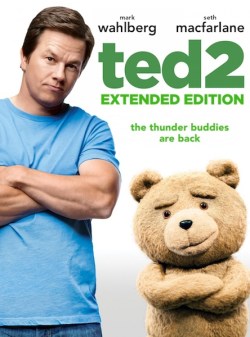
Ted 2Comedy sequels often struggle, and writer-director-producer-star Seth MacFarlane’s in-between feature was sporadically odious, so I approached Ted 2 with trepidation. While it can’t match the freshness of its predecessor, it’s certainly no AMWtDitW.*

The plot (about Ted trying to become a legally recognised person) exists to string together comedic set pieces. Perhaps that’s why the pace feels off: individual parts are funny, but it’s slow going. That’s not the fault of the extended cut (details here) — the additions include at least one of the funniest bits.

Not a surprise success like the first, then, but an amusing couple of hours.

3 out of 5

* The length of that title is anathema to a word-limited review. ^

Road to Perdition (2002)

100 Films’ 100 Favourites #74

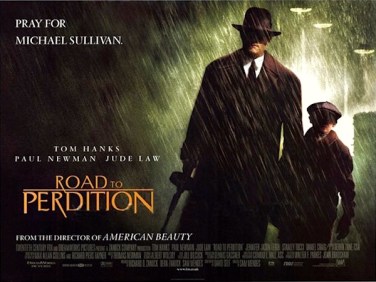
Pray for Michael Sullivan.

Country: USA
Language: English
Runtime: 117 minutes
BBFC: 15
MPAA: R

Original Release: 12th July 2002 (USA)
UK Release: 20th September 2002
First Seen: DVD, March 2003

Stars
Tom Hanks (Forrest Gump, Bridge of Spies)
Paul Newman (Cool Hand Luke, Butch Cassidy and the Sundance Kid)
Daniel Craig (Lara Croft: Tomb Raider, Casino Royale)
Jude Law (Gattaca, Closer)
Tyler Hoechlin (Everybody Wants Some!!, Fifty Shades Darker)

Director
Sam Mendes (American Beauty, Skyfall)

Screenwriter
David Self (Thirteen Days, The Wolfman)

Based on
Road to Perdition, a graphic novel by Max Allan Collins and Richard Piers Rayner.

The Story
1931: Michael Sullivan is an enforcer for mob boss John Rooney, who thinks of him like a son. When Sullivan escorts Rooney’s unstable real son, Connor, to a meeting, the guy snaps and the other side are murdered — an event witnessed by Sullivan’s own son, Michael Jr. In an attempt to cover it up, Connor kills Sullivan’s wife and other son, while Michaels Sr and Jr escape, and begin a journey to take revenge.

Our Heroes
Michael Sullivan Sr is, on paper, not much of a hero: a mob hitman, his trade is death. But when half his family is murdered, he’ll do what’s necessary to protect his surviving son and get justice — his kind of justice, anyway. In the process, he bonds with Michael Jr, finally developing the relationship they never had before. Perpetual nice guy Tom Hanks tones that way down to give what I think must be one of his best performances, which brings out the heart in Sullivan without tipping over into regular Hanks territory, in the process allowing the viewer to empathise with a man who in lesser hands would just be a cold-blooded murderer.

Our Villains
Connor Rooney is a liability, a deranged coward and crook who wishes he was a hard man. But he’s no threat — his father, mob boss John Rooney, is the one with the power and means. At heart he’s no villain to Michael Sullivan — he’s essentially his father — but after Connor murders Sullivan’s family, Rooney feels he must protect his own blood, despite caring for him less than Sullivan. With an actor of Paul Newman’s quality in the role, every nuance of Rooney’s complex emotional position is subtly explored.

Best Supporting Character
To try to stop Sullivan, the mob set hitman Maguire on his trail. He’s a crime scene photographer who uses his job to cover his crimes, and is a nasty, rat-like creep. Jude Law rejects his frequent pretty-boy-ness to really inhabit that part. (Basically, everyone is fantastic in this film.)

Memorable Quote
John Rooney: “This is the life we chose, the life we lead. And there is only one guarantee: none of us will see heaven.”
Michael Sullivan: “Michael could.”

Memorable Scene
Heavy rain falls as Rooney and his men cross an empty street to his car. When they reach it, the driver inside is dead, the door locked. They spread out across the street, guns ready, but there’s no one to be seen… Then a muzzle flashes and the men are slowly cut down — leaving only Rooney standing. As the shooter emerges from the shadows, the camera tracks in on Paul Newman, his posture and expression saying it all: he knows who it is, he knows his time has come, and he’s resigned to it. All of this set to just the sound of Thomas Newman’s mournful piano-and-strings soundtrack. Only when Rooney turns around does the rain begin to bleed onto the soundtrack, and we see the man is (of course) Michael Sullivan. “I’m glad it’s you.” With tears in his eyes, Sullivan finishes his job.

Technical Wizardry
There are several reasons the above scene works so well — the pace of the editing, the sparse sound design, the music, the performances — but one of the biggest is the cinematography. The work of Conrad L. Hall, this is just one of the most obviously beautiful sequences in a film full of gorgeous imagery. He won a well-deserved posthumous Oscar for his work, his third from a career that garnered ten nominations.

Making of
One of the locations found was considered physically perfect but the wrong way round, with room only to shoot from right to left and not vice versa. Rather than, say, find somewhere else, production designer Dennis Gassner and his team dressed the location to be flipped, not only reversing street signs and car number plates, but even changing the side of the steering wheels on all the vehicles.

Awards
1 Oscar (Cinematography)
5 Oscar nominations (Supporting Actor (Paul Newman), Score, Art Direction-Set Decoration, Sound, Sound Editing)
2 BAFTAs (Cinematography, Production Design)
1 BAFTA nomination (Supporting Actor (Paul Newman))
2 Saturn nominations (Action/Adventure/Thriller Film, Performance by a Younger Actor (Tyler Hoechlin))

Despite some initial build-up, Road to Perdition wound up an awards season also-ran, losing out to that well-remembered classic Chicago and everyone’s desire to try to give Martin Scorsese an Oscar for Gangs of New York.

What the Critics Said
“The greatest gangster film since The Godfather.” — News of the World

“To call this the greatest gangster film since The Godfather would be an overstatement, though not by much. It is, however, the most brilliant work in this genre since the 1984 uncut version of Sergio Leone’s flawed but staggering Once Upon a Time in America. Road to Perdition, a less sprawlingly ambitious movie, is without major flaws.” — Eric Harrison, Las Vegas Sun

Score: 81%

What the Public Say
“In a film about the mob and hitmen, the violence is generally kept to a minimum. And when it is done, it’s either very quick, or it’s shown partially offscreen or via a reflection. […] Throughout the film, the violence is never glorified as something heroic. But instead, it’s something that’s done only when it is necessary, and the weight of it is always felt. During the first killing in the film, the first one that Michael sees through a crack in the wall, it’s done unexpectedly and the victim falls to the ground in slow motion. When Mike brings out his Tommy Gun, it’s not something he does with glee, it’s something very deliberate as he solemnly takes the pieces out of the briefcase to assemble it.” — Bubbawheat, Flights, Tights, & Movie Nights

Verdict

Road to Perdition feels like a film that didn’t get its due at the time, and has become almost something of a cult favourite since. Not “cult” in the traditional “gaudy fun B-movie” sense, but in that it has a dedicated following of people who realise its power. On the surface it’s a revenge thriller, replete with ’30s mob style and Tommy Gun massacres, but under that is a more emotive tale about masculinity as it pertains to the father/son dynamic. It’s all handled with sensitive artistry by director Sam Mendes, supported by first-rate technical merits across the board (the design and music are particularly noteworthy, in addition to the cinematography I already mentioned), and career-best-level performances from a strong cast. It lacks the sheer scale and scope to go toe-to-toe with The Godfathers as the definitive gangster movie, but as a smaller, personal tale, it’s exceptional.

#75 will be… Bayhem.

Jack Ryan: Shadow Recruit (2014)

2016 #69
Kenneth Branagh | 106 mins | streaming (HD) | 2.35:1 | USA & Russia / English & Russian | 12 / PG-13

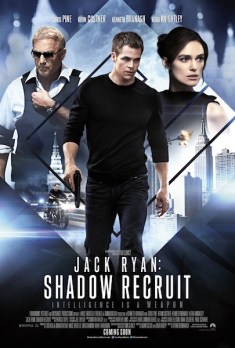
Jack Ryan: Shadow RecruitKenneth Branagh, who once used to direct films based on Shakespeare and opera and that kind of thing, seems to have carved himself a place as a jobbing blockbuster director so far this decade: it started with a spot in Marvel’s then-burgeoning universe, adapting Thor; saw arguably its greatest success with the live-action remake of Disney’s Cinderella; and he’s now working on an adaptation of young adult action-adventure Artemis Fowl — all released by Walt Disney Pictures, incidentally.

In amongst those, he helmed this: a second attempt (after 2002’s The Sum of All Fears) to relaunch (after a sortoftrilogy in the early ’90s) Tom Clancy’s CIA analyst-cum-spy (the titular Mr Ryan, obviously) as a Bond/Bourne-rivaling action-thriller franchise. It didn’t work. (Next try: make it a TV series for Amazon.) While I can’t pretend to be shedding any tears over the wasted opportunity of not getting another spy franchise, that’s not for lack of enjoyment: demonstrating perhaps even more versatility than with his comic book adaptation (which was kinda Shakespearean, really) or his Disney fairytale (which was a grandiose period drama, really), here Branagh managed to craft a very creditable action-thriller — with emphasis on the latter, an uncommon choice these days. Perhaps that’s why it didn’t catch on.

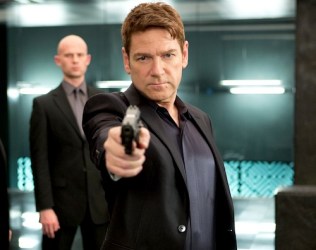
Rather than going back to Clancy’s novels, Shadow Recruit chooses to relocate Ryan to the present day, and takes its inspiration from a 2007 Black List screenplay called Dubai. Dubai is, of course, a notoriously pricey Middle Eastern city, and therefore we naturally assume rich in oil. Shadow Recruit’s plot begins with the US refusing to veto a pipeline that will damage Russian oil interests — somehow, I suspect there wasn’t too much re-writing required here. Anyway, following this decision, Afghanistan veteran turned undercover CIA financial analyst Jack Ryan (Chris Pine) uncovers a plot to crash the value of the dollar, which will lead to a new Great Depression. Dispatched to Moscow to investigate, Badass Branaghhe comes up against oligarch Viktor Cherevin (Kenneth Branagh), the architect of the plan, which will be instigated by a massive terrorist attack on US soil. Unless Ryan can stop him, of course — with the help of his handler (Kevin Costner), and his fiancée Cathy (Keira Knightley), who’s followed him to Russia because she thinks he’s having an affair. I mean, he was sneaking around a lot…

As I said, the film wasn’t a success, either critically or commercially — despite casting a young, theoretically popular lead in Chris Pine, it didn’t attract the young audience needed to produce blockbuster numbers these days. I guess playing the “thriller” rather than “action” card didn’t pay off, so maybe a TV series is a smarter move after all? I guess we’ll see. Anyway, I think the reaction has been unduly harsh, because Shadow Recruit is very effective at what it sets out to do, and is, in my view, easily the most entertaining Jack Ryan movie since at least the first, The Hunt for Red October. Perhaps that’s damning with faint praise: I was disappointed by both Patriot Games and Clear and Present Danger when I finally watched them in 2014, and I described Sum of All Fears as “an adequately entertaining two hours. Otherwise, it’s nothing special.”

Shadow Recruit probably isn’t anything special either, mind. Branagh manages to mount a few excellent sequences, including a very tense dinner / infiltration combo in the middle of the film, where Cathy has to keep Cherevin occupied while Ryan nips over the road and breaks into the oligarch’s office, which develops into a solid car chase. The dynamic is also Just going for a runa little different to the action-thriller norm. Ryan has skills leftover from his military days, but he’s not a one-man army like Bond or Bourne — he needs help both on the ground and from tech guys behind the scenes, who play a vital role in… well, I was going to say “the climax”, but it’s “the bit just before the climax”. The climax is a chase around New York, because of course you have to end with a chase.

This was meant to be a defence of Shadow Recruit and I feel like I’m doing a poor job. Thing is, it’s not up to the quality of the much-mentioned Two Bs when they’re at their best, but its relatively plot-and-character-orientated style distinguishes it from those franchises’ regular MOs. Plus Branagh brings a greater cinematic quality than you’ll find in, say, that Spooks movie, meaning Shadow Recruit straddles the divide between TV-level spying and big-screen action in a way that TV spin-off wanted to but couldn’t really manage. Perhaps the character really will work better in a big-budget TV series, then?

4 out of 5

Magic in the Moonlight (2014)

2016 #151
Woody Allen | 93 mins | streaming (HD) | 2.35:1 | USA & UK / English | 12 / PG-13*

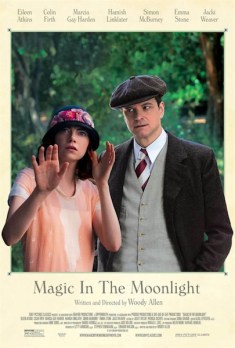
Magic in the MoonlightWoody Allen’s 44th film is a Sunday-afternoon-style period comedy, which nonetheless manages to touch on issues of existentialism and the meaning of life. If that sounds terribly Deep, don’t worry: Magic in the Moonlight may tickle your fancy, but it’s unlikely to tax your brain.

Colin Firth stars as Stanley Crawford, a genius illusionist and renowned debunker of spiritualists, who’s recruited by fellow magician and childhood friend Howard Burkan (Simon McBurney) to expose a young ‘psychic’ named Sophie Baker (Emma Stone), who has enthralled a rich family in the South of France, but whose methods have Howard stumped. Despite his unconcealed cynicism, Stanley too struggles to find the truth, but he does find himself increasingly smitten with Sophie…

After this setup the plot is no great shakes (the one twist is eminently guessable), but the rest of the film is a romantic confection made up of sunny Côte d’Azur locations, pretty vintage costumes, gently witty dialogue, and quality actors gamely playing along. Firth is hardly stretched as a romantic lead — indeed, he has one scene that is virtually lifted wholesale from Pride & Prej — but Stanley’s pompousness and sarcastic cynicism gives the role a little bite. Emma Stone’s big eyes do half the work for her, though she still gives it her all in a way that makes her character and performance endearing. Eileen Atkins, as Firth’s beloved aunt, and McBurney get halfway decent supporting parts, though there’s little time for the rest of the cast, especially Marcia Gay Harden, whose role as Stone’s mother is virtually nonexistent.

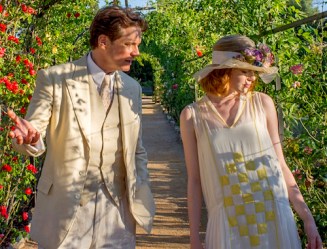
Magic with daylightThe most pleasing aspect is probably Darius Khondji’s photography. He emphasises the region’s beautiful golden light, with saturated colours emphasised by deep shadows, to create a warm and idyllic atmosphere, further accentuated by the twinkling blue ocean and stunning locales. It’s exemplary work that will likely make you long for distant times and places.

It may ultimately be a slight work, then, but it is still a delightfully pleasant way to spend 90-something minutes.

4 out of 5

* for “a brief suggestive comment, and smoking throughout”. So, it’s a PG, really. ^

Return of the Jedi (1983)

100 Films’ 100 Favourites #73

Return to a galaxy far, far away.

Also Known As: Star Wars: Episode VI – Return of the Jedi

Country: USA
Language: English
Runtime: 132 minutes | 135 minutes (special edition)
BBFC: U
MPAA: PG

Original Release: 25th May 1983 (USA)
UK Release: 2nd June 1983
First Seen: VHS, c.1990

Stars
Mark Hamill (The Empire Strikes Back, The Guyver)
Harrison Ford (Indiana Jones and the Last Crusade, Patriot Games)
Carrie Fisher (The Empire Strikes Back, The ‘Burbs)
Anthony Daniels (The Lord of the Rings, Star Wars: Episode I – The Phantom Menace)
Peter Mayhew (Star Wars, Comic Book: The Movie)

Director
Richard Marquand (Eye of the Needle, Jagged Edge)

Screenwriters
Lawrence Kasdan (Raiders of the Lost Ark, Silverado)
George Lucas (American Graffiti, Star Wars: Episode III – Revenge of the Sith)

Story by
George Lucas (Indiana Jones and the Temple of Doom, Radioland Murders)

The Story
As the Galactic Empire construct a new Death Star, Jedi-in-training Luke Skywalker — the Rebel Alliance’s best hope of defeating the evil Darth Vader — is busy rescuing his friend Han Solo from the clutches of crime lord Jabba the Hutt. Meanwhile, the powerful Emperor waits, intending to convert the young Jedi to the Dark Side…

Our Heroes
Luke Skywalker: Jedi Knight.
Han Solo: defrosted resistance captain.
Princess Leia: sister, love interest, bikini-wearer. Is it just me or does Leia get a pretty poor deal as the trilogy goes on?

Our Villains
Quite possibly the greatest villain ever created for the movies, Darth Vader. Here he’s on an arc of redemption, so there’s also the Emperor, who has the appearance of a wizened old man but is strong in the Force. As Vader himself puts it, “the Emperor is not as forgiving as I am.” Uh-oh!

Best Supporting Character
R2-D2 is the best supporting character in every Star Wars film, but in this one we are introduced to Jabba the Hutt (well, unless you watched Episode I or the New Hope Special Edition first). A giant, fat, slug-like crime lord who is impervious to Jedi mind tricks and apparently has a fondness for metal bikinis, he’s as physically repulsive as are his methods and mores.

Memorable Quote
“Many Bothans died to bring us this information.” — Mon Mothma

Quote Most Likely To Be Used in Everyday Conversation
“It’s a trap!” — Admiral Ackbar

Memorable Scene
The speeder bike chase — arguably the best action sequence in the entire original trilogy. Considering this is a series of films that include three or four duels with frickin’ laser swords, that’s some feat.

Memorable Music
John Williams’ music is an essential part of the Star Wars experience. While no single tune in Jedi is as iconic as the Main Theme from A New Hope or the Imperial March from Empire, the overall score is as good as ever.

Technical Wizardry
The background plates for the speeder bike chase were captured by having a Steadicam (operated by the system’s creator, Garrett Brown) walked through a forest while filming less than one frame per second. When played back at regular 24fps, this 5mph stroll came out more like a 120mph hurtle. They spent three days filming to get enough footage for the whole sequence.

Truly Special Effects
These days, the answer to the question “how did they do that?” is “CGI”. Back in the ’80s, however, they had to be a bit more creative — leaving an abundance of achievements worthy of inclusion here. For example, the shot where the Imperial fleet spring their trap on the Rebels was the most complex matte shot ever attempted, with dozens of separate model elements having to be printed in. Or there’s the puppet work. Jabba was full-size, of course, and the 2,000lb costume was operated by four puppeteers: one for his right arm and jaw, another for his left arm and tongue, both of whom moved his body; another had a cable control to move the mouth and nostrils, using his feet to work bellows to simulate breathing; and the fourth moved his tail. Plus the smoke for when Jabba uses his pipe was apparently created by someone smoking a cigar and blowing it up a tube. For the Rancor, on the other hand, Lucas wanted to use a Godzilla-style man in a suit, but the tests didn’t work very well. The final result is not stop-motion, as you might expect, but an 18-inch rod puppet. Filming it was treated as a live-action shoot, though various techniques were used to conceal the methodology, like slow-motion or running the film backwards — anything they could think of to help remove the sense of “Muppet-ness”.

Letting the Side Down
When it comes to Lucas’ Special Edition fiddling, most people focus on the “Han shot first” complaint. Personally, I find the change at the end of Jedi — where Hayden Christensen has been pasted over Sebastian Shaw as Anakin’s Force ghost — more egregious. That said, the stupid song & dance number in Jabba the Hutt’s palace runs it a close second. On the bright side, the added shots of planets around the Empire celebrating the destruction of the Death Star helps aggrandise an otherwise low-key post-climax celebration.

Making of
So, that metal bikini, eh? What a blatant bit of fan service by that dirty old George Lucas! Well, apparently it actually came about because Carrie Fisher herself complained about her all-covering costumes in the first two films meaning you couldn’t tell she was a woman. Costumer Aggie Guerard Rodgers’ design was inspired by the work of famed fantasy artist Frank Frazetta, but whoever decided it should be made as such a rigid piece wasn’t thinking ahead: the solidness of the top meant it didn’t move with Fisher’s body, and she refused to use double-sided tape, so before each take someone from wardrobe had to (to quote IMDb) “ensure that her breasts were still snug inside the costume”. Nice work if you can get it. Nonetheless, several scenes had to be reshot due to what we now call “wardrobe malfunctions”.

The Ewok Line
To quote from the How I Met Your Mother Wiki, “The Ewok Line correlates the birth year of a person and the subsequent appreciation of Ewoks […] Those born on or before May 25, 1973 have a low appreciation of the film’s creatures, while those born after this date have an affinity for them. This is because those who saw the Ewoks in Return of the Jedi, which was released theatrically on May 25, 1983, who were 10 or under still loved their teddy bears, giving them an increased appreciation for the Ewoks.” I was born in 1986 and, yes, I love Ewoks. I mean, how can you not enjoy their silly mix of teddybear cuteness, gobbledegook language, and Empire-beating military competence?

Previously on…
Return of the Jedi picks up on the cliffhanger from The Empire Strikes Back, which of course continued the story of Star Wars. Many, many other films, TV series, novels, comic books, computer games, and whatever other media you can think of, take place before and around these movies.

Next time…
Ooh boy… Well, primarily: 16 years later, George Lucas returned to the world he created for the infamous Prequel Trilogy, finally filling in those missing first three Episodes. Chronologically, the saga picks up after Jedi with last year’s Episode VII: The Force Awakens, and will continue in Episodes VIII and IX. Aside from those main tenets, there’s an unimaginable mass of stuff in what’s known as the Star Wars Expanded Universe: TV series, novels, comic books, computer games, and anything else you can imagine — and it’s only going to continue growing in the future. Most of what was generated before Disney bought Lucasfilm may have been wiped out by whoever’s in charge now, but that doesn’t mean people don’t care about what went on in it. Of particular note is Timothy Zahn’s Thrawn trilogy of novels, which kickstarted the prominence of the Expanded Universe, and which many fans used to view as effectively being Episodes VII, VIII and IX.

Awards
1 Oscar (Special Achievement in Visual Effects)
4 Oscar nominations (Score, Art Direction-Set Decoration, Sound, Sound Effects Editing)
1 BAFTA (Visual Effects)
3 BAFTA nominations (Make Up Artist, Production Design/Art Direction, Sound)
5 Saturn Awards (Science Fiction Film, Actor (Mark Hamill), Costumes, Make-Up, Special Effects)
5 Saturn nominations (Actress (Carrie Fisher), Supporting Actor (Billy Dee Williams), Director, Writing, Music)
Won the Hugo for Best Dramatic Presentation

What the Critics Said
“The characters and dialogue get lost somewhere between the bug-eyed monsters and the exploding spaceships, but it is all so much fun it probably really does not matter a whole lot. […] Because so much of Return of the Jedi concentrates on makeup and special effects, and perhaps also because much of the dialogue (and acting) is so bad, it is pretty hard to get too involved with the characters, who came across with much more human interest in The Empire Strikes Back, the second of the movies. In a sense, the extraterrestrials are a lot more human than the people.” — Harper Barnes, St. Louis Post-Dispatch

Score: 80%

What the Public Say
“[A] thing I like about the scene in Jabba’s palace is the teamwork between all of the heroes in their mission to rescue Han Solo. It reminds me of a heist in way, since you got the droids, Chewbacca, Lando, Leia and Luke all working together and serving different purposes in rescuing Han. I also love the fact that the reason they are all working together is because they all care about Han. It just goes to prove that Star Wars isn’t just a huge spectacle but a story about family and friendship, which makes it a lot more personable.” — Jacob Bartley, Apocaflix! Movies

Elsewhere on 100 Films
I’ve written about the original Star Wars trilogy twice before, both times back in 2007. Of Return of the Jedi’s modified DVD version, I said that “there seem to be only minor differences or effects improvements here — it does make you wonder what the fans were kicking up such a fuss about”, and noted that “the speederbike chase is one of the trilogy’s greatest action sequences. And Ewoks are cute.” Then, treating the film as the sixth part of the saga, I wrote that it had “the biggest failing of the films as a single series: the prequel trilogy is endlessly obsessed with the prophecy about Anakin bringing balance to the Force; it isn’t mentioned once here. A dubbed line or added shot with Yoda saying something would’ve been nice.”

Verdict

Once upon a time I decided Return of the Jedi was actually my favourite Star Wars movie. I watched them again last year and changed my mind again, and wondered quite what I’d been thinking before. Jedi does have a lot to commend it, from multiple memorable set pieces to some effective character work with most of the principals, but it’s certainly not without its flaws, which have only been exacerbated by the prequel trilogy — as the climax to a mythic six-film saga, the finale of Jedi lacks some heft. Arguably it only reaches towards classic status by association with its two predecessors, but on its own merits it’s still an exciting space adventure.

#74 will be… six weeks on the road in the winter of 1931.

American Ultra (2015)

2016 #119
Nima Nourizadeh | 92 mins | streaming (HD) | 1.85:1 | USA & Switzerland / English & Mandarin | 15 / R

American UltraStoner comedies aren’t really my thing, but something about American Ultra — which is often pithily described as “Pineapple Express meets The Bourne Identity” — piqued my interest nonetheless. Partly it’s that Bourne comparison, obviously; partly it’s Jesse Eisenberg choosing to lead an action movie at this point in his career; mostly it’s the reception the film received: critics largely slagged it off, and audiences too, but there’s a noteworthy strand of people who enjoyed it. Sometimes the films with the niche fan base are the best films, and sometimes they’re the worst films. American Ultra is neither, merely settling somewhere between the two.

Max Landis’ wish-fulfilment screenplay (by which I mean Max Landis’ screenplay is about fulfilling Max Landis’ wishes) sees Jesse Eisenberg as a laggard stoner who turns out to be a CIA sleeper agent with Bourne-esque abilities, which are revealed when the director of a rival CIA programme (Topher Grace) sets out to kill him and anyone who stands in their way, including girlfriend Kristen Stewart.

Those aforementioned fans praise it for being original and different, but I don’t see where they got that from — it’s a Bourne clone with added comedy. And by comedy I don’t even Duuudereally mean it’s funny (there are two or three laughs, tops), just that it has a less serious tone. Even if you want to claim the Bourne similarities are just one facet, the film as a whole feels generally reminiscent of any number of low/medium-budget action flicks. It’s not bad, it passes the time, but original or exceptional? No.

3 out of 5