Contact (1997)

2017 #79
Robert Zemeckis | 144 mins | streaming (HD) | 2.35:1 | USA / English | PG / PG

Contact

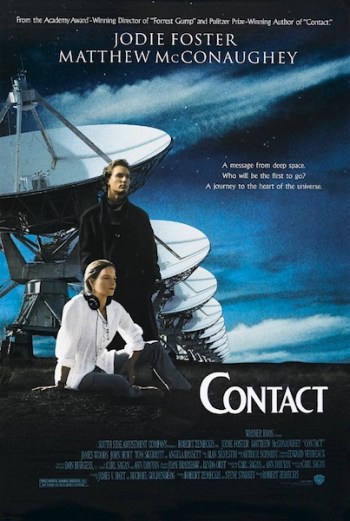
Contact is 20 years old today. I don’t remember it going down particularly well on its release (Rotten Tomatoes backs me up on that: it scores just 62%) and I’ve largely paid it no heed, other than it still comes up now and then. I can’t remember what gave me a sudden urge to watch it last month, but doing so was a bit of a “where have you been all my life?!” experience.

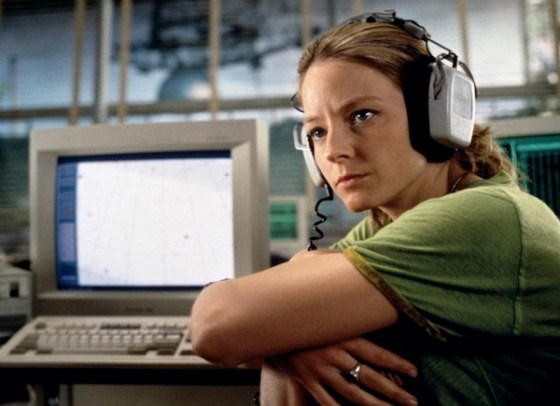
It stars Jodie Foster as scientist Dr Ellie Arroway, who’s obsessed with scanning radio signals from space for signs of alien life, much to the ridicule of her serious colleagues. While working at an observatory in Puerto Rico, Ellie becomes romantically entangled with Palmer Joss (Matthew McConaughey), a Christian philosopher, in spite of their differing views. Their affair is cut short when Ellie’s government funding is cancelled and she leaves to seek independent financial backing, eventually finding it from reclusive billionaire S.R. Hadden (John Hurt). Beginning research anew in New Mexico, her persistence eventually pays off when her team detect a repeating signal, and suddenly her kooky little project is of global concern.

'90s beats

Adapted from a novel by scientist Carl Sagan (of Cosmos fame), Contact is notable for its very grounded and plausible approach to the science of possible first contact. It’s like the anti Independence Day: rather than giant technologically-advanced spaceships turning up out of nowhere and threatening us, we receive a signal with mathematical properties (maths being a universal language) and consider opening lines of communication. Of course, it gets more speculative from there, but that’s unavoidable if you’re telling a story where we hear from aliens. Regardless, all of the science, as well as the political developments that ensue from it, feels very truthful. I’m sure there must be some of the ol’ corner-cutting Movie Science involved somewhere, but that’s usually necessary for the sake of telling a reasonably paced story. Despite that, some viewers find its methodicalness to be “slow” or “boring”. Conversely, that’s part of why I liked it so much: it doesn’t wave its hands around to obscure the discovery part just so it can get to the Cool Stuff — it is the discovery part.

Concurrent to the “how this might actually go down” plot, Contact seeks to explore the axis of faith and science, putting them in juxtaposition to show that, for all their obvious differences, there are also psychological similarities. That’s the purpose of McConaughey’s character, really: a very religious, but amenable, figure for Foster’s very scientific outlook to bump up against. Their romantic storyline works in favour of keeping this discussion balanced: you don’t end up projecting one as the hero and the other as the villain when they’re both halves of the central relationship. It results in some thoughtful perspectives on where the line between science and religion blurs.

“One day, I'm going to win an Oscar...”

Foster gives an impassioned performance as the dedicated Ellie, who’s so committed to both her cause and the truth that she doesn’t compromise, even when it might get her ahead. Her tunnel-vision focus on science means she can come across as a bit of a cold fish, which makes sense given the character’s backstory, but for some viewers that seems to render her too distant to embrace as the heroine. It goes as far as some saying the film’s ending has no heart because Ellie is so cold. Conversely, I think that’s almost why it works. She’s a person who has shut herself down because of her loss, but she still has some small flame of hope that keeps her searching. What happens at the end fully taps into her emotions, fanning that flame. Surely there’s something powerful in that?

Among the rest of the cast, McConaughey shows he had skills long before the McConnaissance, William Fichtner does a lot with a small supporting role, and Tom Skerritt plays a total dick in a way that feels like a real-life total dick rather than a movie version. By way of contrast, James Woods’ character is the other way round: he’s a good actor, but was perhaps railroaded into being a little heavy-handed as a somewhat-villainous National Security honcho. That said, with the current US administration’s attitude to science, maybe he’s sickeningly plausible today.

Pod person

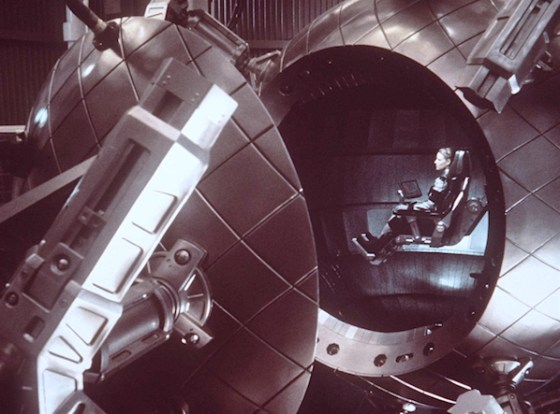
Although not an ID4-style extravaganza, Contact features a great use of special effects — or, rather, that’s why they’re so great: they don’t exist just so they exist; they exist because the story needs them, and they’re more powerful and beautiful for it. This is true not only of some final-act trippiness, but also scenery shots of the giant Machine that gets built, which are made more real by their understatedness. Can you imagine this film now, as it would be made by most directors? There’d be constant helicopter-style shots of the thing. (The exception, of course, would be someone like Denis Villeneuve, as conclusively proven in Arrival.)

I can understand why Contact didn’t catch on with audiences back in ’97. This was the year after Independence Day became the second highest grossing movie of all time, which shows what interested the minds (or, at least, adrenal glands) of the wider viewership. Nonetheless, I don’t understand why it didn’t find stronger recognition among those who appreciate thoughtful, realistic science fiction. It hasn’t really dated in the past two decades (aside from the chunky desktop computers everyone’s using, anyway), and its debates and messages continue to resonate as a reflection of the society we live in, so maybe there’s time yet for its reappraisal.

5 out of 5

Contact placed 11th on my list of The 17 Best Films I Saw For the First Time in 2017, which can be read in full here.

Spider-Man: Homecoming (2017)

2017 #94
Jon Watts | 133 mins | cinema | 2.35:1 | USA / English | 12A / PG-13

Spider-Man: Homecoming

This review contains spoilers for, like, everything.

When Marvel Studios began their grand experiment in revolutionising the Hollywood blockbuster landscape with Iron Man, I began my review with an hysterically funny (and totally under-appreciated) riff on the famous cheesy Spider-Man theme song, which was once buried at the end of the credits of a Spider-Man film as a joke. Nine years later, not only is Spider-Man joining the MCU, he’s doing so with the support of Iron Man — both in the film and in its marketing — and that cheesy song has been rendered in epic orchestral style to open the film. My, how times change.

This is the second big-screen reboot for the Spider-Man franchise, but Sony and new production partner Marvel Studios aren’t keen for us to dwell on that (because the last reboot being such an unpopular move is the reason this one’s happened). So, following this latest incarnation’s soft introduction in last year’s Captain America: Civil War, here we pick up where that left off. 15-year-old Peter Parker (Tom Holland) is now hanging out back in New York, dealing with normal high school things like homework, parties, and casual bullying, and being just a friendly neighbourhood Spider-Man by stopping bicycle thieves and giving old ladies directions. He waits for a call from Tony Stark (Robert Downey Jr.) about their next big mission — a call that never comes. But when Spider-Man attempts to stop a bank robbery where the crooks are armed with suspiciously advanced tech, Peter finds himself on the trail of Adrian Toomes (Michael Keaton), a former salvage worker who uses bits and pieces recovered from Avengers battles to build dangerous weapons that he sells to criminals.

He's some kind of... Bird... man...

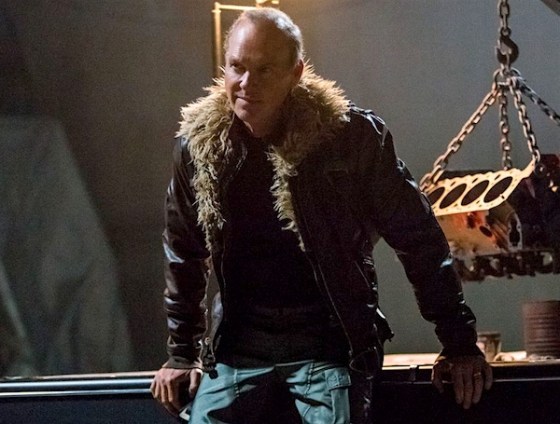
MCU films are renowned for having a “villain problem” — their films’ antagonists are often little more than human MacGuffins; someone for the hero to punch in the third act after they’ve undergone their own journey. Recent films have sought to rectify that (Zemo in Civil War being perhaps the best example), and Homecoming continues the trend. It hasn’t gone full-on pre-Nolan Batman — this is still very much Spidey’s movie, most concerned with our hero’s psychology and his personal arc — but Toomes (aka the Vulture) is a more well-rounded character than most Marvel movie enemies. Indeed, he’s a pretty relatable figure: he lost his livelihood due to government backroom deals forcing him out, since when he’s just tried to provide for the family he loves. In another version of this story, he’d be the hero.

Although he’s not afforded an abundance of screen time, this is where having an actor of Keaton’s calibre pays off, as he effortlessly sells both Toomes’ everyman humanity and his threatening villainous side. He gets an interesting final beat, too: locked up in prison, he refuses to give up Spider-Man’s identity to a fellow inmate. I’ve read some interpret this as being because he wants to kill Peter himself, but I don’t think that fits with the rest of his arc. I saw it as he’d been reformed by Peter saving his life and was doing him a favour. It wouldn’t be the first time he’d spared his life, after all. It could go either way I guess, but there are so many good Spidey villains who haven’t made it to the screen yet that I hope they don’t intend to waste a chunk of Homecoming 2 on reheating the Vulture.

It's mentor be

As everyone well knows by now (thanks to it being repeated ad infinitum in the previous Spidey movies), the catchphrase of the Spider-Man franchise is “with great power comes great responsibility”. However, it’s not said once in this film. Instead, it’s threaded through the very core of the film’s story and character arcs. It’s the lesson everyone comes to learn. It’s what Stark is trying to teach Peter by giving him a fancy suit with a lot of its special features disabled, and by discouraging him from biting off more than he can chew. When Peter gets himself in too deep, as he does repeatedly, it always comes close to costing innocent lives. It’s a lesson Stark learns too, though: he’s trying to be a mentor, a father figure, and do a better job of it than his own father did, but he still doesn’t set the right example for Peter — until, of course, he does.

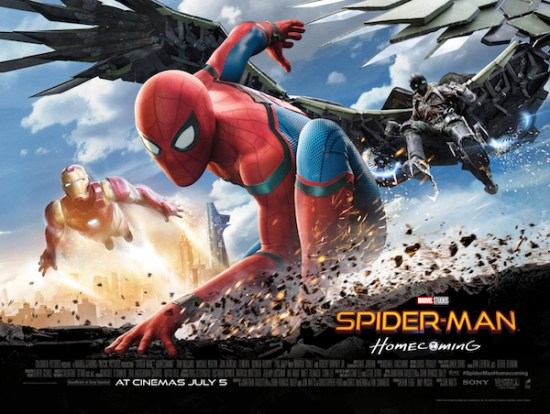
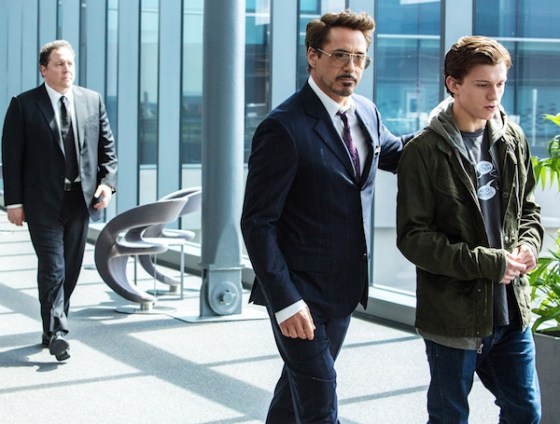
That’s very much a subplot, though. Iron Man isn’t in the film as much as the trailers made some fear — this isn’t The Spider-Man and Iron Man Movie; indeed, that shot I’ve used for this post’s banner image isn’t even in the finished film. While Stark’s place as a mentor figure makes him important to our hero, this story is still all about Peter. Tom Holland is excellent, immensely likeable as both the socially awkward Peter Parker and the wisecracking, overambitious Spider-Man. You want to hang out with him more, he’s such a nice guy. It’s also clear he’s got the acting chops to carry off some of the more emotional dilemmas and realisations that hit Peter. As I said, he goes through the arc of realising his powers come with responsibilities — to himself, his family, his friends, and the people he’s trying to protect — and Holland navigates that while making it look effortless.

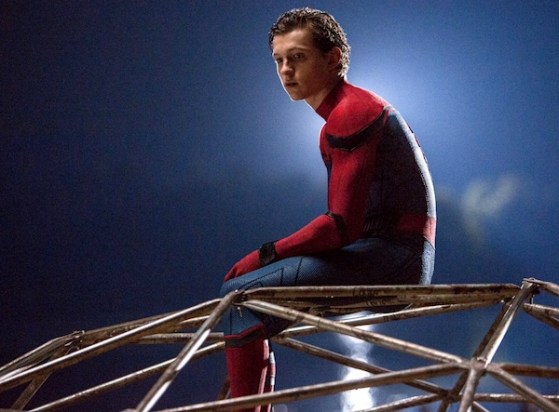
Every superhero's gotta brood sometimes

It naturally brings Peter to a place that, when he’s finally offered one of the things he’s most wanted — membership of the Avengers — he turns it down because he’s not quite ready. That scene, with the modest hero and the gag about the journalists actually being there, is… kinda obvious, even if it’s a strong character moment. But it’s quite interesting on an extra textual level: as it stands, it’s a good setup for future Spidey solo movies, but we’re not getting another one of those until after the big two-part Avengers extravaganza is over and done. Kevin Feige has talked about this being a five-movie character arc for Spidey, implying he has a major role to play in those two Avengers flicks, even though he’s just turned down joining that team full time. Really, it’s nice they haven’t just used this film’s ending to set up / trail their next one, which has been another common MCU problem. Maybe the honchos at Marvel Studios are learning some lessons about power and responsibility too…

Further feeding into the focus on our hero, the movie spends a lot of time on Peter’s school life. All the “typical high school experience” stuff brings a different flavour to the Marvel universe; and, indeed, to Spider-Man movies, which have only passingly used it in previous incarnations. Although it’s ultimately used a bit repetitiously (Peter tries to attend something high-school-y; has to run off to be Spider-Man instead), what there is of it works nicely. Peter’s best friend, Ned (Jacob Batalon), drops neatly into the comedic sidekick role and is a very likeable presence. There’s a neat reconfiguring of Flash (The Grand Budapest Hotel’s Tony Revolori) from his usual depiction as a stock football jock into a kind of nerd-bully.

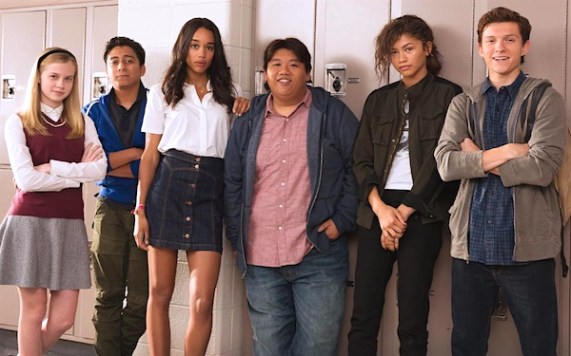
Class of 2017

There’s an attempt to add some depth to the object of Peter’s affections, Liz (Laura Harrier), in the third act, but she’s mainly called on to be beautiful, then sweet, then scared, then sweet again, so… Meanwhile, there’s the much-discussed casting of Zendaya (are we meant to know who she is? I don’t) as a character who isn’t Mary Jane Watson, honest, but who does like to be called MJ. She’s mainly there to be sarky, and is presumably in place to be used next time. The same might be said of Angourie Rice, who demonstrated her considerable talent in The Nice Guys but is here wasted as A.N. Other Schoolmate. Her character name is familiar from the comics, so hopefully they have future plans for her too.

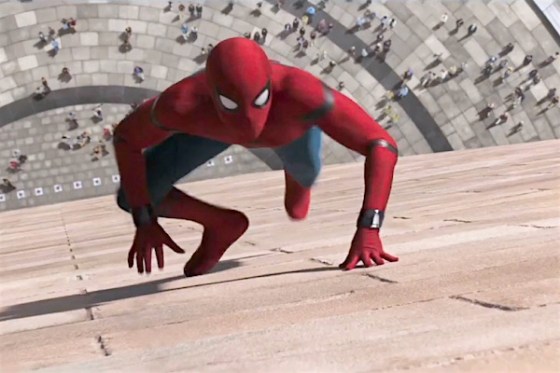
Reading this review so far, you might be forgiven for thinking Homecoming was some kind of character drama. Not so, of course — there are plenty of the requisite blockbuster action scenes. I’ve seen criticism of them for being typically characterless Marvel fare, lacking in either distinctiveness or palpable stakes. While that’s not necessarily untrue of a couple of sequences, I think the Washington Monument sequence at least is mightily effective. I’m certainly looking forward to re-experiencing some of its dizzying heights in 3D when the Blu-ray comes out. The one I did find disappointing was the climax on the outside of the ‘invisible’ plane (“invisible” in the same way Die Another Day’s car was invisible, but executed a bit more realistically, so Homecoming isn’t getting the same degree of flak for it). Taking place in the night sky, aboard a vessel whose lighted surface is constantly flickering and changing, and with the requisite action-scene fast cutting, it was both too dark and too busy, the effect being just a blur of illuminations. I dunno, maybe that works better in 3D too…

Monumental action

And if we’re talking criticisms, I have to have a quick rant about how the trailers gave away the whole movie. Maybe I should be used to that by now — it seems to be happening a lot — but it’s still irritating. So, okay, Homecoming’s didn’t include everything — one pretty big twist was saved for the final film — but most (perhaps all?) of the best gags were included, and so many big scenes were featured that, at times, watching the full movie felt like working through a checklist of bits we’d seen. The most egregious was when it came to Peter failing at the ferry, then Tony taking his suit away, then Peter proving himself by rescuing the plane suit-less as the climax — that whole sequence of events easily deduced from the trailers. Yes, this is a fault of the marketing more than the film itself (or possibly of my brain having deconstructed the trailer and reconstructed it into a film), but it would be nice if the trailer editors could keep some stuff a bit more secret. It’s not as if there was a shortage of visually impressive action moments to hint at them without using significant chunks. And “Spider-Man tries to stop Vulture while Iron Man both mentors and ignores him” would’ve been fine for the plot. (Though, how much do you need to sell the story of a superhero blockbuster? Would “this famous character does cool things with superpowers” actually be adequate?) I’d like to say I’m going to start avoiding trailers in future, but I have no willpower; I just can’t resist.

Finally, a quick word on the post-credits scene. As I left the cinema after it, the usher commented, “isn’t that the worst credits scene ever?” Well, I can see his point — it’s frustrating to have waited around just for that. At the same time, that’s kind of its point. And its point is bang on: it perfectly described how all of these credits scenes feel to the viewer; or, at least, how they feel to me. They’re pretty much never worth it, are they? And if filmmakers think it actually makes people read the credits… well, I dunno about you, but I turn my phone on and update Letterboxd and check Twitter until the scene turns up.

Spider-American

Ultimately, Spider-Man’s first full-blown outing in the MCU is… an MCU movie. Oh, sure, they’ve made inroads to fixing things like their weak villains, but the general tone — the lightness, the humour, the hero-focus, the style of the action — is all MCU stock-in-trade. Fortunately, they’re good at what they do, and that means this is a very good blockbuster movie. Its entertainment value is consistent and high. For me, it lacks the kind of iconicity that mark out Sam Raimi’s first two Spideys as foremost examples of superhero movies — although it’s not as wedded into the ever-developing MCU storyline as some of their other movies, it’s still Marvel Cinematic Universe Episode XVI, to an extent. But, eh, when it gets so much right, what does that matter?

4 out of 5

The Girl with All the Gifts (2016)

2017 #28
Colm McCarthy | 111 mins | streaming (HD) | 2.00:1 | UK & USA / English | 15 / R

The Girl with All the Gifts

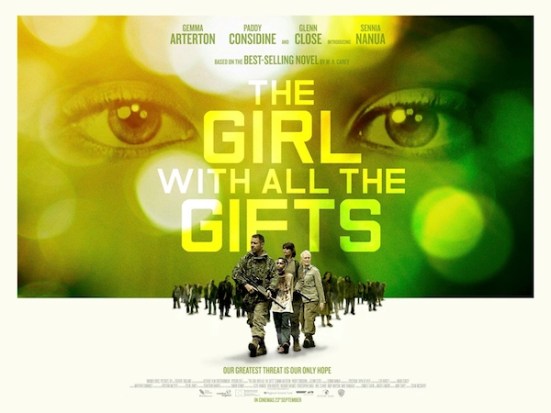
When George A. Romero invented the zombie subgenre in the ’60s, he was more concerned with allegory than blood ‘n’ guts. The latter has come to dominate, as it has with so much of the broader horror genre, but from time to time there’s still room for thoughtful contributions more befitting Romero’s legacy. This low-budget British film, adapted from a young adult novel, is one such effort.

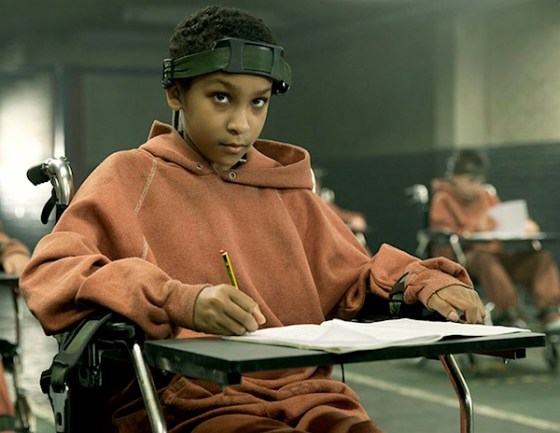
As the film opens we’re introduced to Melanie (Sennia Nanua), a young girl who sits in a concrete bedroom treasuring her photo of a kitten. Then soldiers enter and, at gunpoint, strap her to a chair, before wheeling her to a classroom with similarly restrained children. It’s just the beginning of a fantastic first act, full of atmosphere and intrigue as this world is rolled out before us. The less you know the better, though the chances of going in so cold that it’s a total mystery are sadly slim. If you’re intrigued enough already to check out the movie on my recommendation alone, stop reading now! Go watch it! If not…

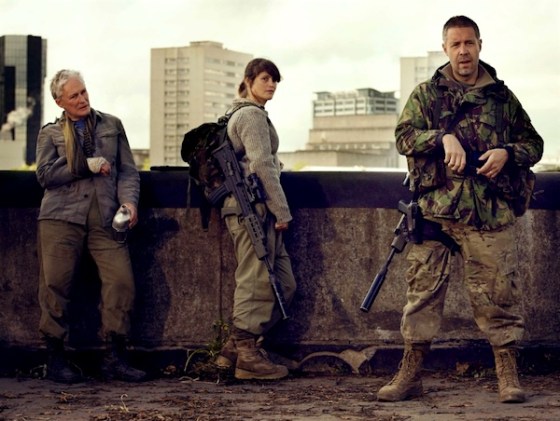
So, as it turns out, we’re in the near future and a fungal disease has turned most of humanity into zombie-like creatures known as ‘hungries’. They spend most of their time in a dormant trance, but the smell of uninfected blood sends them wild and chompy. Melanie and her classmates are children who are infected but ‘normal’ — unless provoked, when they too turn into ravenous fiends — and they may hold the key to a cure. They live on an army base, but, when it’s overrun by hungries, Melanie and a ragtag group of survivors — including Paddy Considine’s sergeant, teacher Gemma Arterton, and scientist Glenn Close, who’s obsessed with finding a cure at any cost — hit the road in search of safe haven.

On the road

In the A.V. Club’s review, Katie Rife asserts that “once this initial premise is revealed and The Girl With All The Gifts leaves the base… this intriguing twist on zombie lore becomes subsumed by postapocalyptic road-trip cliché.” Well, yes and no. There are certainly some familiar beats, but I felt like those just gave a narrative shape to contain otherwise interesting ideas. I haven’t seen enough zombie movies to vouch for The Girl With All The Gifts being 100% original, but I’d certainly not come across some of its ideas before. That goes for both the way it handles the zombie action (though, of course, there are only so many ways you can depict the monstrous undead) and the social commentary, which, as much as anything, tackles the way children and adults interrelate.

The eponymous girl is fantastic — Melanie is an interesting character, and an interesting type of character too. She’s fantastically played by Sennia Nanua, who may be a talent to watch out for in future (I say ‘may’ because, per IMDb, she’s not got anything else coming up). The more familiar supporting cast are as superb as you’d expect. Glenn Close brings plausibility to what could’ve just been an Evil Scientist role, while Gemma Arterton provides the film’s heart as a motherly teacher. Paddy Considine’s role is best appreciated once all is said and done — he seems to be just the gruff soldier type, but snippets of his backstory are revealed right up until the end, revealing new layers to his character.

Special school

Director Colm McCarthy, a veteran of copious amounts of British TV (Spooks, Doctor Who, Sherlock, Ripper Street, Peaky Blinders, and much, much more), keeps the focus on the characters while also giving their world a fantastic sense of scale. The film was made for a pittance (for comparison, it cost about half as much as a single episode of Game of Thrones) but looks incredible. There may be some blurry edges on green screen shots and things like that, but I’ve seen less convincing effects work in movies that cost 50 times as much. Some of the footage was captured by flying over the remains of a town left to rot after Chernobyl, which lends a veracity to the post-apocalyptic vistas (and presumably saved a tonne on CGI). In terms of places you can actually take actors, it was partly filmed in Birmingham, which seems to be becoming a go-to location for dystopian / post-apocalyptic cityscapes (Spielberg’s forthcoming Ready Player One also shot there last year).

The zombie genre is an overcrowded one nowadays, even if you exclude the innumerable direct-to-DVD knock-offs, but there’s still space for well-made movies that can put the familiar tropes to greater use. The Girl with All the Gifts is an impressively mounted and performed production, and is worth watching if just for that horror-thriller kick. However, it also has something to say. I imagine Romero would be pleased.

5 out of 5

The Girl with All the Gifts is available on Sky Cinema from today.

Blair Witch (2016)

2017 #66
Adam Wingard | 89 mins | streaming (HD) | 1.85:1 | Canada & USA / English | 15 / R

Blair Witch

Twists in movies come in all shapes and sizes, but rarely do they come in the marketing. This latest film from the writer-director team behind You’re Next and The Guest was initially promoted as The Woods, only for its true name to be revealed at the first public screening. Quite neatly, during said screening they switched all the posters in the lobby for ones featuring the real title. It’s a shame it wasn’t possible to give every viewer that “oh shit, it’s a sequel to The Blair Witch Project!” surprise, because it’s probably the most interesting thing about the film.

Set however-many years after the original movie (and ignoring the first sequel, just like the rest of us have), it’s about the younger brother of one of the original missing documentary-makers, who comes to believe that his sister is still alive, somehow, in those woods, all these years later. So he sets out with a couple of friends to investigate, and of course one of them documents it, using all sorts of cameras — handheld, body mounted, even a drone. So, yes, this is once again a found footage movie. Well, they are all the rage.

In fairness, the first Blair Witch was the father of found footage, so it only makes sense to retain the form. However, I’d argue that everything that worked about the original movie did so because of how it was filmed — that the cast had been put in that situation ‘for real’ and the filmmakers were fucking with them. It gave it all a rough plausibility, which is largely what made it scary. Conversely, this Blair Witch feels scripted and constructed from the off. That’s fine for most movies, even found footage ones, but here it stands in sharp contrast to how the original worked, and I think it undermines this movie. Almost everything feels inevitable, and you know all the important stuff will be captured on camera (at least one major stunt in the original film was missed because the scared actors didn’t happen to point the camera at it).

A deserted house in the middle of a creepy forest? What could possibly go wrong!

As a horror movie, it does achieve moments that are kind of scary, but they’re undercut by a certain obviousness. I mean, of course a deserted house in the woods is scary when you know there’s a murderous witch inside and you’re limited to seeing it only from one character’s torchbeam-lit perspective. The whole movie is powered by similarly cheap jump scares: friends creeping up on each other; cameras glitching whenever they’re turned off; or, indeed, on — that kind of thing. The only genuinely terrifying bit, at least to me, was a final-act crawl through an underground tunnel. This is not a good movie for claustrophobics. And it only gets worse when you learn they made the actress do it for real.

In some ways Blair Witch is just a remake — a bunch of young people running around in the woods from something scary that we don’t see. Early on it seems like it will bring something interesting to the party with its use of new technology to update the concept: whereas in the original they had one simple video camera, here there are ear-cams with GPS, webcams they can mount in trees, even a drone. Sadly, none of these contribute anything except more angles for the editor to use. Plot-wise there’s a shiny new twist, though I wonder how many people guessed it a long time before the end. Credit to the filmmakers for not overplaying it — it’s there just to be noticed; it’s not highlighted when it’s revealed — but I was so expecting it that such credit doesn’t get them far.

Eh, that's a bit of a reach

According to, er, themselves in their commentary track, director Adam Wingard and screenwriter Simon Barrett actually had a lot of interesting ideas about and explanations for the inexplicable stuff that’s going on in the movie. Unfortunately, they buried these notions so deeply in the finished work that it feels as if they’re not there at all; and now there’ll be no sequel to expound upon them, and the guys were in such a bitter mood when they recorded the commentary (within days of the film being a critical and box office flop) that they don’t explain them, apparently out of spite. Well, I guess we’ll have to take their word for it, then.

Maybe if they had bothered to explore the implications of their new tossed-in ideas then there’d be something to appreciate here, but instead it’s just 80 minutes (and it feels longer) of shaky footage of people running around in the dark. I suppose that, as a horror film, some of it works in the most literal sense of being scary in the moment. But it doesn’t feel earned; it doesn’t feel like it’ll be haunting me later, in the way the most effective horror movies do — in the way the ending of the first Blair Witch did.

2 out of 5

Blair Witch will be available on Netflix UK from tomorrow. It’s also currently available to rent on Amazon UK at a discount for Prime members as part of Prime Day.

Inferno (2016)

2017 #93
Ron Howard | 121 mins | Blu-ray | 1.85:1 | USA & Hungary / English, French, Italian & Turkish | 12 / PG-13

Inferno

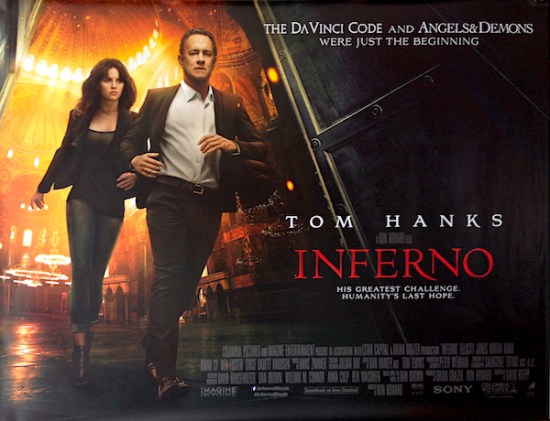
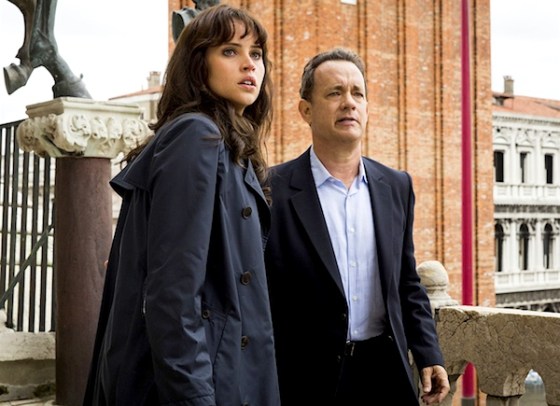
Tom Hanks returns as Robert Langdon, Dan Brown’s symboligist-cum-crime-solver (that’s the main character from The Da Vinci Code, for everyone who’s forgotten in the decade-ish since that book was at the top of the cultural zeitgeist) for his third adventure (they made a second, remember?) based on the fourth novel, after the first film was based on the second novel and the second film was based on the first novel (not that that matters, it’s just kinda funny).

This time, Langdon wakes up in a hospital bed in Florence, with a gunshot wound to his temple that has caused him to both forget the last two days and have terrifying hallucinations of Hell. When an assassin turns up trying to kill him, he escapes with Dr Sienna Brooks (Felicity Jones). Still unable to recall how he ended up in this predicament, Langdon discovers a small projector in his pocket, which contains what will be the first clue to another scavenger hunt of famous old artworks and the like. At the end of the trail: a man-made pathogen that could wipe out 95% of humanity. Pursued by several groups who want the virus for their own nefarious (or not) ends, Langdon and Sienna race against time to save the world.

If you haven’t guessed yet, Inferno is a bit silly. Not utterly silly, but silly in the kind of way the previous Dan Brown movies have been silly — pretending they’re taking place in a plausible real world, when they’re not. The kind of silly where a villain leaves a trail of clues for someone to follow and make sure his scheme is executed, rather than, I dunno, putting a timer on it. (Incidentally, this is a change from the novel, where (based on what I read on Wikipedia) his plan makes marginally more sense.) The kind of silly where apparently the World Health Organisation is some international enforcement agency with gun-toting special ops units and the power to override local police. (I don’t know much about the real WHO, but I find this version very hard to believe.)

Brooks and Langdon

On the bright side, Inferno is not nearly so po-faced as the previous Langdon movies. If you suspend your disbelief, it’s a reasonably compelling mystery (or set of mysteries), where for once the ultimate solution doesn’t feel obvious from the get-go. The same goes for the issue of who to trust. As you’d expect from a race-against-time thriller with an everyman hero, there are multiple different forces in pursuit of Langdon, and you know that one of those groups will turn out to actually be on his side, because that’s how these things always go — but which? Well, I thought it was less blatantly obvious than normal, anyway; though I did guess one other huge twist almost from the start (and I’m sure most viewers who are reasonably versed in this genre of movie will too).

That’s another point that’s been tweaked from the novel, it turns out. In spite of being a film that is considered pretty faithful to its source, they do seem to have shaved off any detail or plot development that was a little outside the norm of a Hollywood blockbuster thriller, which is rather disappointing in a way. It was the ghost of 82’s review that alerted me to these changes, through the fact that the novel even has a different ending. I looked it up and it sounds much better. It’s totally unHollywood, and I bet the studio vetoed it as soon as they heard it, but it’s more interesting and complex than the standard fight-over-the-MacGuffin climax used here.

A clue!

The whole style of the film is similarly standardised. The use of a 1.85:1 ratio and Ron Howard’s unremarkable direction make it all feel very televisual, the only giveaways to its big-screen budget being the stunning locations and the presence of Tom Hanks, Felicity Jones, et al. There are also hand-holding flashbacks and intercuts to things we saw five minutes ago, just like you get on TV dramas that feel uncertain about whether you’re paying full attention or have perhaps tuned in halfway through. Langdon’s gory visions lend a bit of visual spice, but that’s also what they feel like — an attempt to liven things up.

For all these faults, I actually enjoyed Inferno a fair bit. It’s a decent, pacy thriller; completely implausible, both in its overwrought story and frequently leaden dialogue, but as a race-against-time mystery in beautiful locations, it’s an entertaining 120 minutes. I’d give it 3½, but I don’t do half-stars, so let’s be generous and round it up.

4 out of 5

Inferno is available on Sky Cinema from today.

Road Games (1981)

aka Roadgames

2016 #132
Richard Franklin | 100 mins | Blu-ray | 2.35:1 | Australia / English | 15 / PG

Road Games

I hadn’t even heard of Ozploitation thriller Road Games before April last year, when Make Mine Criterion posted an excellent write-up proposing it for release by Arrow Video. That piqued my interest, so when it was announced for release by Australia’s Umbrella Entertainment the very next day, I jumped on a pre-order lickety-split. Just a couple of months later, a film I had only recently found out about was in my hands, in a better-than-it’s-ever-looked remaster, having arrived from literally the other side of the world, for about the same cost as a new release from Masters of Cinema or Arrow, i.e. under £14, including postage. (Makes you wonder how Criterion justify their £17.99 price tag…)

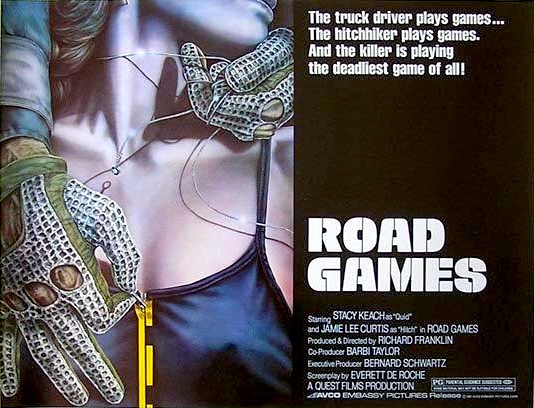
Leaving aside the wonders of today, the film stars Stacy Keach as lorry driver Pat Quid, who one night happens to witness some shady goings on that may’ve been a murder. The next day he’s given the task of transporting a container full of carcasses to the other side of the country, because there’s a butchers’ strike over there and Aussies need their meat goddammit! On the road, he spots a vehicle connected to the possible-murder, and wonders if he’s on the trail of a killer — or if the killer’s on his. The tension only deepens when he picks up a hitchhiker (Jamie Lee Curtis), who may become the next victim…

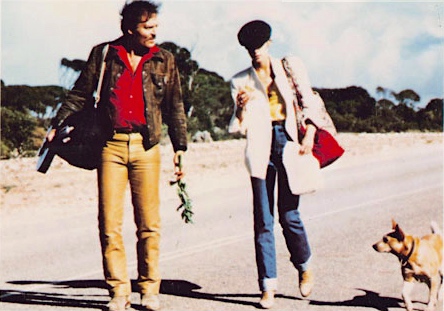
It's impossible to find good quality stills from Road Games

Road Games’ low-budget roots and exploitation-derived genre tag may give the impression it’s a slasher movie or something, but nothing could be further from the truth (though there is one gory shot — so gory it’s a wonder the film got a PG in the US). Rather, it could best be described as Rear Windscreen, because fundamentally it’s the same story: our hero spies on a guy from a distance because he thinks he saw him commit a murder, but is it all in his head? Where Hitchcock staged that impressively in a single confined location, writer-director Richard Franklin opens it up to the whole Australian outback. In some respects that’s an even more impressive feat — of course neighbours are smooshed up against each other, but long-distance travellers? However, it doesn’t feel like a stretch that Quid keeps bumping into the same people, such is the skill of the construction.

Keach makes for an affable lead, whether chatting to his dog early on or bonding with Curtis after he picks her up. Their shared ponderings about the possible murderer are just as effective as the Stewart/Kelly interactions from the Hitchcock film, though perhaps more conspiratorial. It’s easy to draw these comparisons and mirrorings with Rear Window, but it does Road Games a bit of a disservice — it’s not simply an off-brand remake or set-in-a-different-location pseudo-sequel. That said, the parallels are equally unavoidable. There’s also some Duel in the mix, as the killer notices he’s been noticed and turns the tables on our hapless trucker — an inversion, of course, as in Spielberg’s film it’s the trucker who’s the villain.

Seeing red

Basically, while acknowledging these undoubted similarities, I’m trying not to make Road Games sound too derivative, because I don’t think it is. It’s a masterful mystery, using ever-building tension to create a properly nail-biting thriller, which leads to an unpredictable final act (the benefit of many an independently-produced thriller is that it doesn’t necessarily have to comply with a studio’s view on how it should end). While it may owe a debt to one or both of the aforementioned movies, it’s a gripping work in its own right; one which deserves a bigger audience.

5 out of 5

Road Games placed 12th on my list of The 20 Best Films I Saw For the First Time in 2016, which can be read in full here, and also featured on my list of favourite movies from the past decade, which you can read about here.

Sully: Miracle on the Hudson (2016)

aka Sully

2017 #58
Clint Eastwood | 96 mins | download (HD) | 2.39:1 | USA / English | 12 / PG-13

Sully: Miracle on the Hudson

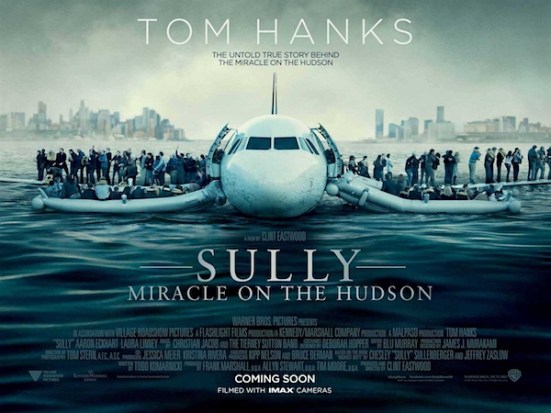
You remember that time someone landed a passenger plane on New York City’s Hudson River, right? This is about that. At the time the pilot was widely hailed as a hero… or so we thought! Turns out that, behind closed doors, some investigators seemed keen to put the blame on his poor decision-making (or they did in movieland, anyway — the real world may’ve been a bit different). So rather than just an exciting drama about a guy landing a plane (which does sound like a thin story for an entire movie), Sully is almost a legal drama: was the heroic captain actually heroic, or did he make a stupid decision that lucked out? (I’m sure you can guess which wins.)

Tom Hanks is perfect for the lead role: he’s the exact right mix of everyman and hero; the unassuming guy who knows the right thing to do, and does it. He even doubts himself after the fact, just so we can be even more sure that he’s a genuinely good guy. The rest of the supporting cast fade into the background a little, with Aaron Eckhart solid as his supportive co-pilot (I assumed he’d turn on Sully, for some reason, so that was nice) and Laura Linney as his wife on the other end of the phone, in a subplot that I suppose is meant to help humanise the hero pilot but really goes nowhere. The same is true for a scattering of flashbacks to Sully’s previous adventures in flight. Even having expanded the film out to the post-landing investigation, it still struggles to find enough material to fill its short 96 minutes.

Landin', landin', landin' on the river

I liked Sully a lot while it was on. It’s well made (though sadly not available in its IMAX format for home viewing), Hanks is always watchable, the supporting cast are good too, and the headline incident is effectively staged, including the post-landing rescues. It’s a heartwarming story of real-life drama and heroism, with a punch-the-air-type moment when Sully is vindicated. But as that outcome never seems in doubt, and the film sometimes twiddles its thumbs in getting there, it’s not all it could be. Or, actually, maybe it is all it could be — and that’s fine.

3 out of 5

I could tenuously link this review to American Independence Day by talking about Sully being an American hero or somesuch, but… oh wait, I just did.

The Adventures of Buckaroo Banzai Across the 8th Dimension (1984)

2016 #134
W.D. Richter | 103 mins | Blu-ray | 2.35:1 | USA / English | 12 / PG

The Adventures of Buckaroo Banzai Across the 8th Dimension

Buckaroo Banzai seems to have quite the cult following in the US, but, as far as I understand, it never made an impression over here; not until the internet enabled such cults to go global, anyway. It has big-name fans (one, Kevin Smith, was developing a remake for Amazon until legal wrangles got in the way), so of course it’s been noticed in more recent times. I’ve been somehow aware of it for ages, but finally got round to seeing it last year after Arrow put it out on Blu-ray.*

For those equally unfamiliar with the film, it’s an action-adventure sci-fi satirical comedy (kinda), concerning an adventure (one of many, I imagine) of Dr. Buckaroo Banzai (RoboCop’s Peter Weller), the famous physicist, neurosurgeon, test pilot, and rock musician. While testing a device that allows him to pass through solid matter, Banzai briefly travels to another dimension. This kickstarts a series of events that leads to the escape of evil aliens the Red Lectroids, who Banzai must defeat lest it brings about the end of the world. That’s the streamlined version, anyway.

To be perfectly honest, I’ve found it quite hard to tell what I thought of Buckaroo Banzai. On the one hand, I can definitely see where it gets its cult appeal, and I appreciate some of the ways it’s being different and boundary pushing. On the other, there’s been a definite backlash to it and I can appreciate where that comes from too — the criticism that some of that “boundary pushing” is merely sloppy storytelling and crazy overacting. There are parts where it’s hard to tell if it was deliberate and quite clever, or just incompetently done. Part of the problem (but also the appeal) is that it’s played so straight. It’s unquestionably a comedy — it’s too ludicrous to be anything else, and the sheer build-up of comedic lines becomes clear as it goes on — but it’s all played with such a straight face that I can see why you’d think everyone involved believed they were making something serious.

Dr Buckaroo Banzai

There are ways it could be ‘normal’, too: it contains so many elements that could be used to construct a traditional narrative — a new member being introduced to the gang, a love interest, an inciting incident which kicks off the events of the narrative, and so on — but it chooses to use none of these in a traditional way, instead being batshit crazy and thoroughly unique with it. Interestingly, director W.D. Richter was also one of the writers on Big Trouble in Little China, which is another action-adventure movie featuring a similar loose, crazy, fever-dream style. (Of all things, he also wrote Stealth, the forgotten-as-soon-as-it-was-released jet-pilots-vs-AI action thriller starring Jessica Biel and Jamie Foxx from 2005.) I can see how, after a diet of mainstream adventure cinema, something like this could feel refreshing. It’s almost like counter-culture pulp; like a Rocky Horror for the ’80s, but without the camp. (Or, at least, not the same kind of camp — I mean, have you seen what Jeff Goldblum’s wearing?)

In the booklet accompanying Arrow’s Blu-ray, James Oliver talks about cult movies and their history. “Cult” is sometimes used nowadays as a catch-all term for anything in the broad sci-fi / fantasy / horror realm, or with a dedicated and eager fanbase. It’s almost mainstream. The term’s roots lie in the opposite direction, of course — films that critics and mass moviegoers disliked but that developed a following of people who appreciate and defended them nonetheless. This is a lot easier and quicker than it used to be since VHS came along, and even more so in the era of DVD and Blu-ray. Banzai was possibly the first cult film to benefit in this way. Oliver concludes by reasoning that the film “resists easy assimilation. It plays too many games to be embraced by everyone and is, accordingly, often patronised or even denigrated, even by some of those who usually like cult movies. But such resistance just makes those who love it love it just that little bit harder. So it is a cult movie and, no matter how much the meaning of that phrase may mutate over time, it likely always will be.” Based on the aforementioned backlash — how it’s had a chance to move in a more widely-known direction but hasn’t done so — I think he’s right.

Villains

Personally, I’m still conflicted. I sort of didn’t think it was all that great, but also loved it at the same time. “Loved” might be too strong a word. I admired some of the ways it was different from the norm. Plus there are some very quotable lines, and the music that kicks off the end credits is relentlessly hummable. On balance, I really wanted to like it more than I actually did like it. Maybe I’ll get there on repeat viewings (because we know how good I am at getting round to those…)

3 out of 5

* Said Blu-ray was actually released two years ago this month — where does time go?! ^

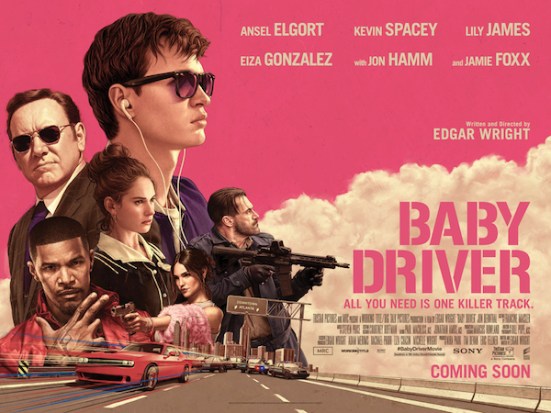
Baby Driver (2017)

2017 #89
Edgar Wright | 113 mins | cinema | 2.35:1 | UK & USA / English & American Sign Language | 15 / R

Baby Driver

It felt like half (at least) of the film-loving internet had somehow had a chance to see Baby Driver before its release on Wednesday, but I’m going to throw my two cents into the ring anyhow. Not that it makes a great deal of difference because, like most other folks, I bloody loved it.

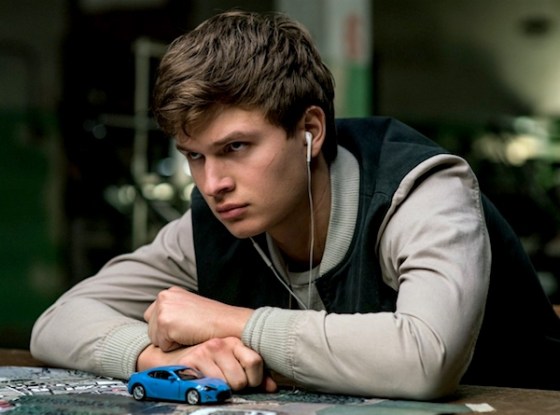
Written and directed by Edgar Wright, director of the Cornetto trilogy and not of Ant-Man, the story focuses on getaway driver Baby (Ansel Elgort), a fundamentally good kid who has ended up suckered into a life of crime, working for robbery kingpin Doc (Kevin Spacey) and a rotating array of criminal compadres. An accident as a kid left Baby with “a hum in the drum” — tinnitus, if you want to get medical about it — meaning he listens to music all the time to drown it out, and also choreographs his daring drives (not to mention his walks down the street, etc) to the music he hears. One day he bumps into Debbie (Lily James) and falls in love, which happily coincides with his “one last job” for Doc. But once you’re in it’s hard to get out, and Baby again finds himself doing one more “one last job”, with a particularly volatile crew…

Baby Driver is a movie about three things: driving, music, and love. As Guillermo del Toro put it, it’s a kind of fable, or fairytale, with Baby as the prince and Debbie as the princess. In this respect it’s a change of pace for Wright, ditching the almost-spoof comedy of his previous successful movies for something more emotionally earnest. Not in a bad way, but in a kind of pure way, like a fairytale. This fairytale world isn’t all castles and dragons, of course — instead it’s full of violent criminals and fast cars; but it’s also a world where you can synchronise your getaway driving to the music on your iPod, so it’s hardly mired in gritty realism.

No little green bags here

There’s a definite edge of Wright’s buddy Quentin Tarantino to this world: a cast of crooks delivering snappy, quotable dialogue to a near-constant soundtrack of deep cuts selected from the director’s music collection (plus a few familiar tunes for good measure) — the style of QT comes to mind more than once while watching. Fortunately Baby Driver’s style is more than homage or copycatting. Although it’s not a straight-up comedy, Wright does bring his own comedic touch (there are several big laughs), and the purity of emotion — that fairytaleness again — isn’t from Tarantino’s wheelhouse either. Plus, visually it presents a brighter and more colourful space than Tarantino normally inhabits. Most of the action takes place in the golden daylight of Atlanta and is filled with popping primary colours. There’s much great work by DP Bill Pope.

Though the soundtrack may have a Tarantino feel in its construction, that’s less prevalent in its usage. Characters communicate through song — not by singing them (most of the time — Baby first notices Debbie because she’s singing “B-A-B-Y”), but by connecting through them (that singing is followed by a discussion of songs featuring her name — both of them). The songs Baby chooses for boogieing around his small apartment, or for dancing down the street on a coffee run (in a title sequence that is marvellously choreographed, with dozens of small details timed perfectly to the track), help illuminate his true character — sweet and romantic — which is hidden by the sullen silence he adopts whenever around criminals.

B-A-B-Y Baby

Some have criticised the film for a lack of character, reckoning Baby’s silence distances him from the viewer so we never build a connection and don’t root for him. Frankly, I’m not sure what film they were watching. No spoilers, but Baby first opens up with something endearing and ingratiating in scene one. Right at the start. It could barely be any closer to the studio logos (and it kinda wouldn’t work if it were). I’m not arguing he’s the most charismatic lead ever to grace the silver screen, but Elgort makes fine fist of selling Baby as both a quiet, focused driver and a sweet, likeable, cheer-on-able hero.

And if you want character in general, the rest of the cast has it in spades, with an array of supporting roles that are as colourful as the cinematography. Recognisable faces like Spacey, Jon Hamm, Jamie Foxx, and John Bernthal get to cut loose as crooks who each have their own kooks, while lesser-known names like CJ Jones (as Baby’s foster father) and Eiza González (as the Bonnie to Hamm’s Clyde) make a mark too. Lily James may be placed in a dream-figure damsel role, but that doesn’t mean she can’t hold her own at times too. She’s not Wonder Woman, but she’s not a Manic Pixie Whatever That Phrase Was either.

Mozart in a go-kart

So, the one major thing I’ve only touched on fleetingly thus far is the main thing the film has attracted attention for: the driving. Done for real by stunt drivers with not a lick of CGI, that knowledge means it packs a viscerally real punch. But it’s not just snobbery: this is genuinely breathtaking action, slickly planned, masterfully performed, magnificently shot and edited. It’s this year’s Fury Road — a kinetic action spectacle made with skill rather than hand-waiving fast-cuts. Even more impressively, it’s been choreographed to music, but not in a draw-attention-to-itself dance-routine-y way. Perhaps saying it’s been synced to the music would be more accurate. Either way, it only heightens the effect. This extends beyond the car chases, too, including one marvellously musical shootout, the gunfire serving as percussion. The sound design throughout is exemplary. This is a movie that deserves to be remembered come awards season. Perhaps, again like Fury Road, some love will extend beyond the technical categories, too. Wright seems deserving of Best Director recognition, just like George Miller was.

But such back-patting is for much later in the year. For now, just revel in the gleeful moviemaking verve of a flick that already seems destined to be remembered as one of the greatest car chase movies ever produced.

5 out of 5

Baby Driver is in cinemas many places right now, but not everywhere. It’ll be worth the wait, guys.

It placed 2nd on my list of The 17 Best Films I Saw For the First Time in 2017, which can be read in full here.

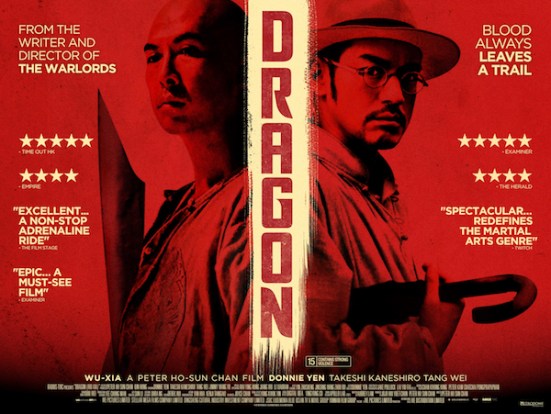
Dragon (2011)

aka Wu xia

2016 #190
Peter Ho-sun Chan | 94 mins | TV (HD) | 2.35:1 | Hong Kong & China / Mandarin | 15 / R

Dragon (Wu Xia)

Donnie Yen is small town paper-maker Jinxi, who incidentally encounters and accidentally defeats two most-wanted criminals. While his village thanks him, detective Baijiu is suspicious — does Jinxi’s story add up? Is he hiding some dark past?

Takeshi Kaneshiro is expert detective Xu Baijiu, who adheres slavishly to the law after a past mistake cost him dearly. But is he delusional, inventing connections and powers for Jinxi that just aren’t there? Or are his delusions allowing him to see the truth?

As a Hong Kong production starring Donnie Yen, of course Dragon is an action movie, but there’s more to it than fisticuffs. It engages with themes of justice and redemption, and what it means not only to take the right action, but to have to find the right action to take. Apparently it began life as a remake of One-Armed Swordsman, and while obvious superficial resemblances remain (the Big Bad Boss Man is played by Jimmy Wang Yu, and Yen has to (spoilers!) lop off his own arm), you can definitely see familiar plot points in both films too. But it’s also certainly not a remake anymore. Funny how these things go.

Can I Baijiu a Jinxi?

Naturally, when the action does kick in, it’s fantastic. With the combat directed by Yen, these sequences are expertly and inventively choreographed dust-ups. It’s stylishly directed by Peter Chan — classy, but also thrilling, exciting, and sometimes innovative; and the whole is majestically shot by DP Lai Yiu-Fai (who also shot Infernal Affairs, which I still haven’t seen).

On the downside, at a couple of points I thought the story leapt a little bit or fudged a detail, which is a shame because I don’t think it needed to. This is possibly the effect of watching the international version, which is cut by around 17 minutes (full details here). While it’s a shame, it’s certainly not enough to ruin an excellent martial arts drama.

4 out of 5