In the run up to the release of The Dark Knight Rises I’ve been re-watching all of the modern-era live-action Batman films. I haven’t watched any of them since 2006, well before The Dark Knight was released and only shortly after Batman Begins had signalled a new direction for the Bat-franchise. I think everyone’s view of Batman on film has changed considerably in the last six years, so it’s quite an interesting context to be viewing them in.
I’ve decided not to provide full-length reviews because, quite frankly, I can’t be bothered (I’m 47 behind for pity’s sake!); but because I’ve been having New Thoughts, I thought I’d share a few below. Plus a score, because these are really reviews nonetheless. (I’d give them each their own page, but I don’t want to swamp you yet again, dear treasured email subscribers.) I know I’ve reviewed The Dark Knight twice already, and I didn’t especially want to get into the habit of reviewing it every time I watch it, but I’ve made a couple of quick observations on it in this context.
And with that said…
Batman
2012 #54a
1989 | Tim Burton | 126 mins | Blu-ray | 1.85:1 | UK & USA / English | 15 / PG-13
 It’s important to re-emphasise what I just said: that this Bat-retrospective was provoked by my realisation that I hadn’t watched these films for six years, since a time when Begins was the pretty-successful new kid on the block. To an extent the changed perspective brought about by the events of the last six years (primarily, The Dark Knight, and (I perceive) a boost in acclaim for Begins by association) colours how we see all of these films now, but I think none more so than this first.
This used to be the dark and serious take on superheroes, treating them in a more grown-up fashion. In the wake of memories of the camp ’60s Batman and the colourful, optimistic Superman film series, that’s certainly what it is. Watched today, it looks positively comic book-y. Sure, it’s a bit grown-up — there’s elements of psychology and adult relationships, not just Boy’s Own Adventure — but the level of heightened reality and camp… it’s nothing like comic book adaptations now. I honestly can’t think of anything made in the current wave of superhero movies that has this tone.
Also, you forget just how true it was that the earlier Batman films focussed more on the villains than the hero. Batman’s in the first scene, but that’s it for a while, and it takes Bruce Wayne ages to appear; when he does, he barely speaks and the scenes aren’t really about him. The story instead follows Jack Napier/the Joker and a pair of journalists, primarily Vicki Vale, though (again) I think it’s easy to forget how prominent her partner (Alexander Knox, played by Robert Wuhl) is. The film puts a little more emphasis on Wayne/Batman later on, but for a hefty chunk it’s not really about him at all. You can really see why Nolan & co thought that was a seam waiting to be tapped when it came to Begins.
Batman feels dated today. I know it’s 23 years old, but it really feels it, in a way the next few films just don’t. There’s still a lot to like here, but it doesn’t impress me in the way it used to when I was younger. It still retains huge nostalgia value at least. Perhaps, with the scales now fallen from my eyes, when I next come to watch it (whenever that may be) I’ll enjoy it more again.
P.S. The first three Batman films have a chequered rating history, but Batman has perhaps the least explicable. Rated a 12 in cinemas in 1989, it’s consistently been given a 15 for home video. since 1990. The first two times it was classified (in 1990 and then 1992) this would’ve been because the 12 certificate wasn’t available for video, but why it wasn’t downgraded to a 12 in 2004, God only knows. It certainly feels like a 12.
Batman Returns
2012 #54b
1992 | Tim Burton | 126 mins | Blu-ray | 1.85:1 | UK & USA / English | 15 / PG-13
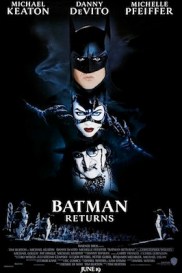 Tim Burton’s first Batman film is great, no doubt, but Returns is a much better film in so many ways. The direction, writing, acting, action and effects are all slicker. They spent over twice as much money on it and it really shows. Plus they have exactly the same running time (to the very minute), but Batman feels surprisingly small scale and Returns feels epic. Watched today, Batman feels Old, whereas Returns… it’s from ’92 so of course it doesn’t feel New — but it feels more like newer films, in a good way.
Some criticise it for being too dark. Well, it is and it isn’t — there’s a lot of black humour in there. I think it works as a tonal whole — it’s not one-note, but it doesn’t swing wildly around either. What’s wrong with a film having a dark tone? Should every blockbuster pitch for exactly the same light-but-not-too-light area? Because they went for that in Forever and it didn’t go down as well.
And that’s related to another thing — some people criticise it for being a Tim Burton film rather than a Batman film, as if that’s a bad or even valid thing. It’s directed by Tim Burton and you don’t expect a Tim Burton film? I’d rather have a director who puts his own stamp on the material than a hired hand who churns out something generic. What’s the point in hiring someone good if they can’t bring their own influence? You don’t think the current films are as influenced by Nolan’s sensibilities as anything else? Look at his personally-authored Inception and tell me that’s in a vastly different style. Then look at Burton’s Planet of the Apes and see what happens when an individualist director is forced into a studio style. Bad things happen, that’s what.
These are meant to be short reviews so I won’t go on about all of Returns’ plus points, but oh my are they many. This is easily the franchise’s best effort until at least Begins, arguably even until Dark Knight; and for those who prefer their Batman less grounded and more fantastical, it could well be the best of all.
P.S. Believe it or not (and some will know this and so believe it, but I didn’t until now), Returns is only uncut in the UK as of 2009! Back when the SE DVDs were classified in 2005 it was still cut by seven seconds for “imitable techniques”, and then got a 12. I don’t know if an uncut 15 was offered then, but that’s what it has now.
Batman Forever
2012 #56a
1995 | Joel Schumacher | 122 mins | Blu-ray | 1.85:1 | UK & USA / English | 12 / PG-13
 Four observations I personally hadn’t made before:
1) everyone goes on about how the pre-Begins Batman films dealt with the villains and ignored Bruce Wayne. That’s true of Burton’s pair, but this one spends a ton of time with Bruce (a lot of that’s about Robin, but it’s about Robin in relation to Bruce). The one who’s hard done by is Harvey Dent/Two-Face, who gets relatively little screen time and most of it is spent as a cackling halfwit sidekick to the Riddler. Not befitting the character at all.
But 2) talking of Two-Face, wow does Tommy Lee Jones over-act furiously! Perhaps that’s not news, but crikey it’s so unlike anything else I’ve ever seen him in.
And 3) I swear Elliot Goldenthal’s score referenced the music of the ’60s Adam West series on several occasions. Which, considering the overall tone of the film, feels entirely possible. (I watched the featurette on the BD about the music but they didn’t mention it, sadly.)
Finally, 4) I was aware they’d completely re-edited the first act to put an action scene up front (and get a lower certificate in the US after all the furore that accompanied Returns), but I wasn’t aware of all the casualties. At one point Batman and Two-Face engage in a car chase that happens for no good reason; in the original cut, Two-Face & co ambush Batman on his way back from attending a Bat-signal call. That at least makes some sense, whereas in the film as-is he seems to go out simply for the purpose of having a chase, then goes home.
Batman & Robin
2012 #56b
1997 | Joel Schumacher | 125 mins | Blu-ray | 1.85:1 | UK & USA / English | PG / PG-13
 Believe it or not, Batman & Robin isn’t a complete disaster. Don’t get me wrong, I’m not about to mount a defence of the film — it is mostly awful. But only “mostly”.
Relatively significant screen time is given to a subplot involving Alfred being very ill. Thanks to the general warmth of feeling felt toward the character, plus the acting abilities of Michael Gough and George Clooney (who is severely untested by the rest of the movie), this storyline deserves to be part of a far better film.
Also, the realisation of Gotham is impressive. Mixing gigantic sets, model work and CGI, Schumacher and co crafted a towering fantasy landscape straight out of the comic’s wilder imaginings. The neon colouring may not be to the taste of those who prefer Burton’s darkly Gothic interpretation or Nolan’s real-world metropolis (if forced to choose, I’d be among them), but this is an animated-series-style Gotham writ in live-action, and judged as that it’s a resounding success.
The rest of the film is an irredeemable mess, however. Characters speak almost exclusively in one-liners centred on dodgy puns, and even when it’s not a one-liner it’s delivered as if it is. Schwarzenegger is the worst culprit for this, but Uma Thurman overacts horrendously also. She’s defeated by being kicked into her chair, just another of the script’s multitudinous stupidities. Her origin is a weak rip-off of Returns’ take on Catwoman; Bane is reduced to a monosyllabic idiot (at one point he has to plant a series of explosives, grunting the word “bomb” every time he puts one down); Barbara ‘borrows’ a bike from Bruce’s collection and, thanks to editing, appears not to return it for about two days without anyone noticing; and so on. I know they were aiming a little more in the direction of the camp ’60s TV series, but even if you allow for that it just doesn’t pull it off (and I gave the ’60s movie 4 stars, so I believe it can it done).
The “toyetic” approach (i.e. focusing more on the tie-in merchandise that could be generated than the story, etc) results in a foul new look for the Batmobile (though the DVD featurette on the film’s vehicles almost makes you appreciate it — the behind-the-scenes version is much more impressive than what we see in the film) and, famously, the heroes arriving at the climax in new costumes with absolutely no explanation! All it needed was them returning to the Batcave, “we better put on our ice-suits”, something like that. Heck, it would’ve allowed Schumacher to indulge in his suiting-up T&A shots one more time. But no, they just magically change into nastily-designed toy-ready outfits. Ugh.
There is ever so much to hate about Batman & Robin that even the really-quite-well-done Alfred plot can’t prevent me from placing it with the lowest of the low at a single star.
Batman Begins
2012 #56c
2005 | Christopher Nolan | 140 mins | Blu-ray | 2.35:1 | UK & USA / English | 12 / PG-13
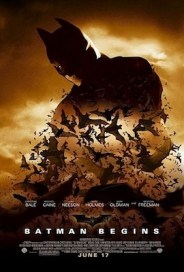 Chris Nolan’s first foray into Bat-world really is a stunning piece of work in many respects. It’s a film with the confidence in its story to take its time and do things its own way. The first 40 or so minutes jump back and forth constantly between Bruce Wayne’s childhood around the time of his parents’ murder, his college-ish days when he runs away around the world, and his present day training with the League of Shadows. But, as is Nolan’s trademark, this mixed-up chronology is never confusing, never unclear, and always serves a point.
Then there’s the fact that Batman himself doesn’t turn up for a whole hour. That’s nearly half the film. But that’s fine — we’re not left wanting, it’s just the right time for him to emerge. When he does, the film becomes suitably action-packed and drives its plot on. Until that point, we’ve had such a thorough basing in the world of Gotham City and the mental character of Bruce Wayne that it seems plausible he’d choose to fight crime by dressing up as a bat.
The Nolan Batman films have become known as the ‘real world’ superhero movies, but of course what we see depicted isn’t the real world, and things wouldn’t happen like this in real life. But it’s the way Begins identifies itself with other movies that creates that feeling. The previous Batman films occur in the exaggerated world of Superman and other superhero fantasy movies; here we’re in an exaggerated world more like James Bond, say, or indeed any other technology-driven action-thriller you choose. It’s not our real world, but it’s the real world of that genre; one closer to our own than the dark fantasy of Burton’s films or the dayglo cartoon of Schumacher’s.
There’s much more that could be said about Begins and naturally I’m limiting myself here (this is meant to be a short comment, after all), but it’s important to note what a fine job Nolan does of making Gotham City a character in the film. All of the Batman films have done this to some degree — it was Burton’s stated aim to make Gotham “the third character” in his first effort — but by giving the city recognisable landmarks, districts, a true sense of history and on-going interrelations, it feels like a real place. And those recognisable landmarks continue into The Dark Knight (particularly spottable are the split-level roads, the Narrows and its bridges, even if the vital-to-this-film’s-plot elevated railway completely disappears between films), cementing the importance of this cityscape. I do hope it continues into Dark Knight Rises. I’ve already read one review that said they should’ve named the final film Gotham City, so I’m optimistic.
The monumental achievement of The Dark Knight has come to overshadow Begins, which is now rendered as a functionary prequel to the next film’s majesty. Don’t let that reputation fool you: on its own merits, this is very much a film at the forefront of the action-adventure, blockbuster and superhero genres.
The Dark Knight
as 2012 #56d
2008 | Christopher Nolan | 152 mins | Blu-ray | 2.35:1 | UK & USA / English | 12 / PG-13
 I was, oddly, a little nervous sitting down to watch TDK for the first time in four years. I’d had such an incredible experience viewing it in the cinema (twice) and, by not watching it since, it had built up some kind of aura in my mind. But I dismissed such silliness and damn well got on with it.
Thank goodness, it’s a film good enough to stand up to such memories. That’s the main thing I wanted to add, I suppose, because everything I had to say in my earlier reviews still stands. The IMAX sequences look almost as incredible on Blu-ray as they did in the theatre (as much as they ever could), but I’m sure you knew that.
What’s interesting is watching this directly after Begins. While Nolan’s first film isn’t even close to being as all-out fantasy as the earlier entries, it errs more in that direction than this one, in my opinion. Begins has a kind of fantastical warmth to it, alongside the more urban-realism aspects. I say “warmth” probably because of the sepia/brown hues of the sequences set in the Narrows and so on. The Dark Knight, by comparison, is set in the cold grey-blue steel world of skyscrapers and the modern metropolis, inspired by towering architecture in its visual style and by epic crime-thrillers in its plotting. Compare the two posters I’ve used here for the gist of what I’m driving at.
Begins is, at heart, still a superhero action-adventure; Dark Knight is a crime thriller that happens to take place in a world with superheroes. Does that make it inherently better? No. But it does make it more unusual for the genre. And as Nolan & co pull off the crime thriller style and feel so damn well, it flat out makes it a great film.
The star rating, of course, stays the same.
In case you missed the links above, my two previous Dark Knight reviews can be read here and here.
And that’s it for the Batman films… so far. Because at the exact time this set of reviews is posted, I should be sat in a large darkened room with a number of other people, about to embark on the concluding chapter of Nolan’s Dark Knight trilogy. I imagine later today or tonight I’ll have some initial thoughts on that one too.

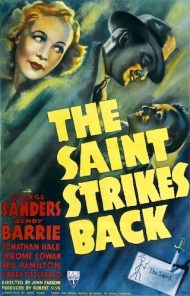 The first film to star the Roger Moore-ish George Sanders as Simon Templar, aka the titular Saint, is also one of the RKO series’ better entries.
 Nonetheless, it’s mostly a fun romp. Sanders’ portrayal of Templar is witty and enjoyably knowing, even more so than Louis Hayward in the previous film. He’s at once more laid-back and less self-certain; by which I mean you can sometimes see him working out his devilishly clever plans as he goes along, rather than floating through with invulnerability. This Saint is the kind of man who’ll bluff that a criminal’s house is surrounded by police so that he can escape, but then can’t resist phoning back to have a little gloat about how his bluff worked. Lighter, jokier — if Hayward was Sean Connery, Sanders is (as noted) Roger Moore. Though I’ve never seen the ’60s TV series, here I can see clearly how Moore was suited to the role.
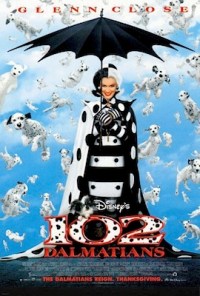 I imagine the live-action re-working of
  And aside from a race around the streets, ‘Paris’ is mostly a studio set anyway. Obviously they couldn’t keep Cruella in Nice Mode for the entire running time, but there’s call for a bit more originality in what happens after she goes bad.
 Plus there’s an awful lot of cute dogs. Always a bright side. And it’s a great answer for “name an Oscar-nominated film” trivia questions (it garnered one for, appropriately, costume design).
 Pixar have always attached original short films to their feature releases. As part of what seems to be their increasing franchisation, however, they’re not always wholly original now: Hawaiian Vacation was the short attached to
  Hawaiian Vacation doesn’t exactly allay these fears — its very existence is proof of that — but at least it’s an entertaining piece in its own right. It succeeds partly by not overreaching itself — this isn’t Toy Story 4 and it doesn’t try to be. It reminds us of the characters and gives them each a story beat, while remaining funny, entertaining and sweet, all in under six minutes. Cars 2 can’t manage that in 106.
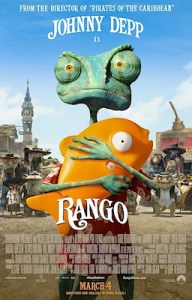 There seem to be an increasing number of live-action directors sticking their oar into animated films; and not just lending their ideas and name, as Tim Burton did with
 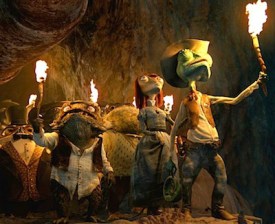 Indeed, perhaps the most striking thing about Rango is ILM’s hallmark, the extraordinary realism. Though some of the characters are rendered cartoonishly (just look at Rango’s face) and all are of course anthropomorphised, the textures and lighting are as true-to-life as any of their work in live-action movies. They consciously went for a photographic look, as if it had been shot with real cameras, including consultation with Oscar-winning cinematographer Roger Deakins, and it paid off because the whole thing looks incredible. I know I only just recommended it in the last paragraph, but the making-ofs are really great for an insight into why the film looks and feels so different to most current computer-animated films. The sequences of them recording performance reference are incredible — they essentially shot some scenes in full, with the entire cast, in costume, with full props, some sets, blocking, marks, camera angles, improvisation… (The only thing lacking on the Blu-ray is a
 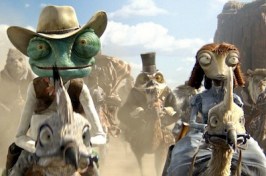 Back to the film itself. I know it’s less interesting, and it is far too slow at the start, but when it eventually gets underway it becomes very entertaining. Somewhere in the middle there’s a five-minute wagon/bat chase that’s a properly exciting action sequence, excellently realised. It was so good I watched it again immediately afterwards. It’s got a clever use of Wagner too, as well as some regular Hans Zimmer action scoring. Zimmer’s score throughout is top quality, referencing Morricone and all the other staples of Westerns.
 The plot, however, is clearly borrowed from
  With its detailed references to other films and real-world visual aesthetic, Rango may be more likely to find appreciation among grown-ups than the children who are the typical target for English-language feature animation. Then again, there’s that immature humour I mentioned. A ‘family’ film indeed. Either way, it’s an entertaining addition to — and alternative from — American animation’s usual offerings.
 Pixar, oh exalted studio of wondrous excellence, who produce naught but critically-acclaimed and audience-beloved films that may as well just be given the Best Animated Feature Oscar without the need for fellow nominees, dropped the ball with
 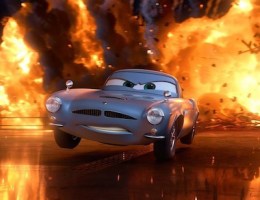 here we get an international spy movie — much more fun. The espionage stuff is clearly inspired by Bond (the primary secret service is British, for starters), and the opening eight minutes — an action sequence starring the film’s Michael Caine-voiced Bond analogy — is probably the best stuff in either Cars movie. Actors like Caine and Emily Mortimer lend the whole affair some much-needed class.
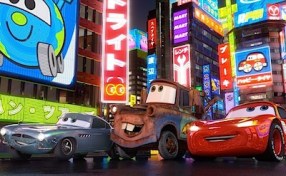 the back-and-forth battling, the last-minute surge, etc etc — so it’s not really any loss.
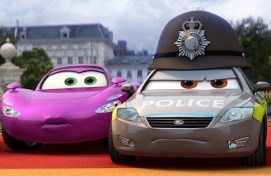 why is the police car wearing a giant hat?!
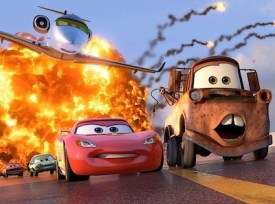 entertaining films, how can they also produce something so uninspired?
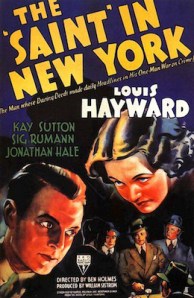 The Saint in New York is a B-movie in every sense of the term, but it’s certainly one of the fun kind.
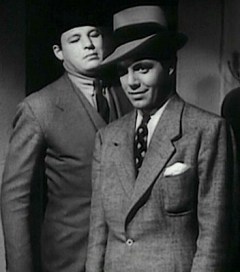 His habit of jumping into moving vehicles, much to the surprise of their drivers, is also fun. The other stand-out character is henchman Hymie, played by Paul Guilfoyle, who is enamoured of the Saint and constantly comments on his actions. Together they make the film a light, fun, amusing experience, with more memorable lines than a film of its stature deserves.
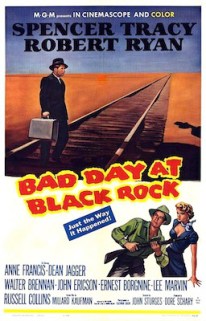 Bad Day at Black Rock comes with an air of the forgotten classic — or, at least, it did to me. I think that’s important to how I ultimately reacted to it. As is that wherever I first heard about it pitched it as a suspenseful mystery with a twist. I forget where that was now, but I remember consciously avoiding finding out the plot’s developments (more so than one naturally would anyway) before viewing.
 I missed the commentary. Indeed, in
  For a film so based in mystery and which has what I’d call a methodical pace (despite its short running time), there are surprisingly good action sequences to look out for: a car chase/battle along a thin path, a one-handed punch-up in a bar, and a climactic shoot-out that’s at its most tense once all the bullets have been fired. It’s not an action movie by any means, but these cinematic sequences stand out nonetheless.


 Remember when M. Night Shyamalan was the wunderkind of Hollywood? Seems so long ago, doesn’t it? But clearly someone somewhere is still invested in him — or he’s managed to limp on well enough that stuff he works on seems worth a punt — because a couple of years ago he was able to launch a series of films dubbed “The Night Chronicles”. I don’t remember the details and they’re not worth looking up, but as I recall the idea is they were a series of low-key/low-budget horror-thrillers conceived by Shyamalan (he has a Story and Producer credit here) but helmed by others. Devil is the first of these. I don’t recall a second turning up yet.
 not the best, but with enough action, intrigue and twists to fill its (admittedly very brief) running time. It comes to a head with a pretty good twist/reveal. Again, it’s kind of ironic that it’s the best twist in a Shyamalan film for years, but it comes in a movie he neither wrote nor directed. Maybe he should take another look at the kind of films he’s choosing to make. (I say “maybe”…)
 As an aside, in my occasional run of Comments Paying Too Much Attention To Certificates, it’s funny what Americans allow at what age rating. Here we have neck stabbing, hanging, creepy devil stuff… Seems a bit much for a PG-13, to me. The UK’s 15 is much more appropriate.
 This year’s 52nd film is, in many ways, thanks to DC’s The New 52 (the comic book initiative/publicity stunt that saw DC relaunch their entire universe across a series of 52 new #1 issues, for those who don’t do comics): it got me back into reading regular comics, and featured in multiple titles for several months was a cool-looking advert for the US release of Detective Dee, complete with the attractive review quote, “
 To take Time’s opinion as a starting point, I have to wonder if they would rank Detective Dee so highly if it had been an American-produced film with actors speaking English. I don’t mean if the film was Americanised, but exactly the same, just an American production. In that instance, I think it would very much be viewed as a summer blockbuster, because that’s definitely what it strikes me as. It’s one with lots of talky bits and an over-complicated story, certainly, but then it’s not unheard of for US blockbusters to confuddle the viewer with an under-written over-developed plot (less so these days, I grant you).
 not in awe of the performer’s abilities or entertained. One of them features the hero fighting a gaggle of cheap CGI deer. Yes, deer. Why?
 and they happily take its advice (see second paragraph)), a fighter whose arms fly off and turn into… something else (choppy editing means I’m not sure), facial transfiguration (imagine
 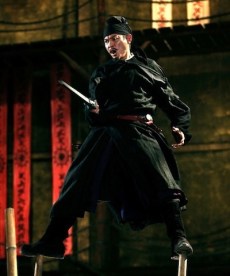 you could enjoy the characters, or the political machinations, but only if you take time to study them slowly and work out what was going on for yourself, because the film’s in too much of a rush to explain it to you. There’s something to be said for entertainment not spelling everything out — it’s often a highly-praised element of anything that achieves it — but Dee doesn’t do that, it rushes headlong past things that could do with more clarity. (One thing I should do is listen to Bey Logan’s commentary — there’s a fair chance he’ll have insights that illuminate me. But in a moment you’ll see why I haven’t done that before posting this.)
 100Films.co.uk