2012 #85
Steven Spielberg | 147 mins | Blu-ray | 2.40:1 | USA & India / English | 12 / PG-13
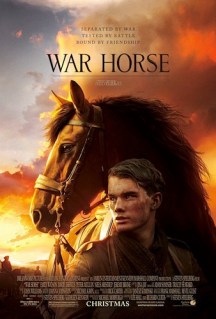 After decades telling tales from the Second World War, Spielberg moves back a conflict. That said, the BD’s special features make sure to point out this “is not his First World War movie” — it’s just a good tale about a boy and his horse.
Based on the children’s novel by Michael Morpurgo, plus the 2000 stage adaptation that inspired Spielberg to make the film, War Horse follows Joey, a thoroughbred born in 1910s Devon, and his loving owner, Alby. When their farm faces tough times, Alby’s father sells Joey to the army as the Great War starts, initiating a trot across Britain and France that takes in both sides of the conflict over the course of the war.
It might be best to define the film as an epic. It’s a relatively intimate one, focusing in on a handful of characters at a time rather than cutting back and forth between various groups, but the way it does move along several sets of characters, across varied locations, and through a lengthy stretch of time, all command a feeling of a grand story. The special features are right in that it’s not really the story of the war, but what it does show is something of the experience of living through that war, and of the humanity that was still present within it.
I imagine some would level accusations of implausibility, but stranger things have happened in the real world than much of what we witness here. Take a late-occurring scene of British-German co-operation in No Man’s Land, for instance — surely two sides at war would never work together! Well, this is the same war that saw the opposing sides play a football match on Christmas Day, remember? 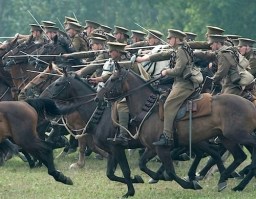 It can’t be denied that there’s factual inaccuracy here (the climax takes place at the Somme in the lead up to Armistice Day in 1918, but that battle was actually fought in 1916), or the occasional heavy dose of sentimentality (it’s directed by Spielberg and co-penned by Richard Curtis — what did you expect?), but I think it carries through these with a scale and heart that is, primarily, entertaining. It is based on a children’s novel and I think aims to be a family film (it should by rights be a PG; my twitter rant on that subject is here), but Morpurgo knows when to treat his audience with respect and at points it certainly doesn’t shy away from the harshnesses of the period.
Similarly, the way the horses are handled seems pretty much spot on. They’re not anthropomorphised, but they definitely develop characters and personality as we follow them throughout the film. Naturally most of the focus falls on the human characters, what with them being the ones who can talk and all that, but Joey is the only character we follow throughout the movie and we’re led to relate to him and his story in a believable way. And I say this as someone who’s not a horsey person. Spielberg reportedly found it tough working with real horses, struggling to get performances from them that matched what he’d seen on stage — unsurprisingly, as those were puppets controlled by well trained and rehearsed humans. Nevertheless, however they went about it (and it was with very minimal use of puppets or CGI), the “horse acting” is solid.
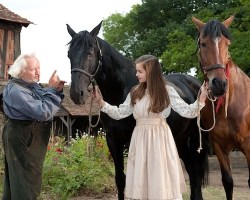 Aiding the sense of the epic is Janusz Kaminski’s cinematography, which is regularly stunning and definitely one of the film’s standout achievements. The beauty of some shots is immediately obvious — he lenses the countryside idyll of Dartmoor in a sweeping fashion, bathed in summer sunlight — but there are striking compositions to be found throughout, be they in close-ups, cavalry charges, horse auctions, battlefield hospitals… There’s often a lovely texture to things too, from the likes of drifting snow or chaff, or the way light streaks across a room. The final scene, fully tinted orange, calls to mind the likes of Gone With the Wind, I presume with full consciousness.
Less remarkable is John Williams’ score. It’s not bad per se, and has its moments, but other times it’s either forgettable or forced (some of the early comical bits are horribly overplayed with whimsical plinky-plonking). For all that, a memorable sequence you’ve surely seen in the trailers — when Joey runs over and through the trenches — is perfectly scored, recalling the action/adventure movie grandeur we all primarily remember Williams for.
As I marked my viewing of War Horse on various websites, it struck me how many negative comments there were. I thoroughly disagree. Not everything has to offer gritty realism, even when it’s dealing with horrendous times and events. Morpurgo, Spielberg and co have conjured a sweeping tale of friendship and humanity in the face of adversity; 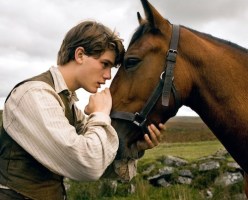 one that isn’t afraid to depict some of the nastier realities of the world, but in a way that makes them relatable for a younger audience. I think that’s important; but this isn’t a Worthy Film for that, it’s just something it does well. I think it also nails sensations of adventure and, yes, sentimentality.
I think it’s a bit of an epic, with all that connotes, and I love a bit of an epic.
War Horse is on Sky Movies Premiere twice daily until Thursday.
It placed 2nd on my list of The Ten Best Films I Saw For the First Time in 2012, which can be read in full here.

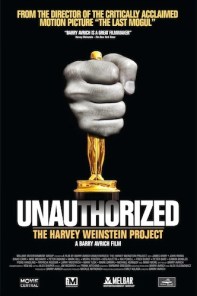 The documentary that Weinstein reportedly tried to stop existing, including discouraging people from participating in interviews. Either he needn’t have worried or really is a complete megalomaniac, because while there is a certain warts-and-all aspect to Avrich’s cinematic biography, it can’t help but admire all that Weinstein has achieved.
 Even for those who were following film culture through this era, and in spite of Harvey’s apparent efforts, there are numerous interviewees who were there — former Miramax employees, for instance — to offer insight. Thanks to archive footage we get even more opinions, including a fair few comments from Harvey himself. How much of this was available at the time, I obviously don’t know. Even if it is mostly recap, it’s a concise and well-constructed one.
 Bill Cunningham is 80. He lives in a small rent-controlled apartment in New York City that is filled with filing cabinets. His bed is little more than a mattress on some boxes. Each day, he dresses in the same distinctively simple blue smock and sets out on his bicycle. He eats at the same places each day; simple cheap food, cheap coffee. He doesn’t have a partner or kids; he may never have had a romantic relationship. He doesn’t watch TV or listen to music. It sounds like some kind of life of poverty or religious devotion. It’s neither, although you could make an argument for the latter, because all Bill does all day is photograph what people wear.
 Bill is, technically, a fashion and society photographer. His real passion, however, is clothes. Real clothes. The clothes people actually wear and how they wear them. His newspaper column — a collection of photos from the streets — is essential reading as far up the chain as Anna Wintour. He doesn’t set trends, he observes them. Exposes them, you might say, because in the past he’s used his work to call fashion designers on where they’ve copied (consciously or not) the work of another from years before, and that has sparked arguments.
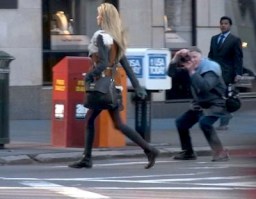 What he actually is, more than a “fashion photographer”, is a documentarian, recording how people choose to present themselves to the world, both as individuals and how that translates en masse. Fashion may seem like a meaningless, arbitrary, frivolous thing to afford such time to, and I’d have no argument against Fashion being called exactly that. But fashion — the actual clothes we wear in our actual lives — is something a good many people spend a good amount of time obsessing over; it’s how they choose to represent themselves in the world, how they indicate what they’re like as a person, how they show which groups or types of people they align with. We all do it, even if it’s not a conscious choice. Surely that’s worth recording?
 But that’s all an aside, probably because it’s so well done. What might be worth picking up on is that there’s no specific story. There are stories in there — like how Carnegie Hall is kicking out its handful of 80- and 90-something resident artists to make way for more office space — but the film doesn’t have an overarching tale. It’s a portrait; one of a fascinating, unusual, but likeable, and certainly unique, individual.
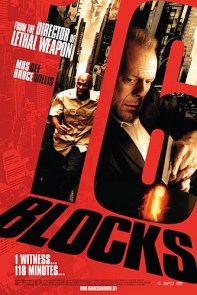 A Bruce Willis action movie? You know what you’re in for here, don’t you? Well, not quite. 16 Blocks casts Willis as less John McClane and more John McCane: old, fat, drunk, limping. He’s a copper still, but the kind of detective whose primary duties are being left to watch over an apartment full of bodies until uniform can show up.
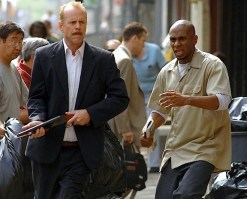 For me, it really lost its way just over an hour in, when our heroes (spoilers!) end up in a hostage situation on a bus. It’s not bad, but it feels like writer Richard Wenk (who’s gone on to co-write heights of culture like
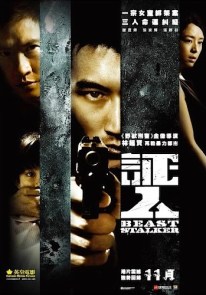 While in pursuit of an accused murderer, a cop (Nicholas Tse) accidentally kills the daughter of said murderer’s prosecutor (Jingchu Zhang). Three months later, just days before his trial, the accused has the prosecutor’s other daughter kidnapped, to persuade her to destroy the evidence proving his guilt. Despite having spent the intervening time in reclusive self doubt, the cop sets out to rescue the kidnapped little girl.
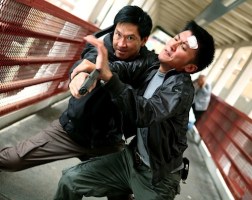 making them a little perfunctory — the real meat actually lies in the plot’s twists and turns. This is more one for fans of thrillers than beat-’em-ups.
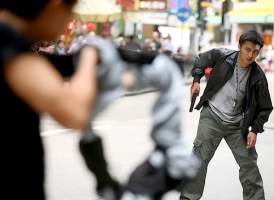 The top performance comes from Nick Cheung as a for-hire kidnapper with the Bondian trait of being blinded in one eye while the other only has black-and-white vision. He gets added complexity thanks to an invalided wife he tenderly cares for — he’s only in this life of crime to pay off his debts and medical bills, y’know. Cheung’s largely silent turn manages a fine balance of menace and sympathy. He won a couple of HK awards for it,
 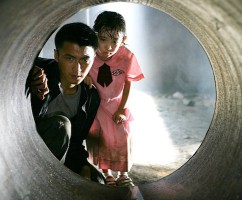 A brief couple of scenes with a bullied colleague play out nicely, though unfortunately they contrast with a painfully written bit in which another colleague tells Tse’s character what people think of him. “They said you were horrible, but I like working for you,” she tells him (I paraphrase), for no discernible reason. It doesn’t even matter that we’re told that, because we’ve already seen it. I just don’t get it.
 Before
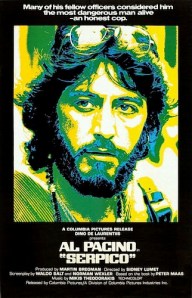
  As the titular copper, it’s a typically strong performance from Al Pacino. Not his best work — I don’t think the part really gives him enough to deliver that — but he’s more often than not the most engaging element of the film. This was his fifth film; considering
  Lewis Gilbert is the director of
 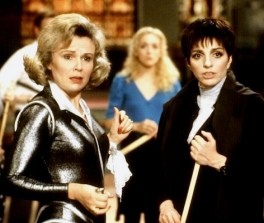 The standout from the cast is probably Julie Walters, in a relatively early big-screen role. Considering how well-known she is now she seems quite lowly billed and little-featured, but bearing in mind this is a US production from the early ’90s, it’s less surprising. She’s very good (isn’t she always?) as the group’s newest member, a posh English lady who sticks her oar in and is a bit too blunt with her comments. I seem to remember her generating most of the laughs in this comedy-drama, although that’s not to disparage anyone else’s work.
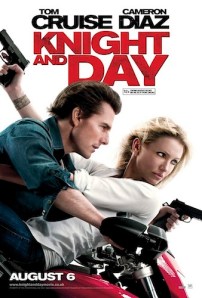 James Mangold is one of those filmmakers with a thoroughly eclectic CV, taking in crime thriller
 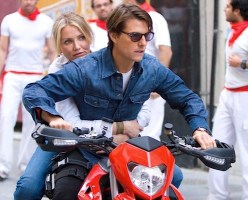 Knight and Day is nothing deep or revelatory or groundbreaking, but if you were expecting it to be then more fool you. If you can’t abide Cruise or Diaz (and I know some people really can’t) then it should certainly be avoided, but those caveats aside I thought it was good fun. No classic, and far from destined to be a standout on Mangold’s multi-Oscar-winning filmography, but an appropriately entertaining couple of hours.
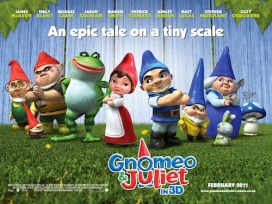 Gnomeo & Juliet is the latest British attempt to crack the lucrative CGI animated kids’ movie market, after the lack of success (or, alternatively, failure) from the likes of
 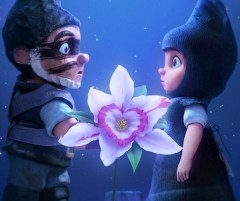 My only other note is that it ends with a truly awful cover of Crocodile Rock by Nelly Furtado. A storyboarded “all’s well that ends well” ending (included on the BD, and the DVD for all I know) looks much better.
 Following the surprise success of
  Hitler (aka Bruno Ganz) and a cool exit; a really good car chase; and a couple of solid punch-ups, including a particularly good one at the climax.
 100Films.co.uk