
Paul Haggis | 133 mins | Blu-ray | 2.35:1 | USA & France / English | 12 / PG-13
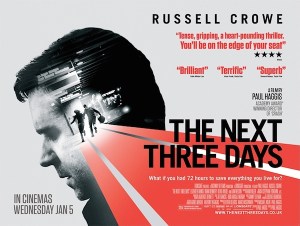 If someone you loved was locked up for decades for a crime you were sure they didn’t commit, how far would you go to get them out? That’s the premise of this methodical thriller from writer-director Paul Haggis (of Crash, of course), based on the French film Pour Elle.
Those with even a very basic grasp of French (like me) may spot that translates literally as “For Her” (though the English releases call it Anything for Her), which is why Russell Crowe does what he does: his middle-class idyll is shattered one day when police storm into his house and violently arrest his wife (Elizabeth Banks), in front of their small child, for the murder of the boss she argued with the night before. (This, incidentally, is the least plausible part of the entire movie — there’s no need for the police to storm the house like that, and in real life they wouldn’t. Well, American police might, I suppose. But I still don’t believe it.) The evidence is stacked against her, and her explanations for it sound a little far-fetched. She’s convicted, sent down… and when all legal means of appeal are exhausted, Crowe sets about planning a prison break.
This setup is, in my opinion, a really good one — though I feel kind of biased as the basics have crossed my mind as a good basis for a plot long before this or Pour Elle existed. Thing is, it’s inherently quite a daft concept: prisons are (rightfully) incredibly secure places — no ordinary Joe is breaking anyone out of there in a couple of weeks. By rights, a film of this ilk should probably be a Taken-esque slightly-OTT action-thriller, 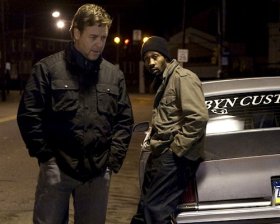 with a protagonist who either already has a “particular set of skills” or implausibly learns them (maybe over a longer period of time) before putting in motion their crazy scheme.
Haggis’ film is a mix of that, in its final act, and an attempt at depicting a serious, plausible, realistic version of what might happen if a regular, intelligent guy set his mind to such a task. Except it’s not really plausible that he’d get very far. Nonetheless, the film takes its time going through the motions of how Crowe might learn and practice the skills required, fund the enterprise, formulate his plan… Some have described this as dull, but I think it actually works. It’s a different kind of film to a pacey prison-break actioner, but if you were crazy enough to try this in the real world, of course you’d start by looking up “how to” articles online, by finding the authors of “how I escaped” books, by trying to buy a gun on the black market and messing it up, and so on.
According to Haggis, the French film is actually quite American-styled, a fast-paced thriller, which he chose to expand out. I’ve not seen the original so can’t say how he’s done that, but the implication is that the detail of the planning, and of the characters’ regular lives, has received more attention. A subplot with Olivia Wilde is a pointless aside that only explains itself once it throws a spanner in the works during the climax, but the scenes with Crowe’s parents pay off thanks to an excellent near-wordless supporting turn from Brian Dennehy. Best thing in the film, easily.
 Running him a close second is the all-action final half hour or so, when Crowe (spoilers! but not really!) finally stages the actual escape. It’s a long time coming, but we’re paid off with a pretty fantastic long-form action sequence. There’s genuine tension about whether they’ll pull it off or not, and along the way we’re treated to a few nice flourishes in his plan. There’s a fair degree of silliness still, though, so at least that’s in-keeping with the rest of the movie.
Thing is, for all my love for the idea, it’s ultimately quite a silly concept. As much as we might dream of rescuing our innocent loved one from a life of torment behind bars, if it came to pass in reality, the vast majority of people would immediately realise it was an impossible dream. By trying to treat it plausibly, The Next Three Days is on a hiding to nothing — for all the realism of how Crowe begins his research and planning, there’s the downside that this slow-paced plausibility turns some viewers off; and when we do get the eventual escape, it’s an “in movie’s only” adrenaline-provoker that said viewers wanted all along. The film pretty much can’t win.
 Finally, there’s an attempt to keep uncertain the truth about Banks’ culpability. Haggis never wanted that question to be answered — Crowe believes she’s innocent, even when she confesses to his face, and that’s what matters. I don’t think Haggis is a filmmaker who can resist answers, however, and for all his assertions that her innocence/guilt is left ambiguous, by the end I think you can be pretty darned certain which it is… which kinda makes all the previous attempts to leave it open feel hollow, especially the ones that side with the untrue.
The Next Three Days ends up as a solid thriller, with a methodical pace that will kill some viewers’ interest, but which conversely provides a depiction of detail that will hold the attention of anyone who’s ever pondered what they’d do in such a situation. The finale is largely worth the wait, at least, even if everyone will wish Haggis had skipped over a few longueurs while getting there.

The Next Three Days is on Channel 5 tonight at 10pm.
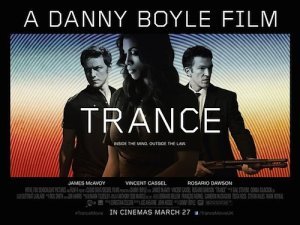 Ambiguous endings used to be anathema to film audiences. They wanted things tied up in a pretty little bow, thank you very much; all the conflicts resolved and all their questions answered. Then the likes of
  In the Blu-ray’s special features, Boyle comments that “it’s more classical than you might expect.” He’s talking specifically about the cinematography (and he’s right, but more on that later), but he could equally be talking about the entire movie. Though it has a storyline that blurs the line between what’s actually happening and what’s happening inside a character’s head (or is that characters’ heads?), the overall tone and style — particularly of the climax — is actually quite Hollywood. It’s Hollywood jazzed up with storytelling trickery, a quirky score, dashes of extreme gore and surprising nudity (that it’s not an 18 is somewhat surprising); but underneath all that it’s not a million miles away from your run-of-the-mill thriller.
 there’s no switching to black and white for dreams, for instance; nothing to definitively tell you which state you’re in. And this is a good thing, because when you need to know you can tell, and the rest of the time… well, the film’s playing with you. That’s the point. What is real and what is a scenario McAvoy’s being talked through? Are these memories what happened or the product of an addled mind?
 Dod Mantle’s cinematography is also strikingly handsome. As noted, the film’s buzz had me expecting something akin to late-career Tony Scott, all jumpy and weirdly saturated and fragmented. Instead, as Boyle said, it’s actually very classical, but with a great eye. There are a number of shots which would look fabulous framed and hung on the wall, not least of the street outside Dawson’s flat at night, a restaurant next to intersecting train lines, and aerial photography of red-lit nighttime motorway junctions, looking like some kind of Rorschach test-esque psychiatrist’s tool.
 Few would deny that Peter Jackson’s extended versions of
 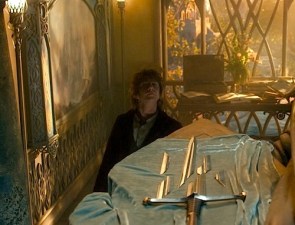 There’s not as much extra time with the dwarves as I expected, though, with most of the character time still going to Bilbo.
 having to work alone on a green screen for many of his scenes with the smaller characters), but newcomers Martin Freeman, Richard Armitage and James Nesbitt shine too. This is Freeman’s film to be the centre of attention, but Armitage and Nesbitt will have much more to do in the follow-ups, and the groundwork is nicely laid here.
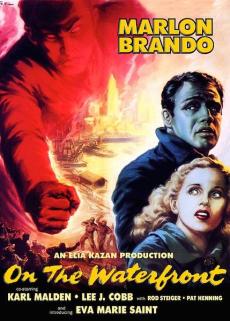 So much more than one famous scene, On the Waterfront is a movie about a magic jacket, which causes anyone who owns it to stand up for what’s morally right even in the face of oppression, but also to suffer badly when they do.
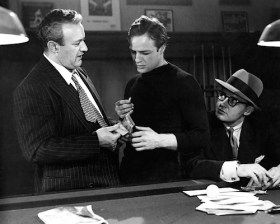 The only potential downside to this comes if you dig behind the scenes. Kazan was one of those who testified before the House Committee on Un-American Activities during its 1940s and ’50s witchhunt for Communists in Hollywood, naming eight men who were later blacklisted. If you consider the film to be Kazan’s answer to critics of his actions (as it “widely” is, according to Wikipedia), then presumably Brando is meant to be Kazan, calling out those who are doing ill to good hardworking Americans. But many a great film has been made with poor motive — just because Kazan thinks what Brando’s character does and what he did are the same thing doesn’t mean we have to. Even then, the issue of Kazan’s testimony is not so straightforward: a former Communist himself, he faced the end of his career if he didn’t testify, and the names he gave up were already known to the committee. The controversy dogged him for the rest of his career, though: when he received an honorary Oscar in 1999, several notable audience members refused to applaud.
 While subtext is undoubtedly a meaningful thing, and using one situation to comment on another is a tried and true way of presenting an argument or criticism, I’m not a proponent of offhandedly dismissing work(s) just because we don’t agree with the actions or beliefs of the person who made it. On the Waterfront is a powerful film, exemplarily made by skilled craftsmen. Whatever Kazan was trying to atone for with its message about standing up to bullies in defence of what’s right, the sentiment is true. And you don’t need a magic coat to do it either.
 Like a
  The plot is essentially “
 with both this and last year’s sequel proving huge hits, and a
 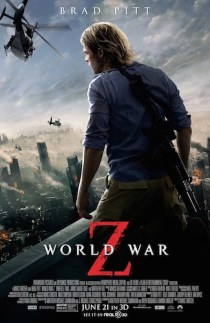 In the weeks leading up to its theatrical release, it was already known that World War Z was going to be an almighty flop. An unscrupulous movie studio had taken a cult novel and thrown away everything but the title, alienating its existing fanbase. They’d spent a fortune making a movie in a traditionally R-rated genre that, if released at R, could never make its money back, and if released at PG-13 would never attract an audience. Then they reshot the entire third act, pushing the budget through the roof and ensuring the resultant film would get critically mauled. A fanbase snubbed, an impossibly huge budget, a genre/rating disconnect, and unavoidably poor reviews to come — World War Z was going to flop, and it was going to flop hard.
 That, at least, is something different. The first half-hour races through stuff we’ve seen time and again: zombie attacks, humans turning on humans as they loot supermarkets, etc. Here the zombies are of the
  It’s a Wales populated by a Londoner, a Scotsman and a Spaniard, but still. I say “more tense” because this is far from the most nail-biting zombie film you could see. The finale is a nice change of pace, and does work as a climax in spite of the bombast that precedes it, but these are zombies as teen-friendly action movie menace, not adult scare-inducers, so don’t except to feel much fear or surprise.
 but I don’t think it was the filmmakers’ aim to make us feel the characters’ plight, but instead to show the scope of a worldwide disaster. It does that pretty well, even if the occasionally-CGI zombies prove to be an
 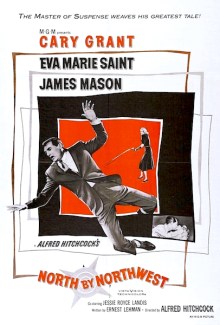 Alfred Hitchcock is famous for a good many movies — I wager most people would jump to
  Grant is as wonderful as ever, a perfect ‘everyman’ to guide us through the crazy turns of events, but also finding the appropriate level of humorous edge where it exists. Eva Marie Saint is a textbook ‘Hitchcock Blonde’, attractive but duplicitous — women, eh? James Mason makes for an excellent English-accented villain — today it may be a terrible cliché to use Brits as villains in Hollywood movies, but we’re so damn good at it. That said, Martin Landau makes for a deliciously creepy henchman, so there’s no monopoly. There’s also Leo G. Carroll, who to me will always be best known from
 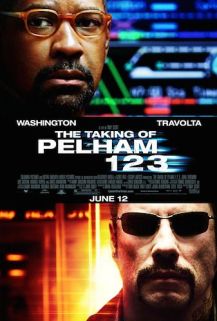 Based on a novel by Morton Freedgood (writing as John Godey), previously adapted into
  None of that here, where the captives are either even more unnoticeable, or heroic off-duty military types. So far so standard.
 Applied here to such a meat-and-potatoes tale, it feels like they’re trying to jazz it up because it can’t sustain itself otherwise.
 The writing and directing team from
  As for the veracity of the facts, I have no idea. Nothing seems implausible. And when condensing eight years of a manhunt into around two hours of screen time, of course some details will be lost, or truncated, or slightly modified to support the flow. I think those who allege the film is poppycock are accusing it of more than minor tweaks, but nonetheless, that’s inevitably part of the process. What’s perhaps most interesting is it hasn’t whitewashed the facts to make a film that feels like A Movie — this isn’t a relentless thriller-shaped eight-year chase, but a more methodical, occasionally messy, real-life-like quest for information.
 This carries through to the final half-hour (or so), which is a near-real-time rendition of the Navy SEAL mission to invade bin Laden’s compound in Pakistan. The unit assigned to the task turn up and get on with it — like the rest of the characters, they are no more than sketches. I read a review that asserted this is where the film’s focus should have been — on who these men were, what their home lives were like, on their training for the mission, and what effect it had on them after. All of which are valid points for a film, but that’s not what Zero Dark Thirty is trying to be.
 The one other criticism I do agree with is that we don’t see enough of the SEALs’ preparation. They built a full-scale replica of the compound and trained on it — was that not worth putting on screen? I know this is the story of Maya and her investigation, not the SEALs and their assault, but I think a bit of time could have been spent on that fascinating aspect of the raid. On the bright side, there’s a sequence where our characters collect their still-in-development super-top-secret stealth helicopters from Area 51. Yes, really. I guess that must be true, because without the reality-claim of the previous two hours it would come across as
 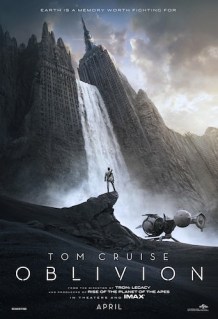 As Oblivion informs us in a hefty chunk of voiceover exposition at the start, the year is 2077, several decades on from a war with aliens that we won but left the Earth in ruins. Humanity fled to a colony on Titan, but the last party to depart remain in orbit aboard a giant space station. Waiting to join them are Tom Cruise and Andrea Riseborough, the last humans on Earth, serving the final few weeks of their mission to watch over the drones that guard giant water-collecting machines, sucking up the oceans for the benefit of the new colony.
 Also, as with many a tale desperate to surprise its audience thus, there are holes in the story and its logic (for a good summary of some of the major sticking points, check out
  I like a good action sequence, and some of the ones Kosinski presents have their moments, but I also found I could have done without most of them. To a degree they seemed to have been slotted in so it could look like an Action Movie in the trailers, the aim (as ever) being to pull in the punters, thereby justifying the budget needed to create such a slick SF world.
 With the aforementioned plot issues, not to mention an ending that some will find too twee (I saw the broad strokes of the epilogue coming from quite a way out, so can’t say I was surprised), Oblivion is not quite all it could have been. But it gets considerably closer than I expected — it’s undoubtedly an A for effort — and that, bolstered by faultless technical aspects, makes for an all-round enjoyable experience.
 100Films.co.uk