
Alan Taylor | 112 mins | Blu-ray | 2.40:1 | USA / English | 12 / PG-13
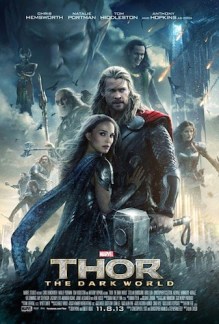 Thor was one of the best surprises of Marvel’s Phase One for me: they took a character I had no interest in, and if anything thought seemed like a silly idea (what’s a Norse God got to do with superheroes?), and produced one of the first wave’s most entertaining and accomplished movies. They followed this up by turning the widely-acclaimed Avengers Assemble team-up into Thor 2 in all but name: sure, there’s plenty for all the other sub-franchises’ characters to do, but the major villain and cosmic scope are much closer to the events of Thor than any of the other lead-in films.
Cut to the real Thor 2, The Dark World, and there’s no small degree of expectation to live up to — not to mention that director Alan Taylor and the five credited writers (story by Don Payne and Robert Rodat, screenplay by Christopher L. Yost and Christopher Markus & Stephen McFeely) are landed with the need to resolve plot threads left dangling by not one but two preceding films. What are the chances of them succeeding?
Mixed, as it turns out. When it works, The Dark World is exciting, inventive, and often genuinely hilarious. Placing most of the movie’s biggest laughs during its climactic battle — which already features a thrilling conceit in and of itself — makes the ending one of the best action sequences in the entire Marvel movie canon. Sometimes that climax is a long time coming, though, with a story that has so many disparate elements to juggle, you can be certain some have got lost in the mix. There’s hints of a love triangle, which disappears almost as soon as it begins; the rules of Loki’s green-tinged cloaking-y-thing are never expounded upon, meaning it can be whipped out whenever a cheap twist is required — indeed, it’s ultimately used once or twice too often.
 Good will towards the participants counts for a lot, though. Tom Hiddleston’s Loki steals pretty much any scene he’s in, but Chris Hemsworth’s Thor is not an unlikeable hero, building further on the responsibility-and-honour story arc of the first film. Idris Elba also benefits from an expanded role, but others are less lucky: one of the Warriors Three is ditched as soon as we’re reacquainted with him; more criminally, Christopher Eccleston’s villain has nought to do but stomp around spouting exposition in a made-up language. Anyone could play that role, you don’t need an actor of Eccleston’s ability. Maybe something got cut (though it’s not in the Blu-ray’s deleted scenes), because I don’t see why else he’d’ve taken the part. Well, possibly the payday.
At the helm, Taylor was a late-in-the-day replacement for Monster director Patty Jenkins. Previously best known for TV’s Game of Thrones (as well as episodes of pretty much every other major HBO series), thanks to Marvel Taylor is now a Major Motion Picture Director: his next project is the Terminator reboot/prequel/whatever. He steps up to feature film level well enough, though the much-heralded “more grounded” Asgard he was supposed to be providing is little shown: we see a pub and a training area, and other than that there’s too much going on to linger in the one-realm-to-rule-them-all. In fact, we get a better look at the film’s Stonehenge-and-sunny-London version of England, where if you get arrested at Stonehenge you’re locked up in London. Ah, American movies.
 Despite the title, there’s much fun to be had with The Dark World. It can’t deliver on all of its aims — the equally-promised expansion of Thor and Jane’s relationship is equally sidelined — but there’s enough entertainment value to make it a worthwhile proposition. Perhaps the longer lead-in that the third film seems to be getting (there’s no announced slot for it among Marvel’s numerous future release dates, meaning it’s unlikely to arrive before 2017) will allow them to round everything out a little better.

Thor: The Dark World is on Sky Movies Premiere from today at 4:15pm and 8pm.
 Residents of a condemned high-rise witness a gang-related murder, but don’t intervene and deny all to the police. Months later, a sniper begins to pick them off. Can they band together and survive?
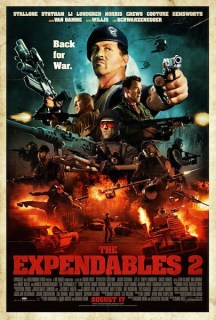 Sylvester Stallone’s ragtag collection of former action stars (and some current ones) reassemble for another throwback fight-fest, this time upping the daftness factor, to mixed results.
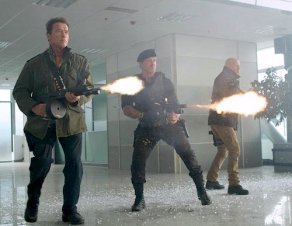 So is it better? Sometimes. The whole thing is inherently silly — these are (mostly) grandfather-aged chaps kicking ass with the best of ’em — and it plays up to that with sly winks to the audience and implausibly-grand combat choreography. But at times the nudge-nudge factor goes a little far, and the disregard for building a wholly plausible story, especially towards the end, is a shame.
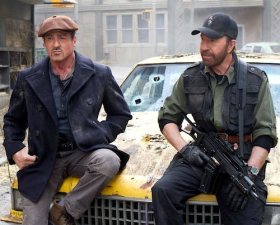 But you didn’t come for that. You came for classic action stars fighting each other. In that regard, it’s pretty much the definition of brain-off brawny fun. If you don’t care for ridiculous action and cheesy dialogue, both of which are laughable in a way that’s hard to tell if it was intended or not, then this is not a film for you. If that sounds up your street, however, then The Expendables 2 is no classic, but it is a fun time.
 On Blu-ray,
  The best of the bunch is Super Manny, because Manny’s always fun and it’s the most inventively zany. Worst is Earl Scouts, because it’s just a poor Tom & Jerry / Itchy & Scratchy riff — Sky viewers won’t be missing much by not seeing it. Attack of the 50ft. Gummi Bear! falls somewhere between those two stools, as I suppose does Steve’s First Bath, though slightly less objectionably so — there’s fun to be had in how it sets up Flint’s grand uber-romantic date, then how it’s trashed by Steve and the robot built to wash him.
 On the whole, the shorts are passably entertaining if you like slapstick-y 2D animation and want to kill quarter-of-an-hour (or 22 minutes with Earl Scouts thrown in). But there’s nothing particularly innovative or original about any of them — certainly not worth going out of your way for.
 Quirky director Jeunet uses quirky cinematography and quirky special effects to tell the quirky story of a quirky girl, who had a quirky upbringing by quirky parents, and now lives a quirky life with quirky friends. A quirky coincidence leads her into the quirky hobby of cheering up strangers in quirky ways, during which she meets more quirky people who do quirky things, and she quirkily falls for the quirkiest.
 A sequel to the suprisingly-good-in-spite-of-its-name animated comedy, Cloudy with a Chance of Meatballs 2 (innovative title; though better than its original moniker, Revenge of the Leftovers) begins mere minutes after
 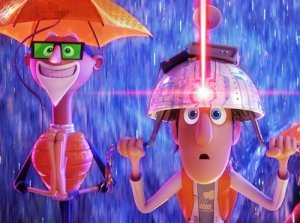 The villain this time is a thinly-veiled riff on Apple and its messianic founder, Steve Jobs. Here they become the aforementioned Life Corp, whose logo (and headquarters) is a giant lightbulb, and the equally-aforementioned Chester V, Flint’s childhood hero. As with almost all hero-since-childhood characters, you can guess where that’s going from the moment he appears at the start of the opening montage. Nonetheless, his storyline and relationship with Flint mostly works — it does take Flint a long time to reach the point of realising The Truth, but for viewers the reveal comes earlier and isn’t treated as an inappropriately big shock. Again, kids less familiar with movie tropes will be even more accepting of it. Plus there’s a Moral Message there for said kiddies (naturally), this time about trusting in your friends. It’s all familiar fare to an adult viewer, but doesn’t dominate to the point of boredom.
 In the end, Cloudy 2 isn’t quite as good as the first film, but not in a “notably inferior” way. It remains relentlessly entertaining, with an admirable energy and drive, which is in part a desperation to not be boring, but not in a shallow way. It may lack the extra little something that the first one has, but if that was an 8-out-of-10 then this is a 7 — which, because it’s fun rather than disappointing, rounds up to:
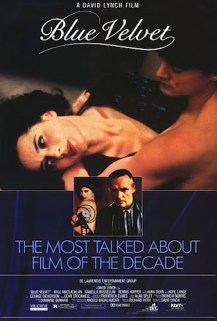 Before he brought the disquieting underbelly of small-town America to television audiences with
 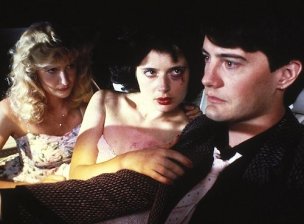 But… is it, really? The white-picket-fence-dwellers are pretty clean; it’s the people inhabiting the scuzzy apartment blocks and industrial estates nearby who are the problem. Those characters are as corrupt and degenerate as their abodes might lead those with regular prejudices to suspect. It’s a less subversive point of view, and I don’t think it’s what Lynch was actually going for. Anyway, the entirety of his moviemaking technique is so outré that you can’t help but find the whole twisted nonetheless.
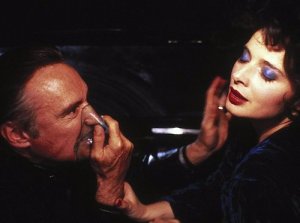 “It’s not a movie for everybody,” Lynch himself said (to Chris Rodley for the book
 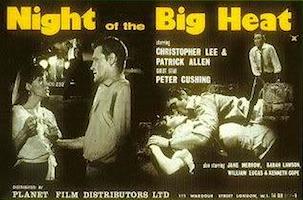 These days largely sold as a horror movie (the old Collector’s Edition DVD is branded as part of a “Masters of Horror” series), probably thanks to its cast (Christopher Lee and Peter Cushing), director (Terence Fisher, of many a Hammer Horror, including five with Cushing and Lee), and rating (an X originally, a 15 now), Night of the Big Heat is not really anything of the sort. Well, maybe a little; but you’re more likely to get scared by a contemporaneous episode of
 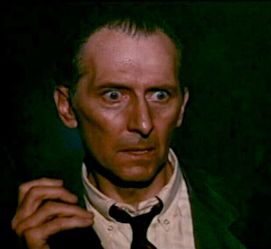 the pair were brought in to redraft because the original screenplay’s dialogue was “unsayable”. Anyone familiar with their ’80s work on Doctor Who, and their associated reputation, will find that highly ironic.) However, when the sci-fi stuff does roll in it’s a bit of a damp squib, leaving the scenes relating to the affair, whether it will be discovered, and what various characters do about their various feelings, as some of the more unique and interesting elements.
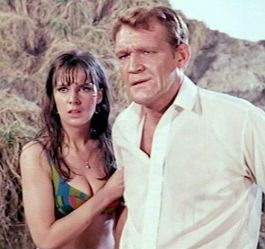 which considering it was shot in February and March is a real achievement. During night shoots the cast had to suck ice to stop their breath being visible, while running around in wet clothing to look like they were drenched in sweat. Poor sods. Said night scenes are a mess of genuine and atmospheric nighttime shooting, alongside the kind of day-for-night filming where everything’s extremely dark except for the sky, and also the kind of day-for-night filming where it’s day and… um… shh!
 Originally produced for the 2010 FrightFest film festival, horror director Jake West’s feature-length documentary with the unwieldy title explores the ‘video nasty’ scare that gripped early-VHS-era Britain. Starting with a primer on the birth of home video, and what it was like to watch movies in those days (because, ladies and gents, we’ve now reached a point where even fans of that (second-)most adults-only of genres, the gory horror flick, are young enough to not recall a time before DVD), West uses archive news clips and a wide array of new talking head interviews to take the story from the UK’s first video recorders in 1978, through a newspaper-led panic, up to the infamous Video Recordings Act of 1984, which irrevocably (thus far, anyway) changed the face of home entertainment releasing in the UK.
 Focusing on the scare rather than the films embroiled in it makes this less a “horror documentary” and more a social history/pop culture one, though the liberal use of extreme clips from the movies in question shuts out anyone without a hardened stomach. (If you did want more on the films themselves, the DVD set that contains the documentary — Video Nasties: The Definitive Guide — includes 7½ hours of special features discussing all 72 ‘official’ video nasties alongside their trailers.) There’s room for little asides amongst the main narrative, though. One of the highlights is the story of an interviewee who was invited on to Sky News in the wake of the James Bulger murder and asked if the film many were holding responsible,
  There was some counterargument, however, which leads us to the film’s best interviewee, and surely a new hero to many: Martin Baker. Baker was one of a few (certainly the first, and for a time the only) critical/intellectual-type voices to speak out in defence of the films that were outraging so many. He’s to be commended not only for his valiant defence of, essentially, free speech at a time when his views were immensely unpopular; but also because he remains one of the most lucid and fascinating commenters in the documentary. He makes the clearest points about the need to not forget both what happened and how it was allowed to happen, lest it occur again.
 that force ISPs to attempt to censor what we can and can’t see on the internet, and just yesterday rushed through anti-privacy legislation without proper debate. Sad to say, many of the valuable lessons of the ‘video nasties’ brouhaha — lessons made explicit with superb clarity in Jake West’s excellent documentary — have not been heeded.
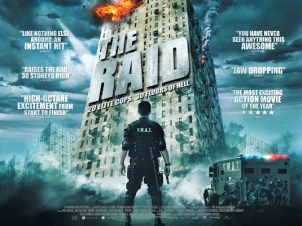 “20 Elite Cops. 30 Floors of Hell.”
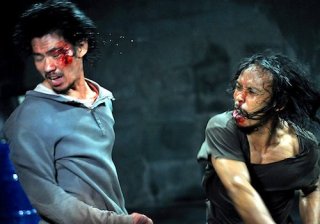 instead of ending with our hero duelling our villain, a fight with the top henchman is followed by a bit of plot clean-up between the villain and a supporting character. It’s the very definition of anti-climactic.
 Another way it’s pleasingly unlike its current American counterparts is the lack of focus on gore. There are plenty of stabbings (of a blood-stain-on-shirt variety), and a couple of sliced necks, but none are lingered on. Things like a hammer beating or repeated machete strikes take place either just off screen or just after we cut away. It’s unquestionably a violent film, but it doesn’t revel in the gory aftermath of that violence in the way many US films increasingly seem to.
 to make for a much more rounded experience. The fights in The Raid may have blown the minds of people who haven’t seen enough Asian action flicks, but I’d argue Dredd is the better film as a whole. And if you still insist on accusing one of plagiarising the other… well, let’s put it this way: Dredd had finished shooting, and its screenplay had leaked online, before The Raid even entered production.
 100Films.co.uk