
Robert Rodriguez & Frank Miller with Quentin Tarantino | 142 mins | Blu-ray | 1.85:1 | USA / English | 18
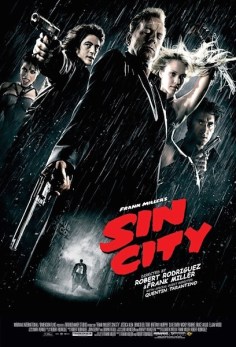 Adapted from a series of graphic novels by Frank Miller, Sin City is a noir homage, replete with high-contrast black-and-white cinematography, dialogue so hard boiled you couldn’t crack it with a sledgehammer, and all the requisite downtrodden heroes, corrupt authority figures, dangerous dames, etc. There’s also the very modern inclusion of shocking ultra-violence and nudity, but I guess a fair degree of that would’ve crept into classic noir if the mores of the time allowed — pretty much the point of the genre is the dark grubbiness of the world, after all.
Anyway, Sin City: The Film is probably best known for its slavish faithfulness to Miller’s original comics; or rather the way that manifested itself: the film was shot digitally (when that was still remarkable rather than the norm, as it has become since) and almost entirely on green screen, with cast members who share scenes sometimes not even meeting, and whole roles being recorded in a day or two rather than the usual couple of weeks. It helps that the movie is a collection of short stories, meaning no one person is in it for more than about 40 minutes. The point of this was to then emulate the comic’s visuals: black-and-white with minimal grey in between, but occasional splashes of colour and other striking effects — blood is sometimes stark white, sometimes red; one character has blue eyes, another golden hair; plasters or necklaces are sometimes rendered as flat white blocks; and so on.
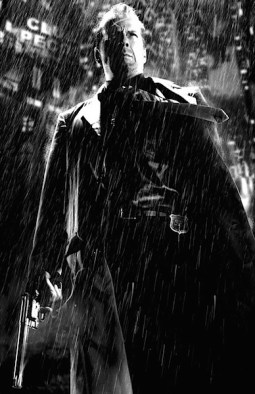 The DVD-premiering extended version, dubbed Recut & Extended (or, in the US, “Recut, Extended, Unrated”) is even more faithful to the comics than the theatrical version. Some of the books’ scenes that were excised are now included, and the structure has been rejigged to present each of the four stories one by one in their entirety (whereas the original version had a small amount of intercutting). The total running time is 17 minutes and 40 seconds longer, an increase of some 14.2%… which is a thoroughly misleading figure. As a presentational choice, each of the four stories is offered for individual viewing, plus option to “play all”. However, rather than that showing them as a single film, they play as four shorts back to back, with a full set of section-specific end credits rolling each time. The actual amount of new material in the film itself is reported to be 6 minutes and 55 seconds, or only a 5.6% increase from the theatrical cut. I’m sure the extensions are great for die-hard fans, but for most the additions are all but unnoticeable — look at that Movie-Censorship.com list and you’ll see there are only three or four new bits that could reasonably be described as “scenes” (ranging from under 30 seconds to about two minutes), and then just a bunch of extended ‘moments’.
The lack of notable new material isn’t the issue, though. The real problem is the re-structure. Let’s not beat around the bush: it scuttles the film. Individually, each of the three longer narratives is fine, but when watched back-to-back as if it were still one film, the structure is unbalanced. Then there’s the shorter story, The Customer is Always Right, starring Josh Hartnett as The Man. In the original cut, his character features in a standalone pre-titles style-establisher (both for the visuals and the kind of tough tales we’re about to be told), and then a neat coda bookend before the end credits. These two scenes have been placed together in this version, and it sucks.
 For one, the second scene belongs more truly to The Big Fat Kill (the final story, starring Clive Owen’s Dwight and the whores of Old Town led by Rosaria Dawson). For another, because this recut purports to be in chronological order, The Customer is Always Right plays second. So we get 47 minutes of Bruce Willis protecting Jessica Alba from a paedophile in That Yellow Bastard, then we get a one-scene story that rightly belongs at the beginning (complete with title card, now 50 minutes into the ‘film’), then we get a scene that, actually, belongs in a completely different place. The next full story is The Hard Goodbye (the one with Mickey Rourke under a slab of prosthetics as Marv), followed by The Big Fat Kill — and it’s after this that the second scene with The Man belongs. Divorced of that context, the scene is robbed of almost all its meaning.
I guess Sin City: Recut & Extended isn’t really meant to be viewed as a single film — hence why there are four sets of end credits, and why the cool opening titles featuring Miller’s original art is nowhere to be seen. Even allowing for that, though, I think the second scene with The Man has been badly placed. A chronological cut of a non-chronological film is an interesting idea, but this doesn’t even get that right. And even if it weren’t for the regular interruption by lengthy credits sequences, the re-order makes for a very stop-start viewing experience, something the theatrical version avoided by divvying up one story and having characters make brief cameos in each other’s tales.
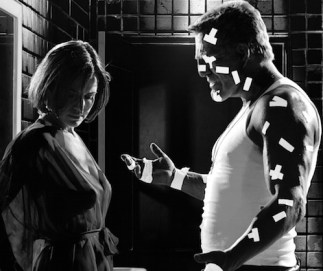 In the end, I enjoyed Sin City considerably less than I did nine years ago in the cinema. This is partly down to the restructure, but I’m not sure wholly so. I don’t think it’s aged particularly well, as things produced at the forefront of emerging technology are wont to do: some of the CGI looks dirt cheap, the shot compositions are often unimaginatively flat, and there’s an occasional internet-video style to the picture quality. It’s not just the visuals, sadly, with amateurish performances from reliable actors, possibly a result of the hurried filming schedule. Just because you can capture an entire part in a single day doesn’t mean you should. Then there’s Jessica Alba, who’s just awful here.
For all that, there are shots that are striking, when the elements come together to make something that still looks fresh and creative even after nearly a decade of the film’s visual tricks being emulated by lesser movies or integrated into general cinematic language. One thing that struck me was that the most memorable moments were all from the trailer — Sin City did have one helluva trailer. The stories and characters aren’t bad, thanks to the hyper-noir style being a deliberate choice, though perhaps it sometimes goes too far with the voiceover narration. Maybe, again, this is the fault of watching the longer cut; maybe there’s just a little too much of it in any version.
Quite often an extended cut will become the definitive version of a film — these days, it’s often a way to get the originally-intended cut past a studio who insist on a shorter running time or PG-13 certificate; or it’s a chance to revisit and improve a project that hadn’t quite worked. Not so with Sin City. This is a version for fans of the books who want to see every last drop included… but even then it falls short, because apparently a few moments are still nowhere to be found.  None of the present additions are game-changing, and though some are good in their own way, there’s nothing noteworthy enough to compensate for the destruction of the original cut’s well-balanced structure. For the average punter — and certainly for the first-time viewer — the theatrical cut is unquestionably the way to go.

This year’s sequel, Sin City: A Dame to Kill For, will be reviewed tomorrow.
Both reviews are part of the 100 Films Advent Calendar 2014. Read more here.
Sin City: Recut & Extended received a “dishonourable mention” on my list of The Five Worst Films I Saw in 2014, which can be read in full here.
 I think I’ve previously discussed my life-long love of the X-Men franchise, so I shan’t go into detail again, but suffice to say Days of Future Past has been one of my most-anticipated movies ever since the title (which is that of a classic and influential story from the comics) was announced. Thank goodness, then, that the final result doesn’t disappoint.
 Beyond that, there’s the characters: the younger versions are having to deal with the fall-out from
  Not everyone gets to shine in a cast this big, although pretty much everyone gets a moment. The future-set cast have the least to do, people like Halle Berry turning up to do little more than show their face, though Stewart and McKellen get a moment or two worthy of their talents. After he was the focus of the last film, Fassbender is slightly shortchanged here; but after McAvoy gave him essential support in First Class, Fassbender plays the same service here, informing Charles’ journey. Of the new additions, Evan Peters as Quicksilver (that’s the one who’ll also be played by Aaron Taylor-Johnson in
  Later, there’s the aforementioned ‘slow-mo’ sequence, and the grand climax, which offers more “fly something big around” antics a la First Class’ submarine, only considerably grander. Yet for all the spectacle, the final moments once again come down to character: what is Magneto prepared to do? What is Mystique prepared to do? Will anyone listen to Charles? And so on. Even the much-vaunted Marvel Studios movies tend to base their climaxes in slabs of ‘epic’ CGI crashing into each other; Days of Future Past does that for a bit, then brings the characters back into focus for the real final beats.
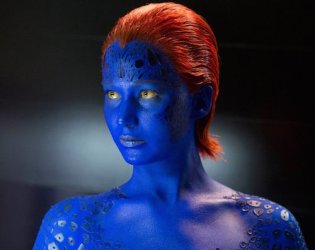 (Jennifer Lawrence being the third pillar of the past triumvirate, as they’ve already focused on Xavier and Magneto). While Days of Future Past does wrap up the majority of its threads (the open-ended ones are answered by previous films, if you want them to be), there’s plenty there to play with in the next film (and, perhaps, ones beyond that) if they want to… which they do.
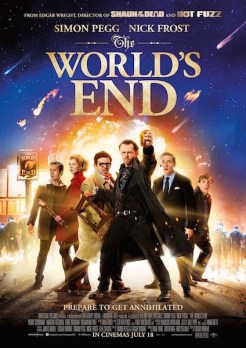
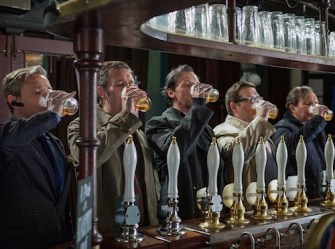 “zombie movie” or “Hollywood action movie”, and occasionally co-writers Pegg and Wright have substituted character development and thematic points for send-up. It may not play to the genre-loving fan-audience that the trio’s previous work has accumulated (demonstrably so, based on many a viewer review), but it does make for a more grown-up film.
 It will definitely reward multiple viewings: it’s littered with signs, omens and portents (in fairness, a good few can be grasped on an attentive first go). There’s a featurette on the BD (but not the DVD) which helps point out any major ones you may’ve missed; though I have to say, even at seven minutes long, and even with it pointing out some that felt too obvious to be worth mentioning, I swear it left some stuff out. That could be a deliberate decision of course, to leave some things for people to just spot.
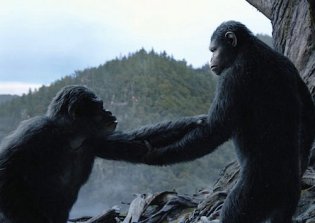 A heady mix of solid writing from Mark Bomback, Rick Jaffa and Amanda Silver, peerless motion-captured performances from the likes of Serkis and Toby Kebbell, and first-rate CG magic from Weta, brings us a set of characters who are compelling and believable. Here is a society trying to define what it wants to be, battling old prejudices in the hope of a peaceful, secure, happy future. If you want to draw analogies to almost any real-world political situation, I’m sure you could.
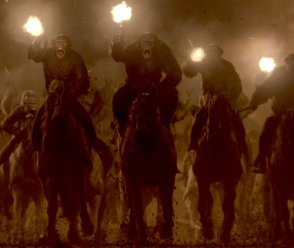 Lest you get the wrong impression, the film isn’t all talk. For various spoiler-y reasons, the fragile relationship between Man and Ape breaks down, and the apes stage an attack on humanity. Here we get perhaps one of the best siege action sequences I can think of, with mankind holed up in a half-constructed skyscraper that sits conveniently at the end of a long street for the apes to charge down. Reeves’ direction is virtuosic here, crafting an epic and exciting sequence even when most of the film’s major players are busy elsewhere. And it’s not even the climax.
 thanks to some surprisingly small-scale narrative choices (the whole thing with the dam doesn’t feel nearly as vital as it should) and Reeves’ direction sometimes being a little straightforward and almost TV-ish. I know I’ve said I hate when people use that as a derogatory comment nowadays, but some repeated locations and shot choices make the film feel cheaper than it was.
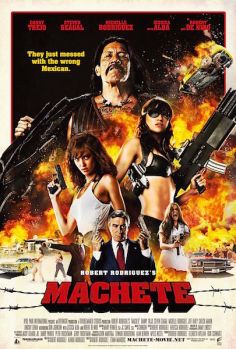 Multi-hyphenate Robert Rodriguez takes his
  to fleetingly include something that ‘needs’ to be there purely because it was in that trailer.
 Comic book creator Frank Miller brings what he learnt co-directing
 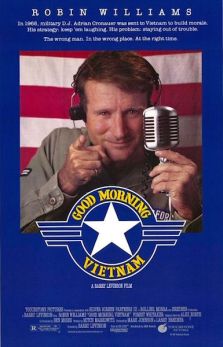 Inspired by the true story of a US Army DJ in Vietnam during the war, the resulting film is a showcase for star Robin Williams — reportedly, his antics aren’t even close to what really happened.
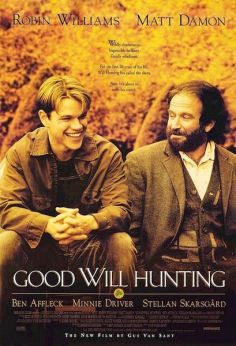 I’d say Good Will Hunting is famous for two things: one, being written by Matt Damon and Ben Affleck when they were young actors after some good roles; and two, Robin Williams’ Oscar-winning supporting actor performance. Such is the power of these two facts that I didn’t even know what it was about until I actually watched it.
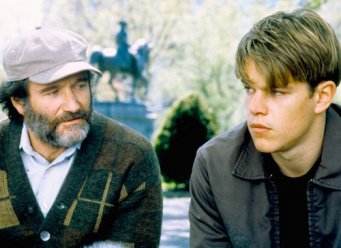 The film is perhaps most enjoyable as an acting showcase. Damon and Williams have numerous incredible scenes together; encounters that feel like genuine slowly-evolving therapy, rather than the simplistic and implausible series of repeated revelations and breakthroughs that such treatment is often reduced to on screen. They run the emotional gamut, too, being not just instances of soul-searching but also moments of wider insight, or intense humour — that’s what you get when you have Robin Williams at your disposal, of course. His Oscar is well earnt.
 Their promising relationship suffers through inexperience and, to be frank, unwarranted daftness, lending it a melancholic air (or is that just me again?)
 Then, slowly, almost imperceptibly, a slight wry grin curls his mouth. Yes, Will has actually done it; and yes, it is what he wanted. It’s all good. Only then does he turn around, and simply announce to his waiting friends that Will isn’t there. It’s a pretty subtle moment, massively over-explained here, but it’s so much more realistic a reaction than the almost-clichéd one we’re expecting to see. In a film full of incredible, powerful performances, speeches and moments, it’s one that stood out to me.
 Besides, it’s the characters and the performances that shine. It’s no surprise that a pair of actors wrote an “actors’ movie”, but it is an achievement that they wrote one that displays genuine people and genuine emotions, rather than just showy performances. Credit to an exceptional cast — and, this once, an exceptional director — for bringing that so beautifully to life.
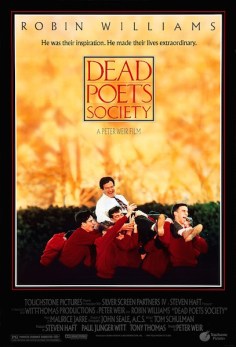 At an oppressive private school (is there another kind?), a gaggle of disenchanted students are invigorated by teacher Robin Williams; until his methods, and the independent thought they inspire, attract the ire of parents and faculty.
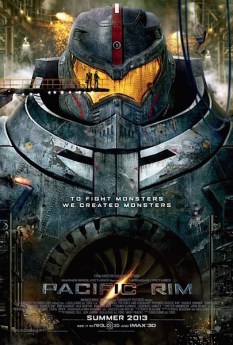 The names writers choose for their characters can sometimes tell you a lot about a movie. Pacific Rim is the kind of film that has characters called Raleigh Becket, Stacker Pentecost, and Hannibal Chau.
 — it was the 3D that added depth and height, and without that (or, as I said, an adjustment of focus to compensate) it’s all a bit… not flat, but not big either. That aside, it is beautifully shot, with excellent lighting.
 100Films.co.uk