aka
Приключения Шерлока Холмса и доктора Ватсона: Собака Баскервилей
Priklyucheniya Sherloka Kholmsa i doktora Vatsona: Sobaka Baskerviley
The Adventures of Sherlock Holmes and Dr. Watson: The Hound of the Baskervilles
2015 #14
Igor Maslennikov | 146 mins | DVD | 4:3 | Soviet Union / Russian | PG
 Sherlock Holmes has appeared in more films than any other fictional character (yep, even those Marvel ones that are everywhere), which also means that Sir Arthur Conan Doyle’s Great Detective has been portrayed by a staggering number of actors. “Who’s the best?” debates usually settle around Basil Rathbone, Jeremy Brett and, these days, Benedict Cumberbatch, though there are ardent fans of Douglas Wilmer, Peter Cushing, Robert Downey Jr… I could go on. In certain rarified circles, however, the “Sherlockian’s Sherlock” is, believe it or not, a Russian: Vasily Livanov, who starred in five popular (in their homeland) Russian miniseries/TV movies between 1979 and 1986 that some regard as definitive adaptations. We even gave him an MBE for them in 2006, so I guess he’s state-recognised.
The most famous Holmes adventure of them all, The Hound of the Baskervilles, was the subject of the third series, a two-part feature-length adaptation. (So yes, technically it’s not a film, but it’s the length of a film and it’s ever-so filmicly made, so I’m counting it.) The story, if you don’t know it, sees Devon gent Sir Charles Baskerville dying and his Canadian heir, Henry Baskerville (Nikita Mikhalkov), coming to England to inherit the estate. However, Sir Charles’ physician, Dr Mortimer (Evgeny Steblov), fears the old chap was murdered, and that it’s somehow connected to an ancient legend of a dog-like beast that roams the moors and torments the Baskerville family. Who better to investigate such phenomenon, and the potential threat to the new Sir Baskerville’s life, than famed detective Sherlock Holmes and his trusty sidekick, Dr Watson.
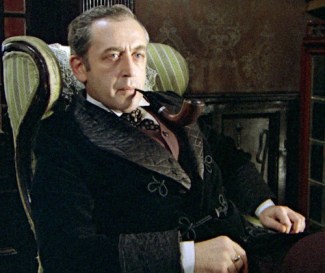 As many a Holmes fan will know, Baskervilles is not the best choice to get a handle on an actor’s interpretation of Holmes. Written by Doyle in the period after he’d killed Holmes off because he was tired of writing him, but before he later brought him back to life (as it were), presumably the author was still a bit bored with his creation, because Holmes disappears for a good chunk of the tale — in this adaptation, cited by many as the most faithful yet made, he’s in roughly the first and last half-hours, leaving a 72-minute stretch in the middle where he doesn’t appear at all. From what we do see of him, Livanov portrays a nicely understated Holmes. Clearly fiercely intelligent, but without the terseness of Cumberbatch’s version or the somewhat-jolly-hockey-sticks take of Rathbone. I’m compelled to get hold of the rest of the series to see what else he had to offer. (Sadly, only Baskervilles has reached UK DVD, but English-friendly imports are available. It’s also been released on Blu-ray, but I believe without English subtitles.)
The weight of the tale falls on Dr Watson, played here by Vitaly Solomin, who starred alongside Livanov in all his adventures. His is an excellent version of the character. Hopefully the Nigel Bruce-inspired image of Watson as a bumbling, useless sidekick has faded now, thanks to a couple of decades of strong interpretations from the likes of Edward Hardwicke, Ian Hart and Martin Freeman, but when this was produced it was presumably still de rigueur. Faithful to the original stories, however, Solomin’s Watson is highly competent; not expert at applying Holmes’ incredible deductive methodology, but nonetheless capable of maintaining an investigation in Holmes’ absence. Whatever Livanov’s merits, I’d happily watch the rest of the adaptations for Solomin’s Watson.
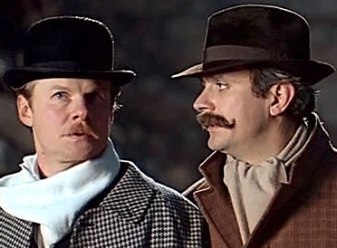 Several other cast members manage to be both faithful to the novel and different to how their characters are usually depicted on screen. For instance, Dr Mortimer is usually played as an older gent, but is quite young in the novel — this is a rare (the only?) instance of that being followed. It’s the first time I’ve seen him played as being a bit shifty and suspicious, too. It benefits the storytelling here, because there really aren’t many suspects — it’s abundantly clear whodunnit, even if you don’t know, because there are no other options! Perhaps most memorable from the supporting cast is “internationally acclaimed actor/director” Nikita Mikhalkov as Henry Baskerville. The role is usually played as young, handsome, keen and brave (in the Rathbone version, Richard Greene even gets top billing in the role, and his incarnation is at the centre of a played-up romantic subplot). Here, Henry is a little older, prone to drinking, readily amused in a larger-than-life fashion, frequently baffled by events, somewhat cowardly, and most often used for comic relief.
There’s certainly a stronger strand of humour than I recall from either the book or any previous adaptation (though I’ve not seen the Peter Cook/Dudley Moore comedy version, which one would hope is funnier), but it’s all texture with Sir Henry rather than a narrative driving force. It also plays down the supernatural or Gothic side of things, which other versions tend to ramp up — the Rathbone film and the 2002 BBC TV movie both insert a seance sequence, even, which works so well that I’d forgotten it wasn’t actually in the novel. It’s a good addition partly for the atmosphere, but also for playing up the sense of community amongst the small band of characters. Here, everyone feels very isolated and rarely seen — there are even scenes where they’re surprised to actually run into one another.  There’s more of an emphasis on people spying on each other suspiciously, which at least is rather appropriate to a murder mystery.
Indeed, I suppose this adaptation plays the story mostly as a detective mystery, if that’s not too obvious a thing to observe. Hound is far from the strongest mystery in the canon, mind, especially as presented here, with the the list of suspects seriously depleted by that absence of community. On the bright side, it makes up for it by having the ultimate revelation seem like proper detective work by Holmes. Normally the reveal hinges on him happening to spot a telling painting, an explanation that is implausible enough even without the element of happenstance. Here, the painting merely suggests a motive and a new line of enquiry to prove that theory. Nonetheless, the final summary contains a goodly number of “I don’t know, Watson”-type answers to dangling motivations/practicalities/etc. Anyone after a solid murder mystery, rather than a detective-led adventure, should look elsewhere.
The film itself is very well made. There’s some gorgeous cinematography by Dmitri Dolinin and Vladimir Ilyin; in particular, the cold morning on which Dr Mortimer examines Sir Charles’ body, mists drifting around some of the village houses, and anything on the moor in evening light, like when Watson finally finds Holmes. Also, just generally, it’s often very filmically shot — a shallow depth of field can pay dividends. The Russian city used as a double for Baker Street and its surroundings doesn’t look the least bit like Victorian London, though in fairness they’ve done their best to hide that, 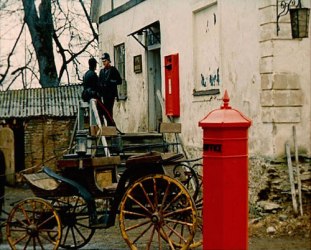 including scattering iconic red VR post boxes around willynilly. The Russian countryside probably doesn’t look very much like Dartmoor either, but its qualities work for the story: very desolate, barren, bare trees, waterlogged dirt tracks for roads, rubble strewn around, the buildings rundown… All very atmospheric for a Gothic horror-tinged mystery, and far superior to the picture-postcard look of some adaptations.
Sonically, Vladimir Dashkevich’s score is succinctly described as quirky, with a main theme that’s very pompously British (apparently based on a familiar piece from the BBC World Service, which the Russian audience would therefore immediately identify with Britishness), but graduating to some quite contemporary riff-y guitar stuff later on.
(Unfortunately, the UK DVD is a little messy. For all the lovely film-ness of much of the PQ, there’s occasionally some nasty video/digital artifacting. Similarly, the subtitles are mostly fine but with sporadic lapses. A few lines are missed, and homophonic substitutions abound: “here” for “hear” (several times), “stake” for “steak”, “to” for “too”, and the second vowel in “Sheldon” changes a few times to boot. Shame.)
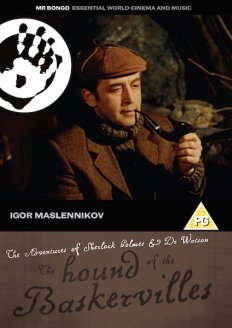 The Hound of the Baskervilles has been filmed far too many times (a quick search of IMDb throws up a couple of dozen versions, for starters), which makes it tricky for any version to stand out from the crowd. This one picks up bonus points for reportedly being the most faithful of them all, backing that up with some strong performances, atmospheric locations and classy direction by the series’ regular helmsman, Igor Maslennikov. It’s not perfect, but then I can’t think of an adaptation of Baskervilles I’ve seen that is. Is it the best Baskervilles? It depends what exactly you want in the mix, but I think you’d have to say it’s a contender.
This review is part of the Russia in Classic Film Blogathon. Be sure to check out the many other fantastic contributions collated by host Movies Silently.

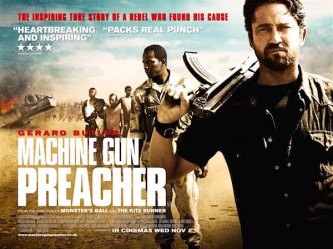 Between the mega-hits of Quantum of Solace and World War Z, Marc Forster directed this poorly-received ultra-flop. It’s based on the true story of Sam Childers (Gerard Butler), a drug-addicted violence-prone biker thug, who finds God, goes legit as a construction worker, travels to war-torn Sudan as part of a Christian mission, and ends up becoming obsessed with trying to save kids there. His old skills begin to come to the fore as he has to battle local militia to protect his work, earning him the titular nickname.
 The problem with the last point is that, in real life, Sam is still over there, still doing the same thing, while conflicts rage on. But this is a film — you need to find some kind of conclusion. The makers have tried, but its an incredibly half-arsed climax; less a resolution to the entire story and more Sam having learnt one lesson from something that went wrong a little earlier.
 mashed together with a polemical charity documentary about Africa, and then with some Rambo action sequences grafted on for good measure. Each of those genres manage to find their own audiences — usually ones so interested in the topic that they’ll switch off any critical filters they may (or may not) possess — but I’m not sure there’s much crossover between them, and the combination certainly doesn’t work for anyone with taste.
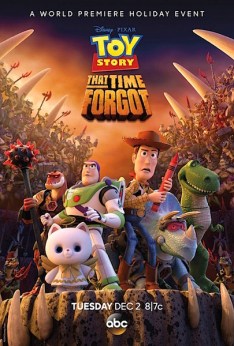 The second Toy Story TV special, and the fifth short adventure for the characters that perhaps should have had their last hurrah in
  The whole thing just feels undercooked. Apparently it took three years to make, with two of those dedicated to development. The Battlesaurs toy line was imagined in full, for example. There’s evidence of that on screen, but it’s just an impression that there’s a lot of background work we’re not getting to see. A TV special gives them limited time to explore the new world they’ve created, of course, but
 If you’ve ever found a late-night train commute dull, this single-location thriller may make you rethink any complaints. Half-a-dozen people travelling from London to Tunbridge Wells find their train speeding out of control. It’s up to them to discover what’s happening and how to stop it.
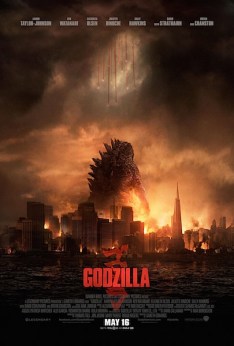 The second attempt at a US re-imagining of Godzilla received mixed reviews last summer, though there can be little doubt that it’s much more successful than the first,
  He’s denying us shots of it not to punish the viewer or to trick us, but literally to tease us, to build excitement and suspense and desire for the final battle. Too many people aren’t used to this — modern blockbusters have trained them for non-stop show-us-all-you’ve-got action from start to finish — and that’s a shame, and their loss, because Edwards’ method is superior to, and ultimately more entertaining than, 95% of other similar blockbusters.
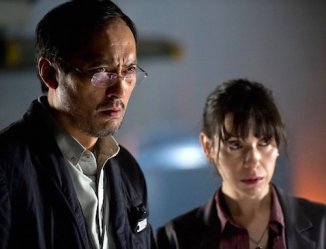 that simply aren’t present in the functional dialogue they have to work with, simply in the way they stand, the way they look at things… It’s not the focus of the film, it’ll pass many people by (indeed, it has), but I think there are some fine performances here. Not awards-winning ones, obviously, but in the hands of lesser actors, they would’ve been so much poorer.
 later, he slips quietly into the bay). Maybe, maybe not, but they always look big — more importantly, they feel big. There are various reasons for this, including Edwards’ shot choices: we often see them from a human perspective on the ground; when we do see wider shots, they’re from suitably far away, or high up, like a helicopter shot (if it were real…) Too many directors shoot their giant monsters with angles and perspectives as if they’re human-sized, which makes them come across as human-sized even when there’s a building next to them, never mind when they’re in places without reference points (coughatsea,PacifcRimcough). Edwards never does this, and it pays off. More than once I regretted that I can never be bothered to go to the cinema any more, because I bet this looked stunning on the big screen (I know I’m certainly
  most present big-budget summer tentpoles. That it got a little lost and under-appreciated in a summer of mega-hits is a real shame — it may not quite match summer 2014’s high points of
 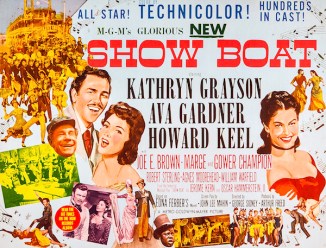 You’d be forgiven for thinking MGM want people to forget this movie even exists: it was dumped on US DVD back in 2000, it’s never had a UK disc release, and a long-rumoured special edition has never emerged. That’s a shame, because there’s a good-quality musical tucked away here.
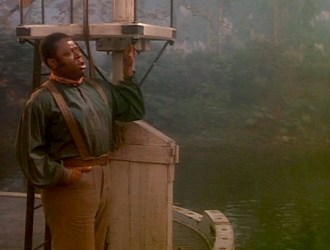 a bit fatalistic for a bright little musical about two people falling in love on a show boat? No, it’s just an indication of where things are going — into darkness, as modern parlance would have it, because from here on out everything goes to pot. To detail the ins and outs would be to spoil the narrative, but much of the film is more tragedy than cheesy Hollywood musical.
 Perhaps it isn’t a film to ease back with on a Sunday afternoon, but not every old film or musical needs to be. If you can get past the opening, Show Boat offers a tough, emotional, perhaps even challenging, view of the world that marks it out as a film deserving of some rediscovery. Can we have that special edition now, please?
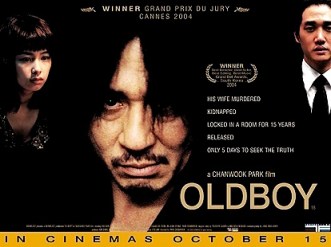 Perpetual drunkard, but also loving husband and father, Oh Dae-su (Min-sik Choi) is snatched off the street and imprisoned in a shabby bedsit without explanation. He learns that his wife has been murdered and he’s being blamed. His daughter lives, but he doesn’t know where. Then, 15 years later, and equally inexplicably, he’s released. He befriends a sushi chef, Mi-do (Hye-jung Gang), before being contacted by Woo-jin (Ji-tae Yoo) who claims to have been his captor. Dae-su is given just five days to discover why he was locked up. If he succeeds, Woo-jin will kill himself; if he fails, he will kill Mi-do. Dae-su’s investigations lead him to dark secrets, shocking revelations, and violent retribution.
 Choi is excellent in the lead role, deserving of all the praise he’s garnered. It’s a highly unusual role with a lot of different and sometimes conflicting facets, but he pulls it all off with aplomb. He maintains a sense of mystery and unknowableness throughout, whilst also being a plausible human being in an implausible situation. As his adversary, Yoo makes for an excellent villain: calm, businesslike, always with the upper hand. The final confrontation is a scene to be savoured, calling to mind everything from James Bond to David Fincher (for me, at least) in terms of the villain’s slick lair and the twisted events that unfold in it.
 In Oldboy’s case, however, so much of what makes it special, unique and exceptional lies in the direction. So do you copy that wholesale? If you do, what’s the point — just watch the original. But if you don’t, what’s the point — you’re losing a large chunk of what’s special. I guess this is why the US version didn’t go down so well — whichever path it took, it was on a hiding to nothing. I look forward to seeing it to judge for myself.
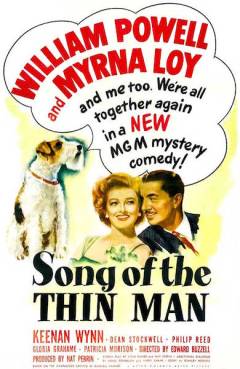 The final film in the Thin Man series sees married detective duo Nick and Nora Charles (the ever-excellent William Powell and Myrna Loy) getting embroiled in the world of jazz musicians, after a friend’s fiancé is accused of murdering a band leader.
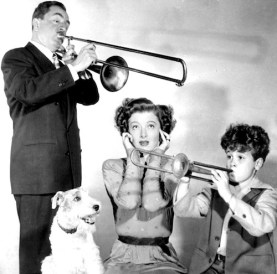 Apparently Loy made it clear before filming began that this was to be the last Thin Man film. Somewhat odd, then, that it’s one of the few to end with an allusion to Nick continuing his detective work in the future, whereas normally he’s being dragged out of retirement each time and happy to return to it by the end (which we don’t believe, of course). Either way, it was probably a wise decision on the part of Mrs Charles, as the law of diminishing returns had kicked in by this point.
 This year’s Best Animated Film Oscar winner is not this year’s best animated film. Not by a long stroke. What it is is one great character, one great emotional plot/subplot, and a lot of stuff that feels like every other big-budget action-orientated CGI animation of the past few years. Most succinctly, this is little more than (as
  The element that is an unequivocal success is Baymax. A soft robot — made of inflated vinyl so as to be genuinely huggable — he’s sweet, funny, and always entertaining. Memorable moments abound, in particular a sequence where his batteries run low, and his interpretation of a fist-bump (a recording booth improvisation by Adsit that was worked into the film). The movie truly comes alive whenever he’s on screen, but conversely loses some magic whenever he’s pushed into the background.
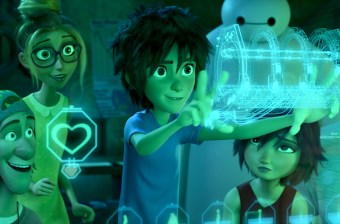 Big Hero 6 is by no means a bad film. It will certainly entertain its target age group, especially if they haven’t seen the other CG spectacles it nabs from. That aside, the entire thing is worth a look purely for Baymax and a few stand out moments — all of them involving the aforementioned vinyl robot, of course. Otherwise, it’s pretty by-the-book. The five-star-level praise it’s attracted in some quarters is completely unwarranted.
 2015 Academy Awards
 Originally titled 12 Years, until
  No one gets in a shocking accident or develops a fatal illness or dies suddenly; no one is seriously bullied or mugged; no one is arrested or imprisoned; no one is made homeless; no one gets pregnant… the list could go on. Every time you second guess that — every time you think, “oh now we’re going to have something big” — the film just rolls on with normality. Just like real life does, in fact.
 Even while Linklater aims for a kind of universality, this is not just about any childhood, but about childhood in the noughties — or as the Americans like to (uglily) call them, “the aughts”. Some have called it “a period film shot now” and there’s a definite truth to that. The noughties-ness isn’t made explicit, but it’s an ever-present factor. The passing of time and issues of the era are conveyed almost exclusively through background details: politics (the Iraq war, the Obama campaign), culture (Harry Potter surfaces multiple times, the best films of summer 2008 are listed), technology (GameBoys, Xboxes, Wiis; CRTs, flatscreens; the ever-evolving iMacs and iPhones), the fashion (haircuts and clothing, particularly when Mason goes all Alternative in his high school years), the music (though the vast majority of it seems pretty obscure, so good luck with finding a grounding through that). It’s those details that ground the film so much in the ’00s and early ’10s, as well as present-day societal factors, like the string of broken marriages, the lack of financial security, the good-natured suspicion and humour with which our sympathetic leads view the Bible-lovers that Mason Sr ends up married in to (can you imagine an American movie about good ol’ family values from a previous era having its leads all but declare themselves atheists?)
 However, it was reportedly shot entirely on 35mm, so something else must explain the changing picture quality. Perhaps that there were two cinematographers, presumably working at different times. However, as I say, during regular viewing the picture shifts are remarkably subtle, there to be spotted by cinephiles and PQ nitpickers, while going unnoticed by the general audience.
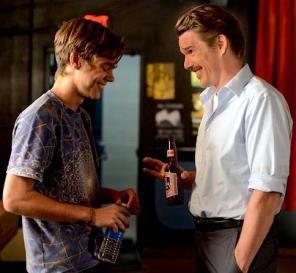 Some will find him irritating as he progresses through his high school years, again in the way the real-life variety of said teenagers are; others will just find it truthful. All of the acting feels incredibly ‘real’, to the point one just assumes it was all improvised. Apparently that’s not the case — according to Hawke, it was all scripted, with the exception of an amusing-with-hindsight scene in which Masons Sr and Jr discuss the potential for a
  If you like your fiction to be about something exceptional or extraordinary, Boyhood is decidedly the opposite. Linklater has put something of the universality of childhood on screen, however. In no way can the life of Mason Jr be interpreted as a median of everyone’s experiences, but that so much within that is so relatable shows that, however different things may appear, there’s an awful lot that’s the same.
 100Films.co.uk