Wallace and Gromit in A Matter of Loaf and Death (2008)

2008 #88a
Nick Park | 29 mins | TV | PG

Wallace and Gromit are phenomenally popular, as proven this Christmas Day when their latest adventure became the most-watched programme on British TV for three years (and that was just the overnights — ratings will rise when official figures are released in a couple of weeks). Not only that, but the TV premiere of their big screen adventure also made the Christmas Day top ten, a not insignificant feat. Popularity does not necessarily mean quality, of course, and in this case such figures come on the back of three popular shorts and a successful feature film. They were all extremely good too and, luckily, A Matter of Loaf and Death doesn’t let the batch down. (I feel there should be a better baking pun there…)

As ever it’s packed with inventive humour, both visual and verbal, and Gromit remains one of the finest silent comedy characters ever created. The amount of emotion and story that can be conveyed with a lump of plasticine is tribute to the abilities of Park and his team of animators. The rest of the creation is top notch too, not just in terms of impressive craft on characters and sets, but also in the use of lighting and camera angles to evoke other films while not losing the series’ individuality. If anyone still thinks stop motion is about a locked-off camera at a flat angle they are sorely mistaken.

Film fans will also delight in a slew of movie references, from a poster for Citizen Canine to an Aliens-inspired climax, and numerous even subtler ones in between. This is a feast that will undoubtedly reward seconds — and more.

If there’s one problem it’s that it’s too short. I don’t mean that in the usual “I just want more” way, but literally that it could perhaps do with being longer. There’s easily a feature-length story here, meaning it feels a little abridged as a half-hour short. It’s not rushed, thankfully, just not played out as effectively as it could be with double the running time.

The last three Wallace & Gromit adventures have each won Park an Oscar (and the first only lost out to Park’s own Creature Comforts). Will this bring the series’ fourth? It would certainly be deserved.

5 out of 5

The Cube Trilogy

Introduction

I watched the entire Cube trilogy in one night — boy was it a long’un.

“Three ninety minute films?”, some of you might think, “I’ve seen single films longer than that!” Yes indeed, this is true, and I’ve watched all of the extended Lord of the Rings in one day — but those are good, and the Cube sequels just aren’t.

Anyway, I’ve posted all three reviews at once — partly because things are lagging review-wise here and I want to get a wriggle on (17 days ’til 2009!) — and so here is a little summary of the trilogy, with a brief note on my thoughts on it as a whole at the end.

This is probably obvious, but in case not: click on each film’s title for the full review.


#83a
Cube
1997 | Vincenzo Natali | 87 mins | DVD | 15 / R

Cube manages to effectively juggle gruesome horror deaths, sci-fi mysteries, an awful lot of maths, and character-based drama. It’s a brilliant, low-budget, understated film [that] everyone interested in the more intelligent end of the sci-fi spectrum should see.”

5 out of 5


#84
Cube²: Hypercube
2002 | Andrzej Sekula | 90 mins | DVD | 15 / R

“The new cube set is bigger, shinier, simpler, emptier, always one plain colour, and devoid of traps. Consequently, but perhaps inadvertently, it seems to symbolise the film itself… Hypercube feels like expensive tosh based on a faux-intellectual idea.”

2 out of 5


#85
Cube Zero
2004 | Ernie Barbarash | 93 mins | DVD | 15 / R

“an entirely different setup: the people who observe the cube!… until one of them goes inside, and then we’re right back in familiar territory… Derivative and, worst of all, quite irritating.”

2 out of 5


Final Thoughts

I first saw Cube many years ago, certainly before it had any sequels, and have always thought it excellent. I picked up the trilogy DVD set a few years back, despite hearing advice that went, roughly, “never ever watch the sequels. Ever.” My God was that good advice.

The first remains a masterpiece, provided you can ignore the two sequels and their weak additions to the mythos. Try to integrate all three into the same fictional universe and you’re just going to wreck much of what’s great about the original. Watch that, love that, and pretend that was all there ever was.

Cube (1997)

2008 #83a
Vincenzo Natali | 87 mins | DVD | 15 / R

CubeI’ve seen Cube a couple of times before, but, as I’ve watched it again immediately before taking on the two heavily-criticised sequels, I thought it might be worth throwing in my opinion on the original too.

Cube has a deceptively simple concept — a sci-fi/horror/mystery in which six strangers are trapped together trying to escape a series of cube-shaped rooms, some of which contain deadly traps — but within that it pulls a lot together. The major element, arguably, is the mystery of what the cube is — where is it, who built it, how does it work, why are those people there, is there a way out? Some of these questions are answered but, crucially, not all of them, and it’s partly due to this, ironically, that it’s a satisfying experience. In its series of careful, measured, necessary reveals, the film strikes a perfect balance between what it lets the viewer know — and the revelations are expertly paced throughout — and what it keeps hidden, either for the viewer to deduce or interpret for themselves, or simply because one doesn’t need to know.

Within the cube and its mystery there are the characters. Depending on your point of view they’re either well-drawn sketches interacting realistically in an unrealistic situation, or archetypes representing different facets of humanity, or simply chess pieces to move the clever construction — of both plot and setting — forward. At times the movie does work like a slasher-horror, picking off characters one by one, but after a few grisly deaths it rather transcends that. The scenes where characters debate and argue aren’t quite as engrossing as when they’re puzzling over the cube, but nor do they drag. Not all the performances are good — Maurice Dean Wint in particular lets the side down for much of the film — but the character arcs are never less than believable and well considered.

Cube manages to effectively juggle gruesome horror deaths, sci-fi mysteries, an awful lot of maths (don’t worry, you don’t need to understand it) and character-based drama. It’s a brilliant low-budget (not that it shows) understated film, which seems to have been somewhat forgotten these days, probably under the weight of the two widely derided and unnecessary follow-ups. But that remains for me to see. Whatever they may be like, everyone interested in the more intelligent end of the sci-fi spectrum should see Cube.

5 out of 5

For a brief overview of the Cube trilogy, please look here.

Casino Royale (2006)

2008 #72a
Martin Campbell | 139 mins | DVD | 12 / PG-13

Casino RoyaleI’ve seen Casino Royale four times in the two years since its release (twice on opening weekend, in fact), which is an unusually high number of viewings for me. Normally I’ll see a film once and, even if I really like it, might not bother again for years; even films I’d name among my most-favourites fall into this category.

The reason I share this upsettingly trivial bit of information about my film watching habits is because, after two years and four viewings, I don’t really have much to say about Casino Royale. It’s a damn fine Bond film, returning to Fleming and resetting the character without losing anything truly essential about the franchise. The action sequences are great because they’re not only exciting but also drive the plot forward and reveal character — when Bond runs through the wall at the building site is a prime example of this.

In Daniel Craig and Eva Green the franchise has probably the best two leads it’s ever had, in terms of acting ability, and they put it to good use. There are many more pitch-perfect things about this film — not least making a poker game engrossing — and, yes, a few flaws, though for me they’re so minor as to not matter; but I don’t feel the need to expound on them a great deal because the film really speaks for itself. And, looking at the UK box office and DVD/Blu-ray sales, I’m not sure there’s anyone who hasn’t seen it.

In summary, Casino Royale is possibly the best Bond film of all time — though when you have a series that has encompassed so many disparate styles (directly compare From Russia With Love to Moonraker and one might even struggle to believe they’re from the same series), it makes for an incredibly hard selection to pick a sole winner from. Still, this one’s up there with the very best, not just of Bond but of action-spy-thrillers in general.

Now, I just wonder what happened next…

5 out of 5

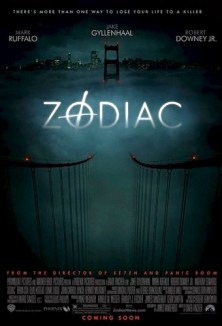
Zodiac (2007)

2008 #64
David Fincher | 151 mins | DVD | 15 / R

Context time: I’m a David Fincher fan. Se7en and Fight Club number among my favourite films of all time; I’ve always found The Game to be an immensely enjoyable thriller; much the same can be said of Panic Room, especially the famous slow motion sequence, which is one of my favourite action scenes ever; and I love The Hire series of short films, which Fincher produced but (sadly) never directed. I’ve never seen Alien³ (or Aliens, or any other entry in that series bar Ridley Scott’s first for that matter), but considering its troubled production history one might say it barely counts. All this considered, why’s it taken me so long to see Zodiac? Well, laziness, to be honest, but I’m here now. And unlike another recently-viewed highly-anticipated film (namely, Southland Tales), this was more than worth the wait.

As other reviews have pointed out, Zodiac is really a film about obsession, and it makes for as engrossing a tale as the case was for those investigating it. In following the story the film chooses to eschew normal structural niceties for fact-following, yet structure is never a problem. Yes, it jumps from character to character, and if you step back and analyse it that’s odd, but while watching it doesn’t matter one jot — this is more like real life than some shallow crime thriller dependent on a twist ending. That level of realism is key throughout, be it the period detail or the exemplary performances — both are excellent and accurate without being showy. Much like Fincher’s direction, in fact, which is appropriately more restrained than usual, though he can still display a suitable level of flair when warranted.

Some have called it slow, even dull, but I was totally engrossed throughout and never overwhelmed by the number of facts being thrown around — and I was watching it in the middle of the night when I should have been asleep. At 5AM, when it finally ended, I was even wishing there was more. (It seems a shame that the recently-released (in the UK) director’s cut adds barely five minutes.) It does exactly what it aims to: it’s not about the killer’s mind and it’s not a whodunnit; it’s about procedure, obsession, and how one deals with an unsolved mystery. The fact it isn’t definitively solved — and yet, for all the characters, there’s a way out or a solution that satisfies them — is possibly the most telling part of the whole film.

After the disappointment of the long-awaited Southland Tales, it’s especially pleasing that the long-awaited Zodiac is such a triumph. It’s easily up there with Fight Club and Se7en, and perhaps even surpasses them both. My most unreserved full marks since Dark City.

5 out of 5

Zodiac placed 2nd on my list of The Ten Best Films I Saw For the First Time in 2008, which can be read in full here.

My more thorough review of the Zodiac: Director’s Cut can now be read here.

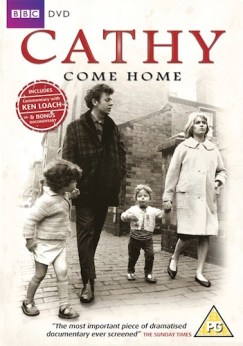
Cathy Come Home (1966)

2008 #59
Ken Loach | 77 mins | DVD | PG

Cathy Come HomeTechnically a one-off TV drama from the BBC’s Wednesday Play strand, Cathy Come Home more than deserves consideration as a film in its own right, due to it being an early work of director Ken Loach, the fact that it’s shot largely on film using relatively experimental storytelling techniques, and also considering the huge social impact it had.

The piece tells the story of Cathy, a young woman who leaves behind a comfortable life for the excitement of the big city. There she falls in love with Reg, who she marries and has children with. But, through a series of incidents and accidents — most of them no fault of their own — Cathy, Reg and the children wind up without a house, and then gradually slide down the scale toward homelessness. In this respect the film can remind us of a facet of the ‘good old days’ that is often overlooked when our collective memory of the ’60s is made up of James Bond, the Beatles, and programmes like Mad Men. The drama also had a big impact at the time: 12 million watched, it boosted the newly-formed charity Shelter, led to debates in parliament, and, eventually, changes to the law.

Loach structures the film cleverly: Cathy and Reg’s slide into poverty is all too believable, while at the same time allowing the viewer to see a cross section of the homeless experience. He employs a documentary style throughout, so effectively that it still fools some into believing the whole piece is factual. In fact there’s a mix of interviews with those really suffering such situations, and performed scenes that are shot and cut disjointedly, as if they were observed rather than written. While some of the performances give the game away, they’re never poor enough to really detract. The downside of this style is that the storyline isn’t always clear. I’m still not sure if it was Cathy’s children that died in the caravan fire or someone else’s, just one among a few such examples. While ambiguity is no bad thing — the cruelly unresolved ending being a case in point — it sometimes just seems like a hole in the narrative. However, these moments are relatively minor, and certainly don’t dint the film’s impact.

Cathy Come Home is a powerful piece of work; an undoubted television classic that (bar a few technically-incongruous studio scenes shot on video) wouldn’t look out of place on a big screen. As an important and timely history lesson, a challenge to prejudices that some of us may hold, and a reminder of how close most of us are to such a fate — especially right now — it remains essential viewing. Sadly, I suspect it always will.

5 out of 5

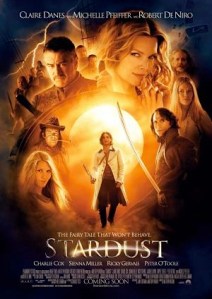
Stardust (2007)

2008 #55
Matthew Vaughn | 122 mins | DVD | PG / PG-13

StardustPerhaps the simplest way to describe Stardust — to a film aficionado, at any rate — is as “the British Princess Bride”. That may do it a disservice however, as this tale of a boy entering a magical realm to find a fallen star is sufficiently its own beast to stand apart from such (admittedly lofty) comparisons, and be much more than a simple rehash with different accents.

Stardust succeeds in numerous ways. The plot is a good mix of fantasy archetypes, fairytale morality, a slight-but-knowing modern filter (thanks primarily to top-and-tail narration from Ian McKellen), humour and action. It rattles along, occasionally running the risk of becoming episodic, but thankfully avoiding it by linking and returning to various episodes. For a British film the effects work is perhaps surprisingly good, with impressive sequences that neither suggest restraint or budget limitations, nor smack of ambitious overreaching by the filmmakers (unlike, for example, the recent Tin Man miniseries).

This sort of fantasy adventure film is a somewhat unexpected choice for co-writer/director Vaughn, who previously produced Lock Stock, Snatch and Mean Machine, and directed Layer Cake, but his direction is neither over-grounded in reality (as you might expect from his background), nor over-done to the point of distraction (as if he were compensating). Instead, he demonstrates an entirely appropriate flair and skill, which promises much for future work.

If you watch a lot of British TV the cast seems star-studded, though even if not there’s the likes of Robert De Niro and Michelle Pfeiffer in major roles. Both are clearly having a whale of a time — as is everyone else, to be fair. De Niro’s role is especially surprising and fun, though to say any more would ruin it. It stands out as one of the best and most memorable elements in a film loaded with them. Charlie Cox is a likeable lead, while Claire Danes’ fallen star is pleasing subversive — you’d expect her to be sweetness and light (literally), but she is in fact amusingly stroppy — and Mark Strong is a perfectly villainous villain. They’re just three further standouts from an almost uniformly excellent ensemble. “Almost” because, sadly, the film’s weakest links are also among the cast. Ricky Gervais plays himself, as ever, almost shattering the well-constructed universe in the process; and Sienna Miller is too bitchy — and, to be frank, too wooden — for us to believe our hero could ever really want her.

But these are minor, easily ignored flaws in what is otherwise a fantastically entertaining fantasy. In fact, in recalling it for this review, it’s just magicked itself an extra star. How very appropriate.

5 out of 5

Stardust placed 4th on my list of The Ten Best Films I Saw For the First Time in 2008, which can be read in full here.

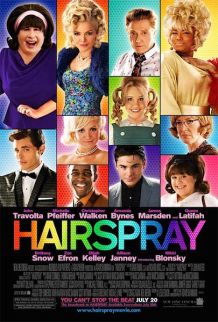
Hairspray (2007)

2008 #53
Adam Shankman | 111 mins | DVD | PG / PG

HairsprayWho’d’ve thought a John Waters film could become a bright and breezy musical? It’s a bit of a surprise but, thanks to a successful Broadway version, that’s exactly what’s happened. But while the key to Hairspray’s success may be its positive attitude and memorable songs, perhaps the key to its quality — and the eventual score of this review — are the issues it tackles around those.

It’s the latter that I found must surprising while watching the film. Everything about its advertising campaign, largely young cast and candy-coloured design suggested Hairspray was a light-as-air feel-good flick — no bad thing, but nothing more than a couple of hours of disposable fun. Pleasantly that’s not the case, as the film tackles head-on issues of racism and other such discrimination, with the ‘beautiful people’ — led by a deliciously bitchy Michelle Pfeiffer — doing their best to keep down those who are in any way different, be they black or, in the case of lead character Tracy Turnblad, fat. The apparently fluffy style of the film in many ways makes it perfect to tackle such issues, showing how they can permeate every area of life, not just Serious Social Dramas, and forces those who would normally avoid the latter type of drama to face up to them. Its ultimately happy ending may be more in keeping with the film’s overriding optimism than with reality, but equally it’s wholly appropriate: the crusade against oppression has to end well here, because if it didn’t the concluding message would be “don’t bother fighting, things won’t change”.

The film’s unwavering optimism is perfectly encapsulated by newcomer Nikki Blonsky, leading the cast as Tracy. She’s instantly and constantly likeable, irrepressibly chirpy and yet not annoying — an impressive feat. Equally remarkably, she’s never overshadowed by the heavyweights who round out the cast; instead, they provide able support. Even John Travolta, disturbingly convincing as a housewife (under a ton of makeup), doesn’t steal the show — he comes close, but Blonsky’s performance holds sway. Elsewhere, Christopher Walken, Queen Latifah, James Marsden and Zac Efron all get catchy songs and have a whale of a time — and, unlike the Ocean’s… sequels, the fun the cast is having is infectious.

The first credit at the close is an unusual one: “Directed and Choreographed by Adam Shankman”. Rather than shirking in either department, the rare combination seems to have helped proceedings: the numbers are all exemplarily executed and the direction doesn’t suffer elsewhere. It’s an indication of the music’s quality that even the three cut songs, which play over the end credits, are pretty good and wouldn’t’ve been out of place in the film itself. The first of these is clearly the actual closing number, though the decision to bump it to the end credits, thereby leaving You Can’t Stop the Beat as the final song of the film proper, was a wise one — it makes for a stronger, catchier, more upbeat finale.

Hairspray is a deft mix of issue-driven drama and colourful musical levity. Catchy, optimistic, uplifting, funny and fun, it may just surprise you.

5 out of 5

Hairspray is on Film4 today, Tuesday 11th November 2014, at 6:45pm.

Hairspray placed 6th on my list of The Ten Best Films I Saw For the First Time in 2008, which can be read in full here.

The Dark Knight: The IMAX Experience (2008)

2008 #48a
Christopher Nolan | 152 mins | IMAX | 12A / PG-13
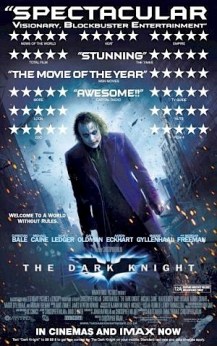
The Dark Knight: The IMAX ExperienceOne of the joys of spending five weeks of this summer in New York is that I have the opportunity to see anything that’s out in the US before the UK early. I haven’t entirely used this to my advantage (no trip to Hellboy II, for example, which has almost left theatres here but is still a few weeks off at home), but I have been to the much-anticipated new Batman movie, The Dark Knight… twice. Unlike in the UK, I have relatively easy access to an IMAX here, and, as any good Bat-fan will know, this means I was not only able to see TDK one week early, but also on the screen it (or, at least, parts of it) were specially shot for. Of course, despite the film virtually being on loop at Manhattan’s sole IMAX screen, the high demand for tickets means I had to wait til the second Saturday to see it writ so large — and even then I was fairly lucky, as some showings sold out inside of two hours.

As I’ve reviewed the film before, and my feelings on it have barely changed with a second viewing just one week later, it seems sensible to focus on the IMAX aspect. For those who somehow missed the news, The Dark Knight is the first Hollywood blockbuster to be specially shot for IMAX — not all of it, but six key sequences… or so they say. From what I could tell, while some whole sequences were indeed shot on IMAX film, often it was used just for bits of scenes, or now and then for the more dramatic establishing shots. For example, every aerial shot in the film — and, as those who’ve seen it will know, there are a fair few — appears to have been shot with IMAX cameras. The choice of sequences to shoot on IMAX is also intriguing. Some reviewers asserted it was “obvious” scenes were IMAXed even on a 35mm print, but I think they might be in for a surprise. Yes, the bank robbery opening, the car chase, and elements of the climax all receive the IMAX treatment, but elsewhere smaller scale action sequences and even some dramatic scenes are awarded the vision-filling honour.

It all looks stunning, of course: the resolution is visibly increased whenever the IMAX film kicks in (the rest of the film, blown-up from 35mm, is blurry and grainy by comparison but still doesn’t come out too badly) and the added size and scope of the format serve to underline the scenes for which it’s employed. While most of them are worthy, if sometimes unexpected, there are times when one wonders if scenes were picked just to make up the numbers with something not especially challenging. That said, it’s always nice to see, so one can’t complain too much. I didn’t find IMAX to be an especially viewer-friendly format for a two-and-a-half-hour feature though — it’s designed to fill your vision, an aim it achieves admirably, but when trying to watch a regular movie it entails an unusual amount of head turning, as well as trying very hard to notice everything right into the depths of your peripheral vision. It was certainly an experience, as the advertising subtitle suggests, but it won’t be for everyone and I’m not sure I’d bother again without some notable incentive (such as the one Dark Knight offers — none of these new-fangled 3D films have been interesting enough to tempt me yet). In some respects, what interests me most is what debates and opinions the use of IMAX will provoke about the film’s correct aspect ratio when it comes to DVD/Blu-ray time. I don’t care to predict what people will say, but I suspect it will be amusing to observe.

One final note: watching this just one week after I first saw it in a normal cinema (one week & one hour, to be exact!), it seemed to me that the odd shot was trimmed slightly or actually missing. Quite why this would be I don’t know, and it may just be my memory playing tricks, especially as the running time listed on the BBFC is actually slightly longer for the IMAX version (as seems to be standard, from a quick look at a few other IMAXed films — I’m sure someone knows why). The differences — if indeed there are any — are minor, but I felt I should mention it.

There’s no questioning The Dark Knight‘s brilliance in its own right, in my mind — it may be questionable whether it’s the Best Film Ever (surprisingly, it still sits at #1 on the IMDb Top 250), but at the same time I genuinely enjoyed this more than any other film I’ve seen from that top ten (and probably beyond). Whatever size screen you see it on, this film is an amazing experience — but some of it was shot especially for IMAX and those bits do look spectacular on the extra-huge screen. If you have the chance, this is really how Dark Knight should be seen — especially as it’s always possible that you won’t have the chance again.

5 out of 5

As if two reviews wasn’t enough, I shared more of my thoughts on The Dark Knight (this time when considered next to Batman Begins) here.

On the off chance anyone’s wondering what happened to #48, it’s WALL-E and the review’s on its way. But I’ve been sat on this one for a week (and not got round to the WALL-E one for over a week!), so I thought I’d just get on and post this, sequence be damned.

Presto (2008)

2008 #47b
Doug Sweetland | 5 mins | cinema | U / G

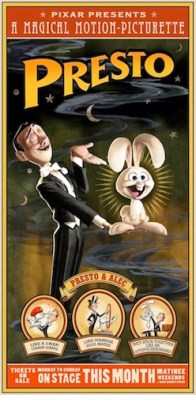
PrestoThe last Pixar film I bothered to head to the cinema for was 1999’s Toy Story 2, back in the days before “it’s made by Pixar” was reason enough to see a film (remember those times? They seem so long ago…) Their only other releases had been the first Toy Story (my enjoyment of which being the motivation to see the sequel) and the unappealing A Bug’s Life. Since then I haven’t had enough desire to expend the effort — or the money — to catch any of their films on the big screen. I explain this because, I’m reliably informed, all Pixar films are preceded by a short while in cinemas… but, because I’ve only seen most of them on DVD, I forgot this, so was initially surprised to see a caged rabbit when I was expecting an adorable little robot.

This rabbit, it turns out, is called Alec, and he’s a bit of a bastard. I think we’re supposed to root for him, and I’m sure kids (and many adults too) will, but while his owner (the titular magician) isn’t especially nice to our starring bunny (the plot is concerned with Alec trying to get a carrot that Presto won’t give him, yet), Presto doesn’t treat Alec quite as badly as Alec treats Presto. On the other hand, the overload of OTT physical violence is all in the name of humour, so that’s OK. It’s not as satirically extreme as The SimpsonsItchy & Scratchy though, which will ironically lead some to declare it promotes violence as comical. But then such ludicrousness is political correctness for you — in fact, Presto‘s brand of violence is very funny indeed. Completely dialogue free, it quickly becomes a breakneck feast of visual, mostly slapstick, humour. It may be violent, but it’s also highly witty, marvelously inventive, and wholly entertaining… even if the hero is morally dubious. But then, Roadrunner was a total wanker and he always won.

You can’t judge shorts on the same level as features, because they’re a different form — that’s why I don’t include them in the main numbering on this blog, and why I once felt the need to go on about that. So while awarding Presto a full five stars doesn’t mean it’s likely to be vying with The Dark Knight or… well, The Dark Knight… for my Film of the Year, it is thoroughly deserved. It’s a perfectly entertaining piece of short comedy, and it’s great that Pixar continues to facilitate wide exposure for such work.

5 out of 5