In the run up to the release of The Dark Knight Rises I’ve been re-watching all of the modern-era live-action Batman films. I haven’t watched any of them since 2006, well before The Dark Knight was released and only shortly after Batman Begins had signalled a new direction for the Bat-franchise. I think everyone’s view of Batman on film has changed considerably in the last six years, so it’s quite an interesting context to be viewing them in.
I’ve decided not to provide full-length reviews because, quite frankly, I can’t be bothered (I’m 47 behind for pity’s sake!); but because I’ve been having New Thoughts, I thought I’d share a few below. Plus a score, because these are really reviews nonetheless. (I’d give them each their own page, but I don’t want to swamp you yet again, dear treasured email subscribers.) I know I’ve reviewed The Dark Knight twice already, and I didn’t especially want to get into the habit of reviewing it every time I watch it, but I’ve made a couple of quick observations on it in this context.
And with that said…
Batman
2012 #54a
1989 | Tim Burton | 126 mins | Blu-ray | 1.85:1 | UK & USA / English | 15 / PG-13
 It’s important to re-emphasise what I just said: that this Bat-retrospective was provoked by my realisation that I hadn’t watched these films for six years, since a time when Begins was the pretty-successful new kid on the block. To an extent the changed perspective brought about by the events of the last six years (primarily, The Dark Knight, and (I perceive) a boost in acclaim for Begins by association) colours how we see all of these films now, but I think none more so than this first.
This used to be the dark and serious take on superheroes, treating them in a more grown-up fashion. In the wake of memories of the camp ’60s Batman and the colourful, optimistic Superman film series, that’s certainly what it is. Watched today, it looks positively comic book-y. Sure, it’s a bit grown-up — there’s elements of psychology and adult relationships, not just Boy’s Own Adventure — but the level of heightened reality and camp… it’s nothing like comic book adaptations now. I honestly can’t think of anything made in the current wave of superhero movies that has this tone.
Also, you forget just how true it was that the earlier Batman films focussed more on the villains than the hero. Batman’s in the first scene, but that’s it for a while, and it takes Bruce Wayne ages to appear; when he does, he barely speaks and the scenes aren’t really about him. The story instead follows Jack Napier/the Joker and a pair of journalists, primarily Vicki Vale, though (again) I think it’s easy to forget how prominent her partner (Alexander Knox, played by Robert Wuhl) is. The film puts a little more emphasis on Wayne/Batman later on, but for a hefty chunk it’s not really about him at all. You can really see why Nolan & co thought that was a seam waiting to be tapped when it came to Begins.
Batman feels dated today. I know it’s 23 years old, but it really feels it, in a way the next few films just don’t. There’s still a lot to like here, but it doesn’t impress me in the way it used to when I was younger. It still retains huge nostalgia value at least. Perhaps, with the scales now fallen from my eyes, when I next come to watch it (whenever that may be) I’ll enjoy it more again.
P.S. The first three Batman films have a chequered rating history, but Batman has perhaps the least explicable. Rated a 12 in cinemas in 1989, it’s consistently been given a 15 for home video. since 1990. The first two times it was classified (in 1990 and then 1992) this would’ve been because the 12 certificate wasn’t available for video, but why it wasn’t downgraded to a 12 in 2004, God only knows. It certainly feels like a 12.
Batman Returns
2012 #54b
1992 | Tim Burton | 126 mins | Blu-ray | 1.85:1 | UK & USA / English | 15 / PG-13
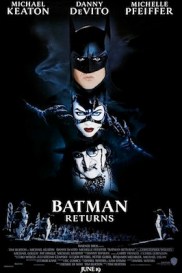 Tim Burton’s first Batman film is great, no doubt, but Returns is a much better film in so many ways. The direction, writing, acting, action and effects are all slicker. They spent over twice as much money on it and it really shows. Plus they have exactly the same running time (to the very minute), but Batman feels surprisingly small scale and Returns feels epic. Watched today, Batman feels Old, whereas Returns… it’s from ’92 so of course it doesn’t feel New — but it feels more like newer films, in a good way.
Some criticise it for being too dark. Well, it is and it isn’t — there’s a lot of black humour in there. I think it works as a tonal whole — it’s not one-note, but it doesn’t swing wildly around either. What’s wrong with a film having a dark tone? Should every blockbuster pitch for exactly the same light-but-not-too-light area? Because they went for that in Forever and it didn’t go down as well.
And that’s related to another thing — some people criticise it for being a Tim Burton film rather than a Batman film, as if that’s a bad or even valid thing. It’s directed by Tim Burton and you don’t expect a Tim Burton film? I’d rather have a director who puts his own stamp on the material than a hired hand who churns out something generic. What’s the point in hiring someone good if they can’t bring their own influence? You don’t think the current films are as influenced by Nolan’s sensibilities as anything else? Look at his personally-authored Inception and tell me that’s in a vastly different style. Then look at Burton’s Planet of the Apes and see what happens when an individualist director is forced into a studio style. Bad things happen, that’s what.
These are meant to be short reviews so I won’t go on about all of Returns’ plus points, but oh my are they many. This is easily the franchise’s best effort until at least Begins, arguably even until Dark Knight; and for those who prefer their Batman less grounded and more fantastical, it could well be the best of all.
P.S. Believe it or not (and some will know this and so believe it, but I didn’t until now), Returns is only uncut in the UK as of 2009! Back when the SE DVDs were classified in 2005 it was still cut by seven seconds for “imitable techniques”, and then got a 12. I don’t know if an uncut 15 was offered then, but that’s what it has now.
Batman Forever
2012 #56a
1995 | Joel Schumacher | 122 mins | Blu-ray | 1.85:1 | UK & USA / English | 12 / PG-13
 Four observations I personally hadn’t made before:
1) everyone goes on about how the pre-Begins Batman films dealt with the villains and ignored Bruce Wayne. That’s true of Burton’s pair, but this one spends a ton of time with Bruce (a lot of that’s about Robin, but it’s about Robin in relation to Bruce). The one who’s hard done by is Harvey Dent/Two-Face, who gets relatively little screen time and most of it is spent as a cackling halfwit sidekick to the Riddler. Not befitting the character at all.
But 2) talking of Two-Face, wow does Tommy Lee Jones over-act furiously! Perhaps that’s not news, but crikey it’s so unlike anything else I’ve ever seen him in.
And 3) I swear Elliot Goldenthal’s score referenced the music of the ’60s Adam West series on several occasions. Which, considering the overall tone of the film, feels entirely possible. (I watched the featurette on the BD about the music but they didn’t mention it, sadly.)
Finally, 4) I was aware they’d completely re-edited the first act to put an action scene up front (and get a lower certificate in the US after all the furore that accompanied Returns), but I wasn’t aware of all the casualties. At one point Batman and Two-Face engage in a car chase that happens for no good reason; in the original cut, Two-Face & co ambush Batman on his way back from attending a Bat-signal call. That at least makes some sense, whereas in the film as-is he seems to go out simply for the purpose of having a chase, then goes home.
Batman & Robin
2012 #56b
1997 | Joel Schumacher | 125 mins | Blu-ray | 1.85:1 | UK & USA / English | PG / PG-13
 Believe it or not, Batman & Robin isn’t a complete disaster. Don’t get me wrong, I’m not about to mount a defence of the film — it is mostly awful. But only “mostly”.
Relatively significant screen time is given to a subplot involving Alfred being very ill. Thanks to the general warmth of feeling felt toward the character, plus the acting abilities of Michael Gough and George Clooney (who is severely untested by the rest of the movie), this storyline deserves to be part of a far better film.
Also, the realisation of Gotham is impressive. Mixing gigantic sets, model work and CGI, Schumacher and co crafted a towering fantasy landscape straight out of the comic’s wilder imaginings. The neon colouring may not be to the taste of those who prefer Burton’s darkly Gothic interpretation or Nolan’s real-world metropolis (if forced to choose, I’d be among them), but this is an animated-series-style Gotham writ in live-action, and judged as that it’s a resounding success.
The rest of the film is an irredeemable mess, however. Characters speak almost exclusively in one-liners centred on dodgy puns, and even when it’s not a one-liner it’s delivered as if it is. Schwarzenegger is the worst culprit for this, but Uma Thurman overacts horrendously also. She’s defeated by being kicked into her chair, just another of the script’s multitudinous stupidities. Her origin is a weak rip-off of Returns’ take on Catwoman; Bane is reduced to a monosyllabic idiot (at one point he has to plant a series of explosives, grunting the word “bomb” every time he puts one down); Barbara ‘borrows’ a bike from Bruce’s collection and, thanks to editing, appears not to return it for about two days without anyone noticing; and so on. I know they were aiming a little more in the direction of the camp ’60s TV series, but even if you allow for that it just doesn’t pull it off (and I gave the ’60s movie 4 stars, so I believe it can it done).
The “toyetic” approach (i.e. focusing more on the tie-in merchandise that could be generated than the story, etc) results in a foul new look for the Batmobile (though the DVD featurette on the film’s vehicles almost makes you appreciate it — the behind-the-scenes version is much more impressive than what we see in the film) and, famously, the heroes arriving at the climax in new costumes with absolutely no explanation! All it needed was them returning to the Batcave, “we better put on our ice-suits”, something like that. Heck, it would’ve allowed Schumacher to indulge in his suiting-up T&A shots one more time. But no, they just magically change into nastily-designed toy-ready outfits. Ugh.
There is ever so much to hate about Batman & Robin that even the really-quite-well-done Alfred plot can’t prevent me from placing it with the lowest of the low at a single star.
Batman Begins
2012 #56c
2005 | Christopher Nolan | 140 mins | Blu-ray | 2.35:1 | UK & USA / English | 12 / PG-13
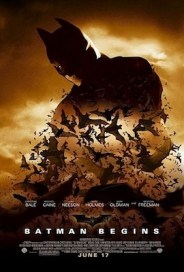 Chris Nolan’s first foray into Bat-world really is a stunning piece of work in many respects. It’s a film with the confidence in its story to take its time and do things its own way. The first 40 or so minutes jump back and forth constantly between Bruce Wayne’s childhood around the time of his parents’ murder, his college-ish days when he runs away around the world, and his present day training with the League of Shadows. But, as is Nolan’s trademark, this mixed-up chronology is never confusing, never unclear, and always serves a point.
Then there’s the fact that Batman himself doesn’t turn up for a whole hour. That’s nearly half the film. But that’s fine — we’re not left wanting, it’s just the right time for him to emerge. When he does, the film becomes suitably action-packed and drives its plot on. Until that point, we’ve had such a thorough basing in the world of Gotham City and the mental character of Bruce Wayne that it seems plausible he’d choose to fight crime by dressing up as a bat.
The Nolan Batman films have become known as the ‘real world’ superhero movies, but of course what we see depicted isn’t the real world, and things wouldn’t happen like this in real life. But it’s the way Begins identifies itself with other movies that creates that feeling. The previous Batman films occur in the exaggerated world of Superman and other superhero fantasy movies; here we’re in an exaggerated world more like James Bond, say, or indeed any other technology-driven action-thriller you choose. It’s not our real world, but it’s the real world of that genre; one closer to our own than the dark fantasy of Burton’s films or the dayglo cartoon of Schumacher’s.
There’s much more that could be said about Begins and naturally I’m limiting myself here (this is meant to be a short comment, after all), but it’s important to note what a fine job Nolan does of making Gotham City a character in the film. All of the Batman films have done this to some degree — it was Burton’s stated aim to make Gotham “the third character” in his first effort — but by giving the city recognisable landmarks, districts, a true sense of history and on-going interrelations, it feels like a real place. And those recognisable landmarks continue into The Dark Knight (particularly spottable are the split-level roads, the Narrows and its bridges, even if the vital-to-this-film’s-plot elevated railway completely disappears between films), cementing the importance of this cityscape. I do hope it continues into Dark Knight Rises. I’ve already read one review that said they should’ve named the final film Gotham City, so I’m optimistic.
The monumental achievement of The Dark Knight has come to overshadow Begins, which is now rendered as a functionary prequel to the next film’s majesty. Don’t let that reputation fool you: on its own merits, this is very much a film at the forefront of the action-adventure, blockbuster and superhero genres.
The Dark Knight
as 2012 #56d
2008 | Christopher Nolan | 152 mins | Blu-ray | 2.35:1 | UK & USA / English | 12 / PG-13
 I was, oddly, a little nervous sitting down to watch TDK for the first time in four years. I’d had such an incredible experience viewing it in the cinema (twice) and, by not watching it since, it had built up some kind of aura in my mind. But I dismissed such silliness and damn well got on with it.
Thank goodness, it’s a film good enough to stand up to such memories. That’s the main thing I wanted to add, I suppose, because everything I had to say in my earlier reviews still stands. The IMAX sequences look almost as incredible on Blu-ray as they did in the theatre (as much as they ever could), but I’m sure you knew that.
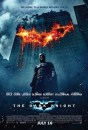
What’s interesting is watching this directly after Begins. While Nolan’s first film isn’t even close to being as all-out fantasy as the earlier entries, it errs more in that direction than this one, in my opinion. Begins has a kind of fantastical warmth to it, alongside the more urban-realism aspects. I say “warmth” probably because of the sepia/brown hues of the sequences set in the Narrows and so on. The Dark Knight, by comparison, is set in the cold grey-blue steel world of skyscrapers and the modern metropolis, inspired by towering architecture in its visual style and by epic crime-thrillers in its plotting. Compare the two posters I’ve used here for the gist of what I’m driving at.
Begins is, at heart, still a superhero action-adventure; Dark Knight is a crime thriller that happens to take place in a world with superheroes. Does that make it inherently better? No. But it does make it more unusual for the genre. And as Nolan & co pull off the crime thriller style and feel so damn well, it flat out makes it a great film.
The star rating, of course, stays the same.
In case you missed the links above, my two previous Dark Knight reviews can be read here and here.
And that’s it for the Batman films… so far. Because at the exact time this set of reviews is posted, I should be sat in a large darkened room with a number of other people, about to embark on the concluding chapter of Nolan’s Dark Knight trilogy. I imagine later today or tonight I’ll have some initial thoughts on that one too.

 Bill Cunningham is 80. He lives in a small rent-controlled apartment in New York City that is filled with filing cabinets. His bed is little more than a mattress on some boxes. Each day, he dresses in the same distinctively simple blue smock and sets out on his bicycle. He eats at the same places each day; simple cheap food, cheap coffee. He doesn’t have a partner or kids; he may never have had a romantic relationship. He doesn’t watch TV or listen to music. It sounds like some kind of life of poverty or religious devotion. It’s neither, although you could make an argument for the latter, because all Bill does all day is photograph what people wear.
 Bill is, technically, a fashion and society photographer. His real passion, however, is clothes. Real clothes. The clothes people actually wear and how they wear them. His newspaper column — a collection of photos from the streets — is essential reading as far up the chain as Anna Wintour. He doesn’t set trends, he observes them. Exposes them, you might say, because in the past he’s used his work to call fashion designers on where they’ve copied (consciously or not) the work of another from years before, and that has sparked arguments.
 What he actually is, more than a “fashion photographer”, is a documentarian, recording how people choose to present themselves to the world, both as individuals and how that translates en masse. Fashion may seem like a meaningless, arbitrary, frivolous thing to afford such time to, and I’d have no argument against Fashion being called exactly that. But fashion — the actual clothes we wear in our actual lives — is something a good many people spend a good amount of time obsessing over; it’s how they choose to represent themselves in the world, how they indicate what they’re like as a person, how they show which groups or types of people they align with. We all do it, even if it’s not a conscious choice. Surely that’s worth recording?
 But that’s all an aside, probably because it’s so well done. What might be worth picking up on is that there’s no specific story. There are stories in there — like how Carnegie Hall is kicking out its handful of 80- and 90-something resident artists to make way for more office space — but the film doesn’t have an overarching tale. It’s a portrait; one of a fascinating, unusual, but likeable, and certainly unique, individual.
 After decades telling tales from the Second World War, Spielberg moves back a conflict. That said, the BD’s special features make sure to point out this “is not his First World War movie” — it’s just a good tale about a boy and his horse.
 It can’t be denied that there’s factual inaccuracy here (the climax takes place at the Somme in the lead up to Armistice Day in 1918, but that battle was actually fought in 1916), or the occasional heavy dose of sentimentality (it’s directed by Spielberg and co-penned by Richard Curtis — what did you expect?), but I think it carries through these with a scale and heart that is, primarily, entertaining. It is based on a children’s novel and I think aims to be a family film (it should by rights be a PG; my twitter rant on that subject is
  Aiding the sense of the epic is Janusz Kaminski’s cinematography, which is regularly stunning and definitely one of the film’s standout achievements. The beauty of some shots is immediately obvious — he lenses the countryside idyll of Dartmoor in a sweeping fashion, bathed in summer sunlight — but there are striking compositions to be found throughout, be they in close-ups, cavalry charges, horse auctions, battlefield hospitals… There’s often a lovely texture to things too, from the likes of drifting snow or chaff, or the way light streaks across a room. The final scene, fully tinted orange, calls to mind the likes of
  one that isn’t afraid to depict some of the nastier realities of the world, but in a way that makes them relatable for a younger audience. I think that’s important; but this isn’t a Worthy Film for that, it’s just something it does well. I think it also nails sensations of adventure and, yes, sentimentality.
 There are a few Oscar nominees from the ’00s that inspire little desire in me to bother seeing them (I’m certain that’s completely true of every era, but I’ve seen most of the ’00s nominees so I tend to focus on them more often), meaning it’s taking me a very long time to get round to them (maybe I never will). Master and Commander isn’t really one of those — it’s no
 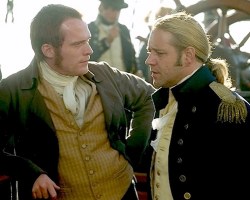 he’s not a naval man and doesn’t always understand their traditions. He’s not a crass audience-cipher in the way such parts often can be, but it does make him identifiable.
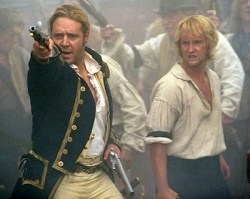 (that makes for a strangely bizarre array of company logos at the start). Despite the fact it’s based on a series of 20 (completed) books, and various people involved have mentioned the possibility down the years, a sequel is so unlikely it seems silly calling it just “unlikely”. And that’s a shame, because this is an entertaining action-drama with likeable characters and an engrossing atmosphere. A little to my surprise, I loved it.



 I made sure to see
 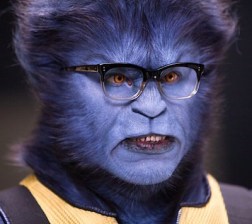 It was blurry, the sound was muffly. I saw a clip in a summer movies trailer just a few days later when I saw
  but that’s fine because here they’re just supporting characters. This is the story of two other young men, Xavier and Lehnsherr, aka Professor X and Magneto.
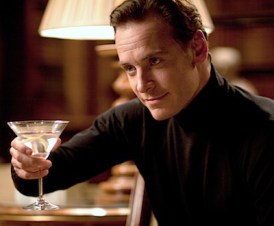 the flipside to the Xavier-Lehnsherr relationship working better, if you will. There’s also Kevin Bacon, playing his second superhero villain in as many years, who does sterling work as a former Nazi seeking world domination — remember the ’60s, when world domination was a valid aim for a villain? There’s more than a little Bond in the mix here.
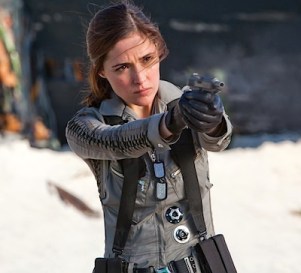 than a superhero movie in many ways — and when it tries to introduce an X-Men team made up of second-string leftover characters it loses its way slightly. But balance is everything with ensemble casts like this, and watching the film again gives a better perspective on its pace and its actual balance. First time through these things are distorted because you don’t know how far through the story you are, how long’s left, how long each scene will last, and so on; a second time, with an idea of where it’s going and so forth, you can better appreciate how it’s all actually weighed up, and I think First Class achieves a balance better than most have given it credit for.
 It’s a complete non-issue for non-fans, and the same for any open-minded fans who realise they’re not trying to faithfully bring the X-Men canon to the big screen. Earlier films should already have shattered that illusion anyway.
 After seeing First Class in the cinema I thought to myself that, while I would dearly love to give it a full five stars, in all good conscience I couldn’t; for whatever reason, it didn’t quite come together enough. Watching it again on Blu-ray, however, I’ve completely changed my mind: I wouldn’t change a thing. All my anticipation is more than paid off — I love this movie.
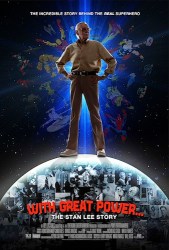 Stan “The Man” Lee is indeed The Man when it comes to the world of comic books. In the 1960s he revolutionised the medium in the US, introducing complex and realistic characters to a world that had previously focused on perfect super-humans like Superman, Batman and Captain America. In a period of just two years he co-created the Fantastic Four, Hulk, Spider-Man, Thor, Iron Man and the X-Men, and after that rejuvenated Captain America (cancelled a decade earlier) for a modern audience. If there’s anyone in the comic world deserving of a dedicated feature-length documentary, it’s Stan Lee.
 both in his Marvel heyday in the ’60s as well as before and since. It also really digs in to his personal life at time, getting very emotional. That Lee and his family appear and tell these tales mean it doesn’t feel intrusive.
  If
If 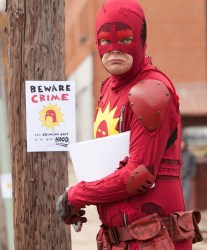 which moves fairly swiftly into the fantasy of being a successful superhero, Super stays quite grounded. The ending allows itself to be a little more triumphantly heroic, but not far beyond the bounds of realism (unlike Kick-Ass).
 really, they are deciding something is right and something else is wrong”. The psychology of superheroes has been a factor to one degree or another for decades now, not least the Batman films making the parallel between the hero and his villains, but the difference in Super is it’s not a parallel — it’s primarily the heroes who are messed up. The villains are criminals and quite nasty at times, but they’re mostly quite normal. They may deserve their comeuppance, but wisely — and interestingly — they’re not over-written or over-played to heighten them to the level of the psycho-hero. The Crimson Bolt is a sledgehammer to crack a nut, even more so than Batman in
 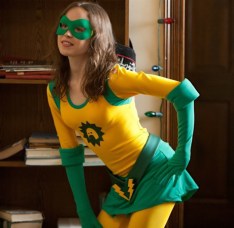 Super is about a troubled human being and his relationship with faith, morality and what he perceives as his calling… I think that is part of why we gave him Ellen Page as a sidekick — because her character, Boltie, actually is insane. The Crimson Bolt is not doing what he does because he enjoys hurting people but Boltie is and that is the difference between the two of them. It starts to become a concern when you enjoy the violence.”
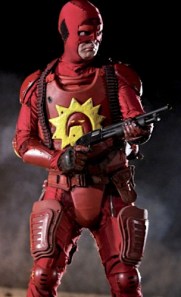 For all its grounded reality, Super lets loose in the final fifteen minutes, creating a punch-packing sequence that’s the rival of any comic book movie. It’s emotionally-charged action, all the more powerful for its semi-amateur-ness and realistic brutality. It climaxes in a face-to-face between our hero and the villain which is as good as any you’ll find in such a film. Is it revelling in the extremity of its violence? You might argue it is, but I don’t think it’s celebrating its gore so much as the triumph of its hero. And that’s followed by a neat epilogue, which I won’t reveal details of but is a kind of ending I’ve been wanting to see for a while.
 a decade-old track by Sweden’s 2007 Eurovision entry (they came 18th of 24. Don’t laugh — we were joint 22nd). And, despite the low budget, there’s great special effects. The tentacles are the rival of any big-budget movie; the blood and guts are all gruesomely realistic, not filmicly censored or reduced or cheaply fake; handdrawn-style Batman “kapow”s (etc) are very effective. The title sequence, in a similar style as the latter, but with a dance routine, is also a ton of fun.
 “I think that so many movies today try to be everything to all people and I’m a little sick of it. Super is not for everyone. It is for some people.” And for the people it’s for, I think it’s exceptional. If you were to compile a list of the greatest superhero movies, I believe Super’s unique style and perspective — plus its excellent climax — would earn itself a place right near the top.

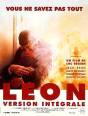 Léon is one of my favourite films. I’ve loved it since a friend lent me the VHS at some point in secondary school. And that’s why, though the extended Version Intégrale was different enough to merit inclusion on the main list (it’s some 23 minutes (21%) longer), I would feel uncomfortable including it in a list culled from new films I’ve seen in the past five years. But it’s still one of my all-time favourites.

 After a couple of decades, Ridley Scott was finally able to realise his ideal Blade Runner. Some prefer the 1992 Director’s Cut; some even like the largely-ignored original release; but, unlike his


 10)
10)  9)
9)  8)
8)  7)
7)  6)
6)  5)
5)  4)
4)  3)
3)  2)
2)  1)
1)  the last perfect score I handed out was in September, and before that July. Anyway, those in the top ten were Easy Virtue, Let the Right One In, Lupin the Third: The Castle of Cagliostro, Monsters, My Neighbour Totoro, The Social Network, Super and X-Men: First Class. From the handful that missed out, The Three Musketeers was also a five-star-er. The remaining eight were
  The Adjustment Bureau
 Conan the Barbarian
 Gnomeo & Juliet
 The Help
 Melancholia
 Real Steel
 The Three Musketeers
 100Films.co.uk