2012 #86
Sam Mendes | 143 mins | cinema | 2.35:1 | UK & USA / English | 12A / PG-13
 Oh Skyfall, how the world loves thee, let me count the ways!
It’s the highest-grossing film in British cinema history, passing a raft of long-running hits (Titanic, Mamma Mia) and 3D-boosted mega-blockbusters (Harry Potter and the Deathly Hallows: Part 2, Toy Story 3) in the process. Previous title-holder Avatar had the double whammy of 3D curiosity and a long cinema run, but it still took a total of 11 months to reach a final tally of £94m. Skyfall passed that in 40 days… and then kept going. As of December 16th, it had reached about £98m in its home market.
In the US, it has to date taken nearly $280m, leaving the previous most-successful Bond far in its wake: that was Quantum of Solace, which ‘only’ grossed $168m. Worldwide, it is approaching $1bn, which would make it one of only 14 films to pass that marker. That, again, puts it well ahead of the franchise’s previous best, which was Casino Royale’s $599m. It hasn’t even opened in China yet, which analysts predict is what will push it over the $1bn mark.
Finally, it’s passed Spider-Man 3 to become Sony Pictures’ highest grossing movie of all time worldwide, and overcome The Amazing Spider-Man to be their highest grosser in the US alone. Even with The Hobbit Part 1 recently commencing its box office campaign, Skyfall should wind up in the US top five for the year (depending how you count these things, possibly top four) and the worldwide top three. Bond films always do well, especially in the non-US marketplace, but by any yardstick this is a mega-hit beyond Bond’s usual proportions.
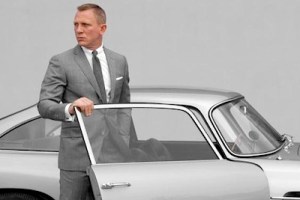 So, in short, people love it. But people don’t matter — I matter (well, I do to me), and what did I think?
Yeah, I bloody loved it too.
I had been intending to write a sort-of commentary on Skyfall, talking through my opinion of the film on a… if not scene-by-scene, then segment-by-segment basis. But then I thought time had grown and I was a bit too distant to write such a thing now. And then I sat down and it happened anyway. So what follows is a 4,400 word (yes, really) natter through the film in broadly chronological order, but taking asides to discuss particular elements in their entirety whenever I get to them.
It contains whopping great spoilers about almost everything, just in case you hadn’t guessed. (My much shorter spoiler-free review is here.)
Have fun.
The film begins (as you’re no doubt aware, because who hasn’t seen it?) without the famous gun barrel. An unforgivable move in the 50th anniversary year/film, surely? I felt so at first, but the opening shot Mendes has chosen — Bond appearing at the end of a corridor and walking into focus — is a good one, and would clash with the famous beginning. Besides, as we’ll see later, they have managed to do something good with it…
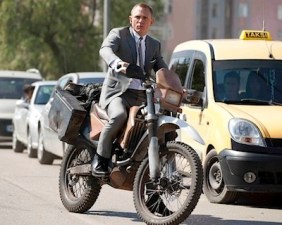 The pre-titles sequence is an exciting chase through — and over — Istanbul. As well as being a thrilling action sequence in its own right, here Mendes really establishes where he’s going with the film. There’s no close-up fast-cut Bourne-inspired shooting and editing here, instantly distancing Skyfall from the unpopular style adopted by Marc Forster for Bond’s previous outing, Quantum of Solace. It also firmly continues the Bond tradition of doing stunts ‘for real’, including some quite spectacular stuff with a digger and a train. I’m sure CGI has come sufficiently far since Die Another Day to make it a more useful tool now (indeed, DAD’s plasticky effects looked dated on release in 2002, never mind a decade later), but there’s something pleasing about knowing producers went to those locations and some person actually did a version of the things we’re seeing, even if it involved wires or stunt doubles or what have you.
The man Bond is chasing here is Ola Rapace, a capable actor who some Brits might know from the Swedish Wallander series (see in particular this review). He turns up again later, but I’m not sure he has a single significant line of dialogue. It’s not a fault of the film, but an unusual quirk of casting that a decent actor is playing little more than a heavy.
The pre-titles ends with M, back in London but communicating via Modern Technology, telling Bond’s co-agent Eve (Naomie Harris) to “take the bloody shot”, which she fluffs and hits Bond. The target and his MacGuffin get away; Bond falls from a viaduct to his death. 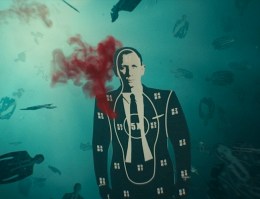 Cue Daniel Kleinman’s title sequence. And hurrah for the return of Kleinman, because the effort Forster’s favourite effects company MK12 offered on Quantum of Solace was a little bit pathetic. Kleinman is the master of the Bond title sequence now, and while he clearly owes a debt to the work of Maurice Binder (he more or less invented the form, after all), modern technology and the responsibility now heaped on this part of the film by audience expectation means he is, arguably, the best creator of Bond title sequences ever. Skyfall is another tour de force, loaded with inventive imagery that is even more rewarding when viewed a second time, knowing the full story. How often can you say that about Binder’s naked girls on trampolines?
After the titles, we learn that M is in trouble: the MacGuffin Bond was after is a list of all Western undercover agents — not something you want to lose. Her superior, Mallory (Ralph Fiennes), informs her she’s on the way out. Mirroring her famous dressing down of Bond in GoldenEye, M is now the dinosaur. Since her first appearance in 1995, the Bond films have slowly come to realise that in Judi Dench they have a stunning actress, and the size of her role has gradually increased. The World is Not Enough was the first to make a big deal of increased involvement, but it’s the Craig era that’s really given Dench a role to sink her teeth into. This is a harder (she swears!), more battle-worn M than the Brosnan-era version of the character. The double act (for want of a better word) between her and Bond is a key part of the Craig films to date, and Skyfall is very much the climax of that story.  She is the co-lead, the film’s real Bond girl, and she is marvellous throughout — doing what is necessary as the boss of MI6, facing up to a hostile parliamentary inquiry, and showing both vulnerability and resourcefulness in the Scotland-set climax, the film is a showcase for Dench. That she is gone is a huge loss to the franchise; that she went with such a meaty role is a credit to the film and the series.
Bond, meanwhile, is on a beach somewhere with a beautiful girl and drinking his nights away. Until, that is, he sees on the news a terrorist attack on MI6 HQ. Time to go home. This is a Bond motivated by duty. He loves women and drink, certainly, but when England is threatened he can’t resist — even when he’s not asked for. Indeed, quite the opposite, because when he’s back no one really wants him. He’s injured, out of shape; old and past it. Quite the shift from Casino Royale and Quantum, where we witness the birth of Bond. Here he’s experienced, possibly at the end of his career. It’s a bold move to make such a jump, especially when you’ve got a leading man who’s set for at least two more films. It helps make for a neat trilogy, though. There are no obvious plot threads linking this to Craig’s previous two outings (notoriously, the second of which is the first direct sequel in the Bond canon), but thematically and in his relationship with M Skyfall is entirely interpretable as the third act in a trilogy, one which examines, deconstructs and rebuilds the character of James Bond.
 Daniel Craig is more than up to this task. Much like Dench, the series has landed on its feet by casting an actor altogether better than you’d typically find in such blockbuster fare. The arc for Bond is perhaps more understated than M’s, even if, as the lead character, it’s even more central; but Craig can convey what’s necessary with a wince or a change in movement. And though Bond is physically debilitated, his mind is there, playing detective as he follows a trail to the villain’s lair, and plotting how best to defeat the always-one-step-ahead nemesis. More on whom later.
With the unknown possessor of the list releasing names of agents online — and them suffering as you’d expect as a result — M passes Bond for duty and sends him to Shanghai on the trail of Rapace’s character. The standout element here is undoubtedly Roger Deakins’ cinematography, laying out a neon-drenched future-style city so beautiful in its own way that an action sequence can afford to be played out in silhouette before a glowing blue sign. I think few would argue that this is the best-looking Bond film ever. The obvious glory comes both in Shanghai and, later, misty Scottish highlands, Deakins’ work making every location an engaging character to compete with the powerful acting. Throughout, though, the film has a considered approach that makes it, however subtly, gorgeous to watch. Visually it feels rich and deep in a way few of its ilk can match.
 From Shanghai Bond travels to a casino in Macau, where he’s reunited with Eve — who, as you’ll remember, shot him. We won’t learn it until much later, but Eve is of course Moneypenny. Providing such an iconic character with an origin story is an interesting move for the series, though perhaps unsurprising within the overall ethos of the Craig era. In retrospect, knowing who Eve will turn out to be, the way the film uses her is quite clever. For instance, she and Bond are clearly close, but it’s left deliberately unclear whether they sleep together — some viewers have assumed it’s implied they do, others the opposite, which just goes to prove it’s left up in the air. And when it turns out she’s Moneypenny, that’s kind of important — not only can there be the usual “will they/won’t they”, there’s also “have they/haven’t they”. The familiar Bond-Moneypenny relationship would be very different if we knew they’d already done it.
Also introduced in this film is Q (Ben Whishaw). Played for the first time as younger than Bond, he’s now a twenty-something geeky hacker-type, entirely befitting the modern world. There’s also a shortage of gadgets (producing one of the film’s best laughs, I think). It’s all part of the mythology of the Craig era, rebuilding the traditional Bond formula in a modern image. Taking us back to the trilogy idea, if Casino Royale began the formation of the James Bond character in an origin story kind of way, and Quantum further refined it, then Skyfall is the completion of the journey: the familiar elements are built up around Bond, and his character is broken down and reassembled for (hopefully) a final time. These moves are all cemented in the final scene, which we’ll come to later (obviously).
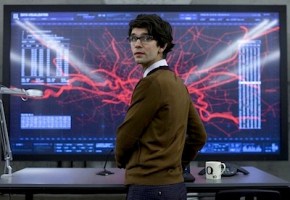 Q also serves as part of another major discussion in the film, that being the role of the secret service in the modern world. So much can be done with the internet and related technology these days that perhaps the real heroes are the Q-types who sit at keyboards and process data; but, as Q himself says, sometimes a trigger must be pulled. There’s also a lot of talk about operating in the shadows — who does and who does not, and whether the secret service as we know it is an outdated way to combat modern threats, particularly nation-less terrorism. For a mainstream action movie there’s an awful lot of thoughtfulness about the state of our world, without making it too blatant that it’s discussing the current political climate. It’s another feat to the film’s credit that it can smuggle this intelligent discourse into an action-thriller format. It’s obvious which side of the line the film will come down on, and of course it’s as much a plot point as a considered debate (more so, even), but it adds welcome layers.
For all this re-building and debating, Mendes — and screenwriters Neal Purvis & Robert Wade (in what, it turns out, will be their final contribution to the franchise) and John Logan — are certainly Bond fans, and they haven’t forgotten this is the 50th anniversary film. You may remember that Die Another Day was both the series’ 20th instalment and the 40th anniversary film, and it went overboard with references to the past: littered throughout, both in dialogue and on props, are titles of previous films; the Q branch scene was loaded with gadgets from previous entries; and there were callbacks galore, the best-known being Halle Berry recreating The Bikini Scene from Dr. No. It was all good fun, but it was very overt in a Roger Moore-ish way — something that absolutely would not sit within the Craig era.
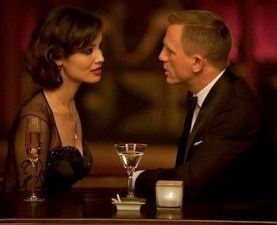 What we get instead, however, is a more subtle use of familiarity and nostalgia. For one thing, the finalisation of the reconstruction of Bond’s character is a good way to mark 50 years; as is re-introducing Q, Moneypenny and the traditional Bond setup. Additionally, there’s things like the Komodo dragons, a conscious nod to Craig and Mendes’ first Bond experience, Live and Let Die (which had crocodiles). It’s a little outlandish, but not implausibly so. The same can be said of the villain’s lair, a deserted island that is based on a real place near Japan. With its erring towards realism the Craig era has done away with hollowed-out volcanoes and ice palaces, but here it manages to reconstruct that notion in a modern, plausible way.
And then there’s the DB5. At first you think it’s just The Car — Bond did win it in a poker game in Casino Royale, after all — but then there’s a gag about the ejector seat. Woah there, I felt — we’re in a realist modern world, and now you’re referencing a classic element, yes, but a somewhat implausible one, from a massively different era in the franchise. Is that ruining the mood for the sake of an audience-pleasing joke? But then they go all-out, as the climax employs pretty much every gadget we remember from the car’s original appearance in Goldfinger. This is the height of the film’s nostalgia, and one could have a long debate about what it Means. When you think about it, theoretically Connery, Lazenby, Moore, Dalton and Brosnan never happened in the world of the Craig films, because that stuff about Bond being just a codename is utter nonsense. So where does the car come from? Who used the gadgets before?  But the thing is, it doesn’t matter, because it’s fun. On the whole Skyfall may be part of the newer, more serious era of Bond movies, but it has room for humour and heart, and the use of the DB5 has those in spades. And if you really want an in-universe explanation, you can come up with one. So does it sit uneasily with the rest of the film? Maybe a little. For some, I imagine it’s a deal breaker. But I think it works, and how.
Back on track: after Macau, Bond gets to visit the villain’s island, via a sequence where he sleeps with supporting Bond girl Sévérine. Much has been written about that act, especially considering the backstory the character is given. Some people firmly object to it on moral levels. Others have discussed why it makes sense and fits, and isn’t actually abusive. I have no real desire to discuss it in depth, but it feels like it should be mentioned, and so I’ll say I side with the latter.
The villain’s island, then, has been discussed — but what of the villain. If Craig and Dench are the film’s core, you need a villain that can equal them, and in Javier Bardem’s Silva you most definitely have it. From his fabulous introduction — a seemingly endless single take in which he approaches down a long, long corridor — onwards, Bardem has crafted a Bond villain for the ages. He’s camp, yes, something that has been much-discussed (the homoeroticism between him and Bond in his introductory scene has been over-discussed, in fact), but he’s also a genuine threat. Bardem pitches it just right, actually: he could have gone overboard with the campness and made Silva ludicrous, but instead his joviality and cackling laugh makes him all the more menacing.  Coupled with a plot that makes him exceedingly clever and capable, he’s the most Bondian Bond villain since the Moore era. And he even has a physical grotesquery, which some hold as essential for Bond villain… and it’s a CGI-aided doozy too. They say a hero is as only as good as his villain, and while that’s not always true, it is almost always, and actor, writers, director and co have all nailed the nemesis here.
The other striking element of the character is his plan. He doesn’t seek some form of world domination, as the vast majority of Bond villains do (even in the modern era — it’s just been a more plausible, often financial, form of domination than the create-a-new-society-in-space style domination of old), but vengeance. And not vengeance against Bond, even, but M. And here’s another thing the film really nails, making Bond-M-Silva a triumvirate that drives everything, both the surface action and some of the thematic subtext. Bond and Silva are M’s two sons, both with reason to be disillusioned, but one loyal and one betrayer. The Bond series previously tried a hero-mirroring villain in the last anniversary-themed film, Die Another Day, but bungled it by doing it overtly but not actually emphasising it correctly. Here, the mirroring is more subtle — Silva is most certainly not constructed in Bond’s image; and, indeed, he’s the older man, the original, while Bond is The Guy Who Came Next — but the implications are better realised.
It’s in the next sequence that we see Silva’s true intelligence: captured by Bond and MI6, he reveals his plan and his deformation… and then he escapes. Here we have the film’s primary depiction of cyber-terrorism and hacking (although it’s scattered throughout). 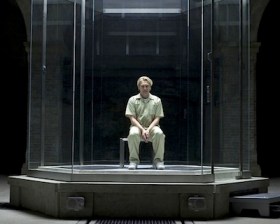 Some, especially tech-geeks of course, have criticised this element of the film for its lack of realism. I assume no one told them they were watching A James Bond Film. Actually, I assume no one told them they were watching a mainstream action-thriller full stop. Real-life hacking involves a lot of boring windows and just the command line and more resolutely uncinematic stuff like that. But here we’re in a fantasy world — it’s a more grounded fantasy world than the ones of Moore and Brosnan, or even Lazenby, but it’s still not Our World exactly. And this is not a film about hacking either — it’s a film in which cyber-terrorism is used as a plot point. So why not make it more visually arresting for the sake of the audience? The point is not “here’s what a hacker would do”, it’s “where the hell did Silva go? Now I must track him down and try to shoot him”. The way the film handles that side of things fits the bill. Sure, the server room on Silva’s island is similarly beyond daft (oh, the dust!), but it makes the right kind of visual impact. I have sympathy for the articles deconstructing this as unrealistic — everything in a film this popular must be broken down and thoroughly analysed for the sake of internet hits, after all — but if it ruined your enjoyment of the film… lighten up, it’s not a documentary. Do you think the depiction of how MI6 functions is any more realistic?
Here’s where we get the fantastic chase through the London underground, and the much-trailed train crash. Skyfall has an intelligent approach to its action sequences, allowing them to emerge from the story when and where necessary — and on a scale that is necessary — rather than shoving in beats that feel forced or of disproportionate scale just because the film merits them at that moment. I suppose that’s what makes it more of a thriller than an action movie, and it’s certainly a mentality that’s been employed to good effect throughout the Craig era:  compare and contrast Die Another Day, where they go off for a car chase on the ice for no good reason before returning to where they started, with Casino Royale, where the biggest sequence is immediately post-titles, or Quantum, which has a relentless first half (ish) before settling down to a story. Skyfall is more balanced, particularly than Quantum, but nothing feels shoehorned in.
Here also is where we find one of the film’s standout moments of moviemaking artistry. Mirroring the silent-but-for-opera chase midway through Quantum, Bond races to an inquiry where M is giving evidence, in pursuit of Silva who is intending to finalise his revenge, with the soundtrack sharing only Judi Dench’s voice delivering a reading from Tennyson: “though we are not now that strength which in old days moved earth and heaven,” she says, cementing those previously-discussed themes of what the role of the secret service (and, indeed, Britain) is in the modern world; and continues, “heroic hearts, made weak by time and fate, but strong in will to strive, to seek, to find, and not to yield,” as a weakened, past-it Bond races to her rescue. It’s so perfect it could have been written for the film especially.
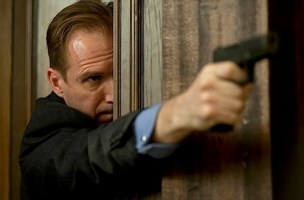 And then there’s an action sequence, a shoot-out at the inquiry, which is relatively low-key and yet one of the best bits of the movie. Mallory gets stuck in, earning Bond’s respect in the process, and as you’ve seen the film you’ll know where that goes, and because of where that goes Mallory having Bond’s respect is absolutely vital.
Silva gets away, and now the pieces are in place for the final act. And what a final act it is! This is not your typical climax to a Bond film, as Bond and M head north to Scotland, where they meet Albert Finney at Bond’s ancestral home — the titular Skyfall Lodge — there to hole up in preparation for an attack by Silva and his crew. Your typical Bond climax is a mano-a-mano fight between Bond and the villain, or an all-out assault by British/allied troops on the villain’s grand base. Not so here. In the quiet wilds of Scotland, one past-it secret agent and two pensioners hide away in a decrepit old mansion, with two guns and minimal bullets, and wait for a small personal army to turn up. It could be an anticlimax, but The Siege of Skyfall (as the more fantasy-inclined might wish to call it) is another excellent action sequence to add to Skyfall’s heavy roster. As before, it’s Bond’s brains that win out, planning tactically how to take down Silva’s men and fool them with the destruction of the house (while our heroes escape out a hidden passage, naturally). It is, once again, inventively written by Purvis, Wade & Logan (the use of the DB5, the construction of the plan, etc);  crisply directed by Mendes (readily followable action, building tension and suspense); stunningly shot by Deakins (dark but for the flames); beautifully performed by Craig, Dench, Bardem and Finney (particularly in the lead-up to the assault)… it’s a climax that does indeed tie together much of what makes the film.
The story comes to a close in a chapel, by the graves of Bond’s parents. There’s imagery and meaning in that, I’m certain. Silva kills M (somewhat indirectly); Bond kills Silva. Some have read this as a failure — that Bond loses — and while it’s certainly a qualified victory, it is a victory. The villain is dead, after all, and by taking him out of the way to Scotland they saved goodness-knows how many lives in London or wherever else they may have chosen to go. Bond loses M, true, but my are there factors in that death. This incarnation of M was a warrior, albeit from behind a desk than from the front line (most of the time), and so is dying in battle (as it were) not more fitting than a half-disgraced retirement? And what of her sins, against both Silva and Bond — is this a punishment? However much the villain may indeed be the villain, he kinda has a point. Bond may not really win at the end of Skyfall, but nor does he lose — much like the rest of the film, it’s a little more complicated than that.
By way of an epilogue, we are back in London, not at Vauxhall Cross but at, clearly, some other MI6 HQ — perhaps the Universal Exports of old. This is where we learn that Eve is Moneypenny, that Mallory is the new M, and that Bond is back in business.  This is where they say, after fifty years of Bond movies, everything is the same… only different. This is where the dialogue is a bit clunky and I wish someone had thought it through some more because it could have been perfect and instead it’s somewhere between awesome and cringe-inducing. “We haven’t been formally introduced” — seriously? You can do better than that!
But what fits, beautifully, is the gun barrel. David Arnold consciously kept the Bond theme out of Casino Royale until the very end because that was when Craig Became Bond; and Marc Forster consciously left the gun barrel to the end of Quantum of Solace because that was when the journey was complete and Craig Really Became Bond; and yet, somehow, they can get away with it for a third time. Perhaps that’s because, here, the Craig Era Becomes Bond — we’ve got M in a wood-panelled office, Moneypenny behind her desk, Q cooking up new gadgets, Bond back at his best… and a trilogy in which Daniel Craig’s James Bond went from gaining his 00 status to being the Bond we knew — with all the rich, deep, emotional backstory we never knew he had firmly in place — is now complete too. When the gun barrel plays (in an improved form from the rushed one we saw in Quantum), it isn’t just part of the fabric of the franchise, it feels earned.
And following it with the Bond 50 logo and the regular declaration that “James Bond Will Return” is fan-heart-wrenching genius.
 Skyfall is, perhaps, a flawed film in places. It’s certainly not perfect. Thomas Newman’s score is adequate but rarely exceptional, and at times reminded me too much of his work for Lemony Snicket (and maybe his other scores too, but I particularly enjoyed that one and remember it well). On a similar note (pun not intended), Adele’s theme has been divisive, some hailing it a return to proper classic Bond themes after a decade and a half of dross, some thinking it over-produced and lacklustre (I fall between the two camps, even if she seems to be under the impression the film is called Skyfoal). There are points where the plot perhaps lingers too long, and others where characters speak in statements rather than dialogue, and of course I had problems with the final scene and while I enjoyed the use of the DB5 it somehow doesn’t quite sit… and yet, I’d’ve done exactly the same if I’d thought of it.
Some say Skyfall is a more dramatic, permanent, and thorough reboot of the franchise than the obviously-a-reboot Casino Royale was. Others say it’s a fine film but not really the equal of Craig’s debut. As I said in my initial thoughts, it really takes time to fairly judge where a new entry sits within the Bond pantheon. There seems little doubt, however, that Skyfall is in the upper echelons. Whether it surpasses Casino Royale, or the best films of any of the other Bonds, is almost immaterial — it is its own beast, both faithful to the Bond legends that we know and capable of forging its own unique path.  That’s some kind of glorious contradiction — one of many in the film and its characters, I’m sure, should you care to take a run at analysing it that way. After the last 4,800 words, this may not be the place.
Thank you for reading; now you can see the star rating this affirmed Bond fan was always rather likely to give:
If you’ve not had enough of my thoughts on Skyfall, my spoiler-free “initial thoughts” can be found here.
This review is the climax of the 100 Films Advent Calendar 2012. Read more here.
Skyfall placed 1st on my list of The Ten Best Films I Saw For the First Time in 2012, which can be read in full here.

 Quentin Tarantino made his name in the ’90s with a series of dialogue-heavy gangster thrillers that provoked a storm of imitators. Since the turn of the millennium, however, he’s contented himself with a series of extravagant hyper-cinephilic genre homage/parodies. After tackling Japanese action movies in Kill Bill Vol.1, revenge thrillers in Kill Bill Vol.2, B-movie grindhouse fillers in Grindhouse/Death Proof, and World War 2 men-on-a-mission movies in Inglourious Basterds, here he sets his sights on a genre whose DNA is threaded through all his movies: the Spaghetti Western.
 It’s fair to say Django Unchained sprawls. But, unlike the chapterised character-flitting antics of Kill Bill and Inglourious Basterds, it has a straight throughline it follows from beginning to end, with only a few asides. In terms of length and scope, it’s perhaps not too much of a reach to evoke The Good, the Bad and the Ugly rather than any other self-indulgent lengthy non-epics. Some have tired of the film’s length (compared to the masses who have elevated it to 46th on IMDb’s all-time top 250, not many), but the prospect of an extended cut (mooted by QT as something he might offer later) excites me. Of course, the Kill Bill single-film edit still hasn’t made it further than Cannes or the New Beverly, so I won’t be holding my breath.
 Or how about those action sequences? Months of work training real horses to do things never before seen pays off (and Tarantino proudly displays the “no animals were harmed” notice right at the top of the credits), while the blood-drenched Candyland shoot-out is arguably one of the best pure action scenes in years. Those are amongst myriad other sequences, from the small and transitory to the epic and vital.
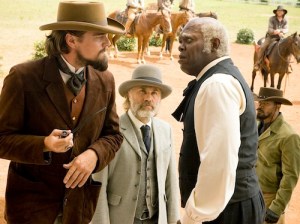 Still, best served — and, perhaps, more deserving of the Supporting Actor nod — are villainous duo Leonardo DiCaprio and Samuel L. Jackson. For starters, has Leo ever played a villain before? He’s on stonking form here as Southern gent Monsieur Candie (who can’t speak French), a sinisterly welcoming fellow with a dark side that’s on constant display. He’s all smiles and all lingering threat and menace. Indeed, scenes are often at their most tense when he’s at his nicest. I think there’s an argument for him to go down as one of the great screen villains — he even has the obligatory cool dispatch. “I couldn’t resist” indeed.
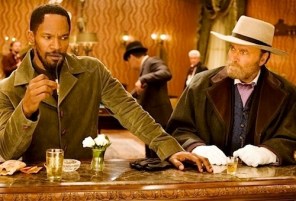 It does make you wonder if some of these people had bigger roles that got cut… or maybe there are just other reasons. However, one remaining cameo features perhaps the most satisfying use of “I know” since The Empire Strikes Back. And QT himself is in it, briefly, doing an Australian accent (I think?) and affording himself a striking exit.
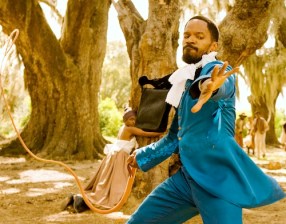 Tosh and piffle, I say. One of the best ways to skewer many an evil institution is to make them a laughing-stock, to take the piss out of them, and that’s exactly what Tarantino is doing. These aren’t likeable, funny people who are Klan members; they’re incompetent fools because they’re Klan members. The resulting scene is hilarious and deservedly one of the movie’s most memorable moments.
 After
After 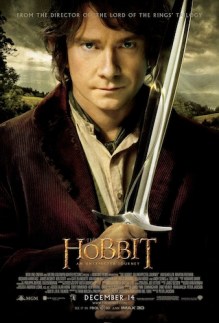 So here we are: nine years after his last tour of duty in Middle-earth, and after a Guillermo del Toro-shaped attempt at not having to serve again, Peter Jackson returns to the world of hobbits, dwarves, elves, orcs, and the rest, to tell the tale some have been clamouring for him to make since
 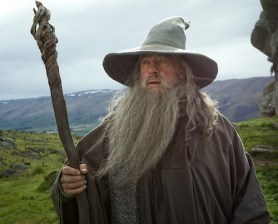 And, I have to say, as someone who hasn’t read the novel since primary school, I couldn’t spot the joins. I could take some guesses, but not many, and considering how long the film is I’m sure there must be quite a lot added.
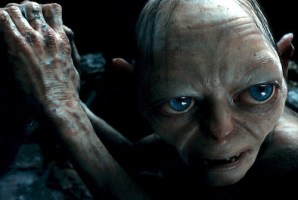 but I could have, and knowing you can do something makes all the difference. There’s also the little timer on the Blu-ray player, which means I can know that it took forty minutes to get out of Bag End rather than just thinking it feels like it. Does that somehow make it more palatable? Would I have been as bothered as others by the film’s length and pacing had I seen it in a cinema initially? It’s tough — nay, impossible — to say, because while there are those other subliminal factors, I also felt like I flat out enjoyed the film for itself, not just for my potential ability to escape it. But it is long and it is episodic, so maybe the association of watching individualistic episodes of TV back to back feeds into the acceptance of that? It’s a circular argument, so we’ll leave it there.
 Howard Shore returns to deliver another fantastic score. After he composed the iconic Fellowship theme for, um, Fellowship, I thought he could never muster anything else as monumental. And, in fairness, that theme is still the defining aspect of the series’ score (its absence here is at times felt, by me at least); but he produced another excellent motif for
 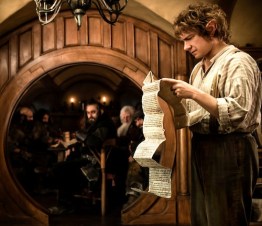 Without the breadth and world-changing story of The Lord of the Rings, The Hobbit was always going to be a somewhat smaller experience. By emphasising the backstory of the dwarves’ stolen homeland and the hints of war-to-come that will ultimately lead in to Rings’ story, Jackson has made it considerably more epic — for good or ill. For me, the whole experience clicked. I don’t think it’s as good as Lord of the Rings, but it is the next best thing.
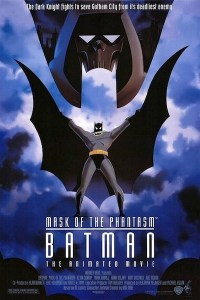 Batman movies have a habit of provoking strong reactions.
 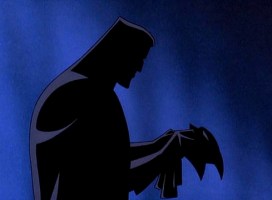 One of the main reasons the film succeeds is that look back at Bruce Wayne’s early days as a crime fighter. Batman’s origin is oft told — too oft, truth be told — but they thankfully don’t rehash it here. Instead, early in Batman’s career Bruce falls in love and finds happiness, causing him to question whether to continue down the path he’s already dedicated his life to. The scene where he talks to his parents’ grave, expressing his guilt at potentially finding happiness after so much mourning, is one of the most powerful, emotional moments in all of Batman’s many iterations.
 But instead of falling in some nasty halfway-house, Phantasm turns up trumps on all fronts.
 Shortly after I watched Tinker Tailor, it was announced that they (“they” in this instance being Working Title, I think) are planning a new film adaptation of Daphne du Maurier’s perennially popular novel Rebecca. This news was greeted (at least on the websites where I read it) with cries in the comments along the lines of, “you can’t remake Hitchcock!” Such is the power of
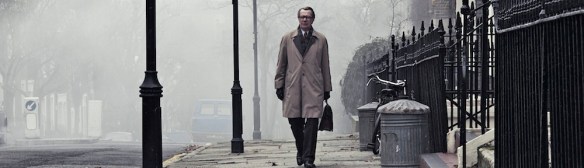
 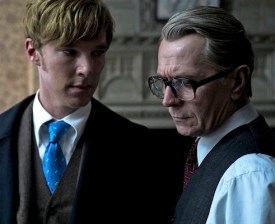 Yet, for all that, the film is excellent. It may not match the TV series in places, in my subjective opinion, but in its own right it shines. Gary Oldman does the impossible and offers a Smiley that is neither an imitation of Guinness’ nor a deliberate counterpoint, but stands apart as an equally proficient rendering of the character. The rest of the cast are equally up to task, with the exception of Kathy Burke, who stands out like a sore thumb in my opinion.
 Another noteworthy advantage of the film is that it’s gorgeously shot. The TV series actually has its own appeal in this area, with a realism that is quite pleasing. The film occasionally goes grander (look at the depiction of meeting rooms in The Circus for a major example — while the TV series goes for any old room in Whitehall, the film offers stonking soundproof ‘pods’), but it works in its own way.
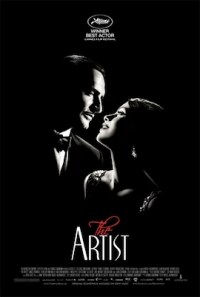 Beginning in 1927, you could (and some have) accuse The Artist of being a remake of
  Besides which, it isn’t a real silent film, and not just because it uses sound on one or two occasions, to very specific effect. Made 80 years after the invention of sound revolutionised cinema over night, The Artist is a tribute and homage to that great era — it’s not trying to beat them at their own game. It’s certainly not the first ‘modern silent’ either, but it’s an appropriate one to have received the most widespread attention (
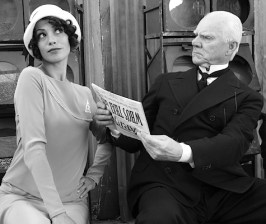 you’d believe they were a precisely-planned specially-constructed set, and unceremonious symbolism is created with former-star George being on the way down and Peppy being on the way up.
 or just faithfully following George around, he draws your attention. I might think that was just me (we’ve been over my love of terriers
  The two-part animated adaptation of Frank Miller’s comic, regularly voted among the top three stories ever told in the medium, concludes here. If you’ve not seen
 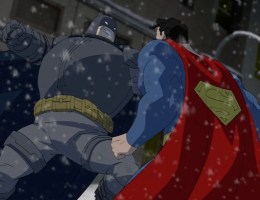 Nonetheless, a pair of big battles form the cruxes around which the story works: Batman vs the Joker, and Batman vs Superman. I won’t spoil the outcomes for those who’ve not read the book, but both are excellently realised on screen. Action can be tricky in comics — you’re stuck with a series of still images to convey fast-paced, often intricate movement. I also generally have the impression that action sequences are not 2D animation’s forte — too many frames need to be drawn, too many different angles to make it quick and exciting enough. The Dark Knight Returns is one of the exceptions, however, and the two big sequences in Part II — as well as a couple of smaller ones — outclass anything in Part I, which was good in the first place. I’d go so far as to say the Superman fight improves on the novel’s version, at least in a visceral sense — Miller delivers Batman’s internal monologue and a certain pleasing disregard of Supes, while Oliva wisely skips any kind of voice over and delivers the entire duel blow for blow. It’s a fantastic climax.
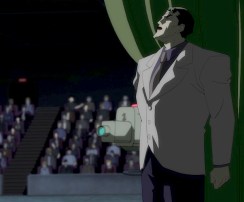 The story may provide some déjà vu for those only acquainted with live-action Batman, because Christopher Nolan borrowed liberally from Miller’s TDKR for his TDKR,
  There were many sceptics when DC first announced they were going to tackle such a sacred Bat-story, and not all were convinced by Part I. I don’t imagine Part II will change their minds, but for those of us who did enjoy the first animated interpretation of Miller’s seminal tale, this is even better. In fact, even without its first half, I’d say it joins the ranks of my very favourite Bat-films.
 From the makers of the successful Christmas TV shorts









 21 Jump Street
 The Best Exotic Marigold Hotel
 Django Unchained
 Hitchcock
 Lincoln
 The Pirates! in an Adventure with Scientists
 Ted
Ted 100Films.co.uk