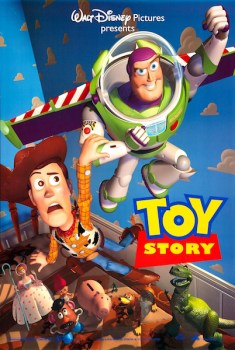
Toy Story (1995)

100 Films’ 100 Favourites #92

The toys are back in town.

Country: USA
Language: English
Runtime: 81 minutes
BBFC: PG
MPAA: G

Original Release: 22nd November 1995 (USA)
UK Release: 22nd March 1996
First Seen: cinema, 1996

Stars
Tom Hanks (Sleepless in Seattle, Catch Me If You Can)
Tim Allen (Galaxy Quest, The Shaggy Dog)

Director
John Lasseter (A Bug’s Life, Cars)

Screenwriters
Joss Whedon (Alien Resurrection, Avengers: Age of Ultron)
Andrew Stanton (A Bug’s Life, John Carter)
Joel Cohen (Cheaper by the Dozen, Garfield)
Alec Sokolow (Cheaper by the Dozen, Garfield: A Tale of Two Kitties)

Story by
John Lasseter (Toy Story 2, Planes)
Pete Docter (Monsters, Inc., Up)
Andrew Stanton (Finding Nemo, Toy Story 3)
Joe Ranft (Beauty and the Beast, Cars)

The Story
In a world where toys come to life when humans aren’t around, Woody is six-year-old Andy’s favourite doll… until he gets Buzz Lightyear, a space ranger action figure, for his birthday. An upset Woody clashes with Buzz, but when the bickering pair are left behind during a house move they must work together to get back to their kid.

Our Heroes
Woody is a cowboy doll, the favourite of his kid, Andy, and consequently the leader of all Andy’s toys. That is until Andy gets a shiny new Buzz Lightyear action figure, whose newness ingratiates him with all the other toys. Plus, to Woody’s continued annoyance, Buzz believes he really is a space ranger and has no idea he’s just a toy.

Our Villain
Sid, Andy’s nasty neighbour kid who does terrible, terrible things to toys…

Best Supporting Character
Mr Potato Head, whose various body parts are slotted on and therefore removable and interchangeable. Hilarity ensues. Also has a nice line in snarky comments.

Memorable Quote
“To infinity, and beyond!” — Buzz Lightyear

Quote Most Likely To Be Used in Everyday Conversation
“You are a sad, strange little man, and you have my pity.” — Buzz Lightyear

Memorable Scene
One of Buzz’s claims as a real space ranger is that he can fly, so Woody challenges him to prove it. Buzz closes his eyes, dives off the bed… and, through a series of flukes, bounces and coasts his way around the room, landing back on the bed. “That wasn’t flying,” cries Woody, “that was falling with style!”

Memorable Song
The film’s themes are perfectly reflected in Randy Newman’s Oscar-nominated and endlessly catchy song, You’ve Got a Friend in Me. Both Toy Story sequels have tried to emulate it, with… less success.

Technical Wizardry
Only the whole movie — it was the first feature-length wholly-computer-generated animated film. As such, we have it to thank/blame for the current entire state of popular Western animation.

Making of
The animators perfected the movement of the toy soldiers by nailing a pair of shoes to a wooden plank and trying to walk around in them.

Previously on…
Toy Story was the first feature-length computer-animated film — there is, in that sense, literally nothing before it.

Next time…
Two feature film sequels, both of which are at least as artistically successful as this first, with a fourth set to follow in 2018. Also, three short films and two TV specials to date, plus direct-to-video spin-off movie Buzz Lightyear of Star Command: The Adventure Begins and the TV series that follows it. You could also argue the entirety of Pixar’s highly-praised output is a follow-up to the success of Toy Story, as well as American feature animation’s almost entire conversion from traditional cel animation to 3D CGI.

Awards
1 Special Achievement Oscar to John Lasseter for “the development and inspired application of techniques that have made possible the first feature-length computer-animated film.”
3 Oscar nominations (Original Screenplay, Song, Musical or Comedy Score)
1 BAFTA nomination (Visual Effects)
8 Annie Awards (Animated Feature, Directing, Writing, Producing, Music, Production Design, Animation, Technical Achievement)
1 Annie Awards nomination (Voice Acting (Tom Hanks))
2 Saturn nominations (Fantasy Film, Writing)
Nominated for the Hugo for Best Dramatic Presentation

What the Critics Said
“Far from just a technological breakthrough, this hellzapoppin fairy tale […] is a magically witty and humane entertainment. It has the purity, the ecstatic freedom of imagination, that’s the hallmark of the greatest children’s films. It also has the kind of spring-loaded allusive prankishness that, at times, will tickle adults even more than it does kids. The moment Mr. Potato Head arranges his snap-on features into a Cubist mash and says, ”I’m Picasso,” it’s clear that director John Lasseter and his team of writer-technicians have taken their most anarchic impulses and run with them. […] In its techno-cool photo-realist way, though, this movie, too, invites you to gaze upon the textures of the physical world with new eyes. What Bambi and Snow White did for nature, Toy Story, amazingly, does for plastic — for the synthetic gizmo culture of the modern mall brat. The film’s wit (and resonance) is that it brings toys to life exactly the way children do in their heads. It molds plastic into pure imagination.” — Owen Gleiberman, Entertainment Weekly

Score: 100%

What the Public Say
“The Animation is superb. Given that this was one of the first ever feature length computer animated movies, those guys at Pixar really hit the nail on the head. The colours are vibrant and the characters are dynamic. An excellent use of Blues, Yellows and Reds really accentuate the ‘children’ and ‘toys’ feel. There are also beautiful realistic elements such as a scene where Woody and Buzz find themselves under a lorry in a petrol station. With this, I was simply amazed at the attention to detail with the stones, tarmac and oil stains on the textures. It really looks like you are close-up to the ground and I love it!” — Alexander Potter, Pottercraft’s Pictures

Verdict

Just because something’s the first to do something doesn’t necessarily mean it’s any good, but Pixar didn’t strike gold with Toy Story just because computer animation was New. It’s the likeable characters, how they develop and learn, the amusing situations they’re put in, plus some heartwarming messages about friendship. There’s more emotion and character development in these wooden-and-plastic toys generated with pixels in a computer than many a film can achieve with real human beings, and that’s why Pixar came to revolutionise and dominate the Western animation genre.

Some would say “the original is still the best”, and it is up there, but on Sunday I will beg to differ…

#93 will be… a superior sequel.
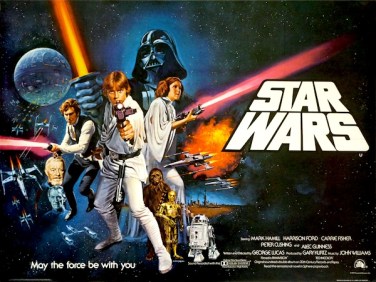
Star Wars (1977)

100 Films’ 100 Favourites #88

A long time ago
in a galaxy far, far away…

Also Known As: Star Wars: Episode IV – A New Hope

Country: USA
Language: English
Runtime: 121 minutes | 125 minutes (special edition)
BBFC: U
MPAA: PG

Original Release: 25th May 1977 (USA)
UK Release: 27th December 1977
First Seen: VHS, c.1990

Stars
Mark Hamill (Batman: Mask of the Phantasm, Star Wars: Episode VIII)
Harrison Ford (American Graffiti, The Fugitive)
Carrie Fisher (When Harry Met Sally…, Star Wars: The Force Awakens)
Alec Guinness (Kind Hearts and Coronets, The Bridge on the River Kwai)
James Earl Jones (Field of Dreams, The Lion King)

Director
George Lucas (THX 1138, Star Wars: Episode I – The Phantom Menace)

Screenwriter
George Lucas (American Graffiti, Star Wars: Episode II – Attack of the Clones)

The Story
When he discovers a distress call from a beautiful princess, a young farmhand joins forces with an old warrior, a roguish pilot, his bear-like first mate, and a pair of bickering robots to rescue her — which involves taking on the evil galactic Empire, and in particular their chief enforcer: Darth Vader.

Our Heroes
Farm boy Luke Skywalker just wants to go off and join the rebellion, but little does he realise how much that path leads to his destiny. Helping him get there is smuggler Han Solo, who may come from a wretched hive of scum and villainy and is happy to shoot first at the same time as his opponent, but has a heart of gold really. The object of their mission, and both their affections, is the strong-willed Princess Leia.

Our Villains
A man in a black suit with breathing problems might not sound like one of the most effective screen villains of all time, but that’s what you get when you come up with pithy descriptions like that. In fact, Darth Vader is so badass, he’s not above choking members of his own side, the evil Empire — and they’re evil.

Best Supporting Character
R2-D2 is the best supporting character in every Star Wars film, but in this one we are also introduced to Obi-Wan Kenobi. A mysterious old man who inducts Luke into the ways of the Force, Obi-Wan is played by veteran character actor Alec Guinness, meaning he is bestowed with instant awesomeness. Not as handy with a lightsaber as he used to be, mind.

Memorable Quote
Darth Vader: “Your powers are weak, old man.”
Obi-Wan Kenobi: “You can’t win, Darth. If you strike me down, I shall become more powerful than you could possibly imagine.”

Quote Most Likely To Be Used in Everyday Conversation
“I have a very bad feeling about this.” — Luke Skywalker

Memorable Scene
It’s fair to say Star Wars is loaded with memorable scenes, but for pure effectiveness you’d have to go a long way to beat the opening sequence: giant spaceships flying overhead, blasting laser beams at each other; walking, talking robots bickering; a gunfight between men and armoured soldiers; and then Darth Vader, stalking into the movie like a sci-fi vision of Death himself.

Memorable Music
George Lucas wanted a score reminiscent of classic Hollywood movies to help inform audiences about what they were watching — that although it was set on alien worlds with giant spaceships and laser swords, it was a familiar kind of heroic adventure tale. Composer John Williams delivered exactly that, drawing on influences including classical composers, like Stravinsky and Holst, and film composers, like Erich Wolfgang Korngold (King’s Row) and Alfred Newman (How the West Was Won). He produced not only a great soundtrack all round, but arguably the most famous movie theme of all time.

Truly Special Effect
Star Wars did so much to break new ground in special effects, it’s difficult to know where to start. Some of it’s a little skwiffy (the lightsaber effects are notoriously problematic, their colours varying even in recent remastered versions), but the model work — the spaceships and their battles — is fantastic.

Letting the Side Down
Han shot first! *ahem* Yes, A New Hope is definitely the movie where Lucas’ unpopular Special Edition fiddling is it at its least liked, primarily for that bit where Han no longer shoots Greedo in cold blood. What do you have to do to get a merciless good guy these days, eh? Other changes have varying degrees of effectiveness: having extra X-Wings in the Death Star battle looks pretty neat, but the CGI Jabba the Hutt — complete with Han stepping jerkily over his tail — is terrible.

Making of
George Lucas screened an early cut of the film for a group of his director friends, most of whom agreed with him: it was going to be a flop. Brian De Palma even called it “the worst movie ever”. There was one dissenting voice: Steven Spielberg, who predicted it would be a huge hit. As if that man’s entire career wasn’t proof enough that he knows what he’s talking about…

Previously on…
Star Wars’ influences can be clearly traced back to the sci-fi cinema serials of the ’30s and ’40s, like Flash Gordon. In-universe, the saga begins with the Prequel Trilogy, and there’s shedloads of other spin-off media. Most pertinently, this December’s first live-action non-saga Star Wars film, Rogue One, should lead more-or-less directly into the start of A New Hope.

Next time…
Star Wars essentially inspired the next 39 years (and counting) of effects-driven summer blockbusters. It also started a mini-industry all of its own — well, quite a large industry, actually: films, TV series, novels, comic books, computer games, board games, role playing games, toys, clothes, lunch boxes… anything you can imagine, I’d wager. Primarily, the story is directly continued in The Empire Strikes Back and Return of the Jedi, and resumed in The Force Awakens, with more to come in 2017 and 2019.

Awards
7 Oscars (Editing, Score, Sound, Art Direction-Set Decoration, Costume Design, Visual Effects, Special Achievement Award for Sound Effects)
4 Oscar nominations (Picture, Supporting Actor, Director, Original Screenplay)
2 BAFTAs (Music, Sound)
4 BAFTA nominations (Film, Editing, Costume Design, Production Design/Art Direction)
13 Saturn Awards (Science Fiction Film, Supporting Actor (Alec Guinness), Director (tied with Spielberg for Close Encounters), Writing, Music (John Williams tied with himself for Close Encounters), Costumes, Make-Up, Special Effects, Editing, Sound, Art Direction, Set Decoration, Special Award for Outstanding Cinematographer)
4 Saturn nominations (Actor (both Harrison Ford and Mark Hamill), Actress (Carrie Fisher), Supporting Actor (Peter Cushing))
Won the Hugo for Best Dramatic Presentation.

What the Critics Said
“The battles, the duels, the special effects — and what special effects! Swords made of light, blasters shooting laser beams, exploding planets — it goes on and on. All the aging acid-heads who tripped out to Stanley Kubrick’s overrated 2001: A Space Odyssey, will go bananas over Star Wars. Not to mention comic-book freaks, science fiction and fantasy fans, lovers of old westerns, romances, mysteries and movies about the Crusades. In addition to being a slickly produced and highly entertaining adventure suitable for the whole family, Star Wars is richly evocative of a whole range of old film forms and I predict that entire books will be written on the sources, the religious symbolism, the mythological and historical allusions, and so on and so forth that Lucas has incorporated” — Robert Martin, The Globe and Mail (This review from the original release, before it was called Episode IV, also notes that it “opens like Episode 6 of a serial”. Good call, sir.)

Score: 93%

What the Public Say
“To this day, A New Hope is used as a primary example of storytelling. It perfectly establishes a world and introduces audiences to a protagonist that goes on his hero’s journey. There’s a reason that so much pop culture parodies and pays tribute to this film and it’s because of how near perfect it is. You have the Princess in peril still holding her own against what will always be one of the greatest movie villains of all time in Darth Vader. That is also one thing the prequels do that take away from this movie and the two that come after: They soften Vader. Vader is cold, ruthless, robotic, and menacing. Not someone who cries about his girlfriend. […] A New Hope just does everything the right way. When it wants you to be excited, you are. When it wants you to be sad, you are. John Williams contributed to this a great deal with his score; and Lucas’ use of practical effects to tell his story make it a masterpiece.” — Reed, We’re Not Sorry

Elsewhere on 100 Films
I’ve written about the original Star Wars trilogy twice before, both times back in 2007. Of A New Hope’s modified DVD version, I said that “there are a few extremely minor changes from the ’97 version… sadly, though, not to the CGI: Jabba still looks dire, not even as good as the Episode I version — CGI that was five years old by the time of this release.” Then, treating the film as the fourth part of the saga, I wrote that “the biggest change [from the prequel trilogy] is in tone: I to III present an epic fantasy story, full of wizard-like Jedi, intricate galactic politics, and ancient prophecies; by contrast, A New Hope is straight-up action/adventure, far more concerned with gunfights, tricky situations, exciting dogfights, and amusing banter than with whether the President has been granted too much executive power.”

Verdict

In my post on The Empire Strikes Back, I said it wasn’t actually my favourite Star Wars film. For all the popularity the series has as a whole, there’s only really one other possible contender for that crown: the first one. By which I mean this one, not Phantom Menace. Here, Lucas almost instantly conjures up a universe that feels wholly-imagined and genuinely lived-in (which is part of the reason people ended up so disappointed by the made-up-as-they-went-along, fill-in-the-blanks prequel trilogy). Throw in an array of likeable and entertaining characters, plus groundbreaking special effects, and you’re on to a winner. The plot may just be a classical hero narrative, but it’s in space and has laser swords — that counts for a lot.

Next: #89 ! Fuck yeah!

Spider-Man 2 (2004)

100 Films’ 100 Favourites #86

A man will face his destiny.
A hero will be revealed.

Country: USA
Language: English
Runtime: 127 minutes | 135 minutes (2.1 extended cut)
BBFC: PG (cut, 2004) | 12A (2004) | PG (uncut, 2009)
MPAA: PG-13

Original Release: 25th June 2004 (Lithuania)
US Release: 30th June 2004
UK Release: 16th July 2004
First Seen: cinema, July 2004

Stars
Tobey Maguire (Pleasantville, The Great Gatsby)
Kirsten Dunst (Interview with the Vampire, Melancholia)
James Franco (City by the Sea, 127 Hours)
Alfred Molina (Frida, An Education)

Director
Sam Raimi (The Evil Dead, Drag Me to Hell)

Screenwriter
Alvin Sargent (Gambit, Ordinary People)

Story by
Alfred Gough (Lethal Weapon 4, The Mummy: Tomb of the Dragon Emperor)
Miles Millar (Shanghai Noon, Herbie Fully Loaded)
Michael Chabon (John Carter)

Based on
Spider-Man, a comic book superhero created by Stan Lee and Steve Ditko; in particular the story Spider-Man No More! by Stan Lee and John Romita, Sr.

The Story
Peter Parker battles problems in his personal life while his superhero alter ego Spider-Man battles the machinations of evil scientist Dr Otto Octavius.

Our Hero
Spider-Man! Spider-Man does whatever a spider can — spins a web any size, catches thieves just like flies. Is he strong? Listen bud, he’s got genetically-modified blood. Wealth and fame he’s ignored, action is his reward… though he’s having doubts about if it’s worth it. With great power comes great responsibility, and neither sit well with a kid who wants a normal life.

Our Villain
Doc Ock! Guy named Otto Octavius winds up with eight limbs, four mechanical arms welded right onto his body — what are the odds?

Best Supporting Character
Before he won an Oscar for Whiplash, or posted photos of his insanely ripped body on social media, J.K. Simmons brought himself to everyone’s attention as the hilariously irascible editor of The Daily Bugle newspaper, J. Jonah Jameson. He was so good, they haven’t even bothered to recast the character for any of the three live-action Spidey films that have come since the first reboot.

Memorable Quote
“So here I am, standing in your doorway. I have always been standing in your doorway.” — Mary Jane

Quote Most Likely To Be Used in Everyday Conversation
“With great power comes great responsibility.” — Uncle Ben may be dead, but they manage to have him say it in this one too.

Memorable Scene
The elevated train fight between Spidey and Doc Ock. It was the first major sequence filmed, before the screenplay was completed, but Raimi had dreamt it up personally. It was shot in Chicago because New York no longer has an elevated railway, but Raimi was seeking to create an idealised version of the city.

Technical Wizardry
The sound effects for Doc Ock’s tentacles were created using motorcycle chains and piano wires, while the sound of him ripping open the bank vault was a hubcap scraping along the floor. The designers consciously didn’t include the noise of servomotors, to enhance the idea that the tentacles have become a part of Ock’s body.

Truly Special Effect
Doc Ock’s tentacles were built practically. Each one was 13ft long, made up of 76 pieces, fully articulated, and controlled by four people. Obviously some of their appearances are CGI, especially when Ock’s using them to move around, but every scene was first filmed using the real props to see if CGI was truly necessary

Making of
Tobey Maguire injured his back before filming began, to the extent that Jake Gyllenhaal (at the time only really known for Donnie Darko) was tapped to replace him, and even began preparing for the shoot. Ultimately Maguire recovered enough to participate (obviously). A couple of years later Gyllenhaal was one of the final contenders for Batman in Batman Begins, but didn’t get to do that either. I’m sure Marvel will find a superhero for him eventually — they do for most people.

Previously on…
Ignoring the many and various animated series and failed attempts to bring Spidey to the screen, there was the first Sam Raimi-directed Spider-Man, which was the first film to gross over $100 million on its opening weekend. Also, MTV animated series Spider-Man: The New Animated Series is technically set after Spider-Man and therefore before Spider-Man 2, but I don’t think anyone remembers it…

Next time…
Spider-Man 3 concluded the trilogy with a whimper thanks to behind-the-scenes clashes, which also scuppered plans for Spider-Man 4. The series was rebooted with the unpopular The Amazing Spider-Man, which was followed by the even-more-unpopular The Amazing Spider-Man 2, leading to the character being rebooted again and integrated into the Marvel Cinematic Universe. The latest version debuted in Captain America: Civil War before starring in a solo movie, Spider-Man: Homecoming, next summer.

Awards
1 Oscar (Visual Effects)
2 Oscar nominations (Sound Mixing, Sound Editing)
2 BAFTA nominations (Sound, Visual Effects)
5 Saturn Awards (Fantasy Film, Actor (Tobey Maguire), Director, Writer, Special Effects)
3 Saturn nominations (Supporting Actor (Alfred Molina), Music, DVD Special Edition Release)
Nominated for the Hugo for Best Dramatic Presentation Long Form
1 World Stunt Award (Best Overall Stunt by a Stunt Man (Peter Parker falling into clothes lines))
2 World Stunt Awards nominations (Best Work with a Vehicle, Best Speciality Stunt (Doc Ock waking up))

What the Critics Said Then
“a sequel that not only outstrips its predecessor but has a perversity and quick-wittedness that hardly seem to belong in a comic-book movie. […] It’s unusual and gratifying to find a multimillion dollar movie that’s been put together with some thoughtfulness, that doesn’t neglect subtlety in between delivering the smash-bang-wallop. […] It’s the interest in human fallibility that sets this movie apart. The superhero who bridles at his own responsibility may not sound an especially gripping prospect, but his dilemma is explored with a conviction that, within the fantasy genre, feels almost groundbreaking.” — Anthony Quinn, The Independent

Score: 93%

What the Critics Say Now
On placing the film in his top ten for BBC Culture’s 100 Greatest Films of the 21st Century: “First of all, the 21st century is the century of superheroes. To approach the history of this era without acknowledging that is to miss the story. Many of my peers opted to make The Dark Knight the film that represented superheroes for them, but while I like that movie it’s a crime film in superhero drag. Spider-Man 2 is an unabashedly comic book superhero movie, a film that is pulsing with the vibrant four color life of the best comic book panels and that is soaked in the sudsy soap opera of the best comic book word balloons. It’s a movie that is a perfect fusion between filmmaker and material, and it is, without a doubt, the best example of superhero filmmaking ever attempted.” — Devin Faraci, Birth. Movies. Death.

What the Public Say
“The most interesting relationship that gets explored in Spider-Man 2, however, is with Spider-Man himself. In the first Spider-Man, Peter basically became Spider-Man the instant he decided to live his life by Uncle Ben’s last few words and donned on the Spidey suit, and that was that. Here, Peter Parker basically breaks up with Spider-Man and with Uncle Ben, as he says he is “Spider-Man, no more,” and has to start over and re-bond with the hero inside of him. [The] movie makes use of this psychological relationship to refine its definition of a hero as established in the first film. It isn’t just about responsibility. It argues that the hero is inherently sacrificial. They give up even their dreams to salvage yours. This definition is much more mature and sophisticated […] It goes to show that a big budget doesn’t have to translate into senselessness. Spider-Man 2 is the intellectual experience I was looking for in a Spider-Man film with all the action that I always imagined was possible.” — Kevin Tae, Taestful Reviews

Elsewhere on 100 Films
Just before Spider-Man 3 came out they released an extended cut of the first sequel on DVD, dubbed Spider-Man 2.1 (remember when they briefly called extended cuts things like that?) At the time I concluded “it’s still a 5-star film because it doesn’t ruin the original — but it’s not at all essential”, though I later added a postscript to note that “I probably should have rated this lower. It may still be a good film, but the fact is the original cut’s better — even if just for the superior version of The Lift Scene. I rather doubt I’ll ever watch it again.”

Verdict

In a simpler time before every superhero movie was connected to every other superhero movie, filmmakers were free to only have to tell one story and develop the ongoing life of their lead characters (rather than juggle everyone else’s lead characters for cameos, too). Spider-Man 2 is a pinnacle of this. It takes the seeds sown by the first movie and nurtures them into more interesting and complex emotional dilemmas, without losing sight of the fact it’s a movie based on a comic book about a man who swings around the city in a red-and-blue onesie fighting crime. Nonetheless, it’s as memorable for Peter and MJ’s up-and-down relationship as it is for the stunning action sequences, which become icing on the cake rather than the raison d’être.

#87 is… no kid’s game.

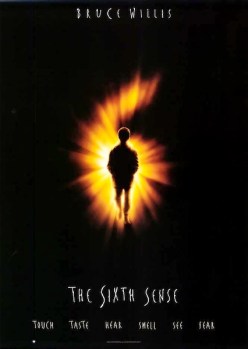
The Sixth Sense (1999)

100 Films’ 100 Favourites #85

Not every gift is a blessing.

Country: USA
Language: English
Runtime: 107 minutes
BBFC: 15
MPAA: PG-13

Original Release: 6th August 1999 (USA)
UK Release: 5th November 1999
First Seen: DVD, c.2000

Stars
Bruce Willis (Pulp Fiction, Sin City)
Haley Joel Osment (Bogus, A.I. Artificial Intelligence)
Toni Collette (Muriel’s Wedding, Little Miss Sunshine)
Olivia Williams (Rushmore, The Ghost)

Director
M. Night Shyamalan (Unbreakable, Signs)

Screenwriter
M. Night Shyamalan (Wide Awake, The Village)

The Story
Child psychiatrist Dr Malcolm Crowe tries to help a new patient, Cole Sear, who claims he can see ghosts.

Our Heroes
Dr Malcolm Crowe doubts his abilities to help people after a former patient shot him before committing suicide, an event which has also left him distanced from his wife. But he may be the only person who’ll believe young Cole Sear, a reclusive child who’s struggling with delusions of seeing dead people… unless they’re not delusions…

Our Villains
Are the dead dangerous, or do they just need help?

Best Supporting Character
Cole’s mom, Lynn, who loves him a great deal and worries about him just as much, but has no idea what’s really wrong or how to help her son.

Memorable Quote
“I see dead people… Walking around like regular people. They don’t see each other. They only see what they want to see. They don’t know they’re dead.” — Cole

Memorable Scene
Stuck in traffic, Cole reveals his ability to his mother for the first time — that there’s been an accident ahead and someone died, which he knows because they’re stood at his window. Naturally Lynn doesn’t believe her son, but then he begins to talk about his grandmother…

Technical Wizardry
The twist ending is immaculately constructed. There are clues throughout the film, but, like all the best twist-ending clues, the vast majority of viewers will completely miss them first time through, even though they seem almost blatant when revisited.

Making of
The colour red is used only to indicate times and items where the worlds of the living and the dead have connected; if something red was present in a scene where this wasn’t relevant, Shyamalan had it changed. There’s a massive list of these moments here, but if you somehow haven’t seen The Sixth Sense yet, do beware of spoilers.

Next time…
There are no actual sequels to The Sixth Sense, but it kicked off M. Night Shyamalan as a kind of one-man genre, making supernatural thrillers with a twist ending — and decreasing critical acclaim with each new movie. It seemed to end with The Happening and he transitioned to be a director-for-hire, but he’s coming back somewhat with The Visit and next year’s Split.

Awards
6 Oscar nominations (Picture, Supporting Actor (Haley Joel Osment), Supporting Actress (Toni Collette), Director, Original Screenplay, Editing)
4 BAFTA nominations (Film, Director, Original Screenplay, Editing)
2 Saturn Awards (Horror Film, Performance by a Younger Actor/Actress (Haley Joel Osment))
2 Saturn nominations (Actor (Bruce Willis), Writer)
2 Teen Choice Awards (Choice Drama, Choice Breakout Performance (Haley Joel Osment))
1 Teen Choice nomination (Choice Sleazebag (Trevor Morgan))
Nominated for the Hugo for Best Dramatic Presentation

What the Critics Said
“the film eventually abandons the heroic-therapist model and ventures toward other ground, ever so gently tightening its squeeze. It seems really to achieve something that Stanley Kubrick was possibly groping after in Eyes Wide Shut, or that Nicolas Roeg achieved in Don’t Look Now, which might be called an extreme sense of the bizarre, not as invented by special-effects wizards with unlimited space on the hard drive but in the subtler ways of film craftsmanship. […] The movie is a maximum creep-out. It’s invasive. It’s like an enema to the soul as it probes the ways of death – some especially grotesque in a family setting. You leave slightly asquirm. You know it will linger. It becomes a clammy, chilly movie building toward a revelation that you cannot predict. As I say: I cannot tell you. You’d hate me if I did. I can only say, don’t look now, but look sometime.” — Stephen Hunter, Washington Post

Score: 85%

What the Public Say
“The film is rich in symbolism, and colour plays a large part in signifying spirits invading the real world. This is what makes The Sixth Sense so captivating. Watching the film for the first time, you don’t expect the ending, and so the shock of it tends to overshadow the subtlety of the beginning. It is only once you have re-watched the film, that you begin to notice little suggestions of what is to come. A success from start to end, this is at once an exercise in potent suspense, and a carefully crafted tale of child psychology.” — Cat Barnard, Screen Muse

Verdict

M. Night Shyamalan gets such a bad rep these days, it’s easy to forget how great his breakthrough movie was. It flew completely under the radar back in 1999: the guy at Disney who bought the screenplay was fired for doing so without permission; Bruce Willis starred in it because he owed Disney two films, and was paid half his normal salary; Entertainment Weekly’s extensive summer preview detailed over 140 films, but The Sixth Sense wasn’t even mentioned. By coming out of the blue, and in an era before the internet was dominant (these days there’d be plot dissections and spoiler-filled director interviews online by the Monday after release, wouldn’t there?), the film obviously had surprise on its side, which is particularly effective when it has such a memorable twist. But even before that ending, it manages to mix plausible emotional drama with scenes of chilling everyday horror, crafting something that is undoubtedly a genre movie but also not out of place in a list of Best Picture nominees.

The Sixth Sense is on Film4 tomorrow night at 1am.

#86 will do… whatever a spider can.

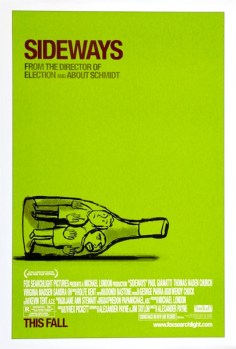
Sideways (2004)

100 Films’ 100 Favourites #84

In search of wine.
In search of women.
In search of themselves.

Country: USA & Hungary
Language: English
Runtime: 127 minutes
BBFC: 15
MPAA: R

Original Release: 22nd October 2004 (USA)
UK Release: 28th January 2005
First Seen: cinema, 2005

Stars
Paul Giamatti (Big Fat Liar, Shoot ‘Em Up)
Thomas Haden Church (George of the Jungle, Spider-Man 3)
Virginia Madsen (Candyman, The Number 23)
Sandra Oh (Under the Tuscan Sun, Hard Candy)

Director
Alexander Payne (About Schmidt, Nebraska)

Screenwriters
Alexander Payne (Jurassic Park III, The Descendants)
Jim Taylor (Election, I Now Pronounce You Chuck & Larry)

Based on
Sideways, a novel by Rex Pickett.

The Story
Middle-aged wine lover Miles takes his friend, groom-to-be Jack, up to California wine country for a more mature kind of bachelor trip, but Jack’s lascivious ways lead them to become involved with a pair of women — while keeping Jack’s impending nuptials a secret…

Our Hero
Miles Raymond is a divorcee, a teacher, and an unpublished novelist, depressed at the state of his life. His one love is wine appreciation, though when Jack goads him into getting closer to a waitress he casually knows, Maya, things begin to look up.

Our Villain
Jack, a has-been actor and Miles’ college roommate. Not really interested in wine; very interested in women — even though he’s engaged, he hooks up with Maya’s friend Stephanie, not telling her about his imminent marriage. Not strictly a villain, but his antics bring Miles little but misery.

Best Supporting Character
Maya is a waitress at Miles’ favourite restaurant, and they bond over a shared appreciation of wine. Unfortunately, her friendship with Stephanie and the secret of Jack’s engagement poses a threat to her burgeoning relationship with Miles…

Memorable Quote
“If anyone orders Merlot, I’m leaving. I am not drinking any fucking Merlot!” — Miles

Quote Most Likely To Be Used in Everyday Conversation
See above.

Memorable Scene
Jack hooks up with a random waitress but has to flee when her husband comes home, leaving his wallet behind with the wedding rings inside. He gets Miles to take him back to her house, where Jack convinces his friend to sneak in to find the wallet. Inside, the waitress and her hubby are having sex, but they spot Miles grabbing the wallet — so he’s chased back to the car by a very angry naked man. (It’s not exactly the film’s cleverest bit, but it is memorable.)

Making of
Sideways was so popular, it actually had an effect on the wine market. Miles is famously critical of Merlot (see above), which actually caused its sales to drop in the US and UK. However, there was a bigger impact on Pinot Noir, which he expresses a love for. After the film’s release, sales of Pinot Noir wines increased by over 20% compared to the year before. The effect lasted, too: a 2009 study found that sales volume of Merlot had slowed and its price had dropped, while sales and prices of Pinot Noir were still up.

Next time…
Author Rex Pickett has penned two sequel novels, Vertical and Sideways 3 Chile, but Alexander Payne has said he has no interest in adapting them and, though Fox owns the rights to the characters, they have no interest in making sequels without Payne. Of gossipy interest, however, is that Pickett deliberately wrote Sandra Oh’s character out of the sequels, because the actress made script changes he disliked and he didn’t want to work with her if they did make a sequel.

Awards
1 Oscar (Adapted Screenplay)
4 Oscar nominations (Picture, Supporting Actor (Thomas Haden Church), Supporting Actress (Virginia Madsen), Director)
1 BAFTA (Adapted Screenplay)

What the Critics Said
“how different these two characters are: the crass actor and the sensitive writer, linked by being roommates at college, but by little else these days. Viewers will probably identify with one or the other, but the beauty of the script is that these are rounded, believable people with recognisable failings and strengths — one is not superior than the other. So, while Jack is a bit dim, crude, and thinks largely with his crotch, he’s also enthusiastic, loyal and embraces life. And while Miles is funny, clever, and knowledgeable, he is also timid, drink-dependent, and crippled by insecurity” — Nev Pierce, BBC Movies

Score: 96%

What the Public Say
“This performance made [Thomas Haden Church] a star, earning him roles in everything from Spider-Man 3 to Easy A. By turns charming and crass, his laconic man-child is a perfect foil to the tightly-wound Miles, and their chalk-and cheese riffing is minded to fine comedic effect at times, most notably in Miles’ horrified discovery that Jack has been chewing gum throughout his detailed tutorial into wine tasting. It’s Giamatti’s picture though. He makes Miles vulnerable, sarcastic, grouchy and tender – sometimes all at the same time. He’s capable of expressing a depth of emotion with nothing more than a flicker in his eyes or furrowing of his brow. It’s a performance he’s never bettered.” — Rob D, Random Movie Guy

Verdict

Do you ever watch a film, like it well enough, but then find that, without re-watching or consciously re-evaluating, it sneakily grows in your estimation? That was Sideways for me, after I saw it on its original release. I’ve watched it a few more times since which have cemented my opinion. It’s a pretty perfect example of the comedy-drama, being both very funny but with a core story based in characters going through emotional crises, whether they know it or not. It’s a deceptively gentle film, the kind of movie where it can seem like nothing’s happening, but the cumulative effect builds to a nice, complicated aftertaste. Like a fine wine, then.

I see #85 walking around like regular movies.

The Shawshank Redemption (1994)

100 Films’ 100 Favourites #83

Fear can hold you prisoner.
Hope can set you free.

Country: USA
Language: English
Runtime: 142 minutes
BBFC: 15
MPAA: R

Original Release: 23rd September 1994 (USA)
UK Release: 17th February 1995
First Seen: TV, c.1999

Stars
Tim Robbins (Jacob’s Ladder, Mystic River)
Morgan Freeman (Driving Miss Daisy, Invictus)
Bob Gunton (Demolition Man, Ace Ventura: When Nature Calls)

Director
Frank Darabont (The Green Mile, The Mist)

Screenwriter
Frank Darabont (A Nightmare on Elm Street 3: Dream Warriors, The Green Mile)

Based on
Rita Hayworth and Shawshank Redemption, a short story by Stephen King.

The Story
When Andy Dufrense is incarcerated in Shawshank State Penitentiary, he soon finds himself helping the corrupt warden money-launder his bribes. With a measure of protection from the guards, Andy’s common decency leads him to try to improve life for his fellow inmates, all the while thriving on the hope he’ll one day get out.

Our Heroes
Andy Dufrense is an intelligent fella, who earns himself protection and privileges by helping with the guards’ finances, and befriends fellow inmates by overhauling the prison library. He’s serving two consecutive life sentences for murdering his wife and her lover, despite claiming he’s innocent — like everyone else in Shawshank. Conversely, his new best friend, Red — the film’s narrator — is the only guilty man in Shawshank. He’s the guy you go to if you want anything smuggled in, like, say, a rock hammer…

Our Villains
Warden Samuel Norton is outwardly a good Christian and forward-thinking prison governor, but is actually a corrupt and vicious sonuvabitch, only too happy to use Andy’s skills to fiddle the books — and punish him harshly for any signs of dissent. His right-hand-man is the captain of the guards, Hadley, who’s not above giving a wayward prisoner a life-altering beating, or worse…

Best Supporting Character
The prison’s librarian, Brooks, who’s been locked up for almost 50 years. The old chap gets paroled, but the outside world has become a very different place by 1954, and he has a heartbreaking fate.

Memorable Quote
“The funny thing is, on the outside I was an honest man, straight as an arrow. I had to come to prison to be a crook.” — Andy Dufresne

Quote Most Likely To Be Used in Everyday Conversation
“Get busy living or get busy dying.”

Memorable Scene
Left alone in the warden’s office, Andy comes across a record. He puts it on the turntable, locks the door, and switches on the PA system, broadcasting opera to the entire prison. Guards and prisoners alike stop where they stand to listen. Meanwhile, the warden bangs on the door and demands Andy turn the music off. He leans toward the record player… and turns it up. The insubordination will cost him, but, for a few minutes, the beautiful music makes the prisoners feel free.

Making of
The American Humane Association monitored filming that involved Brooks’ pet crow. During a scene where it’s fed a maggot, the AHA objected — because it was cruel to the maggot. They demanded the filmmakers use one that had died from natural causes, which was duly found.

Awards
7 Oscar nominations (Picture, Actor (Morgan Freeman), Adapted Screenplay, Cinematography, Editing, Score, Sound)
2 Saturn nominations (Action/Adventure/Thriller Film, Writing)

What the Critics Said
“The mood swings rigorously through every emotion as the cranky, wiseguy and downright crazed array of criminals bare the brunt of the turbulent life within the doomy Shawshank catacomb. […] If you’re miserable enough to look for gripes then, yes, it does drift on too long and who needs prison buggery again? Yet the ending has such poetic completeness you’re too busy contentedly chuckling to worry about sore behinds. This may have confounded American audiences — it flopped big-time on planet Yank — but a more divine movie experience you will not find this side of Oscardom. […] If you don’t love Shawshank, chances are you’re beyond redemption.” — Ian Nathan, Empire

Score: 91%

What the Public Say
“it has these amazing feel good moments yet it doesn’t feel contrived. Most of us film lovers can see right through that. If Shawshank was guilty of that, it wouldn’t have stayed in the number one spot for all these years. […] I think there are a lot of things that make The Shawshank Redemption such a widely loved film and the movie just gets so many things “right” that they all combine to give us something spectacular: Feel good moments like the beer & opera scenes (which never fail to move me no matter how many times I watch this movie). Andy & Red’s friendship. The lesser characters such as Brooks & Heywood (and the heartbreakingly beautiful “Brooks Was Here” theme from Thomas Newman). Seeing the posters on the wall change, showing the passage of time. Alexandre Dumbass. The pet bird. Rita Hayworth. And, of course, the overall message of hope. More than anything, though, I think it’s Stephen King’s story and Darabont’s ability to give us scenes of pure beauty in a movie based someplace as awful as a prison” — table9mutant, Cinema Parrot Disco

Verdict

The Godfather sat seemingly unassailable atop IMDb’s Top 250 for nine years, until The Dark Knight kicked it off, not everyone agreed, and when the dust settled Shawshank was the new #1, a position it’s now held for eight years. Naturally that means there’s been a backlash in some circles. It’s a particularly snooty kind of reaction in general, I find, probably because Shawshank is exactly the kind of movie primed to emerge as a consensus favourite: it has drama and darkness, but also humour and optimism, and elicits emotions across the spectrum — it’s neither too grim to depress people into not enjoying it, nor too sentimental to make them do that mock “throwing up” noise some people do when things get really schmaltzy.

I wager some people confuse the notion of “consensus favourite” with “produced by committee”, which sound similar — a large group of people coming to agree on something — but are actually very different. The latter typically produces bland work that no one loves; something that wouldn’t curry favour with the former. Is The Shawshank Redemption the greatest movie ever made? Not in my opinion. I’d wager not in the opinion of most of the people who’ve given it a score on IMDb that’s contributed to it being #1. But it is a very good film indeed — and, clearly, most of us can agree on that.

#84 will be… not a fucking Merlot.

Serenity (2005)

100 Films’ 100 Favourites #82

They aim to misbehave.

Country: USA
Language: English
Runtime: 119 minutes
BBFC: 15
MPAA: PG-13

Original Release: 29th September 2005 (Australia)
US Release: 30th September 2005
UK Release: 7th October 2005
First Seen: cinema, 7th October 2005

Stars
Nathan Fillion (Waitress, Super)
Summer Glau (The Initiation of Sarah, Knights of Badassdom)
Chiwetel Ejiofor (Dirty Pretty Things, 12 Years a Slave)

Director
Joss Whedon (Avengers Assemble, Much Ado About Nothing)

Screenwriter
Joss Whedon (Buffy the Vampire Slayer, Toy Story)

Based on
Firefly, a TV series created by Joss Whedon.

The Story
In the far future, a crew of renegades harbour a fugitive who knows a terrible secret about the totalitarian rulers. When a ruthless assassin comes for them, their only hope becomes to seek out the truth behind one of the regime’s darkest acts…

Our Heroes
The crew of the Firefly-class spaceship Serenity. Led by Captain Mal Reynolds, they’re a gang of rogues and thieves, but are also honourable sorts (well, mostly) forced into that life by a harsh universe. They’ve recently taken onboard Dr Simon Tam and his mysterious sister, River, who has certain skills…

Our Villains
The Operative, an efficient and moral assassin sent by the Alliance, the universe’s ruling body, to retrieve River — at any cost. But if he’s the rock then there’s also a hard place: Reavers, bloodthirsty perverted cannibals who stalk the uncharted regions our heroes will need to venture into.

Best Supporting Character
Shepherd Book, a preacher and former member of Serenity’s crew, now living on the appropriately-named planet of Haven. Has some very insightful words of advice for Mal.

Memorable Quote
“I don’t care what you believe in, just believe in it.” — Shepherd Book

Quote Most Likely To Be Used in Everyday Conversation
“Shiny” — as a synonym of “great”.

Quote Most Likely To Be Found on a T-Shirt
“I am a leaf on the wind, watch how I soar.” — Wash

Memorable Scene
After the history-lesson-within-a-dream-within-a-hologram-within-a-scene pre-titles, Whedon introduces us to the crew and their titular ship with a four-and-a-half-minute unbroken tracking shot. I do love a long single take, and this one excels by introducing us to all the main heroes, their personalities, their situations, their relationships — all at the same time — while also establishing the geography of the ship; and, by extension, the incredible set, which featured the entire interior of the ship built across just two sections (there’s an invisible cut in the middle of the shot to transition between sets).

Technical Wizardry
I created this category to highlight any elements of production that were especially striking — things like cinematography, editing, design, costumes… No offence to any of them (and considering the film was produced for a slight-for-a-sci-fi-blockbuster $40 million, they all do a super job), but the real star is Whedon’s screenplay. Packed to the gills with the literate, witty dialogue he’s famed for, it also manages to be emotionally affecting, make points about governments and their power, engage with themes of belief and the importance of freedom, and weave in a subtext that reflects the real-life story of Firefly’s death and rebirth — though Whedon claims that last one was an accident.

Letting the Side Down
The public. It didn’t gross enough; there weren’t any sequels. Damn you, mankind!

Making of
Talking of the impressive Serenity set (see: Memorable Scene), it was built in the same way for Firefly, but the blueprints were lost between Fox destroying the series’ sets and production on the movie beginning. When Nathan Fillion learnt this at a production meeting, he was able to supply the blueprints himself — he’d been so excited to be on the show, he’d taken photos of all the pre-production material he’d seen, including the set blueprints.

Previously on…
Serenity continues and, to an extent, concludes Joss Whedon’s criminally short-lived TV series Firefly. Mismarketed by US network Fox, the series wasn’t a success on original broadcast, leading to cancellation after just 11 episodes had aired. Thanks to word-of-mouth and availability on DVD, it has developed a massive following since.

Next time…
Despite the distinct and disappointing dearth of sequels, the Firefly/Serenity franchise has continued on, mostly in the form of various comic books, which have plugged gaps in continuity, revealed long-awaited character histories, and even continued the story after the movie.

Awards
1 Saturn Award (Supporting Actress (Summer Glau))
1 Saturn nomination (Science Fiction Film)
Won the Hugo for Best Dramatic Presentation Long Form

What the Critics Said
“With its Hawksian attention to group dynamics and its skilful definition of character through action, this supremely entertaining hybrid-movie plays like Rio Bravo in space. The textured narrative is peopled by precisely delineated characters who employ a salty retro-future-speak, in which twenty-fifth century slang is morphed with frontier Western archaisms (‘take umbrage’, ‘confound these bungers’). The settings and tone are hyper-real, yet the human behaviour is grounded and credible, the moral conflicts complex and involving. Shiny, intelligent fun.” — Nick Funnell, Time Out London

Score: 82%

What the Public Say
“We get a decent story, providing lots of action, a huge amount of wit and plenty of suspense. It’s extremely entertaining. It’s well written too, with information smartly hidden beneath breezy dialogue, and looks very cinematic. (The camerawork is often expressive and classy.) Maybe what’s most impressive is the economy. Many scenes are doing double-duty, servicing plot and character, action and exposition, drama and comedy… There’s just a sharpness to everything, which means the film rattles along and is never boring.” — Ian Farrington

Verdict

Regular readers may have picked up that I don’t re-watch films much (I can’t identify at all with people who claim to have seen the same film dozens or hundreds of times). Despite that, I saw Serenity in the cinema four times, two of them back-to-back. Such is the genius of writer-director Joss Whedon, and the quality of the Firefly universe — it’s a situation where every element just clicked to make a perfect result. (Well, every element except the original TV network, anyway.) No doubt Serenity is best viewed as a capper to the fourteen-hour TV series — that extra investment in the characters and universe makes the film’s best bits sing — but it’s accessible to newcomers also, being so cleverly structured and packed with all the information you’d need.

It was named “Film of the Year” by the BBC’s Film programme; it topped an SFX poll for the best science-fiction film of all time; and its DVD is a permanent resident on the International Space Station to entertain the crews. Cào nǐ, Fox.

#83 will… get busy living or get busy dying.

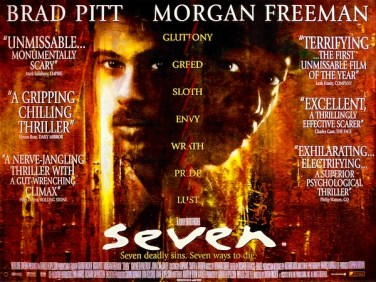
Se7en (1995)

100 Films’ 100 Favourites #81

Seven deadly sins. Seven ways to die.

Also Known As: Seven

Country: USA
Language: English
Runtime: 127 minutes
BBFC: 18
MPAA: R

Original Release: 22nd September 1995 (USA)
UK Release: 5th January 1996
First Seen: TV, 12th June 2001 (probably)

Stars
Morgan Freeman (The Shawshank Redemption, Million Dollar Baby)
Brad Pitt (Legends of the Fall, The Curious Case of Benjamin Button)
Kevin Spacey (The Usual Suspects, American Beauty)
Gwyneth Paltrow (Sliding Doors, Shakespeare in Love)

Director
David Fincher (Fight Club, Zodiac)

Screenwriter
Andrew Kevin Walker (8MM, Sleepy Hollow)

The Story
In an unnamed city, two homicide detectives investigate a series of grim murders inspired by the seven deadly sins.

Our Heroes
William Somerset is a detective who works calmly and methodically, and cares more than most. Serving out the last few days before his retirement, he lands a helluva final case. His new partner is David Mills, a hotheaded but idealistic new transfer who’s keen to prove himself. Despite their chalk-and-cheese temperaments, or perhaps because of them, the pair may be ideally suited to catch the elusive killer.

Our Villain
John Doe, a proper psychopath, and on a mission too. I say the detectives are ideally suited to catch him, but, well (major, major spoilers…) they technically don’t and he essentially wins.

Best Supporting Character
R. Lee Ermey’s police captain, purely for the moment when he answers a phone. I love that bit of humour far more than it probably warrants.

Memorable Quote
“What was in the box? What’s in the box? What’s in the fucking box?!” — Mills

Memorable Scene
The climax — just Somerset, Mills, and John Doe, alone in the middle of nowhere… and then a deliveryman shows up. “John Doe has the upper hand!”

Technical Wizardry
The film’s visual style really helps to sell the tone — dark, foreboding, grim. This is in part because it’s always raining, a decision made to increase the sense of dread, and because of Darius Khondji’s cinematography, which employed bleach bypass (see also: Minority Report), a process that serves to deepen shadows. Additionally, for the film’s Platinum Series DVD release it was rescanned from the original negative, meaning the whole film had to have its colour grading re-done. Some of the changes were quite extensive (as detailed in the DVD/Blu-ray’s special features, if you’re interested).

Truly Special Effect
A serial killer thriller might not sound like a special effect showcase, but John Doe’s extreme methods lead to some pretty unusual and gruesome corpses — rendered with suitably sickening prosthetics, of course. ‘Sloth’ is particularly harrowing, though ‘lust’ is so bad it’s left almost entirely to our imagination — though, again, someone had to design and build the… instrument.

Making of
John Doe’s shelves of handwritten notebooks were real and created especially for the film. They took two months to create at a cost of $15,000.

Next time…
Screenwriter Andrew Kevin Walker originally thought of 8MM as a sequel, and David Fincher was interested, but it didn’t happen and we wound up with the only-half-decent Nicolas Cage-starring Joel Schumacher-directed version instead.

Awards
1 Oscar nomination (Editing)
1 BAFTA nomination (Original Screenplay)
2 Saturn Awards (Writing, Make-Up)
5 Saturn nominations (Action/Adventure Film, Actor (Morgan Freeman), Supporting Actress (Gwyneth Paltrow), Director, Music)
Places with more taste (i.e. where it won Best Film): Empire Awards, Fantasporto International Fantasy Film Awards, MTV Movie Awards; plus Best Foreign Language Film at Blue Ribbon Awards, Hochi Film Awards, Sant Jordi Awards (Audience Award)

What the Critics Said
“designer unpleasantness is a hallmark of our era, and this movie may be more concerned with wallowing in it than with illuminating what it means politically. Yet the filmmakers stick to their vision with such dedication and persistence that something indelible comes across — something ethically and artistically superior to The Silence of the Lambs that refuses to exploit suffering for fun or entertainment and leaves you wondering about the world we’re living in.” — Jonathan Rosenbaum, Chicago Reader

Score: 80%

What the Public Say
“The rain never ends. There is seldom any sunlight, or any warmth. The city feels like a city of the damned, as if its denizens are souls trapped in some circle of hell from which there is no escape. A feeling of dread pervades everything; there is never any inclination that anything remotely like justice or hope or salvation is even possible here. […] it’s all style and atmosphere but… to criticise the film for that, almost feels like missing the point — it’s so integral to the piece, the atmosphere is actually one of the film’s characters” — the ghost of 82

Elsewhere on 100 Films
I reviewed Se7en quite thoroughly (and, if I do say so myself, quite well) as part of a retrospective on Fincher’s films back in 2011, concluding that “some would claim that Se7en is no more than a standard murder thriller with a stock mismatched pair of detectives. In some respects they’re right, but in enough respects they’re wrong. There’s a killer high concept behind the crimes, but it’s really the execution of the film that makes it so much more. It’s in the performances, the way those stock characters are written, their subplots, the story’s pace, the cinematography, the music, individual sequences like Somerset in the library or the climax that rise not only to the top of the genre but to the top of the very medium of film itself.”

Verdict

When asked, I normally say Se7en is my favourite movie. That’s partly pre-picked just to prevent any such conversations turning into a dreary slog where I um and ah through hundreds of options, but naturally there’s some truth in it. On the surface it’s merely a police procedural, but it’s the way it handles that material that elevates it. It’s a dark film about terrible deeds, which both suits its subject matter (murder isn’t really just a fun little mystery to solve, is it?) and presents a worldview that makes us consider who’s really right and who’s really mad — John Doe is clearly an evil psychopath, but does he have a point? It’s also made with supreme artistry by director David Fincher and his team — I’ve already mentioned DP Darius Khondji, but it’s also superbly edited by Richard Francis-Bruce. And I’d argue it has one of the greatest climaxes ever filmed. There are more easily enjoyable movies in my 100 Favourites, but there are none that are any better made, nor any that better expose the dark heart of humanity.

#82 will be… a big damn movie.

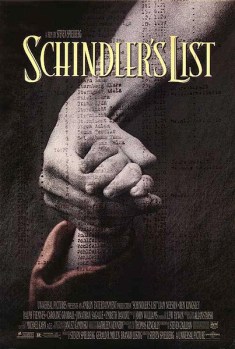
Schindler’s List (1993)

100 Films’ 100 Favourites #80

“Whoever saves one life,
saves the world entire.”

Country: USA
Language: English, Hebrew, German & Polish
Runtime: 195 minutes
BBFC: 15
MPAA: R

Original Release: 15th December 1993 (USA)
UK Release: 18th February 1994
First Seen: VHS, c.2001

Stars
Liam Neeson (Darkman, Star Wars: Episode I – The Phantom Menace)
Ben Kingsley (Gandhi, Iron Man 3)
Ralph Fiennes (The English Patient, The Grand Budapest Hotel)

Director
Steven Spielberg (Amistad, Lincoln)

Screenwriter
Steven Zaillian (Awakenings, Moneyball)

Based on
Schindler’s Ark, a Booker Prize-winning novel (released in America as Schindler’s List) by Thomas Keneally.

The Story
In occupied Poland in the early days of World War 2, German businessman Oskar Schindler opens a factory supplying the German military, staffed by Jewish workers. As the Nazis begin to close the ghettos and ship Jews to concentration camps, Schindler uses his connections and profits to surreptitiously save as many as he can.

Our Hero
Oskar Schindler is a self-interested businessman, womaniser, and member of the Nazi Party. Initially employing Jews merely for financial reasons (they’re cheaper than Polish workers), his innate humanity begins to come to the fore.

Our Villain
Nazis! But in particular Amon Goeth, the sadistic commander of the Paszów labour camp, who’s fond of executing Jews at random, amongst other horrors. Nonetheless, Schindler has to deal with him to ensure the (relative) safety of his workforce.

Best Supporting Character
Schindler’s contact on the local Jewish Council, Itzhak Stern, who becomes essential to making his business a success, and facilitating his operation to save the workers.

Memorable Quote
“I could have got more out. I could have got more. I don’t know. If I’d just… I could have got more.” — Oskar Schindler

Memorable Scene
During the destruction of the ghetto, Schindler sees a little girl in a red coat (the one splash of colour in the body of the film), wandering alone through the devastation. Later, as the Nazis burn piles of the dead, corpses are ferried to the pyres on small wagons. On one, Schindler sees a small body in a red coat… (There’s a good piece on the psychology of why these scenes are so effective here.)

Technical Wizardry
Spielberg chose to shoot in black-and-white to match actual documentary footage of the era, which was how he ‘saw’ the events. It was also shot without storyboards, Steadicams, cranes, or zoom lenses, and about 40% was filmed using handheld cameras, to emphasise a documentary feel. For a similar level of realism, Spielberg originally intended to make the film entirely in German and Polish with English subtitles, but changed his mind because he thought he wouldn’t be able to accurately direct performances in foreign languages.

Making of
Acting as producer, Spielberg initially tried to attract another director because he felt he wasn’t capable of doing the story justice. Martin Scorsese turned it down because he felt it should be done by a Jewish director, and Roman Polanski rejected it because it was too personal (he lived in the Krakow ghetto, only escaping on the day of its liquidation, and his mother died at Auschwitz). Finally, there was Billy Wilder — depending which version you believe, he either wanted to direct but Spielberg was already prepping the shoot, or he actually convinced Spielberg to direct it. Ultimately, Spielberg waited ten years between acquiring the rights and making the film, when he finally felt capable of tackling it.

Awards
7 Oscars (Picture, Director, Adapted Screenplay, Cinematography, Editing, Score, Art Direction-Set Decoration)
5 Oscar nominations (Actor (Liam Neeson), Supporting Actor (Ralph Fiennes), Costume Design, Sound, Makeup)
7 BAFTAs (Film, Supporting Actor (Ralph Fiennes), Director, Adapted Screenplay, Cinematography, Editing, Score)
6 BAFTA nominations (Actor (Liam Neeson), Supporting Actor (Ben Kingsley), Costume Design, Make Up Artist, Production Design, Sound)

What the Critics Said
“If E.T. The Extraterrestrial is Steven Spielberg’s fantasy masterpiece, and Jurassic Park is his commercial masterpiece, then Schindler’s List is certainly his artistic masterpiece. It’s an extraordinary work of vision and passion that raises even the gifted Spielberg to a new level of artistry. And like all great works, it elevates everyone who views it.” — Dennis King, Tulsa World

Score: 96%

What the Public Say
“It’s very, very hard-going and not an easy film to watch, but its importance is unparalleled. You sit there for three hours feeling uncomfortable – because these monstrosities really happened, because we live in a world where people are capable of these acts of inhumanity – and you still can’t even begin to imagine what it must have really been like, to live through that, to see your family and friends shot dead in the street or transported away en masse to the gas chambers. And yet, despite all that, you end the film feeling inspired. Someone made a difference.” — Millicent Murdoch, Millie’s Movie Reviews

Verdict

Schindler’s List wasn’t Spielberg’s first ‘serious’ film, but I think it shows a marked increase in quality over his good-but-flawed previous efforts, The Color Purple and Empire of the Sun. Liam Neeson gives a commanding performance as the imperfect hero, while Ralph Fiennes finds what little humanity there is in Goeth (and there isn’t much) to pull him short of being an Evil Nazi caricature. The stark black-and-white cinematography acknowledges the incomprehensibly horrific events, while Spielberg’s divisive penchant for sentimentality seems well-matched to the tale, offering a measure of hope from humanity’s darkest days.

What’s in #81? What’s in #81?

Saving Private Ryan (1998)

100 Films’ 100 Favourites #79

The mission is a man.

Country: USA
Language: English, French, German & Czech
Runtime: 170 minutes
BBFC: 15
MPAA: R

Original Release: 24th July 1998 (USA)
UK Release: 11th September 1998
First Seen: TV, c.2001

Stars
Tom Hanks (Big, Cast Away)
Edward Burns (She’s the One, 15 Minutes)
Matt Damon (Good Will Hunting, Jason Bourne)
Tom Sizemore (Natural Born Killers, Black Hawk Down)
(The lead cast includes since-famous people like Vin Diesel, Barry Pepper, and Giovanni Ribisi, and the supporting cast even more recognisable faces, but, still, Edward Burns is second billed.)

Director
Steven Spielberg (Empire of the Sun, War Horse)

Screenwriter
Robert Rodat (Fly Away Home, The Patriot)

The Story
In the immediate aftermath of D-Day, a group of soldiers are tasked to locate and rescue just one man: Private Ryan, whose three brothers have been killed in action, earning him a free pass home. As the squad trek across France, mindful of the waste of resources, they encounter first-hand the early days of the Allied invasion of Europe.

Our Heroes
Just a regular bunch of soldiers, co-opted into a PR mission that isn’t that easy. They’re commanded by Captain Miller, their respected leader with a secretive past… a past which is actually thoroughly mundane, and just highlights the bizarre, heightened world of the war.

Our Villains
Nazis!

Best Supporting Character
Matt Damon was cast as the eponymous soldier because Spielberg wanted an unknown with an all-American look. Unfortunately for that plan, before Private Ryan came out Damon won an Oscar for Good Will Hunting and became famous overnight. It certainly changes the effect to have the team rescuing Movie Star Matt Damon rather than Some Unknown Actor, but, on the bright side, he’s good.

Memorable Quote
Reiben: “Hey, so, Captain, what about you? I mean, you don’t gripe at all?”
Miller: “I don’t gripe to you, Reiben. I’m a captain. There’s a chain of command. Gripes go up, not down. Always up. You gripe to me, I gripe to my superior officer, so on, so on, and so on. I don’t gripe to you. I don’t gripe in front of you. You should know that as a Ranger.”
Reiben: “I’m sorry, sir, but uh… let’s say you weren’t a captain, or maybe I was a major. What would you say then?”
Miller: “Well, in that case, I’d say, ‘This is an excellent mission, sir, with an extremely valuable objective, sir, worthy of my best efforts, sir. Moreover, I feel heartfelt sorrow for the mother of Private James Ryan and am willing to lay down my life and the lives of my men — especially you, Reiben — to ease her suffering.’”

Memorable Scene
The opening half-hour, which recreates the Normandy landings in shocking, brutal detail, and is supposedly very true to the actual experience. Surely the definitive modern combat sequence from any war movie.

Technical Wizardry
The heavily desaturated cinematography by Janusz Kaminski instantly lends the film a grim veracity, very appropriate to its tone. Such extreme colour palettes are commonplace nowadays, mainly thanks to digital grading, but when Private Ryan came to US TV providers had to deal with numerous complaints from viewers who thought there was a problem with their signal — which the broadcasters fixed by just upping the saturation of the film, of course.

Truly Special Effect
The involvement of ILM was downplayed so that the film didn’t come across as “an effects movie”, but they still had a key role — for instance, providing most of the bullet hits throughout the D-Day sequence. Not remarkable effects work in itself, maybe, but it’s appropriately invisible.

Making of
The D-Day sequence alone cost $11 million. It was filmed over four weeks (almost half the entire shoot), gradually moving up the beach to film the whole thing in chronological order. Spielberg personally operated the camera for many shots, none of which were storyboarded. The shoot involved up to 1,000 extras, 20 to 30 of whom were amputees fitted with prosthetic limbs to simulate them being blown off. Reportedly, many veterans have congratulated Spielberg on the sequence’s accuracy, including actor James Doohan, aka Star Trek’s Scotty, who participated in the Normandy landings.

Next time…
HBO’s Band of Brothers is basically Saving Private Ryan: The Series, taking the film’s visual style to tell the true story of a company of soldiers from their training, through the invasions of France and Germany, and right up to the end of the war. Often topping lists as the greatest TV series ever made, it certainly belongs in consideration.

Awards
5 Oscars (Director, Cinematography, Editing, Sound, Sound Effects Editing)
6 Oscar nominations (Picture, Actor (Tom Hanks), Original Screenplay, Score, Art Direction-Set Decoration, Makeup)
2 BAFTAs (Sound, Special Effects)
8 BAFTA nominations (Film, Actor (Tom Hanks), Director, Music, Cinematography, Editing, Production Design, Make Up/Hair)
1 Saturn Award (Action/Adventure/Thriller Film)
1 Saturn nomination (Special Effects)
3 MTV Movie Awards nominations (including Action Sequence for the Normandy landings. It lost to Armageddon.)

What the Critics Said
“hands-down the best film of 1998. Spielberg has clearly stated in recent interviews that he made the film as a monument to the brave men who fought and died in that terrible war (and on D-Day, in particular), but he’s also done something morally heroic in the process. Private Ryan clearly illustrates, once and for all, that war — the real, appalling thing, not the flag-waving glorification that you usually see at the movies — is hell on earth. Spielberg accomplishes these goals with a technical virtuosity that no other director, arguably in the history of the cinema, can even approach. […] He’s a director whose work has grown right before our eyes from that of a precocious whiz-kid to the complex, humanistic statements of a true artist. Whether or not you always appreciate how he utilizes his skills, the man is an undeniable genius.” — Paul Tatara, CNN

Score: 92%

What the Public Say
“the opening 25 minutes of Saving Private Ryan – where [Spielberg] thrusts us into the 1944 D-Day landings of Omaha Beach – is arguably his most impressive and certainly his most visceral work. It’s absolutely exhausting in its construction and sense of realism and the realisation soon sets in, that this cinematic auteur is not about to pull any punches in portraying a time in history that’s very close to his heart. The opening is so commanding that some have criticised the film for not living up this grand and devastating scale but Spielberg has many more up his sleeve. He’s just not able to deliver them too close together – otherwise, the film would be absolutely shattering and very difficult to get through. To bridge the gap between breathtaking battles scenes the film falls into a rather conventional storyline about men on a mission but its only purpose is to keep the film flowing and allows Spielberg the ability to make the brutality of war more personal.” — Mark Walker, Marked Movies

Verdict

Is Saving Private Ryan the greatest war movie ever made? Maybe. The relatively simple story allows it to explore the mindset of the soldiers making the first forays into Europe after D-Day, both their camaraderie as a group of men and the actions they took to function through the experience. It’s certainly the most influential World War 2 movie of modern times — nearly 20 years later, its desaturated colour palette remains de rigueur for films set in the war. So too its realistic depiction of combat, which is more plausible than some of the Boy’s Own adventures that came before, though not so ridiculously gruelling as some that have come in its wake. Personally, the only superior WW2 ‘film’ I can think of is Band of Brothers, and considering that has ten hours to explore its characters and situations, it’s not really a fair comparison.

#80 will be… a very different Spielberg/WW2 story.