aka Alien³: Assembly Cut
2011 #14
David Fincher | 145 mins | Blu-ray | 15 / R
 It’s getting on for two years since I last (and first) watched most of the Alien
 Quadrilogy series, provoking some relatively lengthy (for this blog, anyway) debate on my reviews of the three sequels. I refer you to those at the outset for a couple of reasons. One, because a lot of my review of Alien³’s theatrical cut still holds true for this half-hour-longer version; two, because other points in that review may make an interesting counterpoint to the more positive thoughts I now have (“may”); and three, because some of the comments on the reviews also discuss this extended cut, which may also interest you.
They’re also relevant to highlight this point: it’s been two years since I watched Alien³ and I’ve only seen it once. Despite this extended version being 26% longer, that means I still found it hard to spot much of the additional material. I’m sure fans who’d seen the original multiple times in the decade between its theatrical release and this cut appearing in 2003 were able to spot changes much more readily. Nonetheless, a few obvious additions and modifications stand out: an extended opening when Clemens discovers Ripley on the beach; the Alien birthing from an ox (rather than a dog); the lack of a Queen chestburster at the very end. I could’ve turned on the Blu-ray’s “deleted scenes” marker of course, and I did consider that, but I thought it might just get distracting on a first viewing. And speaking technically, I don’t know what the new scenes looked like on the Quadrilogy DVD (as I haven’t watched that copy, obviously), but on Blu-ray the added footage, 2003-era new effects and 2010 re-recorded audio are indistinguishable from the rest of the film.
Readers interested in the history and reasoning of this new, significantly longer cut may appreciate the introduction it had in the Quadrilogy set’s booklet (sadly nowhere to be found on the Anthology Blu-ray). I’ve reproduced the majority of it below:
Following its troubled production and controversial release, Alien 3 slowly became something of a curiosity among serious enthusiasts of the Alien series. Not only would its first-time director, David Fincher, go on to become one of Hollywood’s most sought-after filmmakers but the film itself would generate quite a mystique thanks to heated rumours of creative interference, lost scenes and even a completely different cut of the film that supposedly restored Fincher’s original vision of what many believed to be a seriously compromised work.
Rumour control, here are the facts. There is no wondrous lost “director’s cut” of Alien 3. It doesn’t exist. Indeed, for such a dream to be realised, Fincher would have to be allowed to remake the film from scratch with complete creative control. What does exist is something perhaps equally fascinating.
For the first time, fans can now experience a restored and re-mastered presentation of the 1991 assembly cut of Alien 3. With a running time increased by more than 30 minutes, this Special Edition contains several never-before-seen sequences that offer a fascinating insight into the film’s difficult editing process. This cut also reveals a combination of vintage, previously unreleased optical effects shot and several newly-composited digital effects necessary to seamlessly integrate new footage into the body of the film…
The Alien 3 Special Edition offers fans a unique chance to witness the lost work of a remarkable director.
So there you go. As I mentioned, this version updates the 2003 one with some re-recorded dialogue.
On my original review, Matthew McKinnon commented that as he watched this new cut he realised “it wasn’t shaping up into a more coherent or purposeful movie… just a longer version with more of the same.” I agree that, to an extent, it’s “a longer version with more of the same”, but I found it more coherent too. While the major plot beats still occur at the same time and in fundamentally the same way, perhaps the myriad tweaks have made it clearer just what’s going on? Or perhaps I was just more familiar, having seen it once already? Either way, sequences and events that left me a bit lost last time seem to make perfect sense on this outing.
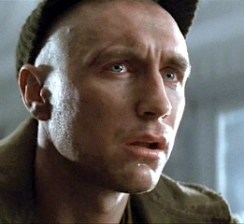 One of the biggest things I remember being told about Alien³, before the Special Edition, was that most of Paul McGann’s performance had been cut; that originally he had a sizeable role that justified his fourth billing, rather than his cameo-sized part in the theatrical cut. It doesn’t feel like there’s an awful lot more of him in this version, though scanning through Movie-Censorship.com’s thorough list of changes one can see a lot of brief shots as well as one or two significant scenes featuring him. Again, despite the sense that little has changed, his character does feel more comprehensible, so maybe these barely-noticeable additions do make all the difference?
As a little aside, I sometimes feel a little sorry for McGann — since his acclaim in The Monocled Mutineer, numerous shots at bigger success seem to have passed him by. He gets a key role in a Hollywood blockbuster, but is then largely cut out; he’s cast as Richard Sharpe in a major ITV series, but is injured and has to pull out (and we can see where that led career-wise for Sean Bean); he’s cast as the Doctor in a big-budget American backdoor pilot for Doctor Who, which flops Stateside and goes nowhere… He’s undoubtedly talented, but these days seemingly forced into lacklustre supporting roles in the likes of Luther. Maybe he doesn’t mind, I don’t know (at least he got “the largest insurance settlement in British television history” for missing out on Sharpe), but it seems like he deserved greater success. Poor guy.
Still, McGann’s performance here is exceptional, even if it’s still brief. He’s just one member of an outstanding British cast though, many of whom are recognisable for the excellent work they’ve done since.  Unsurprisingly, therefore, they’re almost all totally underused. Charles Dance gets the biggest slice of the cake and is as good as ever, but doing little more than show their face we have Pete Postlethwaite, Phil Davis, Peter Guinness, Danny Webb (they don’t all begin with P…) Alien³ is 19 years old now, no one could’ve predicted the future; but viewed with hindsight, the volume of under-utilised talent is almost astounding.
Hindsight also affords other interesting perspectives. Dance’s death is still very effective, for instance. It’s not surprising once you’ve seen the film more than once — obviously — but killing off really the only character our hero (and, by extension, the audience) has become sympathetic to at around the halfway mark? Not unheard of, true (see: Psycho), but still rare enough to be a shock, to disconcert and wrong-foot the viewer.
Plus, we can now look at it in the context of Fincher’s following work. Even though he had limited — often, no — control over much of the project, there are still signs that link it with his later films. It’s stylishly shot for one thing, most of the locations either soaked in shadow or cold light, with an often fluid camera. Darkness litters the film thematically too: setting it on a prison colony for murderers and rapists, the violent attempted gang rape of Ripley, the death and autopsy of a 10-year-old girl… Even if we see no real detail on screen (thank goodness this wasn’t made in recent torture porn-obsessed years), the implication and the emotional connection is harrowing enough. Then there’s the Alien itself, from its ugly birth to its violent murders. Fincher may have not turned so explicitly to horror since, but that brand of darkness does flow on into most of his best films: Se7en, Fight Club, Zodiac.
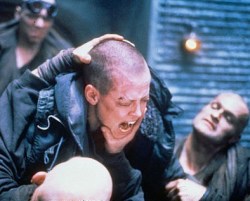 It’s also, perhaps, interesting to remember this being Fincher’s first film. He might seem like an odd choice, a first-timer paling beside the experienced hands of Scott and Cameron. But that would be to forget that, for both, their Alien films were only their second time helming a feature*; and while Cameron’s previous had been sci-fi (The Terminator), Scott’s was period drama The Duellists. A first-timer — especially one versed in commercials and music videos — isn’t all that different, really, and Fincher has certainly gone on to show his worth. Indeed, his very next film was the incredible Se7en.
Alien³’s Special Edition didn’t strike me as massively different from the theatrical cut, despite some obvious changes, with the exception that I now found it to be more intelligible. Whereas before I thought it started well and became less coherent — and, consequently, less good — as it went on, with this version I felt I was following the story and characters throughout. As a result, I enjoyed it more. Perhaps it also benefitted from my viewing situation: the first time I watched it within days of both Alien and Aliens; this time, I chose to watch it in isolation. Whatever the reasons, this Special Edition earns Alien³ an extra star from me.
* Cameron’s name is on Piranha II, and it is a fun joke to think such dross was his directorial debut, but his version (at least) of the behind-the-scenes story suggests it should in honesty be ignored. If you prefer, imagine I said Aliens was only his second major feature.
I watched the Alien³: Special Edition as part of a David Fincher Week. Read my thoughts on all his films to date here.

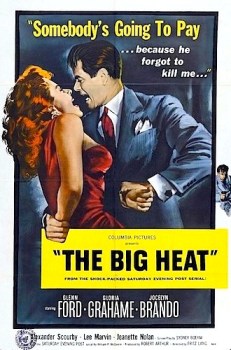 Fritz Lang is probably best remembered for the films he made in Germany; medium-defining classics like Dr. Mabuse, der Spieler, Metropolis, Das Testament des Dr. Mabuse and M — I’d certainly heard of him in the context of those films long before I realised he’d emigrated to America and produced several noirs — but now, I’m increasingly discovering his American output is nothing to be sniffed at.
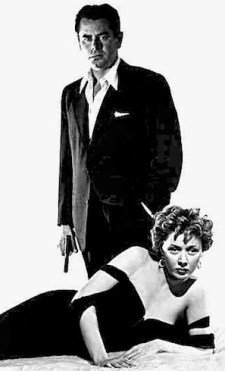 but it does manage what might be described as twists in how far it’s willing to go — mainly, who gets killed and how.
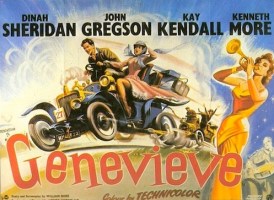 The further behind one gets on reviews, the easier it becomes to forget a film. Or not so much forget the film itself, but when one watched it. Or, to put it another way, I was a little surprised when I looked back over the 20 films I had left to review and saw Genevieve still there. At least I had a hundred or so words of notes for this one.
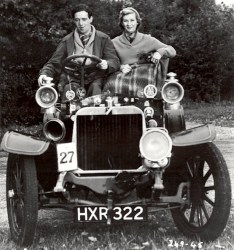 heightened by an evening of irritations and revelations, tipping the second half’s journey-back into an out-and-out race. It’s the second half that contains the more overt comedy as the rivals compete to scupper each other’s chances. That’s not to do down the more gentle style of the opening half, which has its moments. That said, depending on one’s perspective, the realistic sparring of the married couple during the opening scenes might be seen to give the film a bit of an edge of reality, making it not just the staged, (relatively) high-concept comedy it could have been.
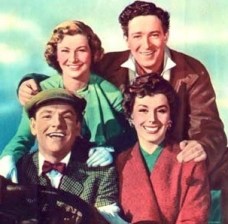 Director Henry Cornelius was vetoed on most of his first [casting] choices… and he was forced to make it at studios he didn’t want to work at. Cornelius’ displeasure was acutely felt by cast and crew as he didn’t hide how unhappy he was. He was also seemingly highly lecherous. Consequently both Dinah Sheridan and Kay Kendall carried whistles on them at all times… Olive Dodds, Rank’s head of contract artists, later testified that every leading cast member came to her at one point and said they wanted off the film.”
 Owen is a 12-year-old loner in New Mexico in 1983, spending his days at school being bullied and filling his evenings spying on his neighbours. Then a girl, Abby, and her father move in next door and it looks like he might finally make a friend.
 The nighttime scenes are bathed in the orange glow of street-lighting, a nice choice of colour scheme as it’s evocative of the real world, especially as it’s not unnaturally overdone: the colour is abundant where there is such lighting, but more natural tones are used in forests, etc. It also provides a very different feel to the original, where a more white, snow-emphasising light was adopted throughout. Despite its realism, though, such a solidly orange palette does make the US one feel more visually stylised. Ironic.
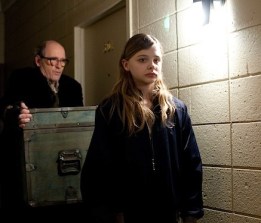 Despite it being easier to spot omissions than additions, Reeves’ film runs the same length as the original and feels faster moving. This may just be because I knew the story well, watching both versions just 24 hours apart, but some things are quantifiable: as well as far fewer scenes with the neighbours — in the original, characters; here, victim-extras — there’s also fewer arty shots of scenery, which helped give the original its sedate arthouse tone. What’s taken the place of all these things? Scenes from the novel, you might think, but from what I’ve read it’s faithful to the film more than novel — stuff I’ve read about being in the novel but not the Swedish film hasn’t been reinstated here either.
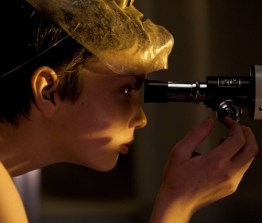 It seems he isn’t innocent in the same way Oskar was, that Reeves is building up his awareness of sexuality… but then he asks Abby to go steady and he still considers it to mean you don’t “do anything special”. What? Also, if she says “I’m not a girl”, surely the logical response is “you’re a boy?!”, not “what are you?” — especially if the only answer she’ll give is “I’m nothing”. But she’s not a boy — probably. It’s not explicit, but she seems much girlier, and of course it would remove any dangerous homosexual element. Or possibly they just wanted to make damn sure they didn’t need to include The Crotch Shot. Considering they’ve changed the bully’s teasing of Owen from “piggy” to “little girl”, it seems even more obvious a shame to have stripped Abby of her androgyny. Unless that’s the point? They tease Owen about being a little girl, before getting their asses kicked — or, rather, bodies ripped apart — by one.
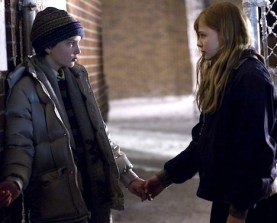 Similarly, the CGI is overdone throughout. It’s not bad per se, just used too overtly. Whereas the original remained grounded and (perhaps surprisingly) plausible, Reeves occasionally indulges in more stereotypical horror movie excess — take Abby’s first attack in the underpass, for instance: superficially similar, but in this version a computer-aided Abby flies all over the place. It draws attention to its has-to-be-fakery and is therefore a less effective sequence.
 It’s probably unfair to judge Let Me In by watching it so close to the Swedish version. I expect it benefits from a bit of distance. It’s still a well-made film, still an unusual take on a familiar genre. But it is — obviously — not as original or innovative. It’s also not as well acted, not as nuanced, not as beautifully made — the images Reeves conjures up do not burn themselves into your mind in the way so many from the original do.
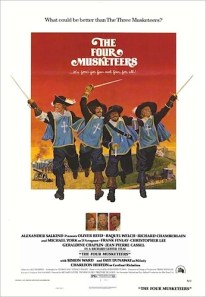 Richard Lester’s Four Musketeers was shot at the same time as the previous year’s
 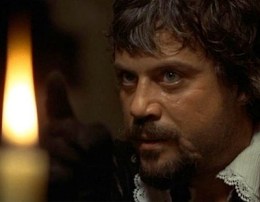 the murder of Constance; the cold-blooded execution of Milady; and ending up with Richelieu still in power too — none of it sits well with the jolly swashbuckling tone that still dominates. There are some good action sequences nonetheless — for instance, the ice-covered lake; breakfast/siege in the ruined fort; and the burning-building finale — which go some way to make up for the shortcomings.
 I expect you know the setup for The Invention of Lying: in a world very much like our own — except for the crucial difference that people can’t lie — Ricky Gervais invents lying. It sounds a simple, strong concept. I like it.
 how religion is just a lie we tell ourselves to make us feel happy — and it says this quite explicitly! In an American film!
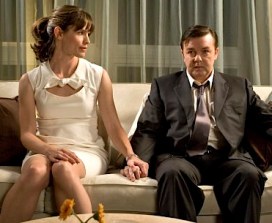 but that would miss the part where Gervais’ character helps her to grow as a person, to see beyond the surface gloss to the real people and situations underneath. OK, it’s not a groundbreaking message, but it suffices.
 They’re all fine, though the “oh, look who it is!” factor occasionally overwhelms the story briefly. (In the case of Merchant and Barry it’s more “oh, should’ve guessed they’d turn up”.)
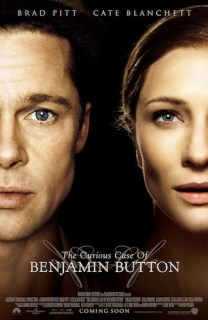 Benjamin Button was released in UK cinemas two years ago last week. Time really does fly. The critical reception was a little divisive — the
  The visuals in general may be Benjamin Button’s strongpoint, holding up a variety of era-evoking colour palettes and other design elements as it passes throughout the 20th Century. Flashback-like asides are conveyed in older film styles — scratchy prints for instance, or with a silent movie aesthetic — that on the one hand could seem an inappropriate indulgence, but objectively work very nicely. For a director who has a reputation in some corners for exhibiting excessive flair with swish shots and effects, Fincher shows steady restraint here — as he did in
  but Button didn’t feel nearly as episodic, nor nearly so obsessed with History. Benjamin encounters foreign diplomats and is embroiled in World War 2, but both are relatively non-specific and don’t colour his life in the way Gump’s parade of Defining Moments do. Instead the storytelling is character focused. Viewer awareness of time passing in the narrative is left to the odd snippet of dialogue or obvious jump; aside from a few clear points, there’s a less convincing sense of era than Fincher evoked in Zodiac. Whether this matters or not is debatable — Button isn’t a chronicle of the 20th Century through one man’s eyes, which is what Gump arguably was, but is rather the story of a (somewhat unusual) life lived during that timed period.
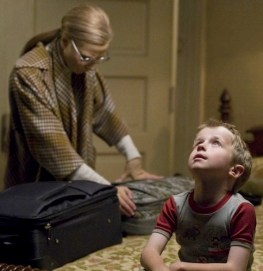 Or perhaps it’s the very point: the more things change, the more they stay the same. Benjamin is ageing in completely the opposite direction to the rest of us, and yet his life isn’t all that different. Witness the end of the film (naturally, spoilers follow): Benjamin loses his language and memory, his life fading away as his brain fails. Presumably this is because he’s regressing to childhood, his brain shrinking and devolving to that of a child/toddler/newborn, but don’t we see the same thing happen to adults with dementia? As Daisy observes earlier in the film, “we all end up in diapers”. A life backwards is not so different to a life forwards, then. It’s all in how you live it, that kind of thing.
 Ultimately, Benjamin Button strikes me as less than the sum of its parts. Bits are good, even very good — “bits” both as in story episodes and technical elements; and I particularly like the sections with Jared Harris, who’s always worth watching — but what does it add up to? It’s quite long and, unlike Zodiac, feels it. It may be easy to admire, but I find it awkward to love.
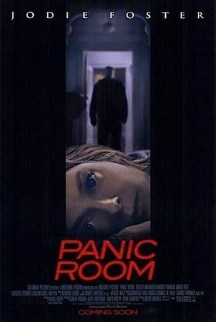 Panic Room stands out as (arguably) Fincher’s most atypical film. Whereas his others are all epic, in one way or another, this is the exact opposite. It’s very contained, virtually the entire running time spent on one night in one house, alleviated only by brief outside bookends and a guided tour of the house at the start. Fortunately, it’s still an outstanding little thriller.
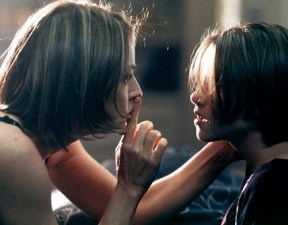 all the way squeezing the camera through banisters, coffee pots, and other assorted obstacles. There are several such shots, the majority early on (though not exclusively — witness the Hitchcockian transparent floor, for instance). This is presumably to help enliven the relatively slow build-up; later, the story’s inherent tension largely takes over.
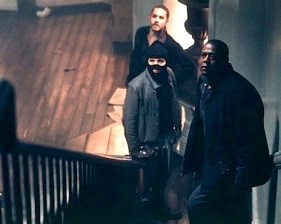 perfectly well staged and suitably tense or exciting as required, but Foster’s slow-mo dash for her mobile, and back into the panic room as the three burglars come pounding up the stairs, is one of those sequences that transcends the film it’s in to become a stand-out example of the form. Any skilled action director could have produced a good sequence at full-speed from that setup, but by switching to slow-motion Fincher stretches out the tension like an elastic band ready to snap, putting us on the edge of our collective seat as we urge Foster on through air that seems as thick as treacle.
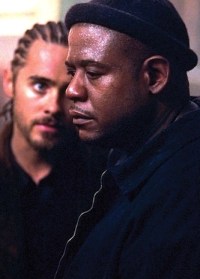 One other particularly interesting element is how we feel about Forest Whitaker’s character. This isn’t
 what’s missing from it, from him as a person, etc. — but these are more of a nice undertone than a major factor. Arguably Fincher would explore similar ground more thoroughly, though focused on a younger generation, in
 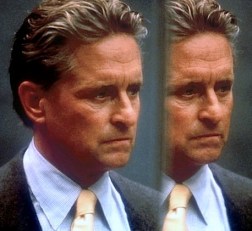 Watching it again, though, I couldn’t help but realise I used to like The Game more than I do now. After a couple of watches it becomes like a holiday photo album: a nice record and reminder of good times had, rather than ones experienced anew.
 100Films.co.uk