2013 #98
George A. Romero | 90 mins | Blu-ray | 2.35:1 | USA & Canada / English | 18 / R
 Once, zombie auteur George A. Romero commented that he’d hoped to make one zombie film a decade — witness Night of the Living Dead in 1968, Dawn of the Dead in 1978, and Day of the Dead in 1985. So why, then, did he churn out three new zombie flicks in four years, between Land of the Dead in 2005 and Survival in 2009? On the US Blu-ray, he explains.
Money.
Yep. As Romero tells the story, after Land of the Dead he had an idea for a film about ‘citizen journalism’. He wanted to make it quickly, before someone else had the same idea (sadly, several such films were already well into development, but hey, he didn’t know that), so how better to make a film quickly and cheaply than by turning to what he knew — zombies. The result, Diary of the Dead, was made so cheaply that, despite a limited release, it turned a healthy profit. Cue pressure on Romero to turn out another to capitalise on this success. So he did. And that probably explains why this entry — the sixth in his thematically-connected series of zombie films — was so poorly received and seems to be almost universally regarded as the weakest instalment.
As is so often the case, I disagree. But we’ll come to that.
A defining feature of Romero’s zombie series is that there are, as he argues, no sequels. The zombie-infested world of the films develops, but no characters return — each film is standalone; you could argue each concerns a different zombie apocalypse, if you really wanted. Survival bucks that trend by being the first direct sequel. If you’ve seen Diary, you’ll remember the (brief) scene where the military turn up and rob our heroes. Bastards. 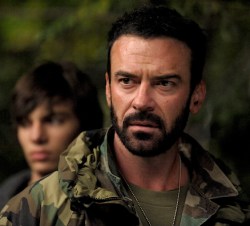 Well, that little gang of military types are back — and now they’re the heroes. Survival even takes the time to flashback to Diary, noting the release of the film-within-a-film led to the military gang’s leader, Sarge (Alan van Sprang), being recognised. It’s not a plot/character thread Romero chooses to develop further — there’s no about-turn in his values, or a desire to hide from said recognition — which is a shame, actually, because the plot supports such a move.
The story proper begins on the island of Plum, somewhere off the coast of America, which has been populated for centuries by two opposed Irish clans, the O’Flynns and the Muldoons. In the days following the outbreak, the O’Flynns set about killing the undead; the Muldoons, however, think they should be kept locked up, in case a cure is developed. This leads to the dominant Muldoons, led by Seamus (Richard Fitzpatrick) kicking some of the O’Flynns off the island, including patriarch Patrick (Kenneth Welsh). That’s how, months later, Patrick meets up with our military gang and lures them back to Plum, where things have changed…
The obvious problem here is one of heroes — who do we support? There’s the military guys, who we dislike from Diary; there’s Patrick O’Flynn, who we first meet when his posse murders a woman so they can get to her zombified children and dispatch them too; and there’s the Muldoons, who don’t factor in again for a while, but when they do… well, they’re not a nice bunch, really. And yet Romero doesn’t construct a whole film from unlikeable characters — well, some viewers would (and have) assert he does, but I tend to think he redeems the military somewhat. We meet up with them as they come across a gang of men in the woods, who have seemingly been hunting the undead for fun. In the latest twist on the zombie-killing format met with human cruelty, they’ve been beheading them and shoving those heads on sticks — and, as we know, unless the brain is destroyed the zombie ‘lives’. A confrontation leads to the nasty hunters being killed, and Sarge kindly ending the existence of the row of zombie heads. Doesn’t sound cheery, put like that, but the military are Doing The Right Thing.
 It’s also here that they meet a character known only as Boy (Devon Bostick), who had been co-opted into the gang of hunters. Turns out he’s handy with a weapon himself, and resourceful and clever. What an intriguing mystery. But don’t get too caught up — Romero never again alludes to where such skills materialised from. In fact, he so doesn’t return to the Boy’s abilities that I wonder if we weren’t even really meant to notice. Which doesn’t make sense. Is he left over to be revisited in a third in this new zombie series? Romero doesn’t seem to be in any rush to produce one… but then, Survival was an almighty flop (it even went straight to DVD here), so I guess we’ll never know.
As discussed, Romero already turned this one out quickly, motivated more by a desirous studio than a flash of inspiration (the fact its production company is called “Blank of the Dead” is telling), and the sacrifice for such speed seems to come in the thematic department: while all of Romero’s previous zombie films have a clear (some would say too clear) socio-political underscore, you could watch Survival and not even imagine one was there. I almost did. Instead, its thesis is a relatively slight offering about the futility of long-standing feuds that no one can remember the start of, and how they ruin everyone’s lives. It’s a valid point, and, in a world where the likes of the Israel-Palestine conflict rumble on, an ever-pertinent one. It feels underdeveloped, though; like Romero didn’t have time to make it work properly, and so just threw some extra elements in there to give the plot some drive. How do the military unit, our de facto heroes, actually relate to anything?
You know, I had a whole thing to go into there, and then the obvious hit me: they represent foreign (usually American) military interference. They wade in and cause a ruckus. Which side are they on? The one they encountered first, not the one that objectively has the best argument —  also a definition of US foreign policy, is it not. And I’m sure it’s no coincidence that the islanders are Irish; and not just Irish in the way so many Americans claim to be “Irish” or “Italian” or whatever just because 200 years ago they had some relatives who emigrated, but properly, thickly-accented Irish. Which, yes, is kinda odd on an island off the coast of America, but hey, why not.
Another thing Romero has almost always done is push his treatment of zombies forward. Diary was the black sheep in this regard — by going back to the start, the zombies regressed to shambling flesh-eaters; and, actually, they’re barely a part of that film, only turning up now and then to motivate an action sequence. Here, Romero is almost back on track: the zombies are a more major part of the movie, thanks to the Muldoons keeping so many of them alive, and Romero once again finds a new direction to push their development in. Some, I think, would find it preferable and more worthy of exploration than the ‘intelligent’ zombies of Day and Land. Indeed, even more so than the Boy, it’s a shame Romero hasn’t moved on to a seventh film to explore the potential of his closing-moments revelation here.
For those more concerned with zombie-killin’ action, Romero and his effects team continue to come up with new ways of ridding the world of the undead. There’s the return of flesh-ripping practical effects in an attempt to satiate the hardcore, but there’s still CGI, and inevitably they seem to have focussed on that instead. As I discussed in my Diary review,  I have no problem with CG blood splatter or what have you, and it’s as palatable here as it was there. There’s also a welcome return for his brand of humour, which went somewhat AWOL in the last couple of films. Those who criticise the film for being too comedic have, in my view, become too obsessed with modern cinema’s uber-serious tone. Lighten up folks, it’s a horror/sci-fi/fantasy movie.
I’ve written an average of 1,531 words about each of Romero’s previous ‘Dead’ movies, and even then not discussed everything I feel is worth saying about them. I thought Survival would merit a lot less because, despite my above analysis, it does feel more lightweight than its predecessors. In the end, it’s in the same ballpark (1,516 to be precise, and I still haven’t said everything worth saying), because a) I don’t think being lightweight is wholly a bad thing, and b) there’s more to it than meets the eye. There are, unquestionably, better zombie movies written and directed by George A. Romero, but I think here he’s produced one of his most watchable; one that can be as entertaining as the others, is still at times as innovative, and does even support a deeper reading, if you’re prepared to look for it. The film not only shows us that the dead can survive, but that so should Romero’s reputation.
Part of Week of the Living Dead for Halloween 2013.

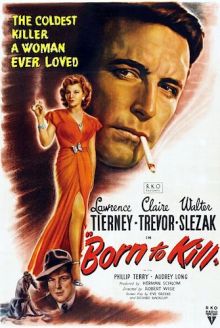 Director Robert Wise certainly had an eclectic career. Depending on your genre predilections, you may feel he’s best known for The Sound of Music and West Side Story, or The Day the Earth Stood Still and Star Trek: The Motion Picture, or The Haunting and The Body Snatcher, or perhaps even a string of film noirs including The Set-Up, I Want to Live!, Odds Against Tomorrow, and this mid-’40s thriller.
 Even today, it’s quite a nasty little work, although tastes have evolved to the point where “discriminating people” are likely to be attracted to it — though not purely for the violence. You’d imagine that would pale by today’s standards, but even now the opening double homicide — presented pretty much in full on screen — is quite shocking, especially because it seems so horrendously plausible. Much movie violence is heightened, involving gangsters or spies or whatever, but here it’s a lover in a jealous rage killing two people in the kitchen of a regular house. Grim.
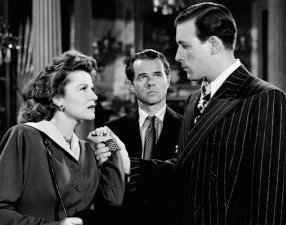 sometimes develop a cult following.
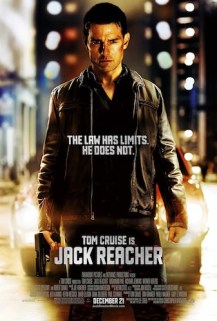 I don’t like Lee Child. I’ve never read one of his novels, but I’ve read and seen interviews with him, and always felt he comes across as intensely pompous and irritating. I disclose this up front because it leaves me predisposed to dislike Jack Reacher, the first (they hope) movie adaptation from Child’s series of novels starring ex-military policeman and now all-purpose vigilante Jack (you guessed it) Reacher.
 How much you consider the twists to be twisty will depend on which suspects your guesswork picks out, but in that regard it’s as strong as other similar genre examples.
 Sean Bean and his ragtag band of knights investigate an unaffected village during Ye plague-adled Olden Days in this folk horror from the director of
 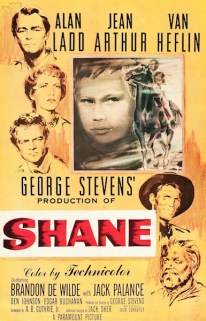 Though not part of my
  The thing with the wife, for instance, is mainly down to a few looks, or the way a line of dialogue is played. I was once taught that if a writer doesn’t put any subtext into a scene the actors will add it themselves — perhaps that’s even what happened here. I was wondering if it was going somewhere, if we were going to learn that Shane and wifey actually knew each other, or if they were going to have A Thing now (this being a ’50s American movie, “almost have a thing but then not quite” is probably nearer the mark). But, without meaning to spoil things, it doesn’t play out like that. At all.
 There is, I think, a degree of consensus amongst Bond fans (both serious and casual) about a great number of things. Everyone has their personal favourites and dislikes that go against the norm, of course, but there are few things that are genuinely divisive on a large scale. It’s largely accepted that
  there’s an awful lot of grand, expensive-looking underwater stunt work; and it’s relatively long too, the first Bond to pass two hours (and, even in the nicest possible way, it feels it). Accompanying it was an array of merchandising that, at least as I understand it, wouldn’t be seen again for years (these days it’s par for the course, kicked off by
  but if you just accept a few of those, allow them to wash over you as it were, then it’s quite good fun. For all its flaws, it’s also packed with brilliant moments: the scene at the Kiss Kiss Club is arguably the best-directed bit in the series to date, and remains one of my favourite moments from any Bond; then there’s the jet pack, indeed the whole opening titles; almost any scene between Bond and one of the numerous females; “I think he got the point”; Domino’s (first) swimming costume… Um, where was I?
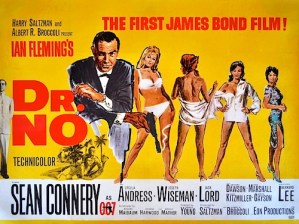 “Bond. James Bond.”
 Yet for that received wisdom about Goldfinger, ever so much of the familiar Bond recipe is here from the off: the gun barrel sequence, a dramatic pre-titles (albeit post-titles here), the music-driven silhouetted-girls-filled title sequence (even if they’re clothed here), Bond’s casual attitude towards women, his dry humour, his relationships with M and Moneypenny, his detective skills, his fighting skills, his driving skills, the megalomaniac villain, his extravagant lair, and of course the Bond girls — indeed, for all of the fame of Goldfinger’s gold-covered beauty on the bed, Honey emerging from the ocean is still the most iconic Bond girl of them all. And I imagine there’s more I’ve neglected to include.
 Plus, freed from the need to constantly Do Bond-Like Things, we get some solid detective work from our hero, rather than just turning up and saving the day. To put it another way, there’s a mystery and a story, not just a series of set pieces.
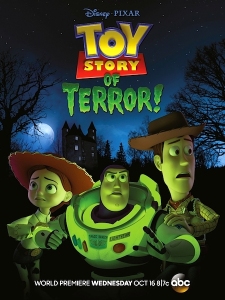 The fourth
 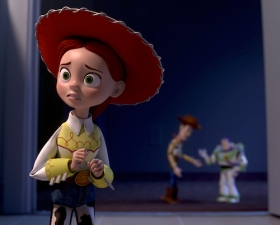 The second half is more familiar Toy Story stomping ground — indeed, if there’s one bum note, it’s that the villain and his ‘plot’ are almost a rehash of
 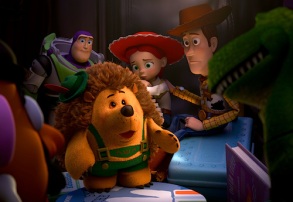 Apparently Toy Story of Terror! spent two years in development. While that might seem excessive for a mere under-half-hour animation, the time and effort have paid off handsomely: the result is a thoroughly entertaining short — and one that actually embraces its seasonal theme, rather than forcing it in as an afterthought. Terrific.
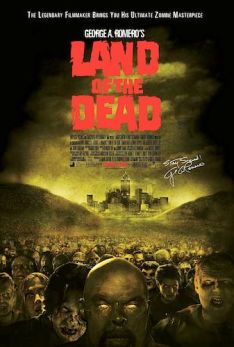 While the first three ‘Dead’ films (or “the original trilogy”, to put it in
 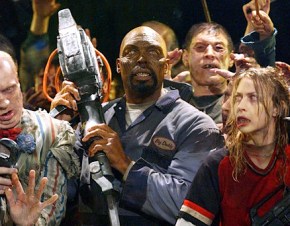 and then a desire for revenge, when he sees the glittering lights of the city in the distance. Lead he does, corralling the other zombies into a slow march towards their target.
 In the world of the humans, meanwhile, we also have an oppressed majority: the slum dwellers. Attempts at revolution there are soundly ignored, with the rich quietly taking the opposition out as ‘trash’ whenever able (which, I guess, is whenever they want). The people are controlled by drink, drugs, gambling, prostitution, and any other cheap entertainment you can imagine, all secretly managed from on-high to keep the general populace docile. And those entertainments are getting increasingly extreme, too: the zombie-on-zombie cage fights previously used cat or dog meat as motivation, but now they throw in Asia Argento. Again, Romero is holding a mirror up to present-day America, where the illusion of a ‘free society’ with easy social mobility is supported by the mega-rich in order to keep the poor down. It takes the zombie invasion for anything to change, which may be a case of Romero “following the story” rather than reflecting a political reality — who’s going to invade the US?
 Those commenters that do acknowledge these facets claim Romero’s just not as subtle as he used to be, which is also poppycock: Dawn’s criticism of consumerism is as blatant as anything listed here — perhaps even more so, because you can just watch Land as a near-future science-fiction humans-vs-humans-vs-zombies action flick, whereas I think Dawn’s ‘subtext’ is unmissable.
 If you want to see people getting ripped apart by zombies with their guts spilling out everywhere, in traditional Romero style, then… seriously, what’s wrong with you people?! But, erm, you should be satiated.
 Threequels, eh — who’d make ’em? It used to be received wisdom that sequels were poor, with only a few exceptions. That’s less often the case these days — indeed, it’s almost de rigueur that the first film in a potential franchise will exist to establish the world in preparation for a superior sequel. But how many great third films are there? There are some good ones, it’s true, but are there any that are the best film in their series? If there are, they’re certainly outweighed by the number that couldn’t live up to the quality of the two preceding parts.
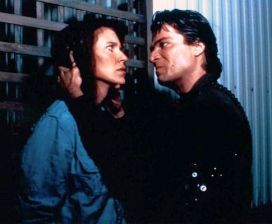 The same is true in Day’s criticism of science, especially vivisection. According to Romero (in the booklet that accompanies Arrow’s Blu-ray), he didn’t set out specifically to tackle that controversial area of scientific research. Instead, he developed a “next logical step” for what scientists would do to the undead. Of course, it’s horrific and criticism is implicit. Thankfully, Romero isn’t painting all science as bad: the lead character, our de facto hero, is also a scientist; but she’s not really interested in the vile work of her colleague, dubbed ‘Frankenstein’ by the soldiers.
 Bub salutes the Captain, an instinctive reaction the same as his shaving. That it leads to an ironic repetition at the film’s climax is perhaps satire, or perhaps just another cool moment. You have to hand it to Romero and co, though: it’s a great villain’s death scene.
 There’s probably an in-depth piece to be written on the evolving gender politics of the ‘Dead’ films, which I’m sure must reflect changes in society. Here, we have an unequivocal female lead, a scientist and voice of reason amongst the madness of both sides. She stands up for herself against the men, who belittle her as much as possible. Actress Lori Cardille has commented that she wanted to develop the woman’s role in these films, even beyond that of Fran in Dawn, who she saw as little more involved than the useless females of Night. Of course, as I noted last time, the role of Fran is considerably more involved and competent than that of Barbra or Judy, so it’s interesting that Cardille felt there was work still to be done. Not that she’s necessarily wrong; and the way the men treat her character in Day suggests that someone having a similar reflection on this film, nearly 30 years on, would find room for continued improvement.
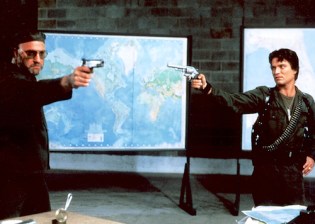 Romero’s critical stance evidenced here. I don’t even object to it being a bleak film, with little sense of hope for the future of humanity; in fact, there’s a lot to commend in that.
 100Films.co.uk