2015 #130
Joss Whedon | 141 mins | Blu-ray | 2.40:1 | USA / English | 12 / PG-13
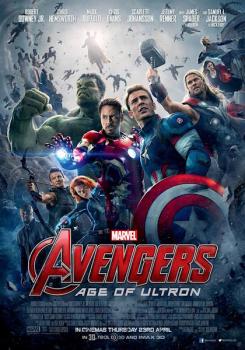 It feels kind of pointless reviewing Avengers: Age of Ultron, the written-and-directed-by Joss Whedon (and, infamously, reshaped-in-the-edit-by committee) follow-up to 2012’s “third most successful film of all time” mega-hit
 The Avengers Marvel’s The Avengers Avengers Assemble Marvel Avengers Assemble. In terms of consumer advice, you’re not going to watch this sequel without having seen the first, and therefore “more of the same (more or less)” will suffice for a review. In terms of a more analytical mindset… well, what is there to analyse, really? I’m not sure this movie has anything to say. “Of course it doesn’t, it’s a blockbuster,” you might counter, which I think is unfair to blockbusters. Not to this one, though. Nonetheless, I have a few thoughts I shall share regardless.
Firstly: Marvel’s initially-stated goal of keeping each of their film series separate enough that you don’t need to watch them all has clearly gone out the window by this point. Okay, you really needed a fair bit of knowledge from The First Avenger and Thor to fully understand Avengers Assemble (indeed, as I noted at the time, that first team-up movie is practically Thor 2), but I reckon you could get by without. In between, things have got worse: jumping from any of the pre-Avengers films to their post-Avengers sequel without viewing the team-up movie renders them semi-nonsensical, and now swathes of Age of Ultron make little sense without at least having seen Captain America: The Winter Soldier, which fundamentally shifted the status quo of the Marvel Cinematic Universe.
That’s not all, though, because Age of Ultron is also concerned with setting up the future. Far from being self-contained, there’s heavy-handed set-up for Avengers 2.5: Civil War Captain America: Civil War, Thor: Ragnarok, and the two-part Avengers: Infinity War. 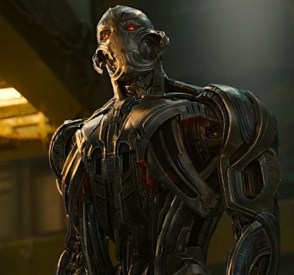 Even though the first half of that is still three years away, we’re still very much on the road to it. Heck, we have been practically since the MCU began, thanks to those frickin’ stones (if you don’t know already, don’t expect me to explain it to you), but now it’s overt as well as laid in fan-friendly easter eggs. The titular threat may rise and be put down within the confines of Age of Ultron’s near-two-and-a-half-hour running time, but no such kindness is afforded to the myriad subplots.
Said threat is Ultron, a sentient robot born of Tony Stark’s work, who seeks to make the world a better place by obliterating humanity. As played by James Spader, it seems like Whedon has created a villain in his own image. Oh sure, every character speaks a little bit Whedon-y, but Ultron’s speech pattern, syntax, tone, and sense of humour is often reminiscent of how Whedon himself sounds in interviews; and if you told me Spader was doing a Joss Whedon impression for the voice, I’d believe you. Considering the well-publicised behind-the-scenes wrangles the film went through, especially in post-production, it does make you wonder how conscious it was — Whedon casting himself as a villain with good intentions who’d like to destroy the Avengers. Something like that, anyway.
A behind-the-scenes story Marvel Studios are more keen to emphasise is how they did a lot of real-world-related stunts for real, like in the Seoul bike/truck/Quinjet chase, for instance (you know, the one where Black Widow is on the bike in the film but controversially not in the toy because of the “no girl toys!” rule). Behind-the-scenes features on the film’s Blu-ray detail the extent they want to in closing down real locations, performing dangerous or hard-to-achieve stunts, and so on and so forth. You have to wonder why they bothered, because there’s so much CGI all over the place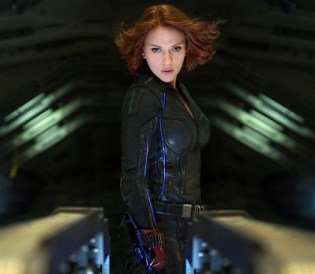 (not just obvious stuff like the Hulk, but digital set extensions, fake location work, even modifying Stark’s normal Audi on a normal road because it was a future model that wasn’t physically built when filming) that stuff they genuinely did for real looks computer generated too. All that time, all that effort, all that epic logistical nightmare stuff like shutting down a capital city’s major roads for several days… and everyone’s going to assume some tech guys did it in an office, because that’s what it looks like. If you’re going to go to so much trouble to do it for real, make sure it still looks real by the time you get to the final cut. I’ll give you one specific example: Black Widow weaving through traffic on a motorbike in Seoul. I thought it was one of the film’s less-polished effects shots. Nope — done for real, and at great difficulty because it’s tough to pull off a fast-moving bike speeding through fast-moving cars. What a waste of effort!
Effort invested elsewhere has been better spent, however. For instance, this is a Joss Whedon movie, so we all know somebody has to die. Credit to Whedon, then, for investing in a thorough attempt at misdirection. He goes all-out to imply that (spoiler!) the bucket shall be kicked by Hawkeye: the archer has suddenly got a bigger role; we get to meet his family; every time there’s a montage and someone starts discussing sacrifice or the inevitability that they won’t all survive, it’s Barton who’s on screen; he’s the most sacrificeable Avenger anyway, the only one with neither his own movie nor fan demand for one; and Jeremy Renner’s dissatisfaction with the role he got in Avengers 1 has been well documented. If anything he goes too far in that direction — it’s so obvious Hawkeye’s for the chop that it’s not wholly surprising when there’s a ‘twist’ and (bigger spoiler!) the even-more-dispensable Pietro Maximoff (he apparently has just seven lines in the entire film) is the one who make The Ultimate Sacrifice. Which is… neither here nor there, really.
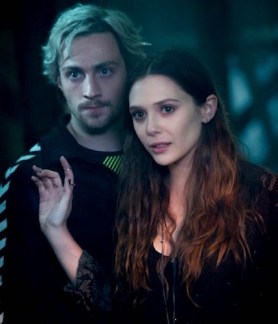 The really daft thing is, Whedon specifically added Scarlet Witch and Quicksilver… wait, are Marvel allowed to call them that? I forget. Anyway, Whedon added the Maximoff twins because, as he said himself, “their powers are very visually interesting. One of the problems I had on the first one was everybody basically had punchy powers.” I know Hawkeye’s power is more shoot-y than punchy, and we all know X-Men used the silver speedster even better, but still… Well, I guess it’s not his problem anymore. Nor is the fact the film ends with a radically new status quo, including most of the big-name heroes having sodded off to leave a 66%-replaced Avengers line-up… which will be completely shattered almost instantly in next year’s Captain America: Basically The Avengers 3. But hey, nothing lasts forever, right? Or even a whole movie, it would seem.
Other people’s opinions, and the expectations they foster, have a lot to answer for when you first watch these films months after release. I found the first Avengers to be massively overrated — only sporadically fun; not that funny; in places, really quite awkward, or even dull. I couldn’t really enjoy it; it just was. This sequel, on the other hand… isn’t underrated, but comes with so much negative, niggly baggage that, with lowered expectations, I was able to just enjoy it on a first viewing. I found it funnier than the first; I thought the characters and their relationships were smoother. It’s still flawed (the Thor arc is clearly bungled; the climax is too much; stuff they did for real, at great expense and difficulty, looks like CGI; and so on), but no more than the first one. I think people’s over-hyped memories make them think it’s worse than it is by comparison. Then again, there’s no accounting for taste — there are definitely things people have criticised about the movie (the level and style of humour; the focus given to Hawkeye) that were actually among my favourite parts.
 At the end of the day, what does it matter? Age of Ultron isn’t so remarkably good — nor did it go down so remarkably poorly — that it deserves a reevaluation someday. It just is what it is: an overstuffed superhero epic, which has too much to do to be able to compete with its comparatively-simple contributing films on quality grounds, but is entertaining enough as fast-food cinema. Blockbusterdom certainly has worse experiences to offer.
Avengers: Age of Ultron is on Sky Movies Premiere from Boxing Day.
This review is part of the 100 Films Advent Calendar 2015. Read more here.

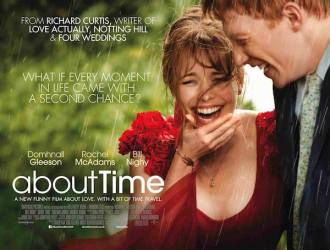 After Tim (Domhnall Gleeson) learns he can time travel back through his own life, his father (Bill Nighy) cautions him not to attempt anything too drastic — so he sets about finding love.
 Hated by Americans and loved (well, ok, “liked”) by everyone else (well, ok, “by lots, but by no means all, of people who reside outside America”), Disney’s attempt to pull a
  I know some people complain about simplistic stories that are used to just string action sequences together, and that’s a perfectly valid thing to get annoyed about, but The Lone Ranger swings to the other extreme and uses an over-complicated story to string together its action sequences. All it actually needs is a little streamlining, because the film is allowed to swing off into too many sideplots. This makes the middle of the film a slog, and you feel every minute of its excessive two-and-a-half-hour running time.
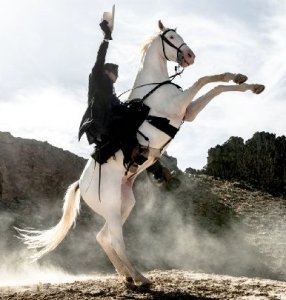 a recurring problem for Disney at the minute. To be frank, I’m not convinced anyone made a truly concerted effort to stem the overspend. When a gaggle of CG rabbits hopped on screen, all I could think was, “who allowed this?!” You’ve got a massively over-budgeted film that the studio want cut back, and one reason for that is CG bunnies that have almost no bearing on anything whatsoever! The amount of time and effort that must’ve gone into creating those fairly-realistic rabbits for such a short amount of screen time… it cost millions, surely. Millions that could’ve been saved with a simple snip during the writing stage if only someone had said, “well, those bunnies don’t add anything and they’ll be bloody expensive, so let’s lose them.”
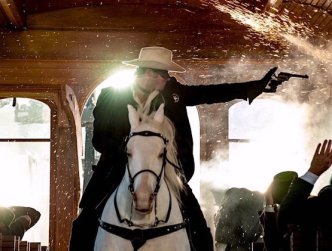 I’m not quite as effusive as Hughes, but The Lone Ranger is worth the time of anyone who enjoys an action-adventure blockbuster. It’s a three-star adventure-comedy bookended by a pair of five-star railroad action sequences, which make the trudge through the film’s middle hour-or-so feel worthwhile. There was a better movie to be made here — one that was half-an-hour shorter, more focused, and probably several tens of millions of dollars cheaper to make — but that doesn’t mean the one we got is meritless.
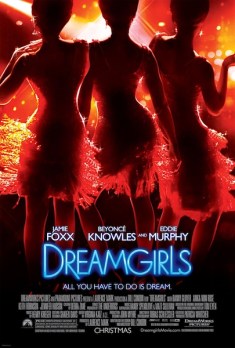 Oscar-winning adaptation of the stage musical that doesn’t tell the story of the Supremes in fictionalised form, no sir.
 Adapted from the classic young adult sci-fi novel by Orson Scott “bigoted idiot” Card, Ender’s Game is the story of Andrew “Ender” Wiggin (Asa Butterfield), who displays uncommon aptitude in a military programme to train children to fight against an alien race that attacked Earth decades earlier. Sent to a training centre in space, Ender must battle his fellow candidates to prove their worth to their hardened commander, Colonel Hyrum Graff (Harrison Ford), ready for the real battle to come.
 It tips its hat to things like drone warfare, child soldiers, and understanding our enemy, but that’s all it does: acknowledge those parallels exist, then refuse to explore them. Conversely, the music is too heavy-handed, taking on the burden of providing emotion that’s lacking from the screenplay.
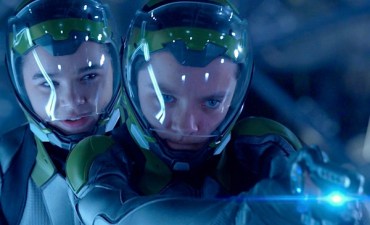 Sadly, after all that training fun, once the cadets jet off to the other side of the galaxy for a rushed third act, interest evaporates speedily. It even has to work hard to sell its own twist as a twist! (Spoilers follow in this paragraph.) In a simulation for a war, Ender does what he’d do to win that war. Then he’s told it wasn’t a simulation, it was the actual war… and he’s all cross. I mean, okay, the fella kinda has a point when he gets angry afterwards: they’ve lied to him, and maybe he would’ve behaved differently if he’d known. But the point of the training was to teach them what they needed to do to win, and it taught them that, and he did it. Maybe this twist works in the book, but in the film it felt somehow unearned.
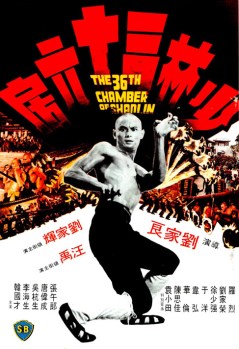 Widely regard as one of (if not the) greatest kung fu movies ever made, The 36th Chamber of Shaolin introduces us to San Te (Gordon Liu), a student whose hometown is oppressed by forces of the ruling Qing dynasty. He and his classmates join the underground resistance run by his teacher, only to wind up witnessing his friends and mentors be hunted, tortured, and killed. Faced with a similar fate, San Te escapes to the Shaolin Temple, widely known for being home to the best kung fu around. The temple’s monks refuse to teach martial arts to normal folk, nor help by joining the fight — they’re Buddhists, after all. Nonetheless, San Te manages to inveigle his way in to their company, and years of training begin.
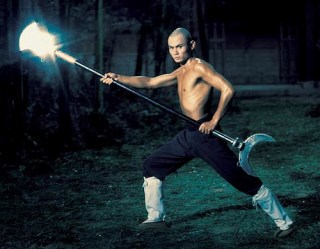 San Te is eventually learning how to use weapons, and when he finally graduates from the 35th chamber he has to prove himself in combat, first against the temple’s justice, then when he returns to the outside world and seeks vengeance. Fights both with and without weapons are imaginatively choreographed and executed with the customary speed and precision.
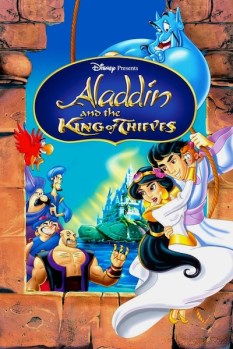 For most of the ’90s and ’00s, Disney churned out direct-to-video sequels to many of their most beloved animated classics. They have a reputation for being unremittingly awful, hence why Pixar’s John Lasseter put a stop to their production after he became Disney’s Chief Creative Officer in 2006. Despite that reputation, however, there are those who say one or two are actually quite good. One of those (and the only one I’ve previously seen) is
  are to be found with the forty thieves… I expect you can guess where that’s going. Fortunately the film gets there pretty quickly, then transitions into a story about the possible redemption (or not) of Cassim alongside the quest for the Hand of Midas, capable of turning whatever it touches into gold (natch).
 Screened in UK cinemas simultaneously with its TV premiere (and coming to the big screen in various other countries over the next week or so, too), the latest episode of the BBC’s modern-day Sherlock Holmes series is actually a standalone adventure set in the character’s original Victorian time period.
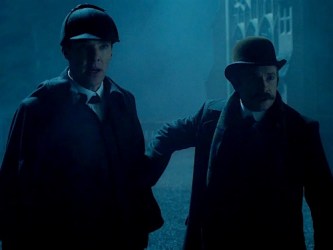 The case they find themselves embroiled in is a little more period than usual, however, with lashings of Gothic and some of the trappings of a Christmas ghost story. The episode is co-written by series creators Mark Gatiss and Steven Moffat, and anyone familiar with Gatiss’ wider work can clearly see his influence here. Moffat brings his trademark fast-paced intricately-tricksy plotting, for which individual viewers’ mileage varies greatly: some find it genius, some find it tedious. Is it clever, or does it just think it’s clever? Is it impossible to follow, or were you just not paying enough attention? As to the first question, I think it’s a bit of both; as to the second, I think the episode ultimately answers everything, but you might need to realise a few things for yourself.
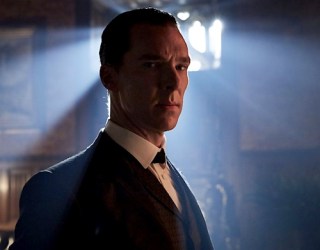 Until the last half-hour or so, anyway, when the modern version suddenly comes crashing in. At first it seems like a clever interlude; a little reminder of the true time period for this version of the characters, and a tease for season four. But it quickly transpires that, no, this episode isn’t actually a wholly standalone aside from the main series — Gatiss and Moffat have found a way to integrate it into continuity. For me, this is where the special begins to come apart at the seams; not because I inherently object to this integration, but because from that point on the episode begins to jump back and forth between the present, the imagined past, and various other dream-state asides. It’s almost entirely justified by the beautifully-shot Reichenbach Falls sequence, but a spot of cinematographic prettiness doesn’t really excuse the way the story goes a little haywire. The least successful part of all, for me, is that it calls into question the solution for the case we’ve just been presented with… but then doesn’t get round to offering another, meaning you kind of feel like the case hasn’t been solved, even though it presumably has been, with the first solution. I think.
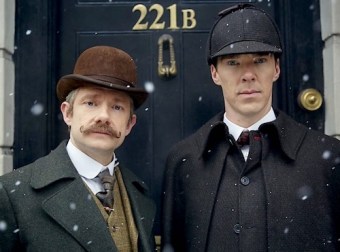 As someone who enjoys Sherlock Holmes in his proper era but is also a fan of this modern day version (I would say “a big fan”, but I’m not one of those people), I’d rather they’d played this a little more straightforward. Not a lot — it’s still under the umbrella of Sherlock after all, and the era-transposed stylistic flourishes in the first hour-ish worked very nicely in my opinion — but the mixed-up mishmash of the final act dilutes the effectiveness of the entire experience. There’s fun and thrills to be had along the way, but in another form it could perhaps have been a Sherlockian classic in its own right.
 Did Daniel Radcliffe murder his girlfriend? Sprouting devilish horns doesn’t help his case…
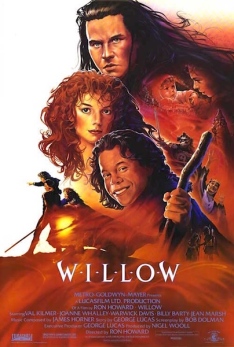 Warwick Davis is the farmer who must return an abandoned baby, unaware it’s heir to a throne evil queen Jean Marsh doesn’t wish to relinquish. Intermittently aided by Val Kilmer’s Han Solo-ish vagabond, they must elude the queen’s forces, led by her daughter, Joanne Whalley.
 100Films.co.uk