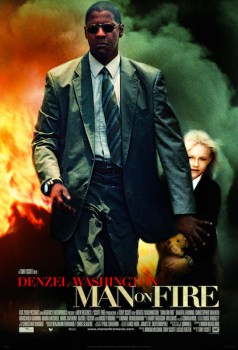
Man on Fire (2004)

100 Films’ 100 Favourites #57

A promise to protect.
A vow to avenge.

Country: USA & UK
Language: English & Spanish
Runtime: 146 minutes
BBFC: 18
MPAA: R

Original Release: 23rd April 2004 (USA)
UK Release: 8th October 2004
First Seen: in-flight, c.2004

Stars
Denzel Washington (Philadelphia, Training Day)
Dakota Fanning (War of the Worlds, The Runaways)
Radha Mitchell (Pitch Black, Melinda and Melinda)
Christopher Walken (The Deer Hunter, Hairspray)
Marc Anthony (Bringing Out the Dead, El cant ante)

Director
Tony Scott (Top Gun, Enemy of the State)

Screenwriter
Brian Helgeland (L.A. Confidential, Legend)

Based on
Man on Fire, a novel by A.J. Quinnell.

The Story
As a wave of kidnappings from rich families sweeps Mexico City, burnt-out former soldier Creasy is hired as the bodyguard of little Pita Ramos. She begins to bring him out of his reclusive shell, so when he fails to prevent her abduction, he vows to make the people responsible pay — very, very violently.

Our Hero
Washed-up alcoholic former Marine and ex-CIA operative John Creasy is a broken man, only taking bodyguard work in Mexico City because he needs the cash. He still has a particular set of skills at hand when needed, though.

Our Villains
An array of ruthless kidnappers and corrupt cops, though some of the villains may be closer to home…

Best Supporting Character
Dakota Fanning has relatively limited screen time as little Pita, at least after the first act, but it’s enough for the viewer to warm to her as much as Creasy does, getting us on side for the violence to come.

Memorable Quote #1
“Creasy’s art is death. He’s about to paint his masterpiece.” — Rayburn

Memorable Quote #2
“Forgiveness is between them and God. It’s my job to arrange the meeting.” — Creasy

Memorable Scene
After corrupt detective Fuentes is kidnapped by Creasy, he wakes up tied to the bonnet of a car wearing just his boxers. Creasy demonstrates how he built a small bomb, before informing Fuentes where that bomb is currently located. To be blunt: it’s in Fuentes’ ass. That certainly gives the interrogation a different flavour.

Technical Wizardry
The film’s visual style — jumpy cutting, heavy saturation, etc — is apparently designed to reflect Creasy’s fractured mental state. The most memorable part, at least for me, were the subtitles, which use various fonts, placements, and reveals to make them feel part of the whole package, rather than a bunged-at-the-bottom last-minute addition.

Making of
The film was really shot in Mexico City, under the real threat of kidnapping and/or other violence. Radha Mitchell was escorted by three bodyguards after her driver was carjacked at gunpoint; Denzel Washington was also surrounded by bodyguards at all times; several crew members were robbed at gunpoint, and, according to the police, the crew were also targeted for kidnapping

Previously on…
A.J. Quinnell’s novel was previously adapted in 1987 starring Scott Glenn, Joe Pesci, and Jonathan Pryce.

Awards
2 Golden Trailer Awards nominations (Best Action (for trailer C), Best Drama (for trailer B))
3 nominations for Dakota Fanning as supporting or young actress (Broadcast Film Critics Association Awards, Golden Schmoes Awards, Young Artist Awards)

What the Critics Said
“On paper, we have a well-worn initial-mistrust-gives-over-to-mutual-affection arc, but Washington’s despair-tinged reserve and Fanning’s astonishing naturalness give the relationship warmth and resonance. Fanning exudes more than enough charm and decency to make Creasy’s renewal of faith completely believable. […] As the action goes increasingly over the top, so does Scott’s visual pyrotechnics. Probably setting a new world record for the number of different film stocks in one movie, Scott and hot-to-trot cinematographer Paul Cameron (Collateral) whip-pan and crash-zoom to new levels of excess, heightening both the teeming life of Mexico City and the anxiety around Pita’s kidnapping. Best of all are the subtitles: rather than simply translating dialogue, they assault the viewer, conveying drama and emotion through aggressive graphic design. You’ve never seen any done like this before.” — Ian Freer, Empire

Score: 39%
(I had no idea this was so critically reviled! I thought it was quite well liked, in fact.)

What the Public Say
“it is relentless in assaulting your senses and your sensibilities, and that can often be unpleasant, at best. While this is obviously the intended effect in many cases, [it] has the effect of making it unlikeable to watch, if not for the actions of its star character, then just for the fact that it seems intent on making the audience feel every ounce of anguish in the torturer and his victim. It’s definitely intended, but it doesn’t exactly result in me feeling empathy for either character, one way or another. It must be said, however, that Tony Scott is not afraid to have his character do horrible things to people. He’s not concerned about what the audience thinks about Creasy so much as they just consider why he is.” — CJ Stewart, The Viewer’s Commentary

Verdict

On the one hand, Man on Fire represents the start of Tony Scott’s stylistic excess that would see him through the rest of his career — the jumpy editing, oddly saturated images, etc. (It’s also present to an extent in Spy Game, though.) It would get a bit much at times (Domino), but Man on Fire uses it effectively. On the other hand, the film works just as well as a character-driven revenge drama. Rather than rush to the shooting-and-killing, Scott and screenwriter Brian Helgeland take their time to build the relationship between Creasy and Pita, so that when we do reach the vengeance portion of the story, you’re as invested as the characters are. Of course, from there it is (as a film from the year before would put it) a roaring rampage of revenge.

#58 will be… practically perfect in every way.
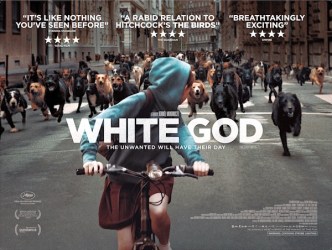
White God (2014)

aka Fehér Isten

2016 #11
Kornél Mundruczó | 121 mins | streaming (HD) | 2.35:1 | Hungary, Germany & Sweden / Hungarian | 15 / R

Thirteen-year-old Lili (Zsófia Psotta) and her dog Hagen are forced to temporarily live with her father, Dániel (Sándor Zsótér), because her mother is going on holiday with her new partner. Dániel doesn’t like Hagen anyway, but when the dog’s behaviour causes problems for him, he sets Hagen loose on the streets. Already angry with her father and his attitude, a devastated Lili sets out to find her beloved dog, who is busy discovering the darker side of mankind and our treatment of animals.

If White God sounds a bit bleak then, well, it can be. It’s a European arthouse drama, really, and so you get the attendant choices with pacing and storytelling style, as well as a commitment to realism — until the third act, at least, which I’ll come to in a moment. Hagen ends up in some very dark places, and co-writer/director Kornél Mundruczó doesn’t shy away from showing their brutality. Conversely, real dogs were used throughout filming, and the film doesn’t have a Hollywood budget for prosthetics or CGI, so we’re spared some of the imagery a less fiscally inhibited director might’ve forced upon us. Mundruczó insisted that all the dogs in the film were real animals trained to perform (and none were harmed, of course), which must’ve been limiting at times, but makes everything we see that much more effective.

For all the toughness of the journey, where it leads is triumphant; not entirely so, I must add, but enough. The film’s third act can pithily be described as Rise of the Planet of the Dogs: having seen the abuses of humans, an impounded Hagen leads a canine uprising that seeks to… well, they don’t speak (they’re dogs, remember, and this isn’t Disney), so who knows what their precise aims are? “Revenge” would be too cruel, but they definitely seeking some retribution. The film’s sadness doesn’t disappear (hence why not entirely triumphant), but some wrongs are righted.

The comparison to certain films about apes goes further than just the theme of an animal revolution, however: just like the last two Apes movies, White God drags a little when it leaves the animals for the humans. I’d love to see an edit which just followed Hagen’s story — you’d certainly keep all the film’s interesting and memorable bits, and lose very little. Not that the human bits are bad, per se, but they don’t go anywhere particularly new. Ooh, a teenager striking out, going to clubs (gasp!), and then realising that her parent isn’t such a monster after all (twist!) The performances are good — young Psotta is very naturalistic, and Zsótér makes you understand the humanity of someone who could’ve been a straightforward villain — but the dogs are where the real interest is at.

Some will find the middle of the film a slog, I suspect, both emotionally and with its occasionally lagging pace. However, the bookends seek to justify it. There’s catharsis in the finale, as described, but even better is the film’s opening. It has to be seen to be properly understood, but it’s operatically scored, shot, and edited, and involves hundreds (literally) of trained dogs en masse. It’s spectacular, unforgettable moviemaking; perhaps even one of the best openings to a film ever. And I don’t say that just as a “dog person”.
White God could benefit from tightening in some places, and less focus on the by-the-motions human subplots wouldn’t be a bad thing, but as a kind of magical realist drama, almost an arthouse take on certain Hollywood blockbuster narratives, it’s a compelling and sometimes awe-inspiring movie.

4 out of 5

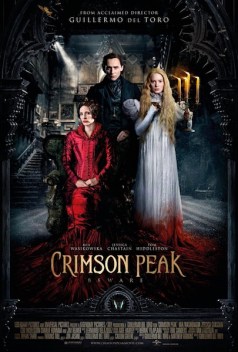
Crimson Peak (2015)

2016 #33
Guillermo del Toro | 119 mins | Blu-ray | 1.85:1 | USA & Canada / English | 15 / R

Mia Wasikowska stars opposite a British thesp best known for playing a comic book villain and a red-headed repeat-Oscar-nominee, in a Gothic drama-thriller from an acclaimed non-Anglo director? That’s a description of Stoker, Park “Oldboy” Chan-wook’s modern-Gothic chiller that co-starred Matthew “Watchmen” Goode and Nicole “The Hours” Kidman, which I awarded a five-star review and a place in my top ten last year. It’s also a description of Crimson Peak, Guillermo “Pan’s Labyrinth” Del Toro’s classic-Gothic chiller that co-stars Tom “Thor” Hiddleston and Jessica “Zero Dark Thirty” Chastain, which struggled to find an audience in cinemas last year. That last fact has often been attributed to its marketing, which I presume was as a horror movie (I never watched any of the trailers). It’s understandable the studio went for that, though: they know how to sell horror, but Crimson Peak is actually something more uncommon.
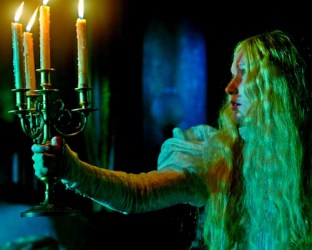
If you’ve not at least heard of The Castle of Otranto then there’s a chance your expectations of Crimson Peak may be misaligned. Which is not to say you won’t like it, especially if you’re of an open-minded disposition, but if having heard it’s “Gothic” and a “horror movie” has conjured up something Hammer-esque in your mind, then you are indeed off base. I think most people hear “Gothic” and automatically extrapolate “Gothic horror”, at least as far as movies are concerned. Crimson Peak isn’t a Gothic horror, though — at least, not in the Hammer sense — but rather a Gothic Romance, which is as distinct from “horror” as it is from “romance”. Perhaps “Gothic melodrama” would be a term better suited to today’s audiences. OK, maybe not — frankly, it’s difficult to imagine any scenario in which a movie of this kind generates big bucks at the box office unless you somehow made one that features a comic book character beating the crap out of the cast every 20 minutes.

The story actually concerns Edith Cushing (Wasikowska), a well-to-do businessman’s daughter in upstate New York who is occasionally haunted by ghosts. She falls for visiting English gent Sir Thomas Sharpe (Hiddleston) and, long story short, moves with him and his haughty sister Lucille (Chastain) back to their crumbling — literally — pile in the English countryside. The house hides many secrets, and ghosts, too. Having said it’s not a horror movie, it would be unfair to class Crimson Peak as simply a tame drama — as you’d expect from writer-director Guillermo del Toro, those ghosts can be bleedin’ scary, and there are certainly a smattering of good old fashioned jumps to boot.
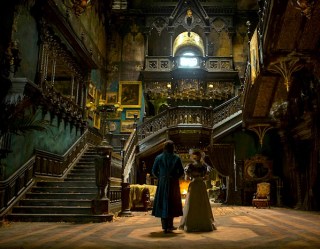
If you start reading online (the ones I read, at any rate), you tend to find people either: a) thought there weren’t enough ghosts, or b) thought there were too many ghosts. And there’s an element of truth in this: the horror bits are a little bit too horror-genre for a Gothic romance/melodrama, but they’re undoubtedly not in it enough to transform it into a full Horror movie. Someone with the predilection to enjoy both is required to stomach the film, which I must say I am, and I dare say Del Toro would fit that bill also. It seems clear that he’s made exactly the film he wanted to make; it’s just unfortunate that turned out to be a tricky sell, and consistently misunderstood by a mainstream audience. (I say “mainstream audience” because you can find an abundance of comments on film-fan websites noting how it was incorrectly marketed, etc.) That said (minor spoiler here), it’s stated in the film itself that the ghosts are a metaphor. OK, it’s stated by Edith about the story she’s writing, but you don’t need a degree in Film Studies to realise this is meant as a meta-comment on the film as well. Or maybe you do.

Whatever one’s thoughts on the story and tone of the film, it can’t be denied that its technical merits are extraordinary. Every inch of the design work is gloriously imagined, and the cinematography — the lighting in particular — is spectacular. And that gigantic house set…! And the climactic ‘limbo’ set, too — incredible work. (That’s not a spoiler, incidentally: it was the set’s nickname, not its literal location.) The ghost effects are excellent too — original, creepy, and executed in a way that blurs the lines between make-up, animatronics, and CGI. It’s a shame the film as a whole wasn’t better received, because I imagine that’s all that held it back from numerous awards-season nods.
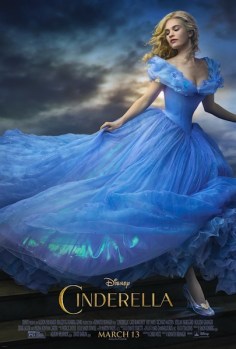
Crimson Peak is exactly the kind of film that, on reflection, I may wind up liking even more than I do now. Perhaps others will feel the same and it will also gain better standing in assessments of the director’s filmography — even as it is, it’s definitely one of my favourite Del Toro films (though I really need to give Pan’s Labyrinth another go, to see if I can see what all the fuss is about this time). The film’s tagline was simply “Beware”, but perhaps the viewer needs to be warned instead to “be prepared” — if you know what you’re getting in to, I think Crimson Peak has a lot to recommend it.

4 out of 5

Crimson Peak premieres on Sky Cinema (including via Now TV) tomorrow, Sunday 17th July.

Cinderella (2015)

2016 #43
Kenneth Branagh | 101 mins | streaming (HD) | 2.35:1 | USA & UK / English | U / PG

Disney’s animated classic is re-imagined in live-action, losing the songs but expanding the story. The latter serves to find a little more realism in the setup (how Cinders became a servant to her stepmother, etc), as well as in the characters’ motivations and actions.

Cate Blanchett excels (as ever) as the evil stepmother, and Lily James sells Ella’s perfectness as delightful rather than irritating. It’s kinda odd to see Game of Thrones’ Richard Madden as a clean-cut Prince, though.

Branagh brings requisite class and gloss for a remake that, while not a classic like the original, is a worthy revisioning.

4 out of 5

Grand Piano (2013)

2016 #34
Eugenio Mira | 87 mins | streaming (HD) | 2.35:1 | Spain & USA / English | 15 / R

Written by Damien “Whiplash” Chazelle, Grand Piano is “Phone Booth with a piano”. Elijah Wood plays a nerve-ridden musical wunderkind about to make his comeback when he receives a phone call ordering him to play an impossible piece of music perfectly or else his loved ones get it. Is he up to the challenge? Can he uncover and defeat his telephonic terroriser whilst also giving a piano performance to a packed house?

Running under 80 minutes before the credits roll, Grand Piano is a brisk thriller that barely has time to be anything less than engrossing. It relies on keeping you entertained with its series of quick reveals, twists, and sequences of tension, rather than meaningful themes or considered characters (though look out for some perhaps-familiar faces in supporting roles nonetheless). Director Eugenio Mira keeps things relatively classy, rather than descending into meaningless shaky-cam antics — this is a movie set at a classical music recital, after all.

The storyline is utterly preposterous, of course, though it amuses me that some people criticise it for that. I mean, it’s a genre picture — no genre picture is not preposterous. The veneer of truth they present varies, but rare is the genre movie that crafts a genuinely plausible version of real life. Die Hard would never, ever happen, but it’s still a great action movie. I’m not claiming Grand Piano is of Die Hard quality, but criticising its plot for being preposterous? It’s not so preposterous that it breaks the ‘rules’ of the thriller genre. Either you’re on board with that, or maybe you shouldn’t watch this kind of movie.
Really, there’s not much more to Grand Piano than its well-made creation of tension and thrills, and so I don’t find myself with much more to say about it. I enjoyed it very much, though.

4 out of 5

Pillow Talk (1959)

2016 #31
Michael Gordon | 102 mins | Blu-ray | 2.35:1 | USA / English | PG

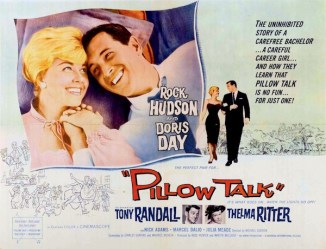
Doris Day and Rock Hudson star in this Oscar-winning rom-com hit.
The “they hate each other, will they get together?” storyline is, of course, obvious, but that’s beside the point. The leads spark off each other wonderfully, director Michael Gordon finds enjoyably inventive uses for split-screen and voiceover, and the Eastmancolor cinematography looks gorgeous in HD.

The only major downsides are a ludicrously rushed ending, and a lack of clarity that the people who share a phone line aren’t in the same building (I assumed that’s how a shared line would work!) Still, minor niggles in a film this fun.

4 out of 5

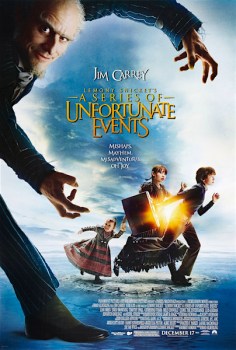
Lemony Snicket’s A Series of Unfortunate Events (2004)

100 Films’ 100 Favourites #50

Don’t say we didn’t warn you.

Title Commonly Abridged To: Lemony Snicket
Title on IMDb: A Series of Unfortunate Events

Country: USA & Germany
Language: English
Runtime: 108 minutes
BBFC: PG
MPAA: PG

Original Release: 16th December 2004 (Australia & New Zealand)
UK Release: 17th December 2004
US Release: 17th December 2004
First Seen: cinema, c.2004

Stars
Jim Carrey (Ace Ventura: Pet Detective, Eternal Sunshine of the Spotless Mind)
Liam Aiken (Stepmom, How to Be a Man)
Emily Browning (Sucker Punch, Pompeii)
Jude Law (The Talented Mr. Ripley, Sky Captain and the World of Tomorrow)
Billy Connolly (Mrs Brown, Quartet)
Meryl Streep (Sophie’s Choice, Mamma Mia!)

Director
Brad Silberling (Casper, Land of the Lost)

Screenwriter
Robert Gordon (Galaxy Quest, Men in Black II)

Based on
A Series of Unfortunate Events, a series of novels by Daniel Handler Lemony Snicket. In particular, the first three: The Bad Beginning, The Reptile Room, and The Wide Window.

The Story
After their parents are killed, the three Baudelaire siblings are placed into the care of a series of kooky relatives, while the scheming Count Olaf attempts to track them down and murder them for their money.

Our Heroes
This is the story of the three Baudelaire children: resourceful, inventive eldest sister Violet; bookish Klaus; and baby Sunny, who is very perceptive and can also bite things. No one knows the precise cause of the Baudelaire fire, but just like that, the Baudelaire children became the Baudelaire orphans, and were put into the care of…

Our Villain
Count Olaf, the kind and friendly guardian who wants to kill the orphans for their inheritance. A master of disguise… sort of.

Best Supporting Character
The film is wittily narrated in the erudite English tones of Lemony Snicket himself, who gets all the best insights.

Memorable Quote
“This would be an excellent time to walk out of the theatre, living room, or airplane where this film is being shown.” — Lemony Snicket

Quote Most Likely To Be Used in Everyday Conversation
“I will raise these orphans as if they were actually wanted!” — Count Olaf

Memorable Scene
The end title sequence re-tells the film in a pop-up book / shadow puppet show kind of style, which is awesome.

Memorable Music
The film has a great, fun score by Thomas Newman. The downside to it is you can hear the style bleed in to other, less appropriate work, like Skyfall.

Technical Wizardry
The entire film was shot on soundstages, including exterior scenes, utilising forced perspective and matte paintings, as well as greenscreen. No doubt that helped create its surreal, fantastical, timeless style. Indeed, the whole thing looks great, with superb gothic/steampunk-inspired design work across the board (and all of it Oscar nominated). If you want to be critical I suppose you could call it “Burtonesque”, but if it works… Plus, it was shot by Emmanuel “three time Oscar winner” Lubezki, so you know that’s good.

Truly Special Effect
Baby Sunny was largely played by a pair of twins, but certain sequences that were either dangerous or required specific actions necessitated the use of various effects techniques. Several scenes were created with an entirely CGI Sunny (motion captured from the animation supervisor’s own baby daughter); some shots of her talking have the lower part of her face replaced with a virtual version; and they built an animatronic baby, too.

Making of
Olaf: “I must say, you are a gloomy looking bunch. Why so glum?”
Klaus: “Our parents just died.”
Olaf: “Ah yes, of course. How very, very awful. Wait! Let me do that one more time. Give me the line again! Quickly, while it’s fresh in my mind!”
That’s Carrey genuinely asking for the line again, in character. Director Brad Silberling liked the moment so much he kept it in the film.

Next time…
Although plans for a sequel and/or sequels were mooted, the kids long ago aged out of such things. Instead, the books are being re-adapted as a Netflix series, starring the legen- (wait for it) -dary Neil Patrick Harris as Olaf and with Patrick Warburton narrating. It’s being produced/directed by Barry Sonnenfeld, who Handler Snicket had originally developed this film adaptation for. An eight-episode first season is due later this year. Personally, I’m quite excited for it.

Awards
1 Oscar (Makeup)
3 Oscar nominations (Score, Art Direction, Costume Design)
2 Saturn nominations (Fantasy Film, Make-Up)
1 Teen Choice Award (Choice Movie Bad Guy)
2 Teen Choice nominations (including Choice Movie Liar)

What the Critics Said
“As the title suggests, Unfortunate Events belongs to the grim but vital strain of children’s literature in which children suffer terribly, parents and kindly adults have the same life expectancy as villains in action movies, and courage and ingenuity are all that keep kids alive. […] At its best, A Series Of Unfortunate Events is the stuff nightmares are made of, a sick joke of a film that realizes the best children’s entertainment doesn’t hide from the bleaker side of life, but plunges into the void and respects kids enough to assume they can handle it.” — Nathan Rabin, The A.V. Club

Score: 72%

What the Public Say
“While there are certainly dark currents under the surface of this fantasy, the director Brad Silberling doesn’t let them overtake the film. Yes, bad things happen—people die and children are in jeopardy. But there’s a dry wit that balances out and also a sense of fun in how the kids use their abilities to discover a new way to survive whatever comes next. Lemony Snicket’s A Series of Unfortunate Events is a strange, dark film, and I recommend it for being just that.” — Tanner Smith, Smith’s Verdict

Verdict

I’ve never read A Series of Unfortunate Events, but I get the impression some of its fans aren’t too enamoured with this film adaptation and its changes. As a movie in its own right, however, it’s a clever, witty, gothic adventure… for kids! Jim Carrey is on fine form as the evil Count Olaf, there’s quality support from some recognisable thesps in guest-star-level roles, the kids are a likeable bunch, and baby Sunny’s subtitled observations are frequently the highlight. Some reviews describe it as “superficial” or a “pantomime”, but even if it is, it’s devilishly entertaining.

#51 will be… professional.

Adam (2009)

2016 #20
Max Mayer | 95 mins | TV | 2.35:1 | USA / English | 12 / PG-13

Hugh Dancy (of TV’s Hannibal) stars as the eponymous Adam, a New Yorker with Asperger syndrome who’s having to work out how to go it alone after his protective father passed way. Isolated by his condition and his struggle to cope with change, his life faces upheaval when he loses his job, but he also begins to strike up a relationship with his new neighbour, Beth (Rose Byrne). As someone once said*, the course of true love never did run smooth — especially when one of a couple has a social interaction disorder.

Inspired by writer-director Max Mayer hearing a person with Aspergers interviewed on the radio, that starting point has had the end result of Adam at times being at risk of slipping into a “this is Aspergers” documentary. Fortunately it manages to pull that back — such explanatory scenes are surely necessary for neophyte viewers’ understanding of Adam’s condition, which is naturally central to the events that follow. Dancy worked with with Mayer for a month before filming began to develop the character, and spoke with individuals affected by Aspergers to learn about their feelings, sensory issues, and interests. It clearly paid off: I imagine it must be tricky to pull off a character like that without taking it too far, but Dancy is great in the role.

As the other half of the relationship, Rose Byrne holds her own having to almost play the ‘straight man’ to Dancy’s more obvious performance. She’s a considerably better actress than some of her movie choices would have you believe, and roles like this prove that. Bonus points to the writing here for Beth not just accepting everything Adam does — that’s much more realistic than him happening across an endlessly understanding saint of a woman. But boo to the critics who didn’t buy that a privileged “daddy’s girl”-type could ever possibly fall for someone with autism — how judgemental are you?
Among the supporting cast, Peter Gallagher plays the kind of role he always seems to play: as soon as he makes passing mention of being investigated for some kind of financial crime, you know he did it (and probably more), and his daughter will find out and it’ll wipe the scales from her eyes. The only question is whether he’ll be found guilty by the court or weasel his way out of it. Talking of predictability, Mayer opts for the ‘indie’ rather than trad-rom-com ending, but that in itself is kind of predictable. Of course, when both possible outcomes are predictable (and, in a rom-com, there are only two), you can’t win.

So you can’t deny there are clichéd building blocks here, and they do hold the film back from being great, but the sweet relationship and Dancy’s performance overcome them enough to make for a likeable movie.

4 out of 5

* It was Shakespeare. It’s always Shakespeare. ^

Independence Day: Special Edition (1996/1998)

2016 #102a
Roland Emmerich | 154 mins | Blu-ray | 2.39:1 | USA / English | 12 / PG-13

I’m not sure when I last watched ID4 (as it was so often branded and marketed, for only semi-clear reasons — sure, US Independence Day is July 4th, but other than that the “4” has nothing to do with anything), but it’s been a damn long time — my DVD copy, which I know I never watched (I have the shiny new remastered Blu-ray now), has a postcard inside advertising the forthcoming Planet of the Apes remake, in cinemas Summer 2001. The time I best remember seeing it was in cinemas on its initial release. Independence Day was a phenomenally huge deal back in 1996: it felt like that shot of the White House being destroyed was on TV on loop; there were making-of TV specials (I remember the behind-the-scenes footage of how they did those incredible, much-discussed effects as clearly as I remember anything from the film itself); I listened to the Radio 1 Independence Day UK audio drama on tape (it was… so-so), read the tie-in comic book adaptation, and also the tie-in novelisation — which was the first book I ever gave up on without finishing because I thought it was so badly written. Ten-year-old badblokebob, literary critic. The film itself was also the first 12-rated movie I went to see in the cinema, so it was even more of a big deal for me.
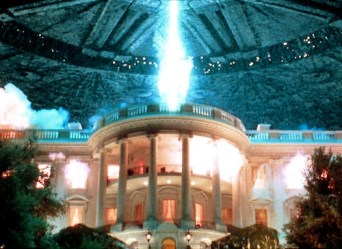
Revisiting it 20 years later, with a sequel imminent, ID4 obviously no longer has that attendant hype, but it does hold up pretty well in its own right as a blockbuster disaster epic. At least, it did for me — I read a review on Letterboxd from someone who watched it for the first time this January, saying that, in the age of the modern spectacle-based blockbuster, Independence Day doesn’t compete. Which feels weird, because it was all about the spectacle when it came out; but of course, things date, and what counted as sheer cinematic spectacle in 1996 is (it would seem) underwhelmingly run-of-the-mill in 2016. It’s fair to say that not all of the model effects still hold up, but there’s a physicality to them that really works. The best ones are still among the best movie effects ever.
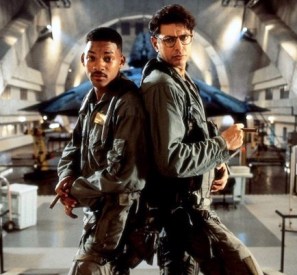
The film’s first half is superior to its second. Co-writer/director Roland Emmerich and co-writer/producer Dean Devlin conceived the film off the idea of 14-mile-wide spaceships just appearing one morning, and the realisation of that concept (and the ensuing destruction) is where the film really shines. That’s not to say there’s not good stuff after the aliens unleash their devastating destructive power — the famous presidential speech comes just before the climax, for one — but it’s from the midpoint on that some things begin to get a tad muddled, some subplots are rushed along, and other events get needlessly elongated. That said, it’s all relative: the 2016 version of this story with this many characters would surely run for five hours as it endeavoured to give them all a starring-role-level storyline and turn every effects-fuelled alien encounter into a 20-minute action sequence.

One area it really succeeds is humour. It doesn’t lose the scale or seriousness of the events, but it keeps the tone entertaining. That feels like a skill a lot of blockbusters used to have that’s gone awry in recent years, though you could use the tone of Marvel Studios’ movies to counterpoint that. Those Marvel films are definitely subject to a different criticism of modern blockbusters, however, which is their mindless destruction of whole cities. It’s a just criticism, and some of the blame for it can surely be traced back to the popularity of ID4. However, here the destruction isn’t so unfeeling: the morning after the aliens’ famous landmark obliteration, President Whitmore mulls over how many people died and how many didn’t have to if he’d made different choices. Both Marvel and DC have had to make that kind of reflection a plot point in sequels to retrospectively justify it happening in the first place.
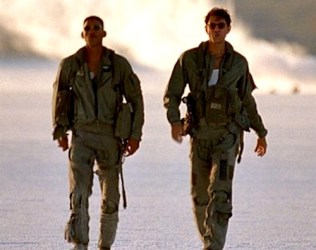
This was the first time I’d watched Independence Day’s extended Special Edition cut, and I’d advise not bothering. It adds around 8½ minutes of new material, but the scenes don’t add all that much, and some of them are so awkwardly rammed in that it’s almost irritating — for instance, several are inserted in the middle of an existing music cue by merely fading out the score immediately before the new scene, then fading it back in afterwards! They’re deleted scenes that have been shoved into the movie, with the score often fudged to make room and stuff like that, rather than it being a genuine “extended cut”. People seem to love extended cuts on disc, but sometimes a nice deleted scenes section is preferable.

With the way things are nowadays — every hit sequelised; old IPs regularly dragged up for new moneymaking opportunities — it was kind of inevitable we’d get ID4 2 eventually. I’m looking forward to it, but not insanely hyped up. It probably benefits from the 20-year wait story-wise, allowing for a drastically new status quo on Earth when the aliens return, but with blockbusters released all year round now, and CGI meaning every one is overloaded with effects shots that are far more epic than ID4 had, there’s little doubt that the sequel won’t have the same enduring impact on the blockbuster firmament. For its faults, you can’t deny ID4 that.

4 out of 5

Independence Day: Resurgence is in UK cinemas now, and is released in the US tomorrow.

Kill Bill: Vol. 1 (2003)

100 Films’ 100 Favourites #48

A Roaring Rampage of Revenge

Also Known As: Kill Bill: Volume 1

Country: USA
Language: English, Japanese & French
Runtime: 111 minutes
BBFC: 18
MPAA: R

Original Release: 10th October 2003 (USA)
UK Release: 17th October 2003
First Seen: cinema, October 2003

Stars
Uma Thurman (Pulp Fiction, My Super Ex-Girlfriend)
Lucy Liu (Charlie’s Angels, The Man with the Iron Fists)
Vivica A. Fox (Independence Day, Sharknado 2: The Second One)
Daryl Hannah (Splash, Wall Street)
David Carradine (Death Race 2000, Q: The Winged Serpent)

Director
Quentin Tarantino (Pulp Fiction, Inglourious Basterds)

Screenwriter
Quentin Tarantino (True Romance, Django Unchained)

The Story
Left for dead by her former teammates, highly-skilled martial artist the Bride awakes from her coma with one thing on her mind: to hunt down her would-be assassins in a roaring rampage of revenge.

Our Hero
The Bride, aka Black Mamba, aka [bleep], is a deadly assassin out for revenge against the gang of former associates who tried to murder her, in particular their leader, Dave. No, wait, that’s not right. What was his name? Anyway…

Our Villains
The five former members of the Deadly Viper Assassination Squad who were involved in the Bride’s ‘murder’. In this film, that amounts to Veronica Green (aka Copperhead), who has settled down as a suburban mom, and O-Ren Ishii (aka Cottonmouth) who is now the leader of the yakuza, commanding a veritable army of ninjas. You’ll have to wait ’til the next film for the other three members to turn up properly, including their leader, Bob. No, wait, that’s not right. What was his name?

Best Supporting Character
O-Ren Ishii’s ultra-violent head bodyguard, teenage schoolgirl Gogo Yubari. Proficient with a weapon that I’ve just learnt is called a meteor hammer. How awesome is that?

Memorable Quote
“That woman deserves her revenge and we deserve to die.” — Budd

Memorable Scene
The House of Blue Leaves: after calling out O-Ren Ishii, defeating her six bodyguards, and meteor hammer-wielding Gogo, the Bride turns to face O-Ren herself… when the sound of dozens of motorbikes roars outside. “You didn’t think it would be that easy, did you?” In flood O-Ren’s yakuza army, the Crazy 88, surrounding the Bride. The fighting begins, and when our hero bloodily plucks out one of their eyes, the film smash-cuts to black & white to obscure the ensuing bloody bloodbath of bloodletting.

Memorable Music
Tarantino once again raids his record collection to create the film’s eclectic soundscape. The stand-out track is surely Tomoyasu Hotei’s Battle Without Honor or Humanity, the theme from New Battles Without Honor and Humanity (aka Another Battle), which has been co-opted into endless TV montages since it appeared in Bill. Of course, there’s also the cover of Woo Hoo by the 5.6.7.8’s, which contains the immortal lyrics, “woo-hoo woo-hoo-hoo, woo-hoo woo-hoo-hoo / woo-hoo, woo-hoo, woo-hoo woo-hoo-hoo.”

Truly Special Effect
In his quest for authenticity to the ’70s martial arts movies he was homaging, Tarantino forbid the use of either CG blood or modern physical methods. Blood spurts were achieved in the same way the Shaw Brothers movies did decades earlier: condoms full of fake blood that splattered on impact.

Making of
The big battle with the Crazy 88 (see: memorable scene) is in black-and-white everywhere apart from Japan (and in The Whole Bloody Affair single-film cut (see: next time)). This is partly an homage to US TV screenings of kung fu movies in the ’70s and ’80s, when censors insisted scenes of extreme bloodshed be obscured by the removal of colour. However, the scene was meant to be in colour (hence why it still is in Japan), but the MPAA demanded the scene be somehow toned down — hence why Tarantino threw in the old TV technique. So it is an homage, but one brought about for the same reason as the originals.

Next time…
Originally shot as one film, Kill Bill wound up way too long and so was split in half for its initial release, with Vol.2 coming out six months later. Tarantino has long promised a single cut version, known as The Whole Bloody Affair, and since 2011 a version of that has screened a couple of times at the L.A. cinema he co-owns. No luck for the rest of us, though. Rumours persist of a Vol.3, which Tarantino always said he wanted to wait ten to fifteen years to make, so we’re in prime “maybe now?” territory.

Awards
5 BAFTA nominations (Actress (Uma Thurman), Music, Editing, Sound, Visual Effects)
2 Saturn Awards (Action/Adventure/Thriller Film, Actress (Uma Thurman))
5 Saturn nominations (Supporting Actor (Sonny Chiba), Supporting Actress (Lucy Liu), Director, Writing, Cinescape Genre Face of the Future Award – Female (Chiaki Kuriyama))

What the Critics Said
“Quentin Tarantino’s giddy homage to the movies he grew up with at the grind houses — the Hong Kong chop-sockies and spaghetti Westerns and samurai and blaxploitation flicks. […] There is no ironic overlay in Tarantino’s movies, no ‘commenting” on the pop schlock he’s replicating. He simply wants to remake in his own way the kinds of movies he’s always loved, and he’s about as uncynical as a movie geek can be.” — Peter Rainer, New York

Score: 85%

What the Public Say
“post-modernism retains an awareness of the past, and examines how the past can be reshuffled into something new and exciting. The idea is to take pieces, tropes and archetypes from past-movements and to reshape them, deconstruct them and reference them, ultimately, with the goal of transcending them. And Quentin Tarantino, as a director, understands this process. […] Kill Bill is something of a post-modern masterpiece, and whilst it never really goes beyond the surface of its tropes, it remains one of the most impressive and entertaining movies of the 2000s.” — Carl, some films and stuff

Verdict

If Tarantino had pulled his finger out and bothered to release The Whole Bloody Affair in a way most of us could see, I might’ve bent my own rules and allowed that on. As it is, faced with Kill Bill possibly taking up two whole spots on my hotly-contested top 100, I opted to include just the first half. Back when the two parts came out, I might’ve made a case that Vol.2 was better. Perhaps it still is — but Vol.1 is certainly the more iconic.

Last year’s Hateful Eight seemed to provoke a lot of “my personal ranking of Tarantino films” posts, which just proved that everyone has a very different take on the ordering of his movies — Kill Bill came last in its fair share. It’s an interesting step in QT’s career, marking a shift from talky American crime dramas to wild genre homages. Reservoir Dogs and Pulp Fiction may be more innovative, but the style and shape of Bill is a herald for what was to come in Inglourious Basterds and Django Unchained. I like those two even more, but its appropriation of ’70s kung fu styles keeps Bill distinctive and largely enjoyable.

#49 will be… a Black comedy-mystery.