Split Second (1992)

2020 #135
Tony Maylam | 91 mins | digital (HD) | 16:9 | UK / English | 18 / R

Split Second

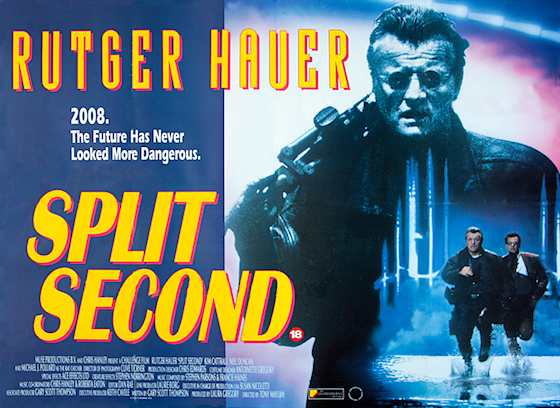
I confess, I hadn’t even heard of Split Second before a remastered Blu-ray release was announced a couple of months ago (more details about that at the end). A sci-fi/action/horror hybrid starring Rutger Hauer is the kind of thing that sounds interesting to me, but the fact I’d never come across it before seemed like a red flag. Fortunately, it’s on Prime Video, so I didn’t have to make a blind buy, and this is a recommendable course of action for anyone similarly unacquainted with the film. I did go on to purchase the Blu-ray, but I can see why others would not. Split Second isn’t exactly in “so bad it’s good” territory, but it has a distinctive quality that will not be to everyone’s taste.

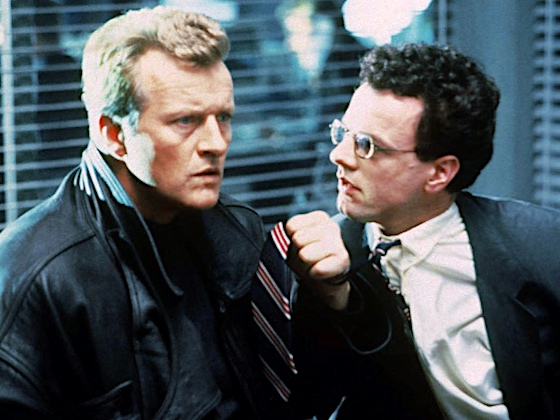
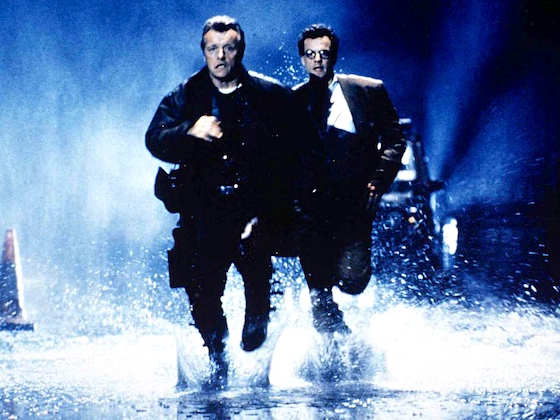
Set in the future-year 2008, when London has been flooded thanks to global warming and pollution has turned day into night, Hauer chomps cigars, chocolate, and scenery as Harley Stone, a badass rogue cop on the hunt for the serial killer who murdered his partner three years ago. Assigned to keep him in check is rookie cop Dick Durkin (Alastair Duncan), and together the pair realise their quarry may not be altogether human…

And if you’re wondering what the film’s title has to do with any of this… yeah, bugger all. One of the working titles was Black Tide, which suits the film so much better. I mean, it’s still not wholly fitting — the global warming/pollution stuff is dystopian-future scene-setting without any true bearing on the actual plot — but at least it evokes the tone and style of the film more than “Split Second”, which sounds like a Steven Segal movie.

Stone Dick

It’s almost hard to describe what that tone and style is, mind. It starts out almost like budget Blade Runner — it’s the future (so we’re told); it’s night; it’s raining; a hardbitten cop visits a seedy nightclub; etc. But then we get Stone’s first line of dialogue, which comes after a guard dog barks at him. He flashes his warrant card — at the dog — and says “police, dickhead.” To the dog. It’s hilariously terrible and awesome in one fell swoop. Hauer doesn’t give it an overtly comical delivery, and so you can’t quite tell if Stone is deadpanning or genuinely offering this information… to a dog.

This kind of almost-a-comedy-but-not-actually tone pops up increasingly as the film goes on, as if it was shot in order and the cast gradually realised how ridiculous it all was. By the time you get to the point where a deranged Durkin is demanding bigger guns, you’ll be cackling. Or you’ll be thinking “what is this godawful crap?!”, which goes back to my initial point: some people will delight in it all, while others will feel they’ve wasted their time on a low-budget no-mark that should’ve been left forgotten in the early ’90s.

I’m the former. You couldn’t reasonably call this a great movie — parts do border on “so bad it’s good”, and there’s much joy from the cast clearly realising it’s ludicrous. Plus, there’s a sense it’s not quite sure what it wants to be. It jumps from genre to genre as it goes on, and even the final monster (designed by Stephen Norrington, who’d go on to direct Blade and The League of Extraordinary Gentlemen) looks to be a mishmash born of uncertain direction, part hell-demon, part tech nightmare (is that a motorcycle helmet?!) But good golly does that crazy mix make for some barmy fun.

Watery London

I tell you what, though: the underlying concept isn’t bad. This is exactly the kind of movie I think someone should actually spend the money and effort to remake: something with decent ideas and intentions, but which didn’t come off on the first go. Iron out the plot (mixing genres is fine; jumping between them feels “made up as we went along”), smooth out the tone (keep the deadpan humour, up the thrills and scares), and give it a decent budget (this one has a rough-around-the-edges feel), and you could have something special. Especially if you retitle it Black Tide.

3 out of 5

Split Second is released on Blu-ray by 101 Films in the UK today. A matching edition will be released in the US on August 11th. It’s also currently available on Amazon Prime Video in both the UK and the US.

The Three Caballeros (1944)

2020 #61
Norman Ferguson | 72 mins | download (HD) | 4:3 | USA / English | U / G

The Three Caballeros

At one point Disney had a reputation for churning out rubbish direct-to-video sequels to their animated classics, a practice they put a stop to because, well, they were getting a reputation for churning out rubbish direct-to-video sequels to their animated classics. But there have also been a small selection of films in the Disney Canon that were granted sequels also within the canon. I have no insight into why this was the case, but I’d love to know the thinking because some of them are random. Like, okay, Frozen was a mega-hit, so makes sense you’d make the sequel ‘official’. Winnie the Pooh? Sure, Pooh is awesome (and also a reliable moneyspinner). Fantasia? Well, it was a passion project, and I guess its inherently artistic nature seems a reasonable way to mark the millennium. Wreck-It Ralph? Um… The Rescuers? Er… Saludos Amigos? Wait, really?

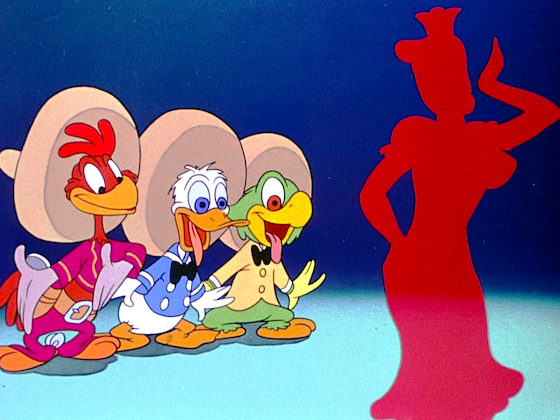
Yep, The Three Caballeros is, technically, the first sequel in the Disney Canon, and that’s only really surprising when considered without context. It’s from the period when Disney were bundling together shorter films to make package features, of which there are half-a-dozen spanning the gap between Bambi (Canon #5) and Cinderella (Canon #12). The first of those was Saludos Amigos, which was basically a propaganda film to showcase South America with the aim of improving relations between the continents. Donald Duck starred in two of that film’s segments, and it introduced José Carioca, a Brazilian parrot character. The Three Caballeros is a sequel in that it also presents a series of shorts about lands south of the US, strung together via a linking device of Donald Duck opening birthday presents from his Latin American friends. José eventually pops up, and the titular trio is rounded out with the introduction of Panchito Pistoles, a Mexican rooster.

The three sex pests

For all the similarities, I thought The Three Caballeros was considerably more enjoyable than its predecessor. Its depiction of South America is perhaps a little more twee, leaning on culture and tradition rather than the modern cityscapes that were so important to the impact of the first film, but that doesn’t grate too much because it’s not striving so hard to be educational. Because of that, it’s also able to be more straightforwardly entertaining. That said, it very much has the feel of a “kids’ cartoon”, rather than the artistry that’s to be found in Disney’s best efforts. Although Donald Duck comes across as a bit of a sex pest at times, which I guess is just changing attitudes. Conversely, the sequences that blend live-action and animation hold up incredibly well, although that might be because Disney’s use of DNR is so heavy-handed that the live-action practically looks the same as the animation. And the finale, where it suddenly explodes into a psychedelic nightmare, feels like someone didn’t know how to end the film and so had a mental breakdown all over the screen.

While I’d chalk up The Three Caballeros as a superior movie to its immediate predecessor, it undoubtedly remains a minor entry in the Disney canon. That said, apparently they updated it into a spinoff series a year or two ago (which I only know about because I happened to spot it on Disney+ the other day), so it obviously endures somewhat.

3 out of 5

The Old Guard (2020)

2020 #162
Gina Prince-Bythewood | 125 mins | digital (UHD) | 2.35:1 | USA / English | 15 / R

The Old Guard

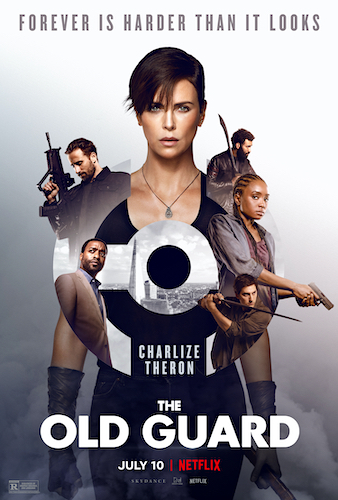
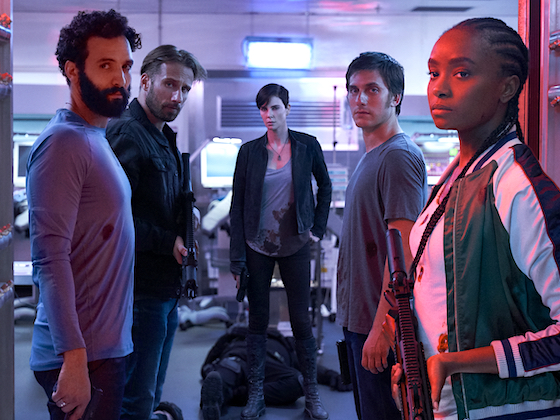
Netflix’s latest attempt to launch a blockbuster film franchise is a comic book adaptation about a group of immortal warriors, led by Charlize Theron, who’ve been secretly fighting to help the rest of humanity down the centuries. Despite their efforts to remain hidden, someone shady has picked up their trail. At the same time, a new immortal (If Beale Street Could Talk’s KiKi Layne) has appeared for the first time in 200 years.

If you’re looking to start an action/fantasy franchise nowadays, what better bet than superheroes? The Old Guard is sort of a superhero movie, but also not really. Their only superpower, which they all share, is a Wolverine-esque healing ability. They can die, they just get better (most of the time). So whether you class this as a “superhero movie” probably depends on your personal definition. I think some critics have just seen “based on a comic book” and gone “superheroes!”, and it’s a shame we haven’t got past that attitude by now. Equally, yeah, the characters do have a superpower, so fair enough. But the film itself plays more like an action-thriller, with the team relying mostly on guns and military tactics in combat rather than special abilities.

Bearing that in mind, the concept has fundamental similarities to another recent big-budget Netflix actioner, Michael Bay’s 6 Underground (which I’ve seen but not reviewed yet, fyi). Whereas that was about a band of off-the-grid mercenaries working in secret to try to influence the course of human history for the better by going around shooting bad guys, The Old Guard is about a band of people who can’t die working in secret to try to influence the course of human history for the better by going around shooting bad guys. Obviously the set dressing is different — The Old Guard has a lot more mythology to explain, and the heroes occasionally whip out swords and axes and stuff; and it lacks (for good or ill) the unique storytelling style of Bayhem — but, honestly, at heart it’s the same deal.

5 overground

They’re also equally badly written. It’s what we expect from Michael Bay at this point — a plot that might hang together if he ever stopped to let it be explained, but instead he’s more concerned with amping every single scene up to 11 with hyperactive editing and gonzo action sequences. The Old Guard, on the other hand, does stop to explain stuff. All. The. Time. Half the dialogue is characters speaking in infodumps to fill us in on this world. Or not fill us in, because there are gaps. It’s hard to tell if those are deliberate mysteries meant for a sequel (there’s a definite sequel tease at the end, naturally) or if the filmmakers just got bored of world-building and decided the characters don’t know how it works either.

On the bright side, it has some nice grace notes, like a betrayal I actually didn’t see coming, or Chiwetel Ejiofor injecting genuine emotion into his character’s motivations. Two of the immortals are a gay couple, played by Luca Marinelli and Marwan Kenzari, the latter of whom was Jafar in Disney’s live-action Aladdin (another one I’ve seen but not yet reviewed). He’s much better here, to the extent you wonder how he was such a limp Jafar. Anyway, the pair get a nice scene when they’re captured by a van full of enemy soldiers: a “what is he, your boyfriend?” taunt receives an epically romantic answer that’s an even better putdown than just “yes”. They also get a couple of beats of welcome humour later on. Not laugh-out-loud stuff, but this is quite a dour film otherwise. Most of the action is well staged if unremarkable, although the finale is a rather good assault on the villain’s HQ, ending with a couple of cool deaths.

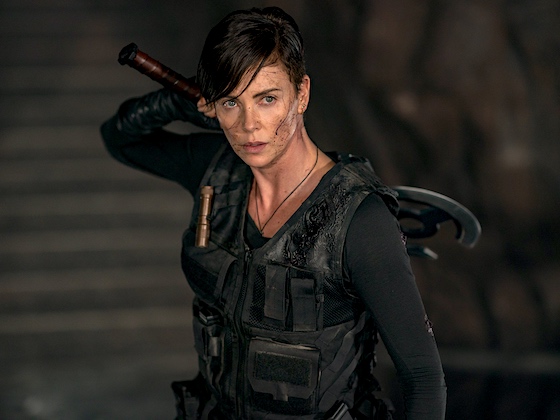
Immortal badass

Despite the poor dialogue and certain familiarities of concept, The Old Guard is more blandly acceptable than 6 Underground. And yet it never swings as big as Bay’s films — for all his many faults, his “go big or go home” style has its merits as blockbuster entertainment. Nothing here is going to stick in the memory as much as 6 Underground’s opening car chase, or midway apartment assault, or madly overblown yacht climax. All told, I’d rather have 7 Underground than 2 Old 2 Guard, please Netflix. Both would be fine.

3 out of 5

The Old Guard is available on Netflix now.

It Chapter Two (2019)

2020 #71
Andy Muschietti | 169 mins | streaming (HD) | 2.39:1 | USA & Canada / English | 15 / R

It Chapter Two

As you may remember from the first half of It, ancient evil Pennywise the clown had been popping up to terrorise the town of Derry every 27 years, until he was defeated by a gang of kids known as the Losers Club in 1989. Fast-forward to 2016, and the bugger’s back. Maybe “defeated” wasn’t the right word. Despite their vow at the end of the first movie — to return to fight if It came back — the grownup Losers have all moved away and forgotten the events of their childhood. All except one, that is, who stayed in Derry and consequently can’t forget. Now it’s up to him to call on the gang to honour their vows, and hope that together they can defeat Pennywise once and for all.

It’s kind of ironic that the plot of Chapter Two sounds like something cooked up by a movie producer who had a surprise hit and was desperate for a sequel. “Ironic” because that’s how many sequel ideas have been cooked up down the years, but in this case both ‘chapters’ are adapted from Stephen King’s original novel, which interweaves the two time periods of the Losers as kids and adults. And it’s not as if they decided to only adapt the kid part and then went “ah, may as well do the adults too”, because the first film ends with a double-barrelled tease for the sequel: Bev has a vision of them as adults fighting Pennywise so they make the aforementioned vow, and the closing title card reveals the film’s full title to be It Chapter One.

Now, I’ve never read It, but it seems to be a fairly widely-held view that the novel’s adult portions are less interesting than the childhood ones. That’s probably why many people seemed to take the first film at face value as an adaptation that had chosen to only tackle half the novel — if they’re the best bits, maybe you don’t need the adult storyline at all. And Chapter Two has probably proven that’s still the case. It doesn’t feel like a missing half; a necessary section of the story mandated by the first being incomplete. What it actually feels like is what I described in the last paragraph: someone realising “our standalone film has been a surprise hit, let’s come up with a story for a sequel”. I don’t know if that’s more a criticism of King’s novel or the way the filmmakers have gone about adapting it. Either way, if you look at both films’ critical and audience reception (both online scores and box office numbers), the drop between chapters One and Two suggests I’m not the only one to have felt this way.

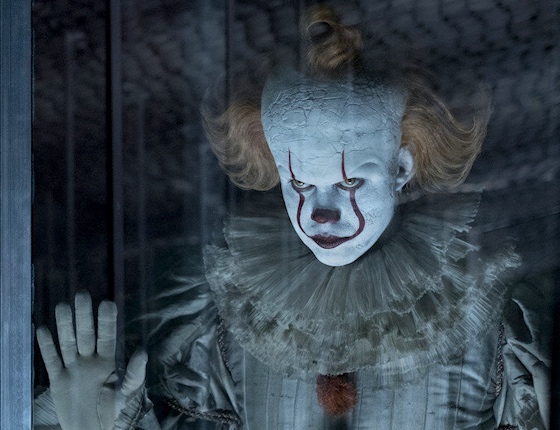
Pennywise wasn't impressed by the film's box office takings

Despite the sense of unnecessariness, I by no means hated Chapter Two. You’ll see this review ends with a three-star rating, but that’s primarily to make clear that it’s a lesser film than Chapter One, which I gave four stars. That said, most of my notes are about the things it got wrong. Like, there are too many lead characters — in fairness, a problem that also blighted parts of the first movie. There are six surviving members of the Losers Club, and when they each have to go off on individual quests, that results in six separate storylines that have to be got through. That’s a lot of screen time — no wonder the film is almost three hours long. I wasn’t actually that bothered by the length — I didn’t think it was slow, just overfull.

There’s been talk of “director’s cut” versions of both films, but some of the stuff left in the theatrical cut already feels like it’s from an extended version. You know, scenes that aren’t strictly necessary but are good or interesting in their own right; the kind of thing you drop from the mass-audience cut but reinsert because they’ll play well in a longer version aimed at fans. That includes some of the flashbacks to the kids, which seem like they’ve been shoehorned in after the younger cast proved popular. (The fact the sequel was filmed a couple of years late also necessitates a spot of CGI de-ageing, which edges perilously close to the uncanny valley.) Maybe releasing a shorter, more focused cut into cinemas and saving that stuff for a later longer release would’ve benefited the online scores and box office receipts.

Not cutting the flab also means it can be a mite repetitive. There are oh so many jump scares and gross things. It gets a bit tiring. But it’s also considerably less scary than the first film. There are some chilling bits (the odd old lady in Bev’s former flat, as seen in the trailer, is a key one), but they feel few and spread out — another side effect of the bloated running time. I’d also argue the film’s true focus is elsewhere: rather than being scary, it’s more interested in a mix of flashbacks to the popular cast of the first film and attempting to dig into the psychology of their adult counterparts.

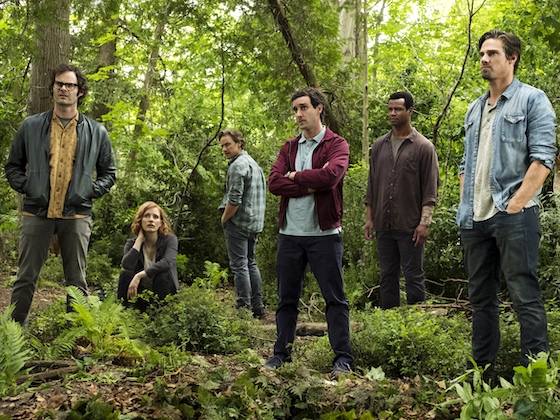
Grown Losers

I don’t think it’s actually seeking to be a horror movie; or, at least, not a straight-up one. It does want to be scary (some of the potential cuts I mentioned include scary sequences that I guess they left in so it would still primarily be a horror movie), but narratively and tonally it’s less concerned with that than it is with being some kind of middlebrow drama about repressed childhood memories and, simultaneously, a good-vs-ancient-evil fantasy epic (the whole saga is over five hours long, remember). But it doesn’t always land the dramatic beats, either. Take the finale (spoilers follow). Victory comes via the bullied bullying their bullier into submission, as the Losers taunt Pennywise to death. It does feel apt, but it’s also not exactly healthy. Maybe they should’ve killed It with compassion…

Ultimately, I think I liked the film it wanted to be (using the horror genre as an analogy/examination of growing up and moving on, or not, and how the past differs from our memories even as it defines us) more than the film it actually is (kind of that, but not in enough depth, and with a bunch of unnecessary business thrown in).

3 out of 5

It Chapter Two is available on Sky Cinema and Now TV from today.

The 100-Week Roundup VIII

As I mentioned last time, these films are technically from the same week as that last bunch, but seven films seemed a lot for one post. Plus, although they were all watched in the same week, they were watched in different months: the last four were my final films from July 2018, whereas these three are some of my first from August 2018.

In this roundup…

  • Beneath the Planet of the Apes (1970)
  • Pride and Prejudice and Zombies (2016)
  • The Quiet Earth (1985)


    Beneath the Planet of the Apes
    (1970)

    2018 #174
    Ted Post | 95 mins | Blu-ray | 2.35:1 | USA / English | 15 / G

    Beneath the Planet of the Apes

    Beneath the Planet of the Apes is the sequel no one wanted to make, including the studio — quite a different attitude to today, eh? But Fox were in financial troubles. For his part, Heston managed to negotiate a reduced role and suggested an ending that would kill off the potential for any more sequels. Well, that worked

    Picking up where the first film left off, it sees Heston’s character, Taylor, disappear mysteriously. After a second Earth spaceship crashes on the planet, its only survivor teams up with Taylor’s girl, Nova, to find him, which leads them to encounter a society hiding (you guessed it) beneath the planet of the apes.

    Overall, this feels like trashier sci-fi/adventure than the first one, with a certain B-movie aesthetic to the underground mutants, and a first half that’s just a bunch of running around. Yet, despite that, there are some powerful ideas and solid social commentary here, mainly about blind faith and the terror of military leadership. Plus, the mutants’ use of telepathy as a weapon is quite clever, and their unmasked designs are suitably eerie rather than just ugly. It also has one of the most brutal and bleakest endings ever seen in a Hollywood blockbuster — or probably outside of one, come to that.

    The violence in the final act was originally cut in the UK, and when it was finally released uncut on video some 17 years later, it earnt a 15, a rating its retained ever since. In the US, it’s always been rated G. Those Americans and their insouciant attitude to violence…

    Obviously I watched this two years ago, and at the time I assigned this three-star rating. But I will say that I remember it more fondly than that. As noted above, it takes a while to get going, and it doesn’t have the same classy aspirations as the first film, but its unrepentant fatalism is almost admirable.

    3 out of 5

    Pride and Prejudice and Zombies
    (2016)

    2018 #175
    Burr Steers | 103 mins | TV (HD) | 2.35:1 | UK & USA / English | 15 / PG-13

    Pride and Prejudice and Zombies

    Here’s another one I found more enjoyable than I feel I should have.

    For starters, it’s wild this ever actually got made. I mean, the title is an amusing idea — it’s basically a five-word gag, isn’t it? — but ponder for a moment how that’s going to play out as a full narrative. To live up to its title, it has to make an effort to follow the plot of the novel, and there lies the rub: no one wanting a zombie movie really wants to sit through a Regency romance, and no one wanting a Regency romance really wants it sullied by zombie-based action and gore. Well, inevitably someone will fall into that Venn diagram, but, as someone who’ll quite happily watch either of those genres in isolation, even I struggled to find the idea of such a mash-up too appealing. It needs a clever hand on the tiller to negotiate those treacherous waters, and I’m not sure the director of 17 Again and Charlie St. Cloud was that person.

    But, as I said at the start, I did find it surprisingly watchable. It does have a certain amount of wit and fun with the concept, like turning arguments about accomplishment into ones about fighting style. Sometimes the zombies and fights are tacked on to the existing story, but sometimes the narrative is neatly remixed to include the zombie threat. And like any true action movie, scenes of high emotion are settled not with words but with a good dust-up. There’s a solid cast too, including Lily James (always a bonus) and reliable stalwarts like Charles Dance, although, as Darcy, Sam Riley sounds like he’s battling a nasty throat infection. But Sally Phillips is basically a perfect Mrs Bennet for this or any other version, and the same could be said of Douglas Booth as Bingley, or Matt Smith, on fine comedic form as Mr Collins.

    Pride and Prejudice and Zombies and Knickers

    It does drop the ball sometimes. The climax doesn’t put enough effort into eliciting tension (it’s like they ran out of money or time or effort: “can the heroes make to the bridge in ti— oh, they just did”); at least one apparent subplot doesn’t go anywhere at all; and a mid-credits scene suggesting the story isn’t over feels lame. It definitely pulls some punches in aid of landing a PG-13 rating in the US, which is unfortunate — it’s a mad concept; it needs to do it properly, go all out and get an R. (I’d still say it’s perhaps a bit too gruesome for PG-13, which is why it landed a 15 over here.)

    I still think the director is the problem. A surer hand would’ve made more of the verbal sparring during the physical sparring; would’ve sold the tension of the action. Apparently David O. Russell was original set to direct, which is mad — can you imagine choosing to follow awards-winners like The Fighter, Silver Linings Playbook, and American Hustle with this? Apparently other directors “considered” included Matt Reeves, Neil Marshall, and Lord & Miller. Presumably they turned it down rather than any producer thinking Burr Steers was a better pick — Lord & Miller, in particular, probably would’ve nailed the tone. But, all things considered, what we got could’ve been a lot worse.

    3 out of 5

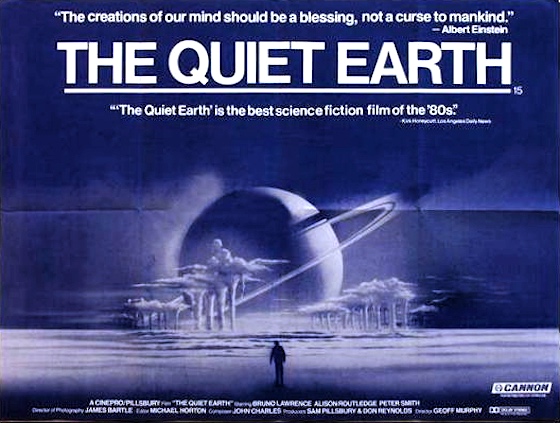
    The Quiet Earth
    (1985)

    2018 #178
    Geoffrey Murphy | 91 mins | Blu-ray | 1.85:1 | New Zealand / English | 15 / R

    The Quiet Earth

    Here we reach the first real hurdle in these two-year-old roundups, because it turns out I made no notes whatsoever after viewing The Quiet Earth. I did note down some quotes from the booklet essay accompanying Arrow’s Blu-ray release, but it seems a bit rich just to list those excerpts.

    What I can tell you is that The Quiet Earth is a science-fiction film about a scientist who wakes up one morning to find everyone else has disappeared — not fled, not died, just gone. What unfolds from there is a mix of mystery (what happened?) and a kind of existential character examination, both of this man and of ourselves — what would you do if you were the only person on Earth? Only, it doesn’t play quite as heavily as that makes it sound. There are more plot developments, but to say too much would spoil the discovery. And it is a film worth discovering. As Amy Simmons puts it in the aforementioned essay, it’s a “deeply relevant work which reflects darkly upon our age of estrangement and isolation. […] Shifting in tone from horror to comedy to pathos and back again, the film’s great strength is in the themes it explores and satirises — namely nuclear fears, technophobia, and cultural and geographical isolation — which are even more urgent now than when the film premiered in 1985.”

    I’m doing it a disservice with this pathetic little ‘review’, but hopefully someday I’ll revisit it and come up with something more insightful.

    4 out of 5

  • The 100-Week Roundup VII

    If I were being slavishly accurate about weeks, there should be seven films in this roundup. But that seemed a bit much, so — as the next one of these wasn’t due until the end of the month — I’ve split it in two.

    In this roundup, the final films I watched in July 2018.…

  • The Garden of Words (2013)
  • The Secret in Their Eyes (2009)
  • Paul (2011)
  • The Way of the Gun (2000)


    The Garden of Words
    (2013)

    aka Koto no ha no niwa

    2018 #170
    Makoto Shinkai | 46 mins | streaming (HD) | 16:9 | Japan / Japanese | 12

    The Garden of Words

    If the only anime director’s name you know is Hayao Miyazaki, you could do worse than familiarise yourself with Makoto Shinkai, director of recent popular hits Your Name and Weathering with You. He’d already been gaining attention with the films he made before those, which include short feature The Garden of Words.

    It revolves around two individuals: a 15-year-old schoolboy who aspires to be a shoemaker, and a 27-year-old woman. They meet one day in a park during a rainstorm and develop a connection. According to Shinkai, the film is a love story between two people “who feel lonely or incomplete in their social relations, but who don’t feel that they need to fix this loneliness.” That’s an interesting perspective, because while there’s undoubtedly a significant element of loneliness in the film, it’s accompanied by an element of depression; that these two characters seem unfilled. Without wanting to spoil anything, it seems to be the connection between the two that ‘saves’ them and elevates their lives — i.e. they did need to fix their loneliness. Perhaps it’s a disconnect between intention and execution that led me note that “where it ends up going isn’t as good as where it begins”. Nonetheless, the characters are engaging, and their emotional turmoil and connection are affecting. It also leaves room for personal interpretation with an open ending — it does reach a conclusion of sorts, but there’s clearly space the viewer to imagine what comes next.

    The animation is simply stunning — both beautiful in itself, and in its technical accomplishment. For that reason, if given the choice, it might be tempting to opt for an English dub, but I’d advise to stick with the original Japanese. I’ve written before about how I’m regularly conflicted when watching anime about whether to go for the original Japanese or an English dub, and I do often I go for the latter — I must admit I’m swayed by the recognisable voice casts on Ghibli films, for example; and, generally speaking, it allows you to appreciate the visuals more when you’re not having to read a lot of subtitles. Nonetheless, this time I chose the Japanese audio, and I’m glad I did: it’s subtle and calm, like the film itself, and the quietness and gentle pace mean there’s not an overabundance of distracting reading (unlike in Your Name, for example). I popped on a bit of the American dub afterwards and it felt all wrong by comparison — somehow brash and decidedly inauthentic. On the bright side, either track sounds luscious in 5.1, with the rain falling all around you, which serves to really immerse the viewer in the situation alongside the characters.

    4 out of 5

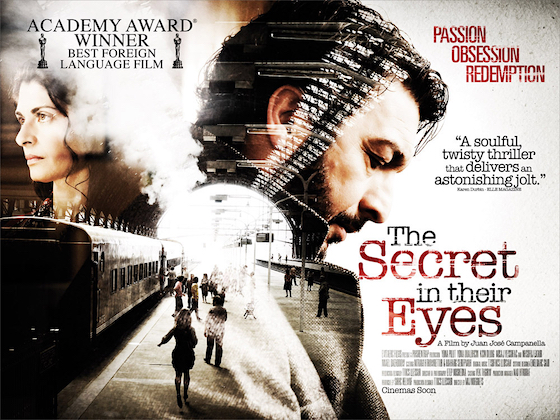
    The Secret in Their Eyes
    (2009)

    aka El secreto de sus ojos

    2018 #171
    Juan José Campanella | 129 mins | download (HD) | 2.35:1 | Argentina & Spain / Spanish | 18 / R

    The Secret in Their Eyes

    A surprise winner of the Best Foreign Language Oscar in 2010 (it beat A Prophet and Michael Haneke’s The White Ribbon), Argentina’s The Secret in Their Eyes is a murder mystery, two very different love stories, and a musing on the nature of justice, especially within a corrupt system.

    Primarily, it’s a procedural thriller about a decades-old unsolved case that one of the original investigators is revisiting in the hopes of finding closure. As that, I thought the film was probably a bit too long — despite some solid thematic weight, the unnecessarily slow pace at times make it feel a smidge self-important for what is fundamentally a crime thriller. That said, those other facets that have been added to supplement the storyline — the romance side; the passage of time (how do people deal with such life-changing events over the ensuing decades?) — do bring something to the film, elevating it beyond standard police procedural fare.

    Even as ‘just’ that, it pulls off some spectacular feats: the famous single-take at the football match really is an all-timer, and the final twist is unexpected and a perfect capper. I was this close to giving it full marks, and maybe when I revisit it someday I will.

    4 out of 5

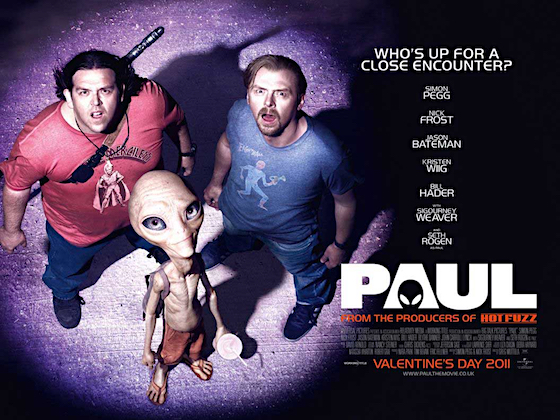
    Paul
    Extended Edition
    (2011)

    2018 #172
    Greg Mottle | 109 mins | Blu-ray | 2.35:1 | UK & USA / English & Klingon | 15

    Paul

    On a post-ComicCon road trip around the US’s UFO heartland, a pair of British geeks (Simon Pegg and Nick Frost) bump into an actual alien, the eponymous Paul (Seth Rogen), who’s on the run from a government facility. Cue a kind of “E.T. for grownups” as the trio — and a widening assortment of supporting characters — endeavour to evade the authorities and get Paul home.

    Mistaken by some for the third part of the Three Flavours Cornetto trilogy (thanks to it starring Pegg and Frost, but it’s missing the vital ingredient of director Edgar Wright, who was committed to Scott Pilgrim), Paul lacks the sharpness of that trilogy at its best. However, it’s full of likeability — in the characters, and of course the humour — to the point where it actually manages to get a bit emotional at the end. It’s also chock full of references and quotes for fellow geeks to spot, some of which are incredibly well-timed to have fantastic impact.

    As for the extended cut, there’s a comparison here. As usual, the theatrical cut was R-rated in the US but the extended one is unrated there, but (also as usually) I don’t think there’s anything that wouldn’t pass at R. The running time difference is about five-and-a-half minutes, but there are 41 differences crammed into that time. It seems like some fairly memorable jokes were cut and others added back — nothing earth shattering, but enough to call the extended cut the preferable one.

    4 out of 5

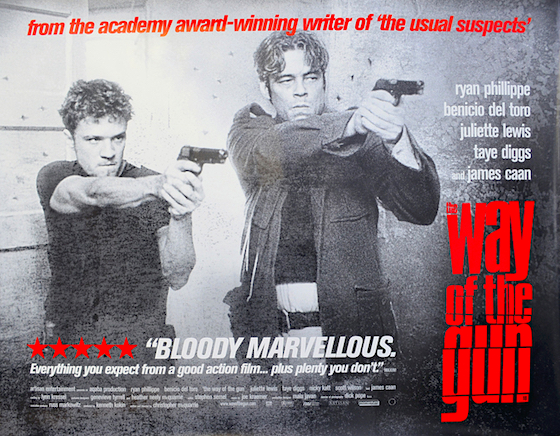
    The Way of the Gun
    (2000)

    2018 #173
    Christopher McQuarrie | 120 mins | Blu-ray | 16:9 | USA / English | 18 / R

    The Way of the Gun

    The debut directorial feature from screenwriter Christopher McQuarrie (who made his name penning the likes of The Usual Suspects and more recently has found success as the regular writer-director of the Mission: Impossible movies), is one of those ’90s crime comedy-dramas — you know, the kind of thing we describe as “Tarantino-esque”, for good reason. It has its fans, but McQuarrie tends to refer to it disparagingly on social media, no doubt in part because it landed him in “director jail” for over a decade. Personally, I agree with McQuarrie (I usually do): it’s not a failure, but it’s not much of a success either.

    My main problem with it is that it’s over-long and over-complicated. Both of those are thanks to too many characters with too many motivations. It’s possible to get your head round it all in the end, but there’s a stretch in the middle where it feels like work. But rather than slow things down and spell it out, it might be better if it moved through them all quicker — at least then it would be pacy. It’s also rather dully shot by Dick Pope, who was later Oscar-nominated for the likes of The Illusionist and Mr. Turner, but has plied most of his trade in the grounded world of Mike Leigh movies, which perhaps explains that. There are still two or three good shots, plus a neat oner that indicates the direction McQ’s style would head.

    There are flashes of McQuarrie’s brilliance elsewhere too, including some nice bits of dialogue and a couple of good sequences. The action scenes, in particular, demonstrate he had a strong skill there from the start. They feel very grounded and real — just the way the characters move; that they’re constantly reloading; how it ends when everyone’s out of bullets. McQuarrie’s brother, a Navy SEAL, was the technical advisor for these scenes, which explains their accuracy. The final shoot-out, with all of that going on, is the best bit of the movie. Well, at least it ends on a high.

    3 out of 5

  • Eurovision Song Contest: The Story of Fire Saga (2020)

    2020 #153
    David Dobkin | 123 mins | streaming (UHD) | 1.85:1 | USA / English & Icelandic | 12 / PG-13

    Eurovision Song Contest: The Story of Fire Saga

    The Eurovision Song Contest: if you’re from Europe or Australia, or one of the other countries that competes but isn’t really in Europe, it needs no introduction. If you’re from somewhere that hasn’t been enjoying/subjected to it every year for the past seven decades… well, it’s hard to explain. Actually, the basics are easy: it’s a continent-wide song competition, where each participating country submits one artist performing one song, and everyone votes for the winner. But, oh, the cultural connotations and ramifications are so, so much more! For some countries, it’s deadly serious — it’s a way to get noticed on the world stage; it may even make the artist famous. For others, like us Brits, it’s a big campy silly joke… except we’re also rather fond of it (some of us), and we’re terribly annoyed that we don’t win it every year (or at least on a regular basis. Like, once a decade or so would probably keep us happy). And that’s just scratching the surface — it would probably take a book (or, at least, a reasonably long article) to fully explain every nuance.

    Will Ferrell’s latest comedy attempts to distill all that history into a globally-friendly movie-length spoof. It’s a big ask, not just because there’s so much background information to assimilate, but because us Brits have been ripping the piss out of Eurovision for decades. And not just sometimes, but constantly: each country provides a local commentary over the live broadcast, and each year ours is basically a roast. (Notoriously so: some countries are not impressed by the sarcastic, piss-taking attitude being our ‘official’ stance on the contest.) We’re not alone, either: a few years ago when Sweden hosted the contest, they did a pitch-perfect sketch about creating the perfect Eurovision song. If you want to get a feel for the entire Eurovision experience in just six minutes, watch Love Love Peace Peace.

    And so with all that in mind, Ferrell and co are on a hiding to nothing; especially as the film has been made with the cooperation and endorsement of Eurovision’s producer, the EBU (they even get a credit right up front), so it was never going to be able to truly get stuck in for fear of offending its subject. So I guess that’s why they barely even bothered. Oh, there are certainly references to and riffs on Eurovision-y things, so viewers in the know can pick up on them and not feel like it’s about Generic Foreign Singing Contest; but this isn’t really a comedy about Eurovision, it’s about a small-town music duo wanting to make it big. Their chosen method is Eurovision, but it could just as well be The X Factor or The Voice or, well, anything, and it wouldn’t change the core narrative.

    And a man in a hamster wheel

    Said narrative goes through all the motions you’d expect. About the only thing that could be described as a twist is that the smarmy “bad buy” isn’t actually up to anything evil after all, he’s genuinely quite nice. As he’s another contestant, you do wonder if that was an EBU stipulation… The man in question is the Russian entry, Alexander Lemtov (Dan Stevens, who’s excellent as usual), renowned as a “sex player” and the subject of an overlong bit about how he probably has a massive penis. “Overlong” is the watchword for most of the comedic routines in the movie. It’s a form of self indulgence that plagues many a comedy nowadays, and here it helps contribute to a running time that’s simply too long. I always feel like the best comedies are within sight of 90 minutes, but this runs a full two hours. Of course, a comedy made for a famously hands-off studio like Netflix is hardly likely to be exempt from indulgence. Maybe a more interfering one would’ve questioned the wisdom of letting Ferrell include a bit where his character criticises American tourists for coming to Europe and ruining it. Um… It could work in a meta way, but it feels like it’s lacking any kind of knowing wink, beyond it’s very existence.

    One thing that does often work are the songs. You may well have heard Volcano Man when Netflix released it as the first promo for the film, but Fire Saga themselves get two or three more numbers, all of which are varying degrees of “surprisingly catchy”. The one they sing as the climax even made me feel a little emotional. I expect it’s the manipulation of the key changes or whatever (I’m no musician), because I didn’t really feel invested in the characters’ relationship before that point, but hey, if it works it works. Then there are the other contestants… where, unfortunately, the film drops the ball again. Lemtov’s number, Lion of Love, clearly had the most effort put into it — it’s quite fun and very Eurovisiony. But a montage of other acts is weird because it feels like it’s been edited to emphasise the jokes, only there aren’t any. I’m not even being clever, saying “there aren’t any” because I didn’t find them funny — the lyrics aren’t humorous, the staging isn’t particularly laughable… they’re just mediocre songs. It’s a wasted opportunity to provide some quick-fire riffs on Eurovision staples. The best it can do is the first of the montage, a rock song by guys in monster costumes — a reference to Lordi, who won in 2006. As far as I remember, no one has tried the same trick in the intervening 14 years.

    Lion of Love

    The weirdest musical number comes halfway through: at a party Lemtov is hosting for all the contestants, a “song-along” breaks out. Not a singalong, a “song-along”. Suddenly, a bunch of previous real Eurovision contestants show up (much to the bafflement of viewers who’ve never seen the real thing, I suspect) to sing a medley of… songs. Not Eurovision songs, just… songs. Well, Waterloo is in there, but I think that was the only one. It sort of almost works as a kind of mid-film celebration of the real Eurovision, but it’s all so random. Why isn’t it a medley of previous Eurovision tracks? Who even are some of the singers? (I recognised most but not all.) Do people who aren’t fans even get what’s going on during that sequence? It’s a cheesy but potentially fun idea, which I’d embrace wholeheartedly if I felt they’d nailed it. Or even if they’d just had them all cover Love Love Peace Peace.

    Yet for all the film’s faults, I’d be lying if I said I didn’t enjoy it. By sticking to tried and tested plot beats and gags, it has an unchallenging comfortableness. There are laughs along the way — some are just echoes of better versions, yeah (most notably, a bit that’s almost jumping through hoops to avoid Rachel McAdams repeating her iconic line from Game Night. It would’ve been better if they’d just leaned into it and let it be a meta-gag), but there were a couple that caught me with a genuine chuckle.

    Sporadically funny; often dated; with tired and rehashed routines; longer than Alexander Lemtov’s penis; and surprisingly emotional at the end… Actually, maybe The Story of Fire Saga is like Eurovision after all.

    3 out of 5

    Eurovision Song Contest: The Story of Fire Saga is available on Netflix now.

    The 100-Week Roundup VI

    Here’s another quartet of reviews from my July 2018 viewing, with an all-star cast both behind the camera (Stanley Kubrick, Ridley Scott) and in front of it (Keanu Reeves, Leonardo DiCaprio, Russell Crowe, etc).

    In this week’s roundup…

  • The Day the Earth Stood Still (2008)
  • Full Metal Jacket (1987)
  • Wind River (2017)
  • Body of Lies (2008)


    The Day the Earth Stood Still
    (2008)

    2018 #163
    Scott Derrickson | 104 mins | Blu-ray | 2.35:1 | USA & Canada / English & Mandarin | 12 / PG-13

    The Day the Earth Stood Still

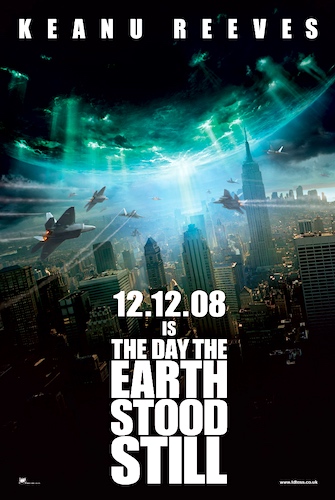
    Blockbuster remake of the 1951 sci-fi classic, starring Keanu Reeves as an alien who has come to “save the Earth”.

    The original might be best remembered for its message about mankind. The do-over doesn’t so much attempt serious “humanity are the problem” moralising as just nod in that general direction. Instead, it conforms to the Hollywood-remake stereotype of simplification, using the plot as an excuse for a CGI destructathon. Even as that it’s a bit of a damp squib, with no genuinely impressive sequences; some of the CGI is pretty crap, even, like the first appearance of the giant robot GORT.

    I know we all love him now because he seems like a genuinely wonderful guy in real life and the John Wick movies are cool, but, still, the role of an emotionally cold alien pretending to be human but struggling to understand what truly makes us ‘us’ is a perfect fit for Keanu Reeves and his usual acting style. Jaden Smith is equally perfect casting as an irritating brat of a kid. Jennifer Connelly struggles gamely to be the heart of the film, and there are small or cameo roles for the likes of Kathy Bates, Jon Hamm, and John Cleese, none of whom can really elevate the basic material they’re given.

    All in all, it’s inoffensively bland, with some light sci-fi ideas, a bit of loose moralising, and a bunch of pixels whooshing about. Perhaps with a better creative team — or without the demands of a studio blockbuster budget — it could’ve been more; something genuinely thought-provoking about the value (or otherwise) of humanity. But it isn’t.

    3 out of 5

    Full Metal Jacket
    (1987)

    2018 #165
    Stanley Kubrick | 117 mins | Blu-ray | 16:9 | UK & USA / English | 15 / R

    Full Metal Jacket

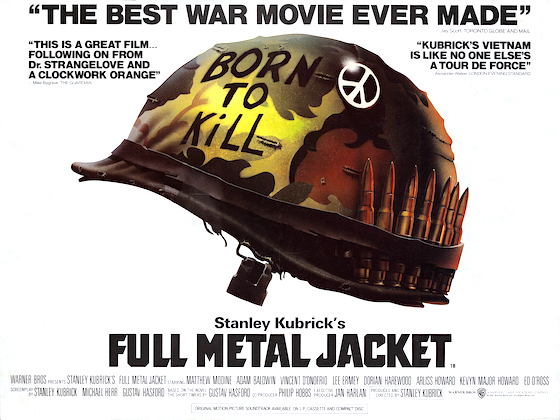
    Kubrick’s anti-war war movie, about the dehumanisation of abusive army training, the virtue and success of kindness, and how combat can erode and destroy the soul. It’s “a Vietnam movie”, but Kubrick wasn’t interested in Nam per se, rather “the phenomenon of war” and what happens to young men when you turn them into killing machines.

    It’s a film of two halves: first, the training; then, the war. The first half is the better known one, and some people will tell you it goes downhill when they leave training. That first part is indeed horrid but effective and meaningful, but I thought the second half lived up to its impact too.

    A film about war’s effect on people requires strong performances, and fortunately it has those. Most famous is R. Lee Ermey’s nasty drill instructor — an unquestionably accurate portrayal of the real thing, because Ermey used to be one. He was originally hired as a consultant, but decided he wanted the role and convinced Kubrick to cast him, then rewrote his dialogue — the obscenity-strewn insults are all Ermey’s own. But for my money the best performance in the movie comes from Vincent D’Onofrio. Apparently he got the part just because he was a friend of Matthew Modine — it was his first film role — but he’s fantastic. And nowadays best known as a gun-happy right-wing nut-job on Twitter, Adam Baldwin is very convincing as, er, a gun-happy right-wing nut-job.

    Naturally, Kubrick’s work is as on-point as ever. A climactic action scene pits the entire troop against just one sniper, which is both thrilling and horrifyingly brutal. The film’s final death is excruciatingly drawn out, to really convey its emotional toll. Douglas Milsome’s photography frequently looks stunning as well. The fire-lit final act is as visually gorgeous as it is suspenseful and gruelling.

    To paraphrase a commentator in the Between Good and Evil documentary, Kubrick “takes the sympathetic characters and breaks them down so that, by the end, there’s no one left to root for, and the sympathy you feel is not for the character, but for what they’d lost.” And another notes how much you can see Iraq in the film, as if Kubrick was predicting the future of urban warfare too. Or, another way of looking at it: how little changes; how few lessons we learn.

    5 out of 5

    Full Metal Jacket was viewed as part of What Do You Mean You Haven’t Seen…? 2018.

    It placed 8th on my list of The Best Films I Saw in 2018.

    Wind River
    (2017)

    2018 #166
    Taylor Sheridan | 107 mins | streaming (HD) | 2.35:1 | USA, UK & Canada / English | 15 / R

    Wind River

    A veteran hunter helps an FBI agent investigate the murder of a young woman on a Wyoming Native American reservation.IMDb

    What follows is a neo-Western crime thriller, written and directed by Taylor Sheridan. As a genre piece, it’s most noteworthy for how well it handles the reveal of whodunnit. Just as you think the film’s getting to the point where they find who did it, but it’s only a suspicion and they’re going to have to go off and prove it, the film takes a hard left in a different direction that’s perfectly handled. To quote from a comment on iCheckMovies, the way it goes about this “seemed truly unique to this genre. The closest comparison I can think of is from Se7en, when [Se7en spoilers!] Kevin Spacey just turns up and hands himself in, completely out of the blue. It unexpectedly shattered the cat and mouse formula that people expected it to follow.” By dispensing with narrative oneupmanship (i.e. trying really, really hard to pull a twist out of thin air, as most mystery/thrillers do), it lets “the story unfold into more of a tragedy than the standard mystery or thriller you might expect it to be.”

    Talking of other reviews, some people are heavily critical of the film having a white male lead when it’s supposed to be about the plight of Native Americans, and especially Native American women. Well, yes, to an extent that’s true, but this is where fantasy rubs up against reality: do you really think a movie with a Native American lead would find it easy to get funding, distribution, and gain attention? Sometimes these things are a necessary ‘evil’ if your goal is to reach a wider audience and thereby spread the message. Besides, the film makes a point of treating the white characters as outsiders, in various ways. It’s not pretending this is how it should be, nor that they’re welcomed like, “hooray, the white people are here to save us!” If anything it’s used to emphasise the point: the Native American cops can’t solve the case themselves because they’re underfunded and understaffed; they have no choice but to rely on white people being prepared to help. That’s an indictment in itself.

    Altogether, this is a powerful movie — arguably Taylor Sheridan’s best, most mature screenplay (which is saying something for the man who wrote Sicario and Hell or High Water), and features a superb performance from Jeremy Renner, reminding you why he was Oscar-nominated for The Hurt Locker before his attempts to be a blockbuster action star.

    4 out of 5

    Body of Lies
    (2008)

    2018 #168
    Ridley Scott | 128 mins | download (HD) | 2.40:1 | USA & UK / English & Arabic | 15 / R

    Body of Lies

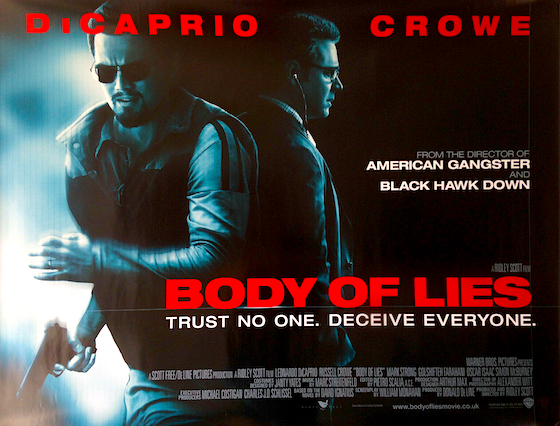
    A CIA agent on the ground in Jordan hunts down a powerful terrorist leader while being caught between the unclear intentions of his American supervisors and Jordan Intelligence.IMDb

    That’s the simple version, anyhow, because I thought the film itself got a bit long-winded and complicated; but if you enjoy spy movies, it’s smattered with some good bits of tradecraft stuff. That said, I’m not sure I buy Leonardo DiCaprio as the CIA’s man in the Middle East — he stands out like a sore thumb there; not good for a spy.

    Meanwhile, Russell Crowe commands complex world-changing missions over the phone while taking his kids to school or watching a football match — a nice touch, I thought, contrasting mundanity with these high-stakes actions. (Quite why he “had” to gain 50lbs for the role is beyond me, though. Sounds like he just fancied being lazy about his diet and exercise regime.) Still, the standout from the cast is the ever-excellent Mark Strong as the head of Jordanian intelligence, a man who is urbane and always immaculately dressed, but does not suffer those who disrespect him, exhibiting a kind of calm fury-cum-disappointment when they offend him.

    For all the confusion I felt about the plot, what I presume is the intended theme (that America can’t win because it refuses to respect or understand the culture of both its enemies and allies in the Middle East; and that the supposed good guys aren’t any better than the bad guys) comes across quite effectively. It’s also about the ineffectiveness of advanced technology. The CIA, so focused on their shiny new bells and whistles, lose out in the end to old fashioned personal interaction and patient preparation.

    Body of Lies seems somewhat torn between making these points and being an entertaining action-thriller. Ultimately it straddles the two stools, not quite satisfying as either — it has its moments, for sure, but it’s less than the sum of its parts. Maybe Ridley should’ve left the spy thrillers to his brother…

    3 out of 5

  • Gemini Man (2019)

    2020 #141
    Ang Lee | 117 mins | Blu-ray (UHD) | 1.85:1 | USA & China / English | 12 / PG-13

    Gemini Man

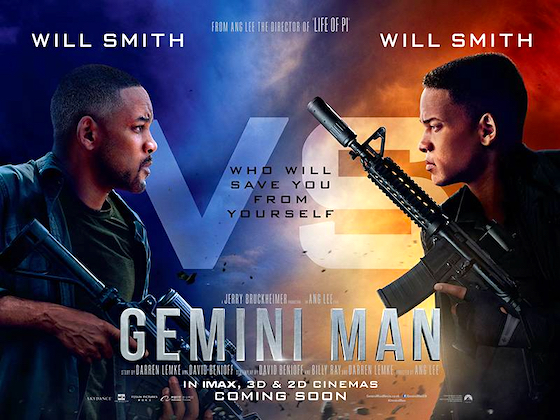
    Gemini Man is a film that, at every point I can remember it being talked about, was discussed more for its various technical feats than anything else. Partly that’s because there are a couple of angles. Firstly, the most obvious: it stars Will Smith as an ageing assassin who must fight… a 25-years-younger Will Smith, achieved with motion capture and CGI. Secondly, director Ang Lee shot it in 3D 4K HFR — that’s High Frame Rate, if you don’t know, with the picture running at 120 frames per second rather than the 24fps we’ve been used to for the past 90-odd years (excepting The Hobbit trilogy, though only if you saw one of the relatively-limited HFR theatrical screenings). Maybe it shouldn’t be a surprise, then, that Gemini Man often feels more like a tech demo with a plot grafted onto it than it does a fully functioning movie in its own right.

    Consequently, I’m going to spend more of this review writing about the film’s presentation than its content. To some degree, that speaks for itself as criticism. But if you are interested in the film and don’t give a toss about how exactly you’re seeing it (or don’t have a choice), feel free to whizz down to the last two paragraphs (just after the picture of Young Will Smith) where I finally offer some thoughts on the film itself.

    Back to the tech, then. There’s currently only one way to see Gemini Man in its intended format: at the cinema. I say “currently” — obviously such opportunities expired when its theatrical run ended, and I don’t imagine it’s likely to get a re-release. Every other option is a compromise. Want to see it in 3D? Not only will you need the appropriate home cinema setup, but you’ll have to import the disc from Germany, the only country where it was granted a 3D Blu-ray release. Want to see it in HFR? That’s easier, because the 4K disc is widely available, though obviously you still need the appropriate kit. (I presume the digital 4K versions are HFR too, but I don’t actually know that.) Mind you, even that’s something of a compromise, because tech limitations mean the home release is 60fps rather than the full 120 (to be fair, so were most HFR cinema screenings).

    Action Man

    I watched it in 4K 60fps, and, oh, it’s weird. So so weird. Distracts-you-for-the-entire-film weird. Virtually-the-only-thing-I’m-going-to-talk-about-in-this-review weird. The disc even begins with a notice/warning that it’s at 60fps rather than 24fps, so presumably they know how weird it feels. The most obvious effect of more frames per second is that motion is smoother, with reduced motion blur, but that applies on a micro level to lend an unnatural clarity to everything. The effect on motion is often called “the soap opera effect”, because such cheap drama has traditionally been shot at TV’s higher default frame rate. Of course, so is much other television, or even behind-the-scenes footage on films; so while it’s not a wholly inaccurate nickname, the effect reminded me more of TV documentaries. The film begins with a train journey in a lusciously green-looking Belgium, before travelling around the globe to other sunny locations with glamorous establishing shots. It looks less like a Hollywood action movie, more like Will Smith is the new host of Cruising with Jane McDonald.

    When it’s not playing travelogue, it looks like a tech demo. I don’t think that’s just the added smoothness, but everything about how it’s shot: it’s very bright and saturated, the kind of look you get in marketing promos, not feature films. Even paused it looks a little odd. Partly that’s the boost given to the colour palette by HDR, but at this point I’ve watched plenty of other films with HDR to be familiar with its effects, and I think this was beyond normal. The other thing the visual quality reminded me of was low-budget films by very new/amateur filmmakers, and that’s definitely to do with Ang Lee’s shot choices — lots of stuff at eye level, gentle pans and tilts, in locations so dull they might have been found around someone’s hometown. It doesn’t help any that all the fonts they’ve used for captions look like the editing software’s bland default. And further, it’s also the effect of shooting on high-resolution digital video — it’s ultra-clear, with none of the grain of real film, but, again, that’s a look more familiar from low-budget productions. Would HFR work better if it was shot on real film? You’d get back some of that tactile grit, rather than telltale digital smoothness.

    Biker Man

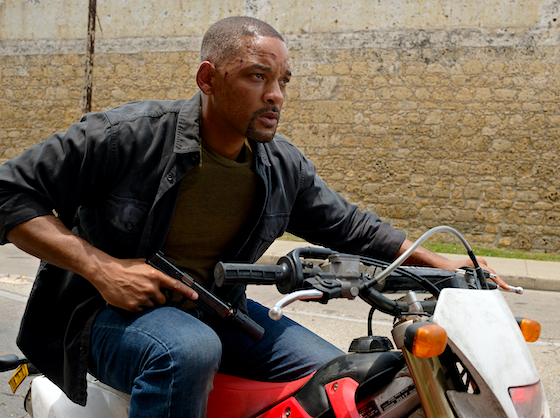
    What about when the film gets to its big action sequences — the kind of thing that obviously a no-budget newbie couldn’t afford. Would the change of milieu fix the mental associations? Yes and no, in that it just adds other ones: the first big sequence, the bike chase you probably saw in trailers or clips, looks like a computer game. Again, it’s a mix of elements: the digital sheen, the smooth frame rate, the shot choices (lots of POV or close following, like a game’s third-person camera), and an unnatural-seeming speed — it looks like some of the CGI has been animated too fast, though that could be HFR’s fluidity making normal motion look odd because we’re not used to it.

    The advantage of wondering all this while watching the film at home was that, afterwards, I could pop in the regular Blu-ray and compare a few scenes in 24fps 1080p SDR. Immediately, it looks a lot more like a regular movie. Is that indeed the loss of HFR’s smoothness, or is it the drop in resolution, or the loss of HDR enhancement? Without being able to view different permutations it’s hard to say which one causes the jarring effect, or if it‘s the incremental change made by each that adds up to a radically different picture when combined. That said, obviously I’ve watched 4K HDR films before, and it’s never struck me as odd-looking as much as this film (I’ve seen some strange applications of HDR, but that tends to be in individual shots/scenes, not an entire movie). The bike chase also looks more normal on the whole, though some of the bits I alluded to before still looked dodgy, so I can only conclude it’s a mix of the animation (because I’m sure it’s not a real stunt) and the HFR.

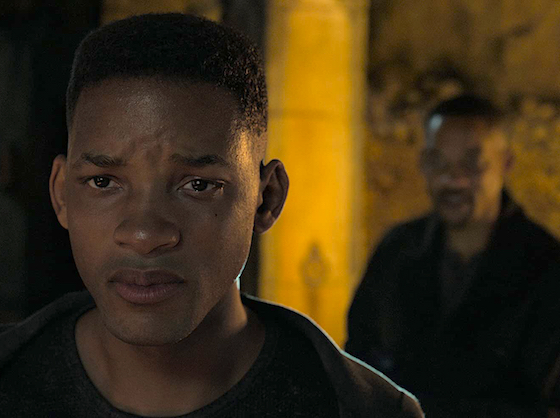
    If all that wasn’t distracting enough, there’s the fact that one of the film’s main stars is a de-aged Will Smith. We’ve seen plenty of de-ageing in films now, whether it be Marvel’s flashbacks or Scorsese’s varied eras in The Irishman. This feels more extensive, though — they’ve not just airbrushed Smith’s age-related blemishes, but recreated his youthful visage with full motion-captured CGI. The end result is both incredibly realistic animation and also not quite there. Maybe that’s just because I know it’s not real — I wonder if someone unfamiliar with the film’s setup wouldn’t register it. It looks more convincing than I remember Peter Cushing being in Rogue One, and I remember stories of kids who didn’t realise he was CGI. I guess the best praise is that, as the film went on, I realised I’d just accepted Young Will as his own character, not a second Old Will in disguise. There are scenes where he’s called on to do Proper Acting and it works. Unfortunately, it’s almost ruined by one scene at the end where the effect suddenly looks like a ten-year-old computer game. Was this a last-minute re-edit, I wonder, leaving them without enough time to do the CGI properly? It’s a shame to have dropped the ball at the last hurdle.

    Young Man

    And if you can get past all the technical distractions (which I guess most people will, as “the tech” is not why most people watch films, and on any format less than 4K the visual oddness evaporates anyway), what about the film itself? Well, it’s a passable action-thriller with a sci-fi tweak. For the level of the latter, think something like Face/Off rather than, say, Blade Runner. I’ve seen quite a few people compare it to a ’90s action movie and that’s pretty fair — subtract the fancy cameras and CGI and that’s what’s left. It’s not necessarily a bad thing, unless you’re so young that ’90s action movies are Old and consequently Bad. There are a couple of very impressive and exciting action sequences — the bike chase, primarily (which I bet looks fab in 3D). That said, the Blu-ray’s visual effects featurette reveals they faked a bunch of stunts that Tom Cruise and Chris McQuarrie would’ve done for real as a third-tier action sequence, which takes the shine off a little. (On the other hand, it also reveals that there’s some fucking incredible CGI in this movie — stuff you’d never imagine was an effect but is, including a full-on close-up of Old Will.)

    So, the reason the tech presentation remains the film’s strongest talking point is that the film underneath is decent but nothing particularly special. That said, I do think it’s been given a hard rap by critics and viewers alike — whether or not you’re interested in the experimental visuals, it’s a fine sci-fi-tinged action blockbuster, with all the attendant qualities and demerits that implies.

    3 out of 5

    Gemini Man is available on Sky Cinema and Now TV from today.
    The Head Hunter (2018)

    2020 #101
    Jordan Downey | 72 mins | download (HD) | 1.78:1 | USA / English | 15

    The Head Hunter

    Originally released in 2018 but not making its UK debut (as a direct-to-DVD release) until earlier this year, The Head Hunter is a low-budget independent fantasy/horror movie. Such a description might conjure up images of fancy-dress-like costumes, plastic props, locations that venture no further than a mate’s back garden and a nearby bit of forest, cinematography with all the hallmarks of digital video, and some embarrassingly basic and boxy CGI. None of this is true of The Head Hunter, which marries some impressive production design to an understanding of its limits — its low budget shows only in its small scale, rather than uncomfortably forcing its reach to exceed its grasp.

    The setting: a medieval fantasy world. It could pass for our medieval times (in Germany it was retitled Viking Vengeance), were it not for the presence of nasty monsters. The title refers to the film’s unnamed protagonist (Christopher Rygh), who lives alone in the a remote shack in the woods, where he prepares weapons and potions. Occasionally he hears a distant horn, which beckons him to ride out in full armour. When he returns, he carries a new monster’s head for his wall of trophies, and some serious injuries too. Fortunately, his potions seem to have magic-level healing properties. He once had a daughter, who now lies buried beneath a nearby tree. One day, the opportunity arises for him to hunt the monster who slew her. “This time it’s personal,” and all that. Only things don’t quite go to plan…

    I have, perhaps, described altogether too much of the plot there, because there’s not much more to the film than that, narratively speaking. Not only does the film run under an hour-and-a-quarter, including credits, but it’s more about moody atmospheric shots than plot; more about the preparation for battle than the fight itself. The Head Hunter may ride out to meet various monsters during the course of the film, but we don’t get to go ride along to see him at work.

    That's a nice head. I'll have that.

    This is where the small budget shows. It was made for just $30,000, which would buy you under two seconds of a Hobbit film (literally — I did the maths), with a cast and crew of no more than five on set at any one time. All the more impressive that it looks as good as it does, then, from the Head Hunter’s detailed and threatening suit of armour to the remote locations that pass through a couple of seasons. It’s a film that relies on atmosphere more than thrills, and it has that in spades, with cold, misty daytime scenes and fire-lit nighttime sequences, where who-knows-what lurks in the shadows.

    As impressive as it is, all things considered, it nonetheless feels a bit drawn out at feature length (even at under 70 minutes before credits). It would probably have made an incredible 30-minute short, though then it would likely have had an even harder time finding an audience than it already has. But that’s not to say it’s not worth your time. If an action-lite atmosphere-heavy fantasy/horror movie sounds appealing, this may just scratch an itch. And it should serve as a great showreel calling card for co-writer/director Jordan Downey, who hopefully will convert it into bigger — or, at least, more story-filled — things.

    3 out of 5

    The Head Hunter is available on Sky Cinema and Now TV from today.