
Marcus Nispel | 84 mins | DVD | 18
 First, a little note on that aka: technically — and, I believe, legally — no such title is attached to this project. However, the initial idea was developed by Koontz and, after he left the project, adapted into his Dean Koontz’s Frankenstein series of novels. Despite the ‘creative disagreement’ (or whatever they chose to call it) that led him to walk away, the film retains significant similarities to the first book. More on these in a moment.
So, this version of Frankenstein is a made-for-TV movie/series pilot (that’s taken six years to find its way to British TV, apparently — in case you didn’t know, the series wasn’t picked up). According to the blurb on my DVD, it’s a “contemporary retelling of Mary Shelley’s gothic horror classic”. I guess no one in the publicity department actually watched it. In actuality it’s more a sequel to Shelley’s novel: Dr Frankenstein has somehow survived to the modern day and emigrated to New Orleans, where he continues his experiments, while his original monster, now going by the name Deucalion, has tracked him down in the name of justice. Or something. Maybe they should’ve just started from scratch… then again, look how that worked out.
Thanks to Koontz leaving the project midway through its conception, it’s difficult to accurately explain the relationship between the novel and the film. This isn’t an adaptation, certainly, but nor is the novel a mere novelization. Most of the official comment on the novel/film relationship is along the lines of this, taken from the current iteration of the book series’ Wikipedia entry: “Koontz withdrew from the project over creative differences with the network, and the production continued in a different direction with similar characters and a modified plot.” Perhaps this is what Koontz would like viewers/readers to believe: that the novels are his undiluted vision, while the film most certainly is not. Well, don’t believe him.
Watching the film having read the book (a couple of years ago), this feels like a faithful adaptation. It comes with the usual caveats of condensing a c.400-page novel into a sub-90-minute film — certain elements are foreshortened, others tweaked, others abandoned — but in terms of the primary plot, the characters and their actions, it’s all incredibly close to the series’ first novel. I hesitate to say “exactly the same” when I’ve not read it for years, but it wouldn’t surprise me if whole scenes and dialogue exchanges match perfectly.
What this also means is that the film suffers from some of the novel’s flaws, when taken as a standalone work. Dr Frankenstein — now Dr Helios, for what it’s worth — is introduced but remains a background figure, only peripherally connected to this episode’s serial killer plot. In this its intentions as a pilot couldn’t be clearer, and with an ending that’s part cliffhanger, part “the story continues”, it’s as clear as in the novel that this is far from over. Other than there not being a TV series or any sequels, that is. (Though if you want to know what happens, there are already two further novels — and three more planned — that continue the story.)
The film itself isn’t badly produced. Marcus Nispel’s direction seems heavily influenced by Se7en, all dark and grainy and very, very brown. Even the title sequence, with its juddery extreme close-ups and pulsating grungy soundtrack, feels borrowed from Fincher’s masterpiece. The cast are fine: Michael Madsen and Adam Goldberg play the same parts they always play, Parkey Posey leads well enough, and as Deucalion, Vincent Perez is… adequate. Thomas Kretschmann’s Helios is the closest the film comes to an outstanding performance; knowing the events of books two and three, one almost longs for sequels to see Kretschmann’s cooly dominant Helios disintegrate as Everything Goes Wrong.
All things considered, Frankenstein is probably best viewed as a compromised curiosity. It’s certainly not a wholly satisfying experience in itself, but those interested in Koontz’s series may find it a nice way to test the waters without having to plough through a whole novel, while those who have read the novel may find it interesting to see one part of the story committed to film. Or, of course, they may find it irritating that it’s not how they imagined. I fall into that middle category; those with no interest in the books or who hold them too dearly may wish to knock a star off this score.

Five have the UK TV premiere of Frankenstein tonight at 11:25pm.
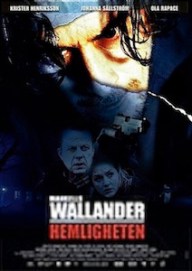 The third theatrical release to star Krister Henriksson as Henning Mankell’s detective is the thirteenth and final episode in the first series. It has a suitably Season Finale feel to it — “this time it’s personal” and all that — but also subtly constructs itself to work as the standalone piece necessary for a theatrical release schedule that skipped six whole episodes.
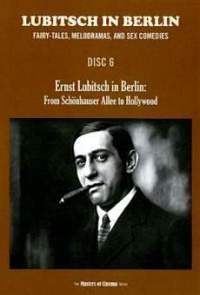 Part biography, part making-of, part analytical retrospective, Robert Fischer’s documentary does what it says on the tin: tells the story of the life and work of actor/director Ernst Lubitsch from his formative years, living on Schönhauser Allee in Berlin, to when he made the move to America in the early 1920s.
 In an age where Henry VIII is young, slim and sometimes irritatingly called “Henry 8”, not to mention more interested in shagging every young girl he can find than in, well, anything else, it’s somewhat refreshing to return to a time when he was always older, fatter and more interested in polishing off a huge slab of meat than seeing his wife. OK, so they call him “Heinrich VIII”, but at least that’s because this production team spoke a different language.
 Before
 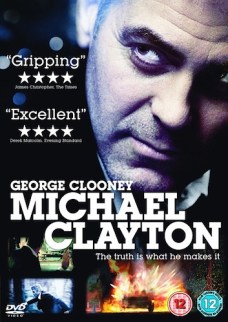 When Michael Clayton turned up among the contenders for 2008’s Best Picture Oscar I was a little surprised, because as far as I could recall I’d never heard of it. Then as I read about it a memory came floating back… a memory of a half-page (at best) review in Empire, of a George Clooney film that sounded like it should be good but was, they asserted, only worthy of three stars. As you’ve surely guessed, when I dug out this review it was indeed of Michael Clayton.
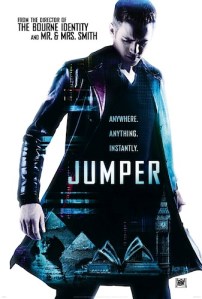 In honour of Jumper’s central conceit — that certain people can instantaneously transport themselves to any other point on the planet — I will conduct this review by jumping about through paragraphs I wrote without bothering to link them properly. (Also done in honour of my laziness.)
 The
The  Having just recently laid into
  “What if
  100Films.co.uk