
Tsui Hark | 123 mins | Blu-ray | 2.35:1 | China & Hong Kong / Mandarin | 12 / PG-13
 This year’s 52nd film is, in many ways, thanks to DC’s The New 52 (the comic book initiative/publicity stunt that saw DC relaunch their entire universe across a series of 52 new #1 issues, for those who don’t do comics): it got me back into reading regular comics, and featured in multiple titles for several months was a cool-looking advert for the US release of Detective Dee, complete with the attractive review quote, “Crouching Tiger, Hidden Dragon meets Sherlock Holmes, only a lot more fun”. A little research finds it highly recommended in other arenas too: there’s a host of awards nominations and wins, from the Venice Film Festival to the Hong Kong Film Awards; an 81% rating on Rotten Tomatoes; Blu-ray.com furnished the UK BD release with a glowing write-up; Time ranked it the third best film for the whole of 2011 (behind The Artist and Hugo). Even the unreliable film section of the Radio Times saw fit to give it four stars.
All of which hopefully establishes how I found it to be a massive disappointment.
Days before the coronation of China’s first Empress, a high-ranked man is mysteriously burnt alive from the inside out. Then the man charged with investigating the case suffers the same fate. On advice (from who or what I shall mention later), the Empress assigns the case to Detective Dee — who has been in prison for eight years for rebelling against the Empress. Sounds like a good setup, eh? A super detective, at conflict with his employer, looking into supernaturally-tinged murders; and it’s a Hong Kong movie so you know there’s going to be some impressive action sequences.
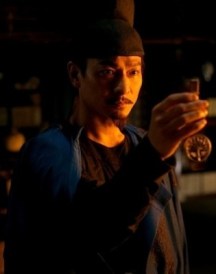 To take Time’s opinion as a starting point, I have to wonder if they would rank Detective Dee so highly if it had been an American-produced film with actors speaking English. I don’t mean if the film was Americanised, but exactly the same, just an American production. In that instance, I think it would very much be viewed as a summer blockbuster, because that’s definitely what it strikes me as. It’s one with lots of talky bits and an over-complicated story, certainly, but then it’s not unheard of for US blockbusters to confuddle the viewer with an under-written over-developed plot (less so these days, I grant you).
Apparently it makes commentary on the economic and political situation in modern China. It must be done quite subtly, then. That’s a good thing I suppose, but I imagine you’re only going to notice it if you already have a familiarity with what’s going on. I don’t. Best I can tell, the film’s message is, “even if you think your ruler’s a bad person who’s done bad things, they’re your ruler and you should let them get on with it and not rebel”. I could have misread it, of course, but that’s what I got from the ending. Not a position I’d personally agree with.
Naturally there are plenty of action sequences (choreographed by Sammo Hung), several of them tacked on for the sake of it. Personally I wasn’t impressed. They’re all clearly shot on digital video (the whole film was, but the smeary fights really show it up), several are under-lit, there’s too much Hollywood-style choppy editing, it felt like some had bits missing, others are stop-start in a way that adds up to not very much… Many of them left me confused about what was meant to be going on,  not in awe of the performer’s abilities or entertained. One of them features the hero fighting a gaggle of cheap CGI deer. Yes, deer. Why?
Detective Dee is a film of moments. There are some pretty shots, occasionally even sequences; the fight in the Phantom Bazaar, an underground river network, is guilty of some of my criticisms but also pulls off a few nice bits. The CGI is what you’d expect from a mid-range US miniseries, but (with exceptions such as the fighting deer) it works well enough, even creating some dramatic vistas, particularly of the 200-foot tall Buddha statue that’s central to the plot. Some of the sets are also incredibly impressive — again, the interior of the Buddha. Occasionally I was frustrated reading the subtitles (which fly by at a rate of knots, it felt to me) because I wanted to look at the detailed, busy production design.
I mention the fast subtitles because the film feels like it’s moving at quite a lick. There’s little room to get to know the characters, or the situation, or their relationships, or their political machinations, before it’s racing on to the next plot point. And yet despite that it feels incredibly slow as a whole — I was clock-watching before the hour mark.
Perhaps one of the things that suffers for this is the film’s relationship with the supernatural. It’s at first supposed that the deaths are some kind of divine intervention, but then this is kicked away — what a silly idea by some foolish characters! But then everyone’s more than happy to accept a talking magic deer (seriously; 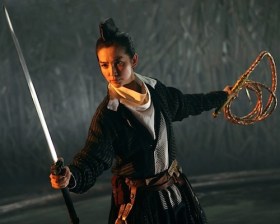 and they happily take its advice (see second paragraph)), a fighter whose arms fly off and turn into… something else (choppy editing means I’m not sure), facial transfiguration (imagine Mission: Impossible’s masks with face-churning magic instead of masks), and so on and so forth. Some of it ultimately has a rational explanation, but why is “divine intervention” so much less believable than “magic”? And why do you have to explain the talking deer and flying arms when the face-churning-thing is left untouched? I can take people flying unrealistically through the air — that’s the style of the genre, much like regular folk breaking out into perfectly-pitched musically-accompanied song is the style of the musical — but not internal inconsistency in other areas.
I’ve avoided the comparison so far, but Detective Dee is like a Chinese version of Guy Ritchie’s Sherlock Holmes, only a less inventive and comprehensible one. And it’s certainly not “a lot more fun”. Dee is a great deducer, a la Holmes, though the film gives him no opportunities to significantly show that off. The plot concerns a series of apparently-supernatural murders that actually have a rational explanation, and are ultimately all about taking control of the country. It stars a period detective who’s been reconfigured as younger and a man of action. But whereas Holmes kept things clear-cut and fast-moving, Dee (as I’ve noted) fudges and obscures motivation and plot and feels tediously long.
There are actually quite a few little things to like about Dee, and maybe there are a few big things too, but I feel like it’s making you work for them — 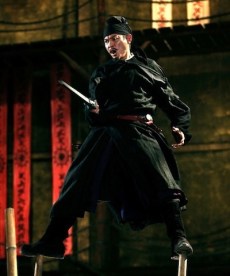 you could enjoy the characters, or the political machinations, but only if you take time to study them slowly and work out what was going on for yourself, because the film’s in too much of a rush to explain it to you. There’s something to be said for entertainment not spelling everything out — it’s often a highly-praised element of anything that achieves it — but Dee doesn’t do that, it rushes headlong past things that could do with more clarity. (One thing I should do is listen to Bey Logan’s commentary — there’s a fair chance he’ll have insights that illuminate me. But in a moment you’ll see why I haven’t done that before posting this.)
Believe it or not, I didn’t hate Detective Dee… but I didn’t exactly enjoy it either. Not fully. I started this review by saying it and I think it’s my key feeling: after getting a little hyped up about something I’d previously ignored the UK release of, I found it to be disappointing. Your mileage may vary.

The UK TV premiere of Detective Dee and the Mystery of the Phantom Flame is on Film4 and Film4 HD tonight, Friday 6th July, at 11:10pm.
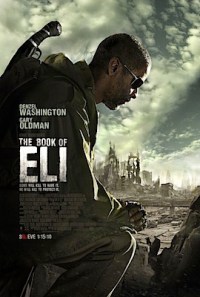 The directors of
  The music is by Atticus Ross, which was interesting because I’d thought it was reminiscent of
  Late on the film pulls out surprise appearances from Michael Gambon and Frances de la Tour. Their roles aren’t even close to needing thesps of such calibre though — they appear fleetingly, the actors underused. Particularly Gambon, who really has nothing to do except fire a gun. I know it’s usually a joke to comment that a usually-better cast member must have needed the money, but that’s the only reason I can imagine he’s here.
 Newman concludes that “you can’t help feel you were invited to a party with fizzy pop and cream cake and got suckered into a sermon instead.” I couldn’t have put it better. Eli starts off with the potential for an arty 5; slips slightly to a solid 4 when the standard post-apocalyptic trope of a gang fighting for local power comes in to play; unsteadies that 4 with an increasingly atonal second half; and quite frankly borders a 1 with its sickening ending.
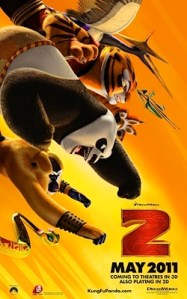 The first
  Thirdly, it has Gary Oldman as a villain. That should be wondrous, but it isn’t. He’s fine. Gary Oldman villains aren’t fine, they’re classic characters. But no, this one’s just fine. I guess he needed some cash.
 Hopefully the inevitable third entry (this ends with a very obvious setup for where the series will go next) can regain some more of the first film’s magic. As things stand, I found Panda 2 to be a fairly decent 90 minutes — though, saying that, a slightly slow one — but not one that came close to the numerous joys of its forebear. Disappointing.
 The final entry in Marvel’s multi-film campaign leading up to big team-up
  The connections don’t stop there. Some people complained that
  It also has the same problem that the first
  It’s hard to say what exactly is wrong here, but it’s mainly an abundance of CG backdrops, green/blue screen stuff that doesn’t scan. Heck, in one shot you can see a blue glow around the edge of a character’s hair! That’s bordering on the amateurish.
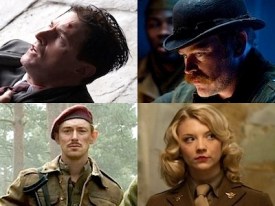 Still, do look out for
  Elsewhere, Tommy Lee Jones could play roles like this grumpy-but-good-at-heart-General in his sleep, but at least claims the film’s best line. Equally, Hugo Weaving could be in a similar state of unconsciousness and give a good villain, and while he does his best to chew the scenery, I thought he was fine but unmemorable in an underused role. As I said, the screenplay positions him as a “we need a villain for a climax”-level enemy when his character should be The Hero’s Nemesis, leaving a waste of both character and actor. Co-villain Toby Jones is similarly ill-treated, although at least he may return, semi-reincarnated as another villain (no explicit clues in the film, but he is one in the comics).
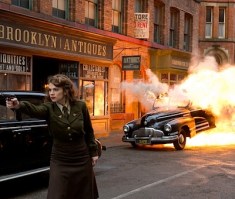 And I haven’t even mentioned the over-graded sepia hue, because it’s Set In The Past. Digital grading brought much potential to the film industry, but instead it’s pathetically and predictably overused. Whenever you compare a film itself to some B-roll footage in a behind-the-scenes documentary or somesuch, you suddenly noticed how not-like-real-life the film looks. In every thriller whites are actually blue, for instance. Here, I imagine if you compared it you’d find whites are actually bronze. I don’t imagine this kind of thing is going away now though.
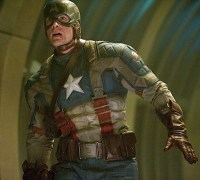 But hey-ho, here it is. Like I theorised at the end of Iron Man, maybe with this setup out of the way they can produce a better sequel… but considering the skinny-little-man-turned-muscly-superhero is one of the more interesting aspects of Cap, and they’ve done that now; and the World War 2 setting is another unique facet, which they’re leaving behind… sadly, I’m not holding out quite as much hope.
 Apparently MySpace had some hand in the creation of this movie. Remember MySpace? It’s what there was before Facebook. It was always rubbish, it just took a lot of people a long time to realise that. Anyway, some reviews seem to dwell on its involvement in the production of this movie —
  Most of the cast is drawn from the pool marked “British character actors” — you may or may not know the names, but you’ll probably know most of the faces. The lead is Eddie Marsan (Lestrade in
 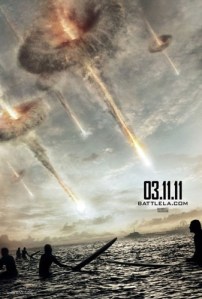 Battle Los Angeles (on screen; Battle: Los Angeles on posters — c’mon, let’s have some consistency with punctuation! Punctuation matters) seemed to come in for a wall of criticism when it hit cinemas way back whenever. For my money, though, it wasn’t that bad.
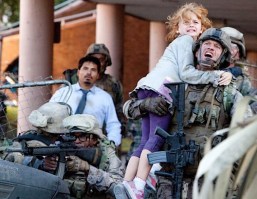 This kind of gung-ho militarism is laid on too thick. It seems fine for much of the film, but then as it heads into the second half and, especially, the third act, we have to suffer all manner of speeches and Emotional Moments that lack weight due to characterisation issues. The latter is badly handled for all kinds of reasons. All of the marines are entirely clichéd; so too are their story arcs; too much time is wasted trying to make us care about them — there are too many and they’re too shallowly drawn; things are worsened when a couple of civilians are added to the mix, who suffer from all the same problems… except they’re perhaps under- rather than over-developed. As we reach the third act, anything approaching plausible characterisation is jettisoned. Like the small-scale focus, what begins as naturalistic ends up with Big Speeches and all manner of Emotional Moments.
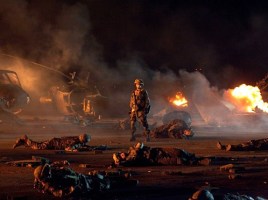 evoking the likes of the aforementioned as well as Black Hawk Down and
  They may take a little while to get to, but they’re relatively worth the wait.
 It never seems to have been fashionable to admit to liking
  being set in medieval/dark ages times, this has a very different, more traditional feel than the urban original film… albeit with lashings of CGI.
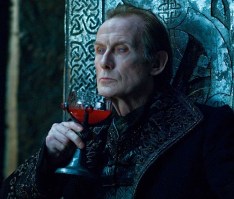 In the director’s chair for the first (and, to date, last) time is special effects whizz Patrick Tatopoulos, who does a fine job of producing an action-fantasy film. There’s nothing remarkable about it but it largely works, though it’s a little bit on the dark side at times. I don’t know why so many films do this, incidentally — we’ve reached an era where people are mostly watching films in cinemas where the bulbs are under-lit to save money, or at home in probably less-than-ideal conditions, with various lights on and a screen left on factory settings. I wouldn’t mind if these dark movies looked fine once you were properly calibrated, but most of them are still ever so dark. Why do they think this is a good idea? Especially when you flick into 3D (which, fortunately, this film was just ahead of.)
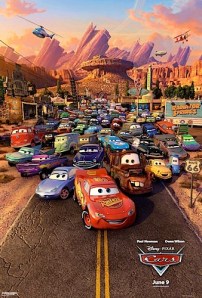 Since the creation of the Oscar for Best Animated Feature, only two Pixar features have failed to win:
  how the building of the interstate killed off so many small towns is both historically accurate (more or less) and emotional — but I imagine it also explains why the film can feel so long.
 having them talk to each other and giving them personalities, and it doesn’t need to make sense because his age isn’t even close to double digits and he’s just playing. But does that make it a viable idea for a film?
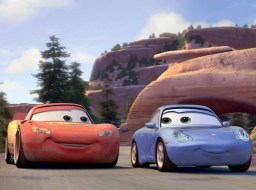 Cars is undoubtedly a below-par Pixar movie. It’s not a bad film — it has funny bits, exciting bits, a good moral message, some nice cameos and references and that kind of thing — but it doesn’t stand comparison to even a regular Pixar outing, never mind the best of their output. But hey, if you can produce 10 features that manage a 90%+ score on
 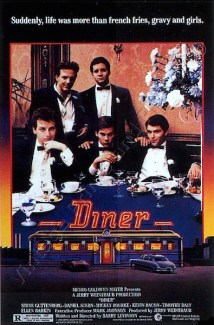 Baltimore, the week between Christmas and New Year, 1959: the lives of six friends in the run-up to one of them getting married, during which period they spend surprisingly little time at the titular establishment.
 There are no big turning points or revelations or developments for any of these characters. One is in trouble thanks to deep gambling debts, but there’s the equivalent of a magic wand that wipes them all out; another is permanently drunk with serious family issues, but neither of those go anywhere; another pines for a girl he barely sees and has never been with — well, except for one significant night — but by the end I’m not sure if they were going to get together or leave it be or… what. Similar things could be said for all the others.
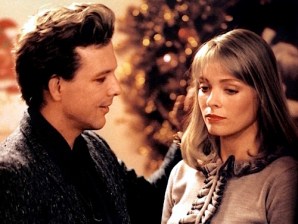 Like I said, this kind of storytelling works for some viewers and not for others. If it hadn’t been for the pat ending of that gambling debt plot, or the non-development of some other promising threads, maybe I would have liked it more. As it stands, Diner certainly has its moments, but maybe not enough of them for me.
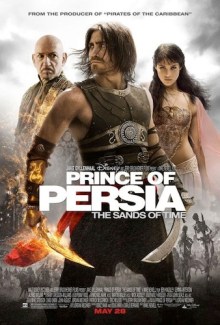 Disney’s attempt to launch a second franchise in the mould of
  There are some good action beats, but there’s also plenty of disorientatingly-edited, CGI-enhanced sequences, as per usual for the genre these days. For the former, see for instance Dastan’s climb up the wall into Alamut (or whatever it was called), or the knife-thrower-on-knife-thrower battle near the end. For explosions of CGI, see the massive logic-shattering ‘sand surfing’ sequence in the climax. Visually they’re clearly trying to evoke
 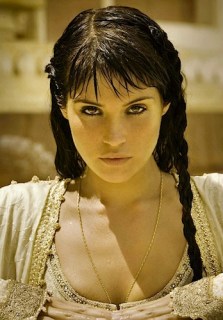 has the role Keira Knightley would’ve played five years ago. I think she’s meant to be a Strong Independent Princess but, much like Dastan, we’re told we should be inferring it rather than seeing any evidence of it.
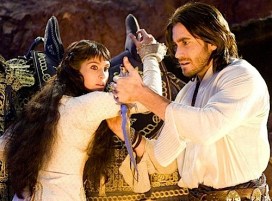 Plus, the sword-and-sandals milieu makes a bit of a change. I know we’ve had plenty of swords-and-sandals-flavoured movies in the wake of
  100Films.co.uk