Underworld Awakening (2012)

2013 #1
Mårlind & Stein | 89 mins | Blu-ray | 2.35:1 | USA / English | 18 / R
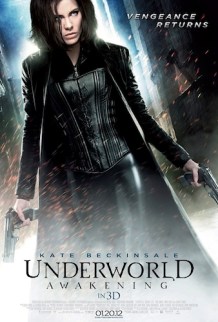
Underworld AwakeningJust when you think the Underworld series is dead, it suddenly lurches back to life with a new instalment. Fitting for a series all about vampires & that, I suppose.

Having diverted to a prequel telling us a story we largely already knew, here we rejoin Selene (Kate Beckinsale), last seen six years ago (real world time) in Underworld Evolution, which was very much Part 2 to the original film’s Part 1. They told a pretty complete tale, actually, so rather than try to find something there, Awakening launches into something new. Following a two minute recap of the first two movies (it’s so long ago that this is actually very handy), a quick-cut prologue-y bit tells us that the long-secret war between vampires and Lycans (aka werewolves) was discovered by humans, who set about wiping them out. Trying to escape, Selene’s crossbreed lover Michael (Scott Speedman) is killed and she gets frozen… only to wake up however-many-years later into a changed world… And so on and so forth. Escapes, shooting, action-y-business all ensues.

Said violence is very bloody and brutal, much more like the second film — I swear the first (especially) and third weren’t anything like as gory. Evolution well earnt its 18 certificate, after a very 15 first film, and quite surprised me at the time. This isn’t as extreme as that, but still. The main drama and attraction in the Underworld series lies in the vampires-vs-werewolves-with-modern-tech concept, not in ripping off limbs or spurting blood or whatever. Or maybe that’s just me.

Whose daughter might she be...By taking such a bold move with the plot, meanwhile, the story pushes the series’ mythology in new and relatively interesting ways. It’s becoming a bit dense and fan-only (unless you let it wash over you and just enjoy the punching), but at least they’re not regurgitating the same old stuff. It manages a few twists along the way too, which is always nice. The plot seems to have been half worked around Speedman’s non-involvement, leading me to wonder why — he’s not too busy, surely? Perhaps he’d just had enough? But no, apparently it was genuinely just written this way. I guess he couldn’t be bothered to turn up for some cameo shots, because the stand-in is really obvious.

Also glaringly obvious is the set-up for a sequel. Not so much as the first film, which had such an End of Part One feel (including a direct cliffhanger) that the sequel picked up mere hours later. But this is still a story obviously incomplete (again, there’s a sort of cliffhanger), but at least it has the courtesy to… actually, no, it’s only as complete as the first film. The main narrative drive is resolved, but other bits are blatantly open.

But it didn’t seem to go down too well, so what are the chances of us seeing it continued? Well, as we’ve learnt, you can never write the Underworld series off. And its niche fanbase, semi-independent production, and relatively long three-year gap between sequels There's still lots of shootingmeans the next one will probably turn up out of the blue with little hype, much as Awakening did last year. Plus, though this is the most expensive film to date (double the budget of the preceding one!), it’s also the most financially successful: $160.1 million worldwide, beating number two’s $111.3 million. Assuming Beckinsale still feels up for it, I imagine 2015 will bring us a continuation — and, hopefully, a conclusion.

The higher budget and higher gross I mentioned are surely both down to one thing: 3D. Shooting in proper 3D (as opposed to the ever-so-popular post-conversion) costs a fortune, as a producer reveals in the BD’s bonus features, but it can also net you more money at the box office thanks to that 3D premium. Such a gamble hasn’t paid off for everyone (Dredd), but it clearly did here (how the hell did Underworld 4 make four-and-a-half times as much money as Dredd?!) Watching in 2D, it’s clear that some sequences were designed with 3D in mind — not in the way that, say, Saw 3D or The Final Destination sometimes only make sense with added depth, but in ways where 3D would (I imagine) enhance the visuals. There are some instances of stuff flying at the camera, a popular sticking point for the anti-3D crowd, but that’s actually been part and parcel of Underworld’s style since the start (just watch a trailer for the first film — there was a shot of it used prominently in most of the marketing).

New-style evolved LycanAlso worthy of commendation: new-style ‘evolved’ Lycans; a small role for Charles Dance (always worth seeing); the evocative near-future setting; good quality action sequences; some nice steel-blue cinematography/grading. Some of it was shot at 120fps on brand-new pre-alpha never-used RED cameras — take that Peter Jackson, eh. Plus it’s only a little over 1 hour and 18 minutes long without credits. Some would bemoan such brevity, but it has its positives.

I’ve always quite liked the Underworld series, even if the first one is still clearly the best. Awakening gets most kudos for taking things in a new direction, even if, as a film in itself, it’s only OK.

3 out of 5

Broken Arrow (1996)

In the interests of completing my ever-growing backlog, I decided to post ‘drabble reviews’ of some films. One day I may update with a longer piece, but at least there’s something here for posterity.

For those unfamiliar with the concept, a drabble is a complete piece of writing exactly 100 words long.

2013 #35
John Woo | 104 mins | TV | 2.35:1 | USA / English | 15 / R

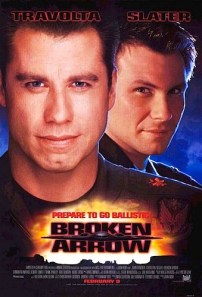
Broken ArrowUS Air Force pilot Jon Travolta crashes a plane, steals a nuke, and former friend and colleague Christian Slater must stop his dastardly plan in this ever so ’90s actioner.
In his second Hollywood outing, Hong Kong action maestro John Woo (over-)directs his little heart out: there’s an endless array of slightly hilarious slow-mo, crash zooms, etc. Plus, it has the honour of featuring possibly the most gloriously OTT villain death in the history of cinema.

It all seems quite cheesy now, but still quite fun. Perhaps best suited to those nostalgic for a style of movie now gone by.

3 out of 5

Underdog (2007)

2013 #5
Frederik Du Chau | 74 mins | TV | 16:9 | USA / English | U / PG

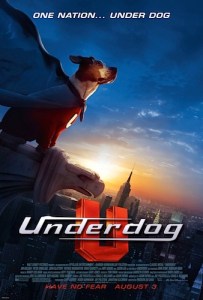
UnderdogIn this big screen live-action version of some old US cartoon, a dog gets superpowers and, naturally, becomes a superhero. That’s pretty much it.
The film is widely disliked, it seems, with a very low rating on IMDb; but I thought it was actually good fun. It’s not Citizen Kane, but it’s not trying to be — it’s a kids’ comedy-adventure, and kids will get the most out of it, but it also has enough wit and charm to see it through for some older viewers.

And there’s Peter Dinklage as the raving villain — you know that’s got to be good.

3 out of 5

In the interests of completing my ever-growing backlog, I decided to post ‘drabble reviews’ of some films. One day I may update with a longer piece, but at least there’s something here for posterity.

For those unfamiliar with the concept, a drabble is a complete piece of writing exactly 100 words long.

The Amazing Spider-Man (2012)

2013 #44
Marc Webb | 136 mins | Blu-ray | 2.40:1 | USA / English | 12 / PG-13

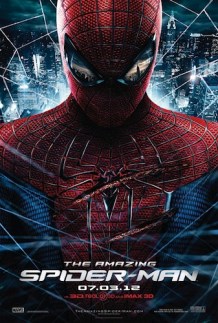
The Amazing Spider-ManAndrew Garfield dons the webbed onesie for an unwarranted reboot of the only-one-decade-old Spider-Man film franchise, retelling his origins… but with a twist! Cos, y’know, the last version was only out about 10 minutes ago.

Director Marc Webb’s only previous feature credit is hipster rom-com (500) Days of Summer. Presumably he was chosen, not for his surname, but because half of Amazing is a hipster rom-com. Peter Parker is no longer a socially inept geek, but a mumbling hipster who easily attracts the attention of his longed-for girl (and maybe one or two others) because he’s hipster-cool.

This is just the first of many mistakes. There’s the ditching of the famous “with great power” motto, just Because; and he does grow webbing naturally, as per the controversial decision in the Sam Raimi-helmed trilogy, but now he develops artificial wrist-based web-shooters too, because That’s In The Comic Goddammit; and then there’s some kind of conspiracy backstory with his parents because That’d Be Different.

Essentially, everything is geared towards making sure this isn’t just a rehash of the previous series-starting film, because, as we established, that only happened just a minute ago. In the process, various bits get bungled, rejigged and rearranged to try and convince viewers that you haven’t seen all of this origin story before, when really you have… and done better, too.

The film isn’t without merit. Some of the done-for-real web-swinging is nice; Garfield is good when not affectedly stuttering; love interest Emma Stone is pretty until she opens her mouth; Mask off, as per usualsome of the action sequences are alright. Mercifully, the much-trailed first-person segments are cut down to a minimum; kind of a “we made this so we ought to use it, but we’ve realised everyone was going to hate it”.
But supporting characters get short shrift. Denis Leary doesn’t turn up until halfway through and gets a half-arsed arc that jumps from one end to the other. Rhys Ifans gets off to a good start as sympathetic villain-to-be Dr. Curt Connors, but then his story too is jumped forward when someone clearly realised the running time was running away from them.

Spider-Man’s mask seems to come off every 10 seconds. Attempts at “aren’t New Yorkers all wonderful” patriotism come off as cheesy and literally laughable (the aligned cranes!), whereas in Raimi’s films they kinda felt good even though you knew you should find them horrid. Gone is the humour or colourfulness of those previous films. I know the latter wasn’t to everyone’s taste, but it nailed the intended tone of Spidey much better than this Nolan-inspired grim real-world style.

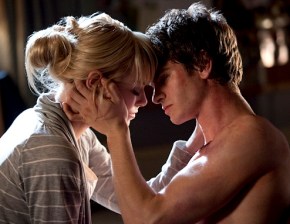
Someone mentioned Twilight in the run up to release. Disappointingly, they seem to have taken this to heart, focusing on the romance at least as much as the superhero antics. I don’t know how they divide up in terms of screen time, but it feels like the romance received more time and effort from the makers. Superheroes for TwihardsNot that it pays off — instead it just feels like the action scenes were bunged together because, hey, some of the fans want that stuff, right?
Plus, remember how everyone disliked Spider-Man 3 so it did less box office than either of its predecessors? This did even less again. While I’d like to say they’ve listened to fans for the sequel, I think it’s superficial: the suit’s had a major redesign to make it look even more like the comics than either previous version (bigger whiter eyes!), but it will feature at least two, probably three, and possibly four major villains. Such multiplicity was 3’s undoing, and as Webb & co couldn’t find the room to do even one villain properly in this film, I dread to think how they’ll handle several.

The Amazing Spider-Man isn’t a disaster — I’ve given it three stars for a reason — but Raimi got it right in his first two films, and by being different for the sake of it they’ve thrown away a lot of what worked and emphasised many of the things that didn’t. I’m sure there are plenty of single adjectives people would use to describe this iteration of Spider-Man, but “amazing” isn’t one of them.

3 out of 5

Flightplan (2005)

In the interests of completing my ever-growing backlog, I decided to post ‘drabble reviews’ of some films. One day I may update with something longer, but at least there’s something here for posterity.

For those unfamiliar with the concept, a drabble is a complete piece of writing exactly 100 words long.

2013 #36
Robert Schwentke | 94 mins | TV | 2.35:1 | USA / English | 12 / PG-13

The Dark Knight RisesNotorious (to me) for unjustly beating Serenity to #1 at the US box office (a slight we Brits can proudly say went unrepeated), this plane-based uncredited remake of The Lady Vanishes is the kind of film that’s a 12 for no real reason. It contains “moderate violence and suspense”. Wow.

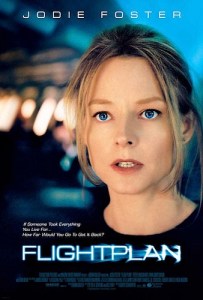
Flying home after her husband’s sudden death, Jodie Foster’s kid goes missing, but no one remembers seeing her. Is Foster mad, or is it a great big plot conceit? You guess. Things progress adequately, it’s only an hour-and-a-half, and then we can all move on to something better. Like Serenity.

3 out of 5

Not only is this exactly 100 words, but each half is exactly 50. I know, I’m incredible.

Dungeons & Dragons: The Book of Vile Darkness (2012)

2013 #33
Gerry Lively | 86 mins | TV | 1.78:1 | UK / English | 15 / PG-13 *

Dungeons & Dragons: The Book of Vile DarknessRemember the Dungeons & Dragons film from 2000? To say it went down badly is an understatement. Nonetheless, they made a sequel with some returning cast (which I’ve not seen), which I doubt fared any better and maybe went straight to DVD. This one is again low-budget, and possibly was made for TV, but it’s all-new; and though form hardly suggests it will be any good, I was on a bit of a fantasy binge and it was on TV, so…

And yes, it is rubbish… I suppose… Thing is, it sort of grew on me. For all I know they may’ve shot it in order, because it feels like the production grows in competency as it goes on. From a start that looks like a fan film shot in someone’s garden, by the time our hero teams up with a ragtag gang of evil-doers it begins to come together. Such is the plot: a band of adventurers do some adventuring. Proper D&D, I guess. In a neat twist on the usual formula, the gang we follow for most of the film are nearly all villains, the only exception being our hero who has infiltrated them. Are there even badder baddies who’ll make the (remaining) members of the gang turn out good after all? Well, of course.

Even though I ended up liking it, let’s be honest: The acting never gets good, though one chap, Barry Aird, delivers his handful of good lines with aplomb, even managing to make the ludicrously clichéd ones sound half decent. He’s easily the best thing in the film. The screenplay isn’t much cop, the story and dialogue both riddled with clichés and the like… though I think some of the dialogue is better than the actors can manage with it. And for all the laughable stuff, I’m sure some of it was meant to be humorous, like when Sexy Witch Lady pushes Random Strumpet aside and there’s an almighty crash. And there’s an undead kid who is properly creepy.

Her sex is on fire tooDirector Gerry Lively helmed the preceding D&D movie and some stuff you’ve never heard of, as well as serving as DoP on such auspicious-sounding films as Son of Darkness: To Die For II, Waxwork II: Lost in Time, Hellraiser III: Hell on Earth, Return of the Living Dead III, and Children of the Corn III: Urban Harvest. Clearly cheap-sequels-no-one-wanted are his stomping ground. His direction is never more than television-y, although that’s an increasingly unfair description as more and more TV programmes become more and more movie-like; but as that’s still the high-end ones, I guess the derogatoriness holds for now. It’s not helped by editing that is occasionally bizarrely jumpy, as if someone thought it would be OK to skip a second or two just to speed things up.

One area I’m happy to flatly praise are the computer effects. Done by a Bulgarian company (which is where the film was shot), these are largely very good. No, we’re not talking Avatar level here, obviously, but for a direct-to-DVD/TV film they were pretty classy.

Despite its low-rent stylings across the board, The Book of Vile Darkness somehow won me round. It’s not going to compete for genre break-out status, never mind anything greater, but for anyone after a well-intentioned sword-and-sorcery movie, they could do worse.

3 out of 5

Dungeons & Dragons: The Book of Vile Darkness is on Syfy UK (Sky 114; Virgin 135, HD 165) tonight at 12:10am, and again on Thursday at 11pm.


* IMDb says this is the US rating, but that seems improbable: they list it as direct to TV, which wouldn’t use the MPAA system; and even if it wasn’t, it contains breasts. Americans don’t seem to like their under-17s seeing breasts. ^

And Now for Something Completely Different (1971)

2013 #51
Ian MacNaughton | 85 mins | DVD | 1.78:1 | UK / English | PG / PG

And Now for Something Completely DifferentThe first Monty Python theatrical release (four more would follow; five if you count last year’s A Liar’s Autobiography) is a compilation of re-shot sketches from the first two series of Monty Python’s Flying Circus.

Designed to launch the sextet to a US audience who wouldn’t have seen the TV series, And Now For… contains around 40 sketches, including two of their most famous: the Dead Parrot sketch and The Lumberjack Song. I have to confess, I’m really a Python neophyte — to be precise, I’ve seen Holy Grail twice, Life of Brian once, and only stray sketches in documentaries and clip shows and the like. As such, almost the entire film was new to me (the only exceptions being the aforementioned pair), so I can’t tell whether the re-shoot impaired or enhanced the quality. (In fact, I say “re-shoot”, but the film was shot between series one and two of Flying Circus, so this is actually the first performance of the series two sketches.)

The Dead Parrot sketch clearly isn’t as good — it feels like Palin and Cleese re-enacting past glories, robbed of much energy by not being shot as-live in a single take. The Lumberjack Song, on the other hand, seems to survive fine. The rest is as much of a mixed bag as sketch shows ever are — it’s become a cliché to call them “hit and miss”, but it’s true. Over 40 years on, the Pythons’ style is still so leftfield, experimental, absurdist and irreverent that one man’s hilarity will easily be another’s bafflement. LumerbjackFor my money, it becomes a bit tiring watching sketches for so long, even with the attempts made to link them together — it doesn’t form a narrative, so much as a series of casual crossovers that would make re-arrangement in an edit impossible. In and of themselves, however, many of the skits hit their mark.

Director Ian MacNaughton also helmed the TV series but, freed of the constraints of BBC studio filming, he mercifully does more than point-and-shoot. Sometimes this doesn’t work (an early sketch, “Marriage Guidance Counsellor”, is initially shot from bizarrely high angles followed by some very flat compositions), but other times it comes off beautifully: a long track-and-pan throughout “Nudge Nudge” is flawless.

Perhaps this is showing my Python inexperience again, but, considering how everyone goes on about the brilliance of Graham Chapman, he’s far from foregrounded here. Cleese, Idle and Palin seem to get the most material; Chapman is often a kind of straight man (in fairness, often among the rest of the troupe acting this role for the benefit of a lead); Jones doesn’t do much at all, which is perhaps why he later moved toward directing. Of course, this perception could just be the result of the sketches chosen; or, for all I know, he was more talented as a writer than performer; or perhaps he came into his own later (he’s the lead character in both Holy Grail and Brian, of course). But, on this evidence alone, I don’t think Chapman would be the one to draw anyone’s attention. In fact, the thing that most struck me about the cast is that, while most of them look familiarly young, Eric Idle looks about 15.

And now...Reportedly the Pythons didn’t consider the film a success, hampered by interfering higher-ups and a ludicrously low budget (according to Wikipedia, this was “so low that some effects which were performed in the television series could not be repeated in the film”!) Ironically, US reviews were mixed and the film did little business at the box office (a 1974 re-release, after the TV series had turned up on PBS, was a greater success), while in the UK it was popular enough to turn a profit, despite the fact it contained nothing new for British fans — “indeed many were disappointed that the film seemed to belie its title.” Indeed.

It’s difficult to know what And Now for Something Completely Different offers fans today. With the TV series readily available on DVD, I imagine it more often pays to re-watch the original versions. Equally, as noted, this is technically the first outing for some. Perhaps it’s just a curio; a different perspective on familiar material. For newcomers… well, as one, it’s difficult to say how much it offers a grounding in the Pythons’ material. Is it a best-of? Some of their most famous stuff isn’t here (presumably it came in the latter two series), and almost an hour-and-a-half of sketches gets a bit much. Indeed, it’d probably work better in more bite-size chunks; say, 30 minutes at a time.

3 out of 5

The Fast and the Furious: Tokyo Drift (2006)

2013 #45
Justin Lin | 100 mins | TV | 16:9 * | USA & Germany / English | 12 / PG-13

The Fast and the Furious: Tokyo Drift2001’s car racing actioner The Fast and the Furious seemed, to me, to meet with a mixed reception; the kind of thing where some critics disliked it and some enjoyed it for what it was, and audiences were more the latter but only passingly so. It must’ve done well though, because in 2003 we were treated to a sequel.

For 2 Fast 2 Furious the studio backed the wrong horse, signing up the first film’s uninteresting hero, Paul Walker, and leaving its more entertaining villain, Vin Diesel, to his skyrocketing action star career. The main talking point seemed to be the title, out of which the piss was relentlessly taken… and has been ever since.

Come 2006, there seemed to be some kind of last-ditch attempt at saving what someone thought was a good idea. The third film in the series ditches a number for a subtitle; ditches the US settings for Japan; and ditches every character from the earlier films in favour of a fresh start. What remains is the tone and the content. The plot is the usual mix of street racing and gangster posturing, though at least the “woohoo hot chicks!” and rap culture business has been toned down from last time.

The plot, such as it is, sees a rebellious US high school student (target audience cypher, check!) sent away to his father in Japan instead of going to prison (I’m sure there’s some logic there…) and ordered never to go near a car again. Which he promptly does, of course. Racing is different in Japan, though: rather than drag-style muscle with the odd inconvenient corner, here it’s all about drifting — sliding round corners with style. Goaded into a race, said high school student (I can’t remember his name. Who could?) loses miserably. And then he sets out to learn how to drift and there’s some stuff with a girl who’s with the bad guy and there’s some gangster-types and you know the drill, I’m sure.

Tokyo drifterIf I sound dismissive, it’s slightly affected: Tokyo Drift is surprisingly decent. Surprisingly decent for a Fast and Furious film, that is. In my review of 2F2F I described it as “junk food” — you know it’s bad for you, but sometimes it hits the spot. Tokyo Drift is the same kind of film, all fat and sugar and no substance, but kinda tasty at the right time. And at least it provides something different to the previous films. Not so much the new characters, who are predictably bland; or the plot, which is samey; but the move to Tokyo, which lends proceedings a different flavour and style, not least the emphasis on drifting — most/all of which was performed for real by stunt drivers, rather than the often computer-enhanced car action of the previous films.
Despite this looking like a desperate grab that would leave The Fast and the Furious series as a trilogy in technicalities only, somehow the franchise has since revitalised itself. More on that next time, but it does have a bearing here: as later films brought returning characters and on-going plots, so Tokyo Drift slipped away as an anomaly; an aside, perhaps even a mistake, that has no place in the series’ primary narrative. While that last point may or may not be true, as a film in itself, Tokyo Drift is as passingly entertaining as anything else the F&F series has yet offered me.

3 out of 5

* The original aspect ratio is 2.35:1, but this was on ITV and they’re less respectful than Channel 4 or (sometimes) the Beeb. The cropping was rarely noticeable, however. ^

Green Lantern: Extended Cut (2011)

2012 #53
Martin Campbell | 124 mins | Blu-ray | 2.40:1 | USA / English | 12 / PG-13

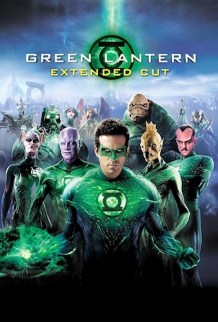
Green Lantern: Extended Cut“Hype” has to be one of the biggest factors in how we view films these days. Technically it’s defined as “extravagant or intensive publicity”, I suppose thereby meaning something to “positive expectation”, but I think it also works the other way: if you’ve heard nothing but awful things about a film, its weakness has been ‘hyped’. It’s this latter point that applies to Green Lantern, which has an almost insurmountable degree of negative expectation attached. To summarise the headline points, it’s got a woeful rating of 26% on Rotten Tomatoes and took just $220m at the international box office, which might sound a lot but barely covers its production budget. So I expected to despise Green Lantern, or at least roll my eyes or twiddle my thumbs at its constant awfulness, but I actually quite enjoyed it.
And that’s why I talk about hype, because my expectation that the film would be irredeemably awful is at least partly why I found it surprisingly enjoyable — a bit like XMO Wolverine, which I didn’t like nearly as much when I watched it again a few years later. I’m not going to try to argue Green Lantern is a great movie, or even that it doesn’t contain significant flaws, but as a comic book-y two-hour diversion, I found it passably entertaining.

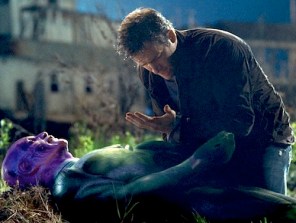
For those not in the know, the plot concerns Hal Jordan (Reynolds) finding a dead alien and a ‘magic’ ring that inducts him into a sort of intergalactic police force, the Green Lanterns. Stupid name and concept, attributable to it being a genuine magic thing before being reinvented as alien tech at some point, and perhaps it was the very daft datedness of the idea that (in part) put a mass audience off. Dead alien's ringBut I digress. Cocky jocky Hal is whisked off to the other side of the galaxy to learn how to be a Hero and use his ‘magic’ ring, which can conjure stuff up, then returns to Earth to save it from some menace(s). As superhero origin stories go, at least it’s got a couple of differences.
Hal’s character arc — the cocky guy who’s actually got fears and insecurities due to the death of his father — is actually quite a good one; a neat twist on the usual hero archetypes. So many superheroes have a version of the “loved one died when I was young” thing, but for most it’s motivation to fight rather than a worry that holds them back. But that arc is underplayed almost to the point of being unnoticeable, so when Hal overcomes it in order to save the day, you barely register that he’s overcome anything. Which is a shame, because there was potential in that. You don’t necessarily expect depth of character from a blockbuster, but it does hold it back.

However, the film’s primary problem (at least for me) was a lack of threat; or, rather, a lack of urgency. There’s a great big devourer of worlds out there, but we never get the feeling it’s doing much harm to anyone. I mean, it is, but we don’t feel it. Even at the climax, when it sets course to Earth, it’s more of an understanding that our hero is going to save the planet, rather than a genuine sense of peril that Earth is under assault. Perhaps this stems back to characterisation: some of the cast are likeable enough; the others are bland enough to not be unlikeable; and that leaves us wanting for someone to root for.

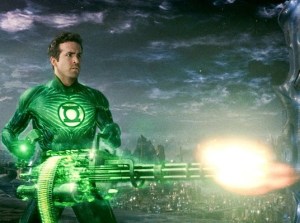
It gets cleverer than thisThere are positives. The action sequences are good, which is a definite plus in this kind of film. The inventiveness with what the ring can do is fun. There’s a lack of relation to the sketchily-drawn characters that stands in the way of us truly engaging with them, and there’s a certain brevity and lack of scale that undersells the alleged threat to Earth (it’s a giant evil space-cloud that can barely cover a few city blocks, let alone the entire planet) — but, that aside, they’re entertaining enough. That said, much as the film pulls its punches with characterisation and threat, so it does with awe and spectacle. The Lanterns’ planet Oa doesn’t have the same impact as Asgard in Thor, yet we’re told several times what a spectacular place it is.
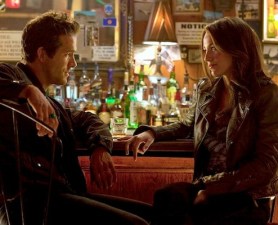
The Blu-ray’s Extended Cut adds exactly 9 minutes and 39 seconds of new content (as ever, details can be found here). This is almost entirely a prelude sequence, showing the death of Hal Jordan’s dad. The sequence serves to flesh out the relationships between Hal, love interest Carol and future-villain Hector a little, but there’s not a lot gained that isn’t learnt elsewhere. It also breaks up the flow. I only watched the extended version in full, but I imagine it’s a smoother transition in the theatrical, rather than pinging back and forth between intergalactic goings-on and bits & bobs on Earth. The only other extension comes when Hal has a chat with his 11-year-old nephew. Conversely, this scene plays much better in the extended cut, and I’m not entirely sure why they felt the need to cut it.

Damp squibIndeed, I’d say the Extended Cut doesn’t go far enough, with some of the disc’s deleted scenes meriting inclusion. However, the main one occurs on Oa, meaning an effects-heavy scene that hasn’t had CG work done or all the voices recorded, so couldn’t just be dropped back into the finished film as-is. I imagine that’s why it wasn’t. That said, even if they’d done such work, those scenes are minor points, not game-changers.
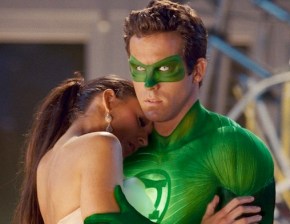
What an extended cut of Green Lantern should really have done is build character and emotional impact. The plot is decent enough, but the film rattles along and sticks purely to story — we never feel it. It is nice to have a blockbuster effects movie that comes in closer to two hours than three, but they used to be able to make those and have us care. Where’s that ability gone? The only relationship that gets any real screen time is the romantic one, and that’s a damp squib.

I quite enjoyed Green Lantern while watching it. I felt quite positive afterwards. But the more you think about it, the more you spot the lack of depth. Maybe that’s OK — maybe it’s fine for a film to just give passing pleasure while it’s on. It wouldn’t be good if every film operated at that level, but it’s a painless experience now and then. Bye bye Green LanternStill, I think there’s a better film lurking in Green Lantern, and it’s a shame it didn’t get the screenwriter(s) or director(s) required to bring it out. It’s even more of a shame that worse films than this have received a kinder critical consensus or huge box office. That leaves some suit feeling vindicated and churning out the same rubbish again, whereas with a bit more effort Green Lantern 2 could’ve been worthwhile.
3 out of 5

Stiff Upper Lips (1998)

2012 #96
Gary Sinyor | 91 mins | TV | 4:3 | UK & India / English | 15 / R

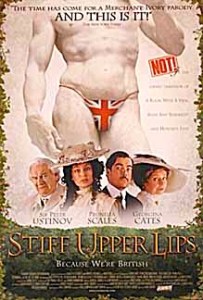
Stiff Upper LipsSpoof of British ‘Heritage’ films and TV series, particularly the work of Merchant Ivory. It was probably a bit belated: released in 1998, you’ll note most targets are from the ’80s. It only even made it to TV recently (I watched on Radio Times’ recommendation). Specific targets include Brideshead Revisited and A Room with a View, with individual sequences riffing off the likes of Chariots of Fire and Orlando.

A mite sex obsessed — though, arguably, that’s only highlighting the original works’ undertones, so in that respect makes fair mockery. At worst, however, it feels like American Pie in period dress.

3 out of 5

In the interests of completing my ever-growing backlog of reviews, I decided to post some ‘drabble reviews’ of a few films. In the future I may update with something longer, but if I don’t, at least there’s something here for posterity.

For those unfamiliar with the concept, a drabble is a complete piece of writing exactly 100 words long.