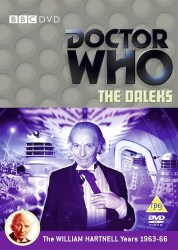

Doctor Who:
The Daleks
and
Dr. Who and
the Daleks
Doctor Who: The Daleks
1963-4 | Christopher Barry & Richard Martin | 172 mins | DVD | 4:3 | UK / English | U
Dr. Who and the Daleks
1965 | Gordon Flemyng | 83 mins | Blu-ray | 2.35:1 | UK / English | U
In a fortnight’s time, on the 23rd of November 2013, Doctor Who will celebrate its golden anniversary — 50 years to the day since the premiere broadcast of its first episode, An Unearthly Child. Those 25 minutes of 1960s TV drama still stand up to viewing today. OK, you couldn’t show them on primetime BBC One anymore; but the writing, acting, even the direction, and certainly the sheer volume of ideas squeezed into such a short space of time, are all extraordinary. It is, genuinely, one of the best episodes of television ever produced.
But that’s not why Doctor Who is still here half a century later. It may be the strength of that opening episode, the ideas and concepts it introduced, that has actually sustained the programme through 26 original series, a 16-year break, and 8 years (and counting) of revived mainstream importance; 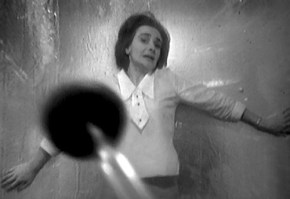 but that’s not what secured the chance to prove the series’ longevity. That would come a few weeks after the premiere, in the weeks before and after Christmas 1963, when producer Verity Lambert went against her boss’ specific orders and allowed “bug-eyed monsters” into the programme — in the shape of the Daleks.
Something about those pepperpot-shaped apparently-robotic villains clicked with the British public, and Dalekmania was born. Toys and merchandise flowed forth. The series soon began to include serials featuring the Daleks on a regular basis. And, naturally, someone snapped up the movie rights.
Rather than an original storyline, the ensuing film was an adaptation of the TV series’ first Dalek serial. These days you probably wouldn’t bother with such a thing, thanks to the abundance of DVD/Blu-ray/download releases and repeats by both the original broadcaster and channels like Watch; but back then, when TV was rarely repeated and there certainly wasn’t any way to own it, retelling the Daleks’ fabled origins on the big screen probably made sense. Nonetheless, there was an awareness that the filmmakers were asking people to pay for something they could get — or, indeed, had had — for free on the telly. Hence why the film is in super-wide widescreen and glorious colour, both elements emphasised in the advertising. The film is big and bold, whereas the TV series, by comparison, is perhaps a little small, in black & white on that tiny screen in the corner of your living room…
But, really, that was never the point. Doctor Who has always thrived on its stories rather than its spectacle (even today, when there’s notably more spectacle, it’s those episodes that offer original ideas or an emotional impact that endure in fans’ (and regular viewers’) memories). The plot of The Daleks is, by and large, a good’un, and certainly relevant to its ’60s origins —  its inspiration comes both from the Nazis, not yet 20 years passed, and the threat of nuclear annihilation, at a time when the Cold War was at its peak. The film adaptation is so unremittingly faithful (little details have changed, but not the main sweep) that these themes remain, all be it subsumed by the COLOUR and ADVENTURE of the big-screen rendition.
The Daleks were, are, and probably always will be, a pretty blatant Nazi analogy. There’s not anything wrong with that, though its debatable how much there is to learn from it. Where it perhaps becomes interesting is the actions of the other characters. Here we’re on the Daleks’ homeworld, Skaro, which is also populated by a race of humanoids, the Thals. They are pacifists and, when they learn the Daleks want to kill them all, decide it would be best to just leave rather than fight back. The Doctor’s companion Ian has other ideas, goading them into standing up for themselves. These days the idea that our heroes would take a pacifist race and turn them into warmongers strikes a bum note; but this is a serial made by a generation who remember the war, perhaps even some who fought in it, and naturally that colours your perception of both warfare and what’s worth fighting for. The Daleks aren’t just some distasteful-to-us foreign regime that maybe we should leave be unless they threaten us directly — they’re Nazis; they’re coming to get us; they must be stopped.
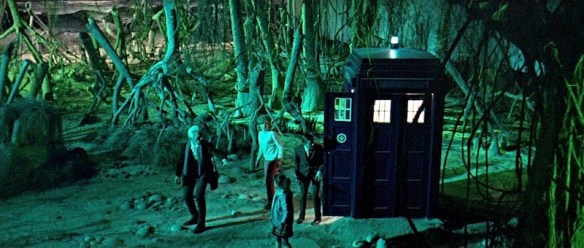
On the other hand, this is contrasted with Skaro itself — an irradiated wasteland, the only plant and animal life petrified, with the Thals and our time-travelling heroes requiring medication to survive. This is a Bad Thing… but this is where war has led, isn’t it? This is why the Thals are pacifists — because they don’t want this to happen again. And then they go and have a fight. Perhaps we shouldn’t be digging so deeply into the themes after all. It’s not that a “children’s series” like Doctor Who is incapable of sustaining their weight, it’s that writer and Dalek creator Terry Nation is really more of an adventure storyteller. That said, he did go on to create terrorists-are-the-good-guys saga Blake’s 7 and how-does-society-survive-post-apocalypse thriller Survivors, so maybe I’m doing him a disservice.
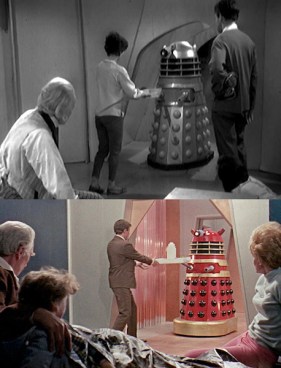 If the film’s rendering of the story and consequent themes is near-identical to its TV counterpart, plenty of other elements aren’t. The most obvious, in terms of adaptation, is that its 90 minutes shorter — roughly half the length. That’s not even the whole story, though: the film is newbie friendly, meaning it spends the first seven minutes introducing the Doctor and his friends. When we take out credits too, it spends 75 minutes on its actual adaption — or a little over 10 minutes for each of the original 25-minute episodes. And yet, I don’t think anything significant is cut. Even the three-episode trek across the planet that makes up so much of the serial’s back half is adapted in full, the only change being one character lives instead of dies (a change as weak as it sounds, in my view).
The funny thing is, even at such a short length it can feel pretty long. It’s that trek again, as Ian, Barbara and some of the Thals make their way to the back of the Dalek city to mount the climactic assault. It feels like padding to delay the climax, and some say it is: reportedly Nation struggled to fill the seven-episode slot he was given, hence the meandering. When it came to the film, Nation insisted Doctor Who’s script editor David Whittaker was hired to write the screenplay (apparently the trade-off was that producer Milton Subotsky got a credit for it too), which perhaps explains the faithfulness. It’s a shame in a way that Whittaker just produced an abridgement, because a restructured and re-written version for the massively-shorter running time might have paced it up a bit.
 The most obvious change — the one that gets the fans’ goat, and why so many dislike the film to this day — comes in those opening seven minutes. On TV, the Doctor (as he is known) is a mysterious alien time traveller, his mid-teen granddaughter Susan is also a bit odd, and Ian and Barbara are a pair of caring teachers who he kidnaps to maintain his own safety. In the film, the title character is Dr. Who — that’s the human Mr. Who with a doctorate — who has a pair of granddaughters, pre-teen Susan and twenty-ish Barbara, while Ian is the latter’s clumsy fancyman. They visit the time machine that Dr. Who has knocked up in his backyard, where clumsy old Ian sends them hurtling off to an alien world. In many respects this is once again the difference between TV and film: the former is an intriguing setup that takes time to explain and will play out over a long time (decades, as it’s turned out — the Doctor is still a mysterious figure, even if we know a helluva lot more about him now than we did at the start of The Daleks), while the latter gives us a quick sketch of some people for 80 minutes of entertainment. Plus, making Ian a bumbler adds some quick comedy, ‘essential’ for a kids’ film.
Even more different is Peter Cushing’s portrayal of the Doctor. At the start of the TV series, William Hartnell’s rendition of the titular character is spiky, manipulative, tricksy, and in many respects unlikeable. In the first serial he even considers killing someone in order to aid his escape! Not the Doctor we know today. As time went on Hartnell softened, becoming a loveable grandfather figure. It’s this version that Cushing adopts in the film, with a sort of waddly walk and little glasses, looking and behaving completely differently to his roles in all those Hammer horrors. If proof were needed of Cushing’s talent, just put this side by side with one of those films. But this was at a time when Hartnell was the Doctor — with ten men ‘officially’ having replaced him in the TV series (not to mention Peter Capaldi to come, a recast Hartnell in The Five Doctors, and various others on stage, audio, fan films, and so on), it’s easy to forget that Cushing taking over must have been a bit weird. It certainly put Hartnell’s nose out of joint. And for all Cushing’s niceness and versatility across his career, Hartnell’s Doctor is a more varied, nuanced, and interesting character.
You can see why fans don’t like it — it’s not proper Doctor Who. I think that’s not helped by the film’s prominence in the minds of ordinary folk. During the ’90s, when Who was out of favour at the BBC (except with Enterprises/Worldwide, for whom it’s always made a fortune), the main way to see it was with repeats of the films on TV. Even before that, I’m sure the films have been screened much more regularly than the serials that inspired them. Plus the general public don’t understand that Cushing isn’t a real Doctor (even now, you see people asking why he isn’t in the trailers for the 50th anniversary, and so on), which just rubs it in. But if you let that baggage go (which you really should), Dr. Who and the Daleks is an entertaining version of the TV serial.
And yet… it isn’t as good. The widescreen colour looks good, sure, and the Daleks’ tall ‘ears’ are an improvement (hence why they were adopted for TV in the 2005 revival), but other than that the design is lacking. 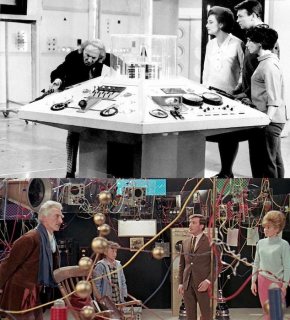 The console room in the TARDIS is another iconic piece of design, the six-sided central console and roundel-decorated walls having endured in one form or another throughout the show’s life (even if some of it’s become increasingly obscured in the iterations since the 1996 TV movie). In the film, however, it’s just… a messy room. There are control units and chairs and stuff bunged around, with a mess of wires draped about the place. On TV it looks like a slick futuristic spaceship; on film it looks like a junkyard. Oh dear.
Then there’s the Dalek city. The film’s version is more grand, with lengthy corridors rather than the faked photo-backdrops used on TV; but that’s besides the point, because that very grandness undermines its impact. The Daleks’ corridors on TV feel truly alien — they’re the same height as the Daleks, which is about a foot smaller than most of our leads, meaning they’re constantly having to duck through doorways. It’s perfectly thought-through design, led by how the place would actually have been built rather than making it convenient for the cast. The film’s city is the opposite, with big doorways and rooms. It’s a minor point perhaps, but it can leave an impression.
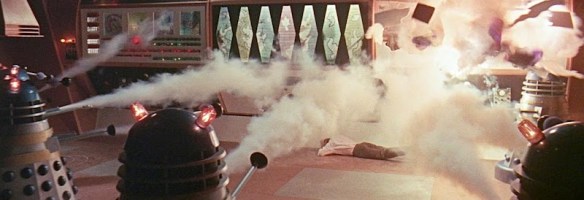
Ridley Scott is, by and large, a great film director, and is responsible for at least two of the all-time greatest science-fiction movies; but I doubt even his 26-year-old self, then a BBC staff designer originally assigned to work on Doctor Who’s second serial, could have come up with a more iconic look for the Daleks than Raymond P. Cusick. With the exception of the ‘ears’ and the colour scheme, his design is rendered faithfully from TV to film, because it’s so good. Why does it work? I have no idea. Perhaps because it’s genuinely alien — they’re not in any way the same shape or size as a human. Of course, it sort of is: the design is based around being able to fit a man sitting down, in order to control it — but it doesn’t look like that.  Then there’s the way they glide, the screechy voice, the sink-plunger instead of some kind of hand or claw… It’s a triumph, and it works just as well in gaudy colours on film as it does in simple black and white.
Thanks to being just on contract, Cusick’s contribution to the Daleks and Doctor Who can be overlooked. Even after the creatures became a phenomenal success, the most he managed to get was a £100 bonus and a gold Blue Peter badge; though as the latter is practically a knighthood, it could be worse. Nation, meanwhile, reaped the rewards (though no gold badge), to the extent that today his estate control whether the Daleks can appear in Doctor Who or not. Nation gets a credit every time they appear; Cusick doesn’t. Obviously Nation is owed much of this, but Cusick is too: without that design, the Daleks would have been nothing. Thankfully, the making of Doctor Who is probably the most thoroughly researched and documented TV production of all time, and even if he doesn’t get an onscreen credit on new episodes or any financial rewards for his family, Cusick’s name is well-known in fan circles — the outpouring of appreciation when he passed away last February was equal to that received by many of the programme’s leading actors (always a more obvious object of adulation).
I think the Dalek films aren’t given the credit they’re due by many Doctor Who fans. There’s a reason for that, but those reasons are past. The original stories have been available on VHS and then DVD for decades now, meaning the films aren’t the only way to experience these adventures any more. Plus, as the relaunched show has established Doctor Who as a contemporary popular TV series, so the general populace sees it as a franchise that has had three leading men; or, for the better-informed masses, eleven. 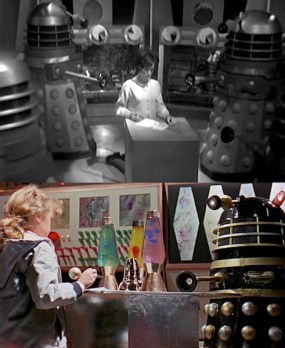 Whenever the series brings up past Doctors (and that’s surprisingly often, considering the “come on in, it’s brand new!” tone in 2005), Cushing isn’t among them. While he may once have been a prominent face associated with the show to non-fans, the ‘war’ has been ‘won’ — he’s become a footnote.
Maybe it will take a while for fans to stop being so stuck in their ways, but I hope they do and can embrace the Dalek movies as fun alternatives — they don’t replace the originals, but should stand proudly alongside them as symbols of Doctor Who’s success.
Next time… the Daleks invade Earth twice, as I compare the second Dalek serial to its big screen remake.

 After a decade locked away in motion-capture madness, Robert Zemeckis returned to the realms of the real with this Oscar-nominated drama. Its most high-profile nod was for Denzel Washington, starring as an airline pilot who miraculously crash lands his plane, but is revealed to have been high during the flight. Cue a film that attempts a grown-up account of addiction, but fumbles it, in the process missing the more interesting story of the crash investigation.
 Once upon a time, Real Steel would have been rated PG, been aimed at 7- to 10-year-old boys, and would probably have been quite the success. In the current Hollywood moviemaking climate, however, it’s rated PG-13, consequently aimed at teenage boys and grown men who still have the tastes of teenage boys, and seems to be regularly slated in online comment sections.
 Some things are also distinctly unresolved: just why was Evil Lady prepared to pay $200,000 for a no-hope junkyard robot? I figured there was going to be some Nasty Secret to come out, especially as there’d been hints of the robot having extra abilities… but no. And what was up with the kid being 11 but Jackman always thinking he was 9? Figured that was going somewhere too. There’s talk now of a sequel — I hope such random bits weren’t intended as elaborate seeding for a follow-up, because that’s just irritating. That said, it would be nice if whoever’s in charge spotted those things and built on them in the sequel’s story.
 Real Steel is a good family movie, masquerading as a teenage-focused robot action blockbuster thanks to its 12 and PG-13 certificates. The true best audience for it will be those around the same age as the central kid: they won’t find him as annoying as older viewers will, and the whole robot fighting thing will just seem exciting.
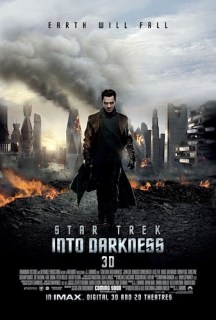 In an ethnically diverse and equal future, white American Kirk and white Vulcan-American Spock are commanded by white American Pike and white American Marcus to lead their crew to capture a Starfleet-targeting terrorist: John Harrison, a white Englishman who may be more than meets the eye…
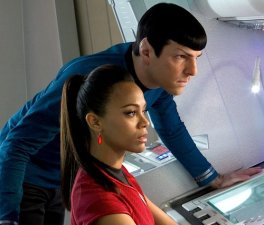 There’s still humour, mind; something which marked the first film out for a kind of geek controversy, as some felt it went too far. Because the original Star Trek TV series was dark and super-serious? An increased role for Simon Pegg’s Scotty provides most of the laughs, as everyone else is busy going Into Darkness. Unfortunately, despite the sporadic likability of several cast members, they don’t seem to have much to give. An inversion of a famous scene from a previous Trek movie ought to be tremendously moving, but doesn’t even stir.
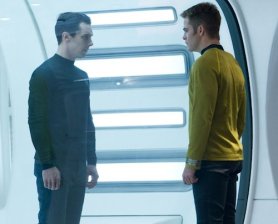 and I think the same process may have been used for some finished scenes. Which is a sarky way of saying that sometimes he phones it in. Take his first proper face-to-face with Kirk, when he’s in the Enterprise’s brig: he’s on Posh British Villain autopilot. There’s no menace, no tension; just words in our accent. It’s Cumberbatch’s Sherlock robbed of any of the charm, wit or intelligence.
 There are good bits — in fact, I’d say that’s a pretty apt description: good bits in amongst mediocrity. There’s an arty dialogue-free bit starring Noel Clarke that’s kind of good… and kind of self consciously “look, we done told a story with no speaking!” Shot on a mix of 35mm and IMAX, the film occasionally looks very nice. I imagine some sequences were visually stunning in IMAX, though Paramount haven’t done us the courtesy of preserving the ratio shifts on Blu-ray (unless you buy some German version, apparently). I felt there was considerably less lens flare this time out too; if it was still there in hefty doses then the film was obviously doing something right because I didn’t notice it.
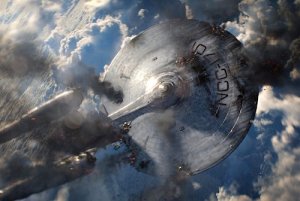 You probably remember that, just a few months after its release, a convention of Trekkies voted Into Darkness the worst Star Trek film ever made. That’s a bit much — for all its flaws, it’s still better than most of
 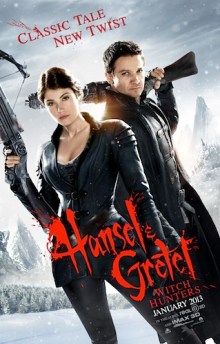 Having heard only bad things, I expected a soul-crushing dud of
 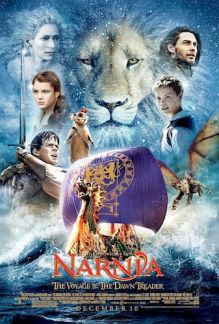 I’ve never actually read the Narnia novels, but I did have them read to me when I was very young and, for some reason, I remember Voyage of the Dawn Treader being my favourite. Sadly, this doesn’t quite translate to the big screen.
 but as a grown adult it is painful. The level of subtlety here is so low a participant in
  A mash-up of mythology and… well,
 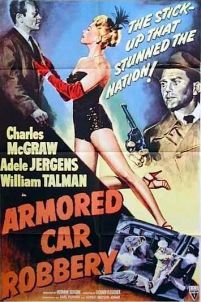 A B-picture from the middle of the classic film noir era, Armored Car Robbery is perhaps most notable today for being one of the first films directed by Richard Fleischer, who would later call the shots on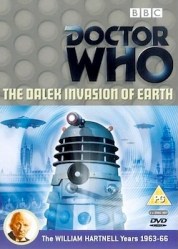
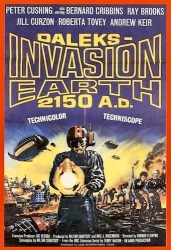
 In a week’s time, on the 23rd of November 2013, Doctor Who will celebrate its golden anniversary — 50 years to the day since the premiere broadcast of its first episode,
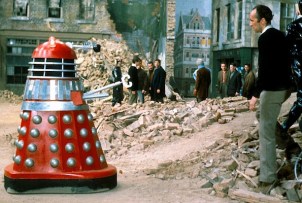
 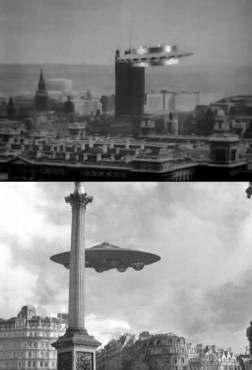 There are some fantastic sets, bolstered by peerless location filming of a deserted London (simply achieved by shooting very early in the morning), and the usual array of quality performances from the series’ regulars and guest cast. It’s only let down by the special effects. The Daleks are as great as ever, and a weird monster that turns up for a few minutes is passable (if you’re being kind), but shots of the Dalek saucer flying over London look like a pair of foil pie cases on some string in front of a photo. Even by the standards of the era it’s bad. The DVD release includes the option to watch the story with new (in 2003) CG effects in place of these sequences, and for once I’d actually recommend that.
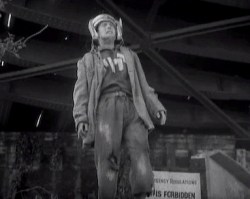 A man stumbles towards the steps, he screams in agony, battling with the strange machinery on his head. And then he hurls himself into the river, where he floats face down — dead. Beginning a kids’ programme with suicide? You wouldn’t do that today! We later learn that he’s a Roboman, controlled by the Daleks, essentially dead already… but it’s a bit late by then. Later, we meet unscrupulous country folk: a black marketeer who won’t give over food to the enslaved mine workers without payment, and won’t escort Ian out of the camp without payment either; and two women, employed by the Daleks to mend the workers’ clothes, who betray Barbara to get more food. There are heroes here, certainly — men and women who fight the Daleks, and some who give their lives for the cause — but not everyone’s doing the honourable thing.
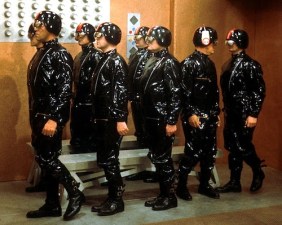 So that’s nice for them. There’s also some significant additions of humour, like when Tom is pretending to be a Roboman to stow away on the Dalek saucer and ends up in a mime act as he attempts to mimic a group of the real thing while they have lunch. Bless Bernard Cribbins. There aren’t too many of these almost-farcical bits, but the few there are lighten the general tone.
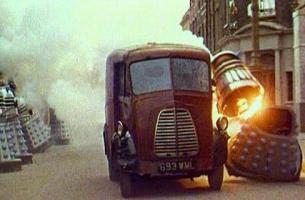 no burgeoning romance for Susan, here a small girl rather than TV’s young woman. Both stories split our leads into three groups following the assault on the Dalek saucer, but while the film retains the outline of these subplots, it rearranges which characters take which route. It’s a slightly bizarre turn of events, to be honest, and doesn’t always pay off: whereas the TV series manages to plausibly pace the various characters’ journeys from London to Bedfordshire, in the film the Doctor and his chum walk there in the same time it takes the Dalek saucer to fly it. Either that saucer’s underpowered or they’re impressive hikers.
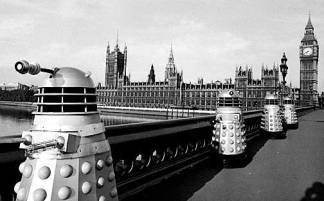 (Incidentally, perhaps the most striking thing about the serial’s location sequences are that they don’t include the iconic shot of the Daleks rolling across Westminster Bridge. That bit is in there, but it was filmed from an entirely different angle; I guess the famous image was just a unit photograph.)
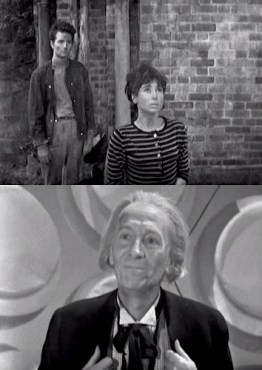 but the TV serial has a real advantage in this department. The original companion, this was Susan’s final story — the first companion departure in the series’ history. It handles it marvellously: rather than the final-minutes cut-and-run so many companions suffer, Susan’s growing sense of departure is built throughout the story… and then it’s the Doctor who realises it’s time for her to go, not her, and he leaves her behind. The speech he gives is one of the finest in the series’ history, beautifully and poignantly delivered by William Hartnell, and with a nicely under-played reaction from Carole Ann Ford. Doctor Who has had countless companion exits now, but this one still takes some beating.
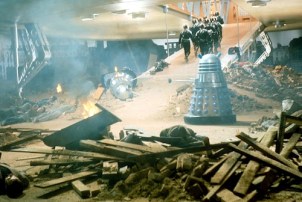 Most Doctor Who fans won’t lament that (especially as The Chase isn’t the most well-loved of Dalek adventures either), but, even though the TV series remains the superior product, I think the Dalek movies have their own merits and charm. I’m not suggesting we should be finding a way to write them into Doctor Who canon, but as an alternative to the norm, they’re a good bit of fun.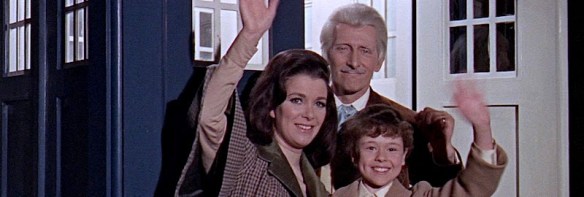
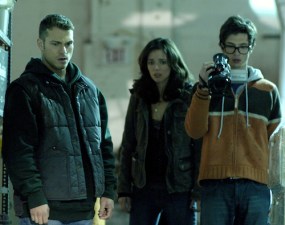
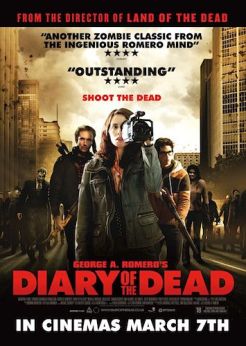 While making a horror movie in the woods, a group of friends hear news of the dead coming back to life. As they try to reach home, their aspiring documentary-maker director keeps his camera rolling, recording their encounters with the living dead…
 so goodness knows how it’ll look after even ten. Thing is, despite all that, Diary still has one ace up its sleeve: it’s written and directed by George A. Romero.
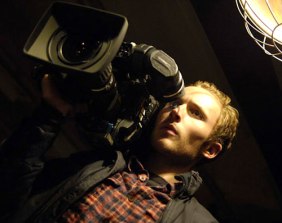 That said, the thematic concerns feel less resonant than in Romero’s previous work. The found-footage has led him to frame this as a film-within-a-film — the first title card reads The Death of Death, followed by one noting it’s “a film by Jason Creed”, the aforementioned aspiring director — complete with montages of news footage and, at times, a voice over narration. This rather rams the point home at times, over-explaining features that previously Romero would have allowed us to spot for ourselves. In some respects you can’t blame him being more obvious in this day and age — it needs to be on the nose to get through to some people — but it’s less satisfying, the blunt information coming across as a statement rather than asking us for our own interpretation, which I feel can lead to a more insightful analysis.
 Such folks, and even genuine Romero fans, seem to have two major problems with Diary (aside from arguments about the acting, the storyline, or even the entire concept). First, the gore: where Land added CGI to the traditional mix, Diary’s almost exclusively courtesy of computer wizardry. That’s the age we live in: computer effects are so commonplace that they’re now the cheap and easy thing to achieve, rather than men with buckets of red food colouring and entrails from the local butcher. For me, it’s a mixed bag. I don’t think this is the worst CGI I’ve ever seen (unlike some commentators), but I do think it lacks the distinctive Romero feel — there’s none of his trademark eating of intestines, for instance, or the tearing a human in half that’s become a key visual in every film since Dawn. Perhaps that’s because of the realism angle? No one would film that; they’d turn away. Of course, when zombies get shot/beaten/etc, that’s different; that we can watch.
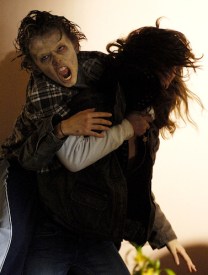 The other problem bemoaned by fans is that this is a reboot, of sorts. Romero’s previous zombie films feature no recurring characters and don’t sit properly within the same timeline, but they nonetheless feature an evolution of the zombie epidemic: it spreads from a one-night issue in Night to a dragging problem in Dawn, to an all-consuming one by Day, in which we see the zombies gaining in intelligence, to the point where they consciously form an invading force in Land. But Diary scraps all that, going back to the start of the epidemic. It doesn’t remake Night — in fact, it handles a few things notably differently (in Night the radio and TV report factual and helpful information; in Diary, they obscure the fact the outbreak is even happening) — but it does disregard the development Romero had taken the undead through.
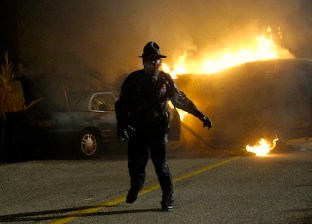 But, nonetheless, the epidemic did develop and evolve across Romero’s previous films, and that’s been lost here. Maybe there’s nowhere further to go with it? I’m not convinced of that. Perhaps Romero will have another idea and get to tell that story someday in the future, leaving Diary (and
  100Films.co.uk