2015 #185
Alan Taylor | 126 mins | Blu-ray | 2.39:1 | USA / English | 12 / PG-13
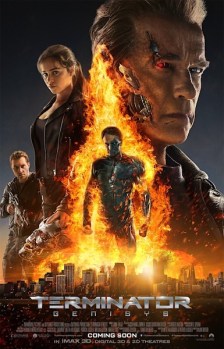 I liked Terminator Salvation. There, I said it. (I also said it in my review, so, y’know, not news.) Not many other people agreed, however, meaning plans for a new wave of Terminator films in its wake were abandoned. Fast-forward a few years, past a load of complex and dull rights wranglings, and we reach this: one of the biggest critical flops of 2015. It also flopped with audiences in the US, taking under $90 million, but fared better internationally, to the tune of $350 million — making it the franchise’s second highest grossing film, in fact. Nonetheless, perception has hewed closer to the critics’ take. Is that vitriol deserved?
The story begins in the future war against the machines, where an army of humans led by John Connor (Jason Clarke) and Kyle Reese (Jai Courtney) storm a Skynet facility and find a time machine that has recently sent a Terminator back to 1984 to assassinate Connor’s mother, Sarah (Emilia Clarke), before she’s given birth to John. Reese volunteers to go back and save her. Now, this is where the film leans on being the series’ fifth — we’re expecting him to land in the first film. And at first he does… until a T-1000 (the one that turns into metal from T2) turns up, and Sarah rocks up to save Reese — accompanied by an aged T-800 (Arnold Schwarzenegger), who arrived decades ago and has been protecting and training Sarah ever since.
At this point, some people will already be predisposed to hate the film. Why mess with a classic, etc. I can see where they’re coming from; at the same time, it’s an interesting idea. Time travel is a key part of the Terminator series, and John grows up with the knowledge that one day he will send Reese back to 1984 to save his mother — but what if Skynet knew that too? That would change what both John and the computer did, surely? What are the ramifications of that? (And even if you’re not interested, the original Terminator is still there — they’re not re-editing it or removing it from circulation or something — so if you don’t want it affected, that’s fine.)
 Now, a good idea doesn’t guarantee a good execution, and here is where we begin to encounter Genisys’ problems. Time travel is a tricksy thing to engage with in fiction, and is highly prone to creating plot holes — something blockbusters regularly struggle with anyway. Genisys has at least one glaring one. Then there’s the general level of quality — the screenplay, acting, effects, and so on. In this regard, I suspect the reason so many people reacted so badly to it is that it follows, and riffs off of, two of the greatest sci-fi/action movies ever made. In and of itself, Genisys is no worse than any of the other half-dozen-or-so middle-of-the-road $150-million-plus-budgeted blockbusters we’re routinely served every year now. If you instead compare it to its iconic forebears, however, it comes up much shorter.
I think one of the major problems is the direction. Marvel hired Alan Taylor for Thor 2 because of the perception that he knew how to handle fantasy thanks to Game of Thrones. That and because, as a TV director, he would’ve been cheap, and Marvel like their directors cheap (and consequently controllable). Clearly the success of Thor 2, such as it was, was parlayed into this big directing gig. I’m just not sure Taylor has the chops for it. The fight scenes are muddled, riddled with close-ups and too many cuts. Not a unique problem these days, of course, but after, what, a decade of that style being criticised, you’d think they’d’ve finally wised up. Nowadays it looks cheap. Most of the direction looks cheap. This is an expensive movie, with lots of practical stunt work, but it never looks it; and those stunts were mostly done on green screens or with the aid of wires here and there, so they’ve ended up CGI’d too. And the CGI looks surprisingly cheap. The Terminator films used to be right at the cutting edge of effects; now it’s just any old blockbuster.
 And yet the man who was responsible for those remarkable pictures, James Cameron, was impressed by it. He’s interviewed among the film’s special features, where he explains, “can I guarantee that you’ll enjoy it? No. I just know that I enjoyed the film, you know. But I strongly suspect that… you’re gonna love this movie.” Well, he was way wrong there! You almost feel a bit sorry for everyone in those special features, actually. They’re all so confident that Genisys is a great, well-made movie that everyone’s going to love, and they have big plans for a trilogy which they keep talking up. I would love to see their reactions after the reviews and box office figures came in…
So, Terminator Genisys is not a good movie… but I don’t really think it’s a bad one, either. It just sort of is. The action palaver is passable, the plot at times interesting, the developments and twists on the series’ history… well, your mileage will vary. It didn’t help anyone that they were in the trailer, but I’m not sure people would’ve reacted any better if it hadn’t been spoiled. Still, it shouldn’t’ve been spoiled. Stupid marketing people.
Could Terminator Genisys be a lot better? Definitely. Could it be worse? Definitely. I didn’t mind it.
This review is part of the 100 Films Advent Calendar 2015. Read more here.

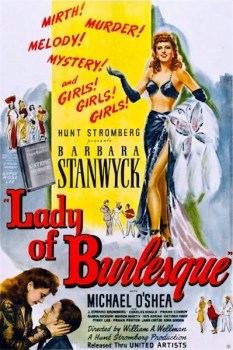 Based on the novel The G-String Murders by Gypsy Rose Lee (as in Gypsy), Lady of Burlesque stars Barbara Stanwyck as Gypsy surrogate Dixie Daisy, a performer in a burlesque show in New York where the backstage arguments turn murderous.
 Stanwyck carries the film, both on stage and off. Her “will they/won’t they (of course they will)” romance with Michael O’Shea’s comic is kept aloft by her biting ripostes to his advances, and when a comedy sketch is interrupted by backstage noises she saves the day by breaking into song, doing the splits, a cartwheel, and the Cossack dance in quick succession. Not bad for a 36-year-old!
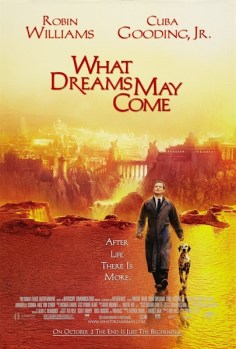 When What Dreams May Come first came out, the reviews seemed to conclude that it was rubbish, but at least visually splendid. Back in 1998, that put me off — “it’s not meant to be very good” was the takeaway thought there. As the years have gone on, for some reason those reviews (or possibly just one I extrapolated into a consensus, who knows?) stuck with me; and as my temperament as a film fan grew, that it was visually extraordinary (even if nothing else) began to seem reason enough to watch it. It lingered in the back of my mind, never quite becoming a “must see”, especially as the opportunity rarely (if ever) presented itself. So that’s more or less how I come to it now, 17 years since its release and those reviews — a long-awaited scratch of a long-lingering itch. (Perhaps this gives some insight into why/how it takes me so long to get round to watching recommendations/things I’m quite keen to see/etc.)
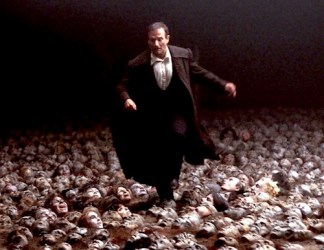 Hell, incidentally, also looks incredible, as do the various locales visited by Chris and his companions (played by Cuba Gooding Jr and Max von Sydow) on their way there. Director Vincent Ward and his team have created a rich, engrossing visual space here. It’s not just the Oscar-winning visual effects either, which create Chris’ initial realisation of Heaven as a kind of living painting, but also the locations, their decorations, and some fantastic sets. The design work is brilliant, and the vast majority of it still holds up today. Even the CGI doesn’t look glaringly like 17-year-old graphics, and in many cases what I presume is a mix of live action, models and some CGI is far more effective than the all-CG look it would likely have if made today.
 Nonetheless, some will identify with the sentimental “love transcends death”-type message more than others, and there’s a chance those who like (or don’t mind) their films to be at the soppier end of the spectrum will genuinely love it. For the rest of us — for anyone who likes visual splendour in their movies, anyway — it does indeed merit a look for the imagery alone.
 Once-great detective Sherlock Holmes (Ian McKellen) has retired to the countryside with his housekeeper (Laura Linney), her son Roger (Milo Parker), and his bees, but an unsolved case from late in his career troubles his dementia-addled mind. As he tries to remember the events, we also learn the significance of a trip he recently made to Japan, and the benefits of his growing friendship with Roger.
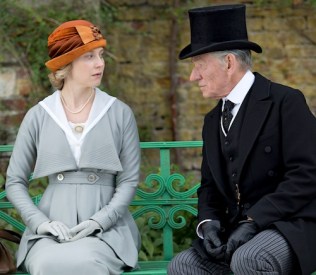 Alongside him, the lad, Milo Parker, is very good, managing to holding his own against the knight of the realm. Also excellent is Hattie Morahan, playing the object of the case in Holmes’ flashbacks. She’s probably best known for playing embattled fellow parent Jane in
 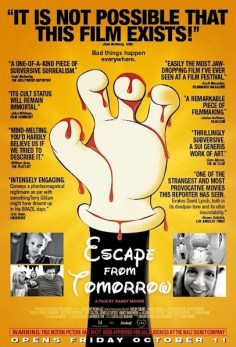 Disney meets David Lynch in this arthouse-y psychological thriller, best known for being shot on the QT (i.e. illegally) in DisneyWorld.
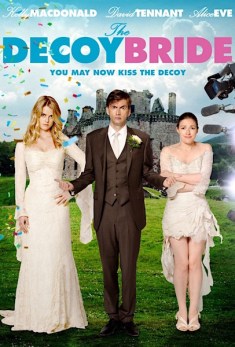 This is not a well-reviewed film —
  It’s The Julian Assange Movie, in which Benedict Cumberbatch dons a lanky white wig and an Australian accent to portray one of the most significant figures of our times, whether you like it or not.
 so I can’t really judge her. The same goes for the rest of the cast, where a wide array of starry and/or acclaimed names (Peter Capaldi, Laura Linney, Anthony Mackie, Alexander Siddig, Dan Stevens, David Thewlis, Stanley Tucci, Carice van Houten (who’s big in Belgium,
  They don’t seem to have any particular significance in themselves — they’re not famous, nor more wronged than anyone else — so maybe they’re just meant to be emblematic? As in, Laura Linney’s character is there to be representative of Assange’s effect, not the only person it happened to. Or was she the only person fired, and that’s the point? The film doesn’t make it clear.
 he’s the honourable one; the one who’s actually invested in the site’s supposed values. But then the film is partly based on his book, so he would be the good guy.
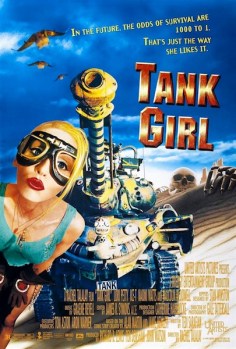 Critically derided, this anarchic adaptation of the rebellious comic has become a cult fave. You can see why: a ramshackle plot allows for plenty of outré zaniness, including a big musical number to a punky Cole Porter cover, and surely no one predicted the bizarre truth about the Rippers!
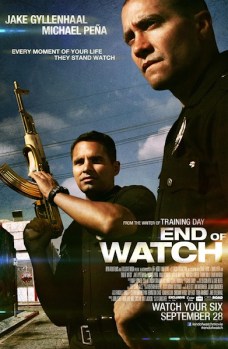 I don’t think anyone paid writer-turned-writer/director David Ayer much heed when he was one of a pack of people penning historically-inaccurate submarine thriller
  it would wash as a stylistic choice; because he attempts a diegetic explanation for why it’s shot this way, but then breaks the rules of that explanation instantly (and continues to do so, with increasing frequency), it turns a valid stylistic choice into an irritating, ill-thought-out distraction. Plus: you want to be innovative and shoot an L.A. cop movie on digital video? Too late! Michael Mann already got there… in 2006.
 Although there are things to commend End of Watch — in particular the performances, and even a couple of tense sequences when the filming style actually pays off — I can’t get on board with it being a best-of-year-type movie. Even if it could’ve been more — and, in spite of that varied CV, isn’t the best thing Ayer’s done (I very much liked his next movie, Brad Pitt WW2 tank movie
  Astronauts head to a Saturnian moon to examine its water in this scientifically-accurate drama.
 100Films.co.uk