2010 #83
James Wong | 89 mins | TV (HD) | 15 / R
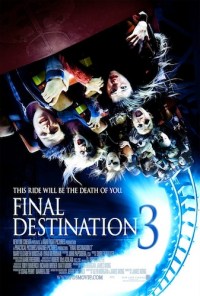 Never mind Death, it’s another force entirely that the makers of Final Destination need to worry about. The law of diminishing returns, to be precise, and it strikes the series hard in its third instalment.
The setup’s the same as the first two: teenager has premonition of an accident, kicks up a screaming fuss, a bunch of people are saved, the accident happens killing others — usually including some we assumed would be saved — and then Death begins to pick them off one by one. The twist this time (it’s a sequel, of course there’s a twist) is that the last photo taken of someone before they die includes a clue to their death, and our hero just so happened to be snapping away at everyone for the yearbook…
Unfortunately, this time out, no one can seem to make the concept work. FD2 was a very direct sequel, bringing back surviving characters (well, character) and building on the concepts — primarily, everyone who was saved in Film 2 had been saved before by encountering a Film 1 survivor post-plane crash. What it also did was add an element of fun to the thriller plot. We know they’re all going to die, we know it’s a mystical force, but it played around with how it would happen,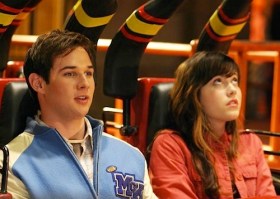 with the ludicrously OTT setups that led to their death. It made it funny.
Final Destination 3 attempts most of this, but doesn’t succeed. We’ve got a wholly new set of characters, all of them high schoolers, losing the faintly interesting age diversity introduced in the second film. None of them are built up beyond the most surface of elements — the bimbos, the jock, the goths, the irritating one — and turn up one by one in order to die in a creative fashion.
Even the two leads we follow from victim to victim lack character, despite being given the whole film to develop some. Ryan Merrimen starts out as an irritating, stereotypical, loudmouth jerk, only to instantly discover a Surprising Sensitive Side when he survives because, well, the audience need to feel sympathetic towards him now. As the unwitting prophet,  Mary Elisabeth Winstead, soon to be seen as the ultimate object of geeky desire in Scott Pilgrim vs. the World, is a wet blanket, filling the film with mopery about failing to save everyone. I suppose, when compared to her aloof hipster role in Pilgrim, it at least shows she has range. Her character is supposedly a control freak, a fact we’re battered around the head with thanks to painful expository dialogue, but that thread goes nowhere.
So what of The Point of a Final Destination film: the deaths? Some are moderately inventive, and one or two even provoked a crumb of the intended amusement, but somehow it didn’t click as it was clearly intended to (i.e. more with the humour of the second than the fear of the first). Even the most appropriate deaths — like the bimbos being burnt alive in sunbeds — somehow fails to generate the required level of interest. It may be that they’re just not ridiculously complicated enough. They’re implausible, certainly, but… not implausible enough. By the end, the lack of creativity is just disappointing.

As for the big opening — the poster-filling roller coaster crash — well, it follows in the footsteps of the second film more than the first. That is to say, in the first the plane just blew up (more or less), while in the second we were treated to an array of fanciful deaths in the extended pile-up sequence. You might expect the ‘coaster to just derail, but oh no: it goes back and forth, splits in half, people fly out, get hit by bits of track, fall onto spikes, fall… out… Maybe I was just in a bad mood or something but, like the rest of the deaths, it somehow didn’t work, didn’t fulfil the visceral need it was tilting at. I’d rather it had just derailed, plummeted to the ground — maybe exploding into an unrealistic fireball — and been done with.
 Plus, having set up the whole photos-predict-deaths thing, it’s barely used. Most of the pictures are kept out of sight for as long as possible, and only a couple offer reasonably discernible clues to the character’s fate. The others are either blatant — such as the one where a gun’s being pointed at her head (it’s actually a nail gun that does her in, but that hardly qualifies as a twist) — or too meaningless — being half-blinded by a camera flash apparently equates to a firework hitting you in the face, or something.
With its third entry, the Final Destination series nosedives in quality. The first was an entertaining high-concept horror-thriller; the second more of the same but with a ludicrously humorous bent; the third tries its hardest to do both, but fails miserably to pull off either. No wonder they were intending to scrap the series until the fourth’s miraculous box office turnaround.
Talking of the fourth, I hear it’s even worse. Perversely, I almost can’t wait to find out how.

 Force of Evil comes well recommended, with places on several 1,000 Best Movies lists and inclusion both on They Shoot Pictures…’s 250 Quintessential Noir Films and in the US National Film Registry, not to mention a full 5/5 in Paul Duncan’s consistently handy Pocket Essential Film Noir. But it didn’t work for me.
 Duncan’s analysis (Force of Evil is one of seven noirs treated to an extended segment in his book) suggests a more complex reading of the film than I took from it, explaining much as symbolic or metaphorical. Considering I didn’t engage with the film, I’m tempted to see Duncan’s reading as a way of rationalising things that either aren’t there or were flawed, but the film’s wider critical acceptance suggests he may well be right.
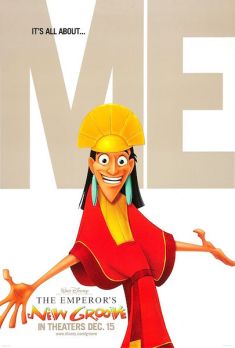 Disney’s 40th (canonical) animated film had a very troubled production, which, from what I can tell, turned it from a derivative riff on The Prince and the Pauper into this load of tosh.
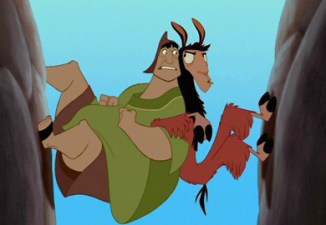 In reality it doesn’t suffer from that too much, and again looked nice and crisp in HD. I usually ignore image quality when it comes to reviews — not that I don’t care, but in these reviews I’m aiming to look at the content of the film rather than the particular copy I watched — but HD has such noticeable benefits for animation (when done well).
 with conflicting or logic-less motivations and a quest structure that requires no skill (the titular Seeker has to find six ‘signs’ — i.e. little magic MacGuffins — a task which seems to involve waiting around until one falls into his hands, sometimes literally); Cunningham’s direction is over enthusiastic, throwing in jaunty angles and varied film speeds like it’s been outlawed to use a straight shot at 24 frames per second.
 it’s easy to assume the good bits must have occurred by accident, or be left-overs from the novel. Equally, as most occur in the film’s second half, the damage has already been done. They also don’t negate the fact that exciting or inventive action scenes don’t make up for a plot that leaves them bereft of character development, emotion, or truly genuine thrills.
 Readers may remember that I opened my
 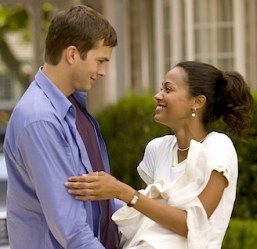 Mac and Kutcher play the roles they always play— No, actually, in fairness, I can’t say that: I think I’ve only seen Mac in the
 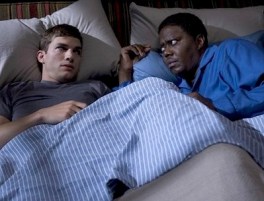 It’s as recognisable from TV sitcoms —
 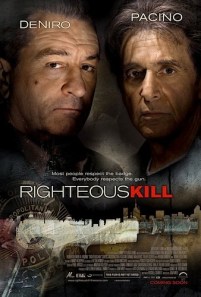 You remember Righteous Kill, right? It’s the film that reunited De Niro and Pacino, only the second time they’d appeared on screen together. And while the first,
 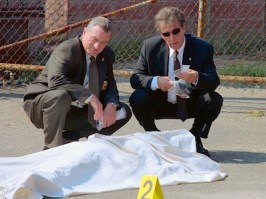 he’s lensing a procedural thriller about a pair of 60-something cops and not Miami Vice 2. Suffice to say, it doesn’t work; if anything, it makes it worse.
 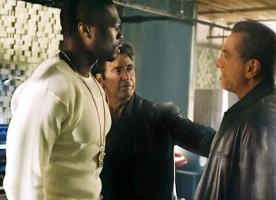 The film’s at its best when focusing on the De Niro/Pacino pairing, granting us the occasional good scene. Or just line — every little helps. But there’s not enough of that and too much of the dross. Other characters come and go with near-random irregularity, subplots are abandoned, or if they were resolved I missed it, and there are so many clichés you wish the DVD came with a spotters’ guide — at least ticking them off would give you something to do.
 I think that — along with
  bring back the dead and let you see a teeny bit into the future, shortly before some baddies explode in puffs of green smoke and some more baddies are revealed to have full-on superpowers. Where did these come from? No idea. The film offers no explanation, be it mutant gene or radioactive exposure or plain old training, instead just assuming viewers will accept that this is the real world… oh, but some people have these cool powers.
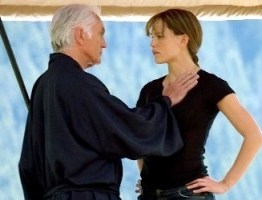 here there might at least be a reason to keep watching, but the weak action is just icing on the cake of the clichéd story and bland characters. Director Rob Bowman claims he made an R-rated film which he was forced to cut to PG-13, the implication being that neutered the whole thing. Maybe that’s where all the action went, though on the evidence of what’s left I’m not sure I believe him.
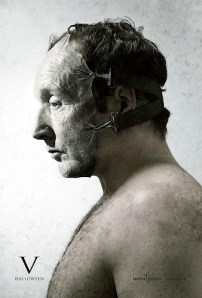 And so the never-ending Saw franchise trundles on to its fifth part. Indeed, Saw Part 5 might be a more apt moniker for this film: it picks up directly from the end of
  One of the franchise’s Big Things has always been the last-minute twist. Signalled by the Saw theme beginning to play and emphasised with an explosion of very brief flashbacks to earlier in the film, the twist shows us what we’ve missed all along and turns the story on its head. The
 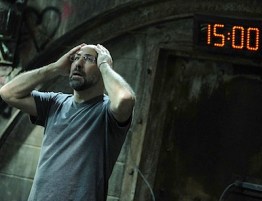 In fact, it’s this side of the film that holds a bigger and better twist than the highlighted arc plot one, though some viewers may miss its significance as it goes so unheralded. (Arguably this ease with which it might be missed says something about how significant it is; equally, perhaps I’m assuming a lack of intelligence on the part of Saw’s regular audience by implying they would miss it.)
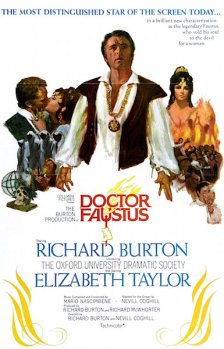 Despite the numerous film versions of the Faust story, this is the only one that adapts Christopher Marlowe’s A-level-favourite 1588 play. It’s a shame, then, that it’s heavily edited from the original text and, despite also being a filmed version of the Oxford University Dramatic Society’s 1966 stage production, has clearly been inappropriately chosen as a vehicle for then-couple Richard Burton and Elizabeth Taylor.
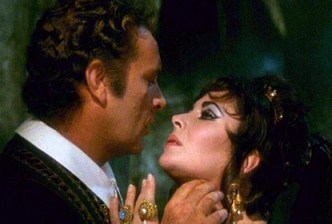 Elsewhere, Burton and Coghill’s vision of Faustus is stylistically reminiscent of a Gothic Hammer Horror, which is either wholly inappropriate or an ingenious genre mash-up — after all, such a genre-mashing trick has been pulled many a time with Shakespeare over the years. There are repulsively horrific corpses, a harem of naked ladies, an array of special effects, plus a medieval-styled gothic atmosphere to all the sets and costumes, though the scene where Faustus mucks about with the Pope feels more Carry On. Using inanimate objects in the roles of the Good and Evil Angels — respectively, a statue of Christ and a skull — is a small but inspired touch.
 perhaps just to heighten the presence of Helen by losing scenes she couldn’t have been shoehorned into; but in the process it both loses some of the best material and destroys any hope the film had of being a definitive filmed version of the play. Ultimately, such oversights proved to be the final straw for the film’s already-tenuous grip on a three-star rating.
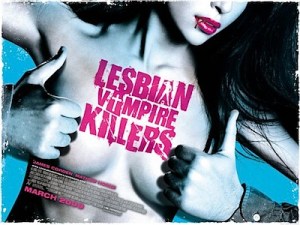 Pre-release hype pegged Lesbian Vampire Killers as the next
 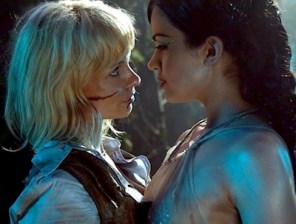 Unfortunately, even with corrected expectations, the film fails to deliver on its twin promises of raunch and horror. Aside from a couple of brief surgically-enhanced medieval boobs, a flash of knickers and the odd girl-on-girl kiss, the film’s sexy content is non-existent. Said Nuts audience would certainly get more from their weekly wank mag; this is mostly 12A-level. The horror, meanwhile, is reduced to well-signposted jump scares — and even then few enough to count on one hand — and the odd bit of comical decapitation/melting with holy water/axes in the head. To be fair, this is meant to be more comedy than horror, and in this sense a few such moments succeed passably.
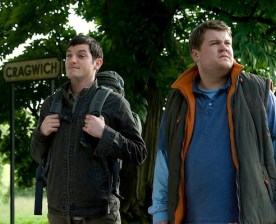 Indeed, consistency is not the film’s strong point. Everyone makes a big fuss about the vampires and how hard they are to kill, yet every one is dispatched with ease, the level of threat never allowed to even attempt an increase before there’s white goo splurting everywhere (that’s what happens when they die, incidentally, not someone’s reaction to the lesbianism). The climax is a mere extension of this, substituting a rising scale of action for running around avoiding the easy killing bit. Any good will amassed in the middle — and there may be a tiny bit — is dismissed in boredom.
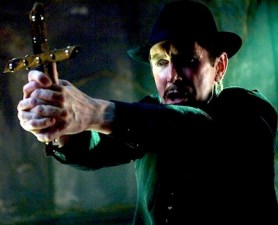 shot for the lowest-common-denominator lad’s-mag-buying audience, though quite what they made of the classic horror reference points that do remain is anyone’s guess. If we’re talking about expectations (and, clearly, I am), Lesbian Vampire Killers did somewhat defy mine — though as I was expecting it to be one of the worst comedies I’d ever seen, that might not be saying much.
 100Films.co.uk